


Reports that Neura Robotics, a German humanoid pioneer founded in 2019 in Metzingen, Germany, is seeking a landmark €1 billion funding round with Tether participation have intensified the spotlight on Physical AI. Such massive capital signals a definitive shift from theoretical laboratory demos to the industrialisation of robots capable of navigating human-centric manufacturing environments. While the facts remain reported rather than finalised, the industry is closely watching how these resources will scale cognitive robotics across Europe.
Integrating these advanced machines into production lines requires more than raw hardware; it demands a fusion of safe mechanical design and self-learning software. For factory operators, the core question is how humanoid systems can augment existing workforces without requiring a total facility redesign. Neura’s approach emphasises this adaptability, aiming to turn robots into reliable teammates capable of handling assembly and inspection tasks alongside human colleagues.
News of the funding arrives as manufacturing clusters encounter persistent labour shortages and rising demand for flexible automation. As cognitive robots move closer to mass deployment, the focus shifts toward safety validation and the software stacks that power them. For readers following the evolution of humanoid factories, this €1 billion signal marks a pivotal moment where high-risk frontier hardware meets large-scale institutional backing.

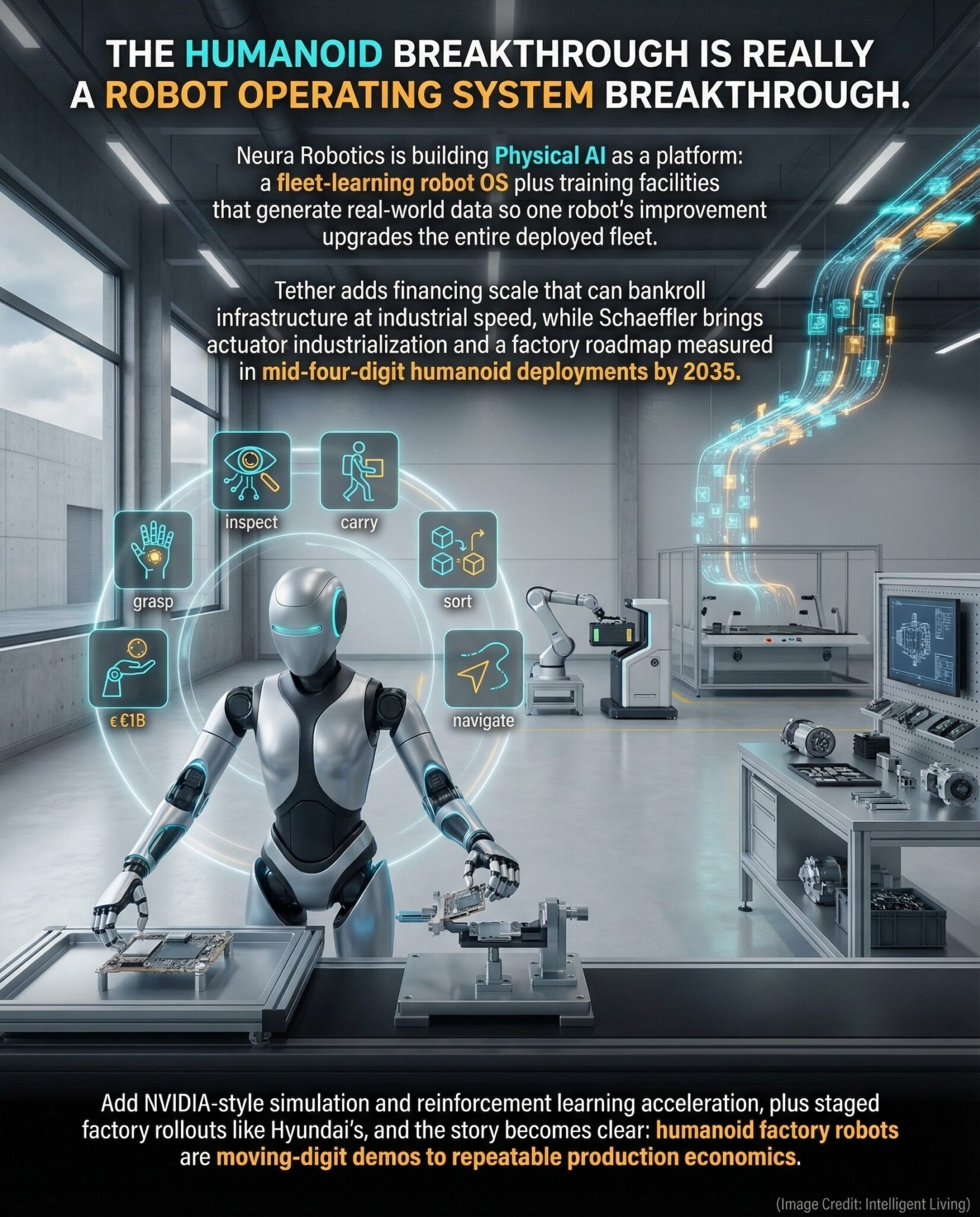
Quick Facts: Neura Robotics Funding, Tether, and Humanoid Factory Signals
- Reported raise: approximately €1 billion in process, with Tether’s involvement cited in press reporting.
- Reported valuation: roughly €4 billion in the March 2026 reporting window, with older reporting suggesting a higher band.
- Prior financing: The company secured a €120 million Series B in January 2025, supported by a diverse group of institutional investors.
- Humanoid baseline: Neura’s 4NE1 humanoid platform specifications outline a human-scale system positioned for industrial and service work.
- Industrial demand anchor: Schaeffler’s stated goal of integrating several thousand humanoids by 2035 establishes the clearest long-horizon intent for the factory floor.
- Platform claims: NEURA Gyms for collecting real-world task data serve to narrow the sim-to-real gap for cognitive robots.

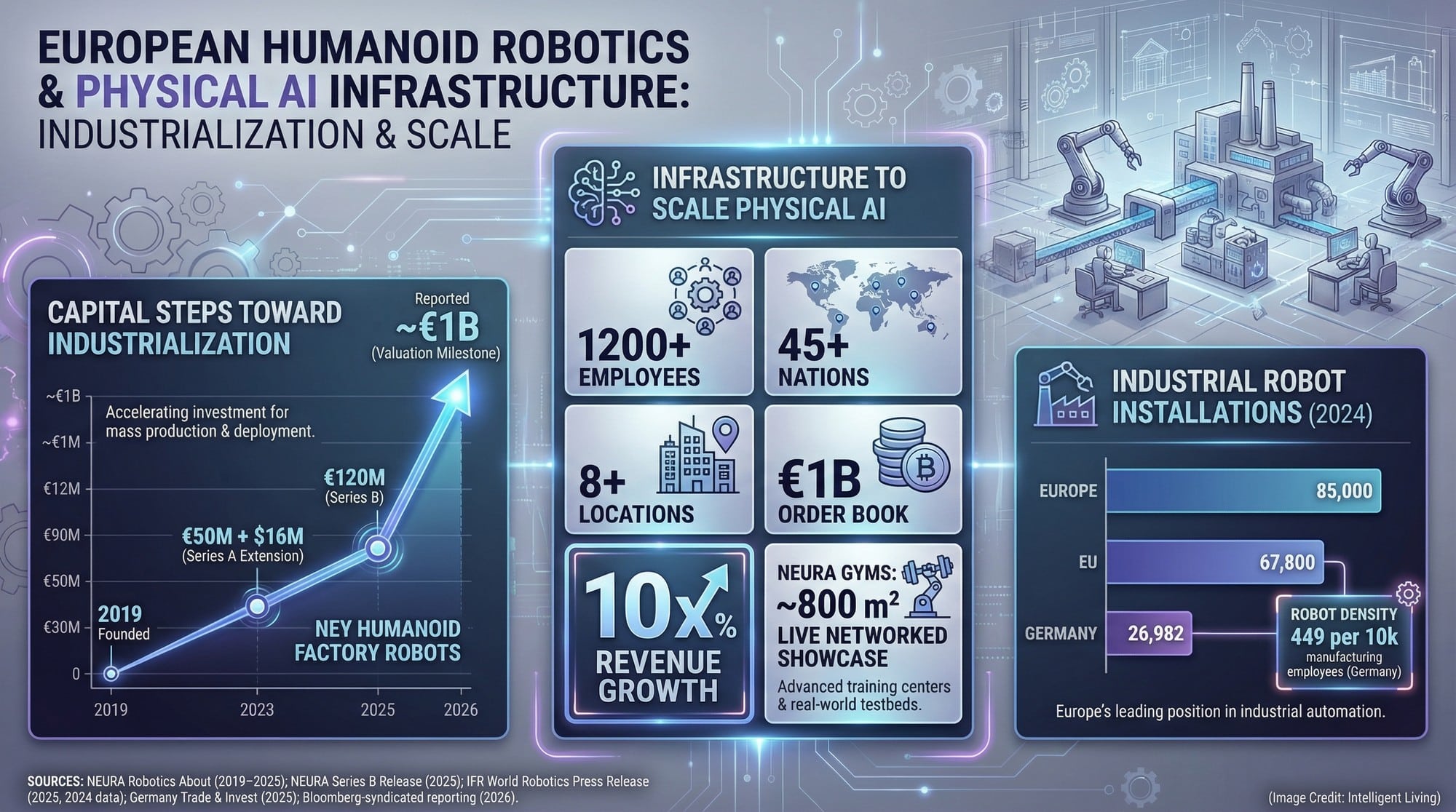
Capital Injection and the Scaling of Physical AI Infrastructure
What’s Being Reported About Neura’s €1B Round
Journalists have described the fundraising as ongoing and sourced their pieces to people familiar with the matter. Recent financial reports suggest the round is approaching €1 billion and reference a company valuation near €4 billion, while noting that Neura declined to confirm the story at the time.
Reporting differences are frequent during large private financing rounds. Several factors contribute to the variance in headline figures:
- Deal structures often mix pure equity with convertible notes.
- Structured financing packages frequently include milestone-based tranches.
- Specific terms may remain confidential until final paperwork is signed.
Neura’s past fundraising history shows how quickly terms shift as robotics firms transition from prototypes to production planning. For instance, a successful $55 million round in 2023 illustrates how early scale narratives form long before factory volume is finalised.
One plant manager described replacing several temporary positions with a single automated cell. He soon discovered the real value lay in the software rather than the hardware, as it ensured behaviour remained consistent across every shift. Operational predictability represents the core value investors seek when funding systems meant to function continuously in factories.
The Strategic Impact of Physical AI on European Manufacturing
If the round closes, the importance is not merely monetary. It signals that institutional capital is willing to take on the long, expensive work required to make humanoids safe, reliable, and useful in real industrial settings. Europe’s robust manufacturing clusters offer the ideal proving ground for robots to handle assembly, inspection, and logistics. Such transitions help local factories protect their production capacity through smarter automation.
Industrial partners change the conversation from proof of concept to repeatable deployment. When a component supplier and a robotics firm plan a multi-year integration, price and reliability become measurable planning inputs for factories. That path from lab demo to line-side helper is the best way to make humanoids relevant to ordinary workers and local communities.
During a staged Atlas rollout that starts with factory parts sequencing, engineers prioritise tightly defined tasks, safety gates, and measured expansion rather than immediate, facility-wide replacement.
A quiet trend sits underneath many of these announcements. As the price curve shifts and smaller organisations begin experimenting, accessibility becomes part of the adoption story, and the arrival of the sub-$6K Unitree R1 price signal for entry-level humanoids demonstrates how quickly the accessibility boundary is moving.
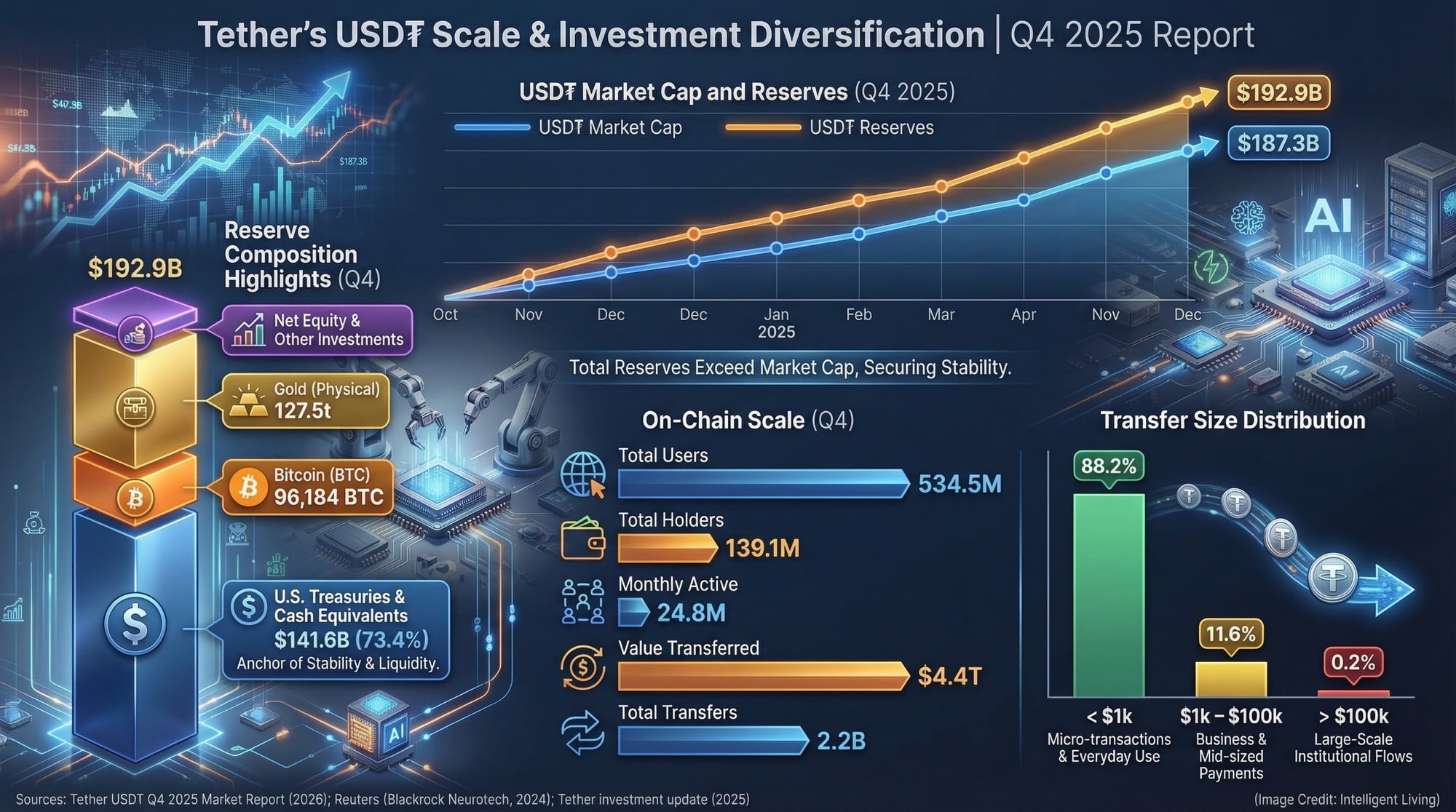
Investment Strategy and Platform Differentiation
Tether’s Strategic Diversification into Industrial Humanoid Robotics
Tether is widely known for USDT, but its investment behaviour has increasingly included technology plays beyond crypto markets. Large-scale robot programmes demand patient funding and a commitment to underwriting training infrastructure, safety validation, and the specialised tooling required for reliable production.
Recent market movements reveal why a stablecoin issuer is venturing into the humanoid robotics sector. Strategic moves in this space highlight a shift toward long-horizon hardware and infrastructure.
- Tether demonstrates a strong appetite for high-risk frontier hardware, including a $200 million Blackrock Neurotech investment in brain-computer interfaces.
- The company is establishing a clear robotics pattern, recently supporting a Generative Bionics investment update in the humanoid sector.
- The strategy frames humanoid technology as a durable bet on the future of physical labour and automation.
Bridging Stablecoins with Tangible Automation
Market signals suggest that Tether is looking beyond digital assets to anchor its value in tangible, high-impact industries. Such diversifications provide the patient with capital necessary for scaling complex hardware.
Tether’s strategy to broaden investments beyond digital assets highlights a portfolio-building posture, which helps explain why it can show up in sectors that look far from payments at first glance.
Massive capital channelled toward practical applications allows investors to target projects that scale effectively while delivering measurable results in the physical world. For anyone who has watched a startup finance team try to plan manufacturing, the change is immediate. A single anchor investor can shift a timeline from cautious pilots to scheduled factory tooling and predictable hiring.
Current forecasts for stablecoins and tokenised assets explain why payment rails and settlement tools are becoming strategic infrastructure, and the same arc is visible as tangible assets move on-chain during traditional finance experimentation.
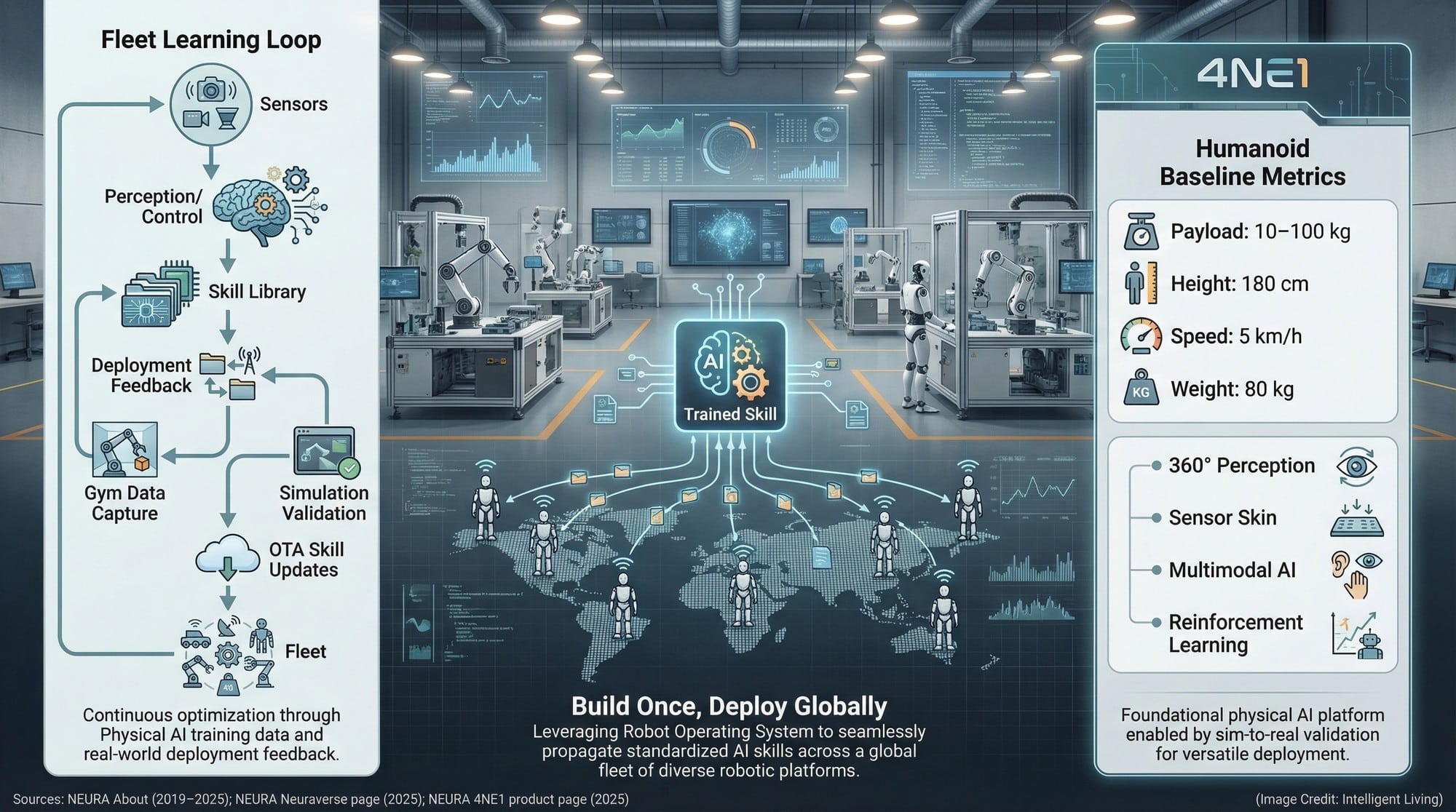
Neura’s Differentiator Might Be the Platform, Not the Body
Neura emphasises Neuraverse, a software-first environment that connects robots, simulations, and real-world training. The company also runs NEURA Gym facilities that generate task data under controlled variability. Operating as a platform-first organisation allows Neura to treat every machine as a vital data point rather than a standalone unit for sale. Their hardware serves as a vehicle for a continuous learning system, powered by the Neuraverse ecosystem and NEURA Gym training loop and refined through constant deployment feedback.
Fleet learning drives incremental software updates that ensure machines remain reliable in unpredictable environments. This model sharpens three critical areas:
- Safety protocols for human-robot interaction.
- Dexterity for complex assembly tasks.
- Efficiency across active production lines and logistics centres.
Fleet Learning and Software-Led Consistency
Think of a robot OS as a mobile operating system for heavy machinery. It standardises how hardware interacts with the world, making complex tasks as predictable as a phone app.
Training stacks are shifting toward automated feedback loops. Utilising AI systems that generate robot reward programmes to speed up skill learning highlights why software innovation matters as much as motors when a fleet needs to improve consistently.
Compact on-site hardware like desktop AI supercomputers for local inference allows teams to prioritise latency and reliability on the factory floor.
Dexterity is one of the hard limits for humanoids in the real world. A robot that can walk is not automatically a robot that can manipulate fragile parts or handle mixed materials, which is why visuo-tactile robotic hands are moving from viral demos toward mass production; robotic manipulation is finally reaching industrial validation.

Commercial Adoption and Market Valuation Dynamics
Scaling Demand: Schaeffler’s Industrial Humanoid Integration Roadmap
Schaeffler’s plan to integrate thousands of humanoids by 2035 stands as the clearest demand-side anchor in the industry. Through a technology partnership with Schaeffler, Neura and Schaeffler are focusing on deployment tied to production data that can train new capabilities and harden safety routines.
Such industrial commitments lower the technical and commercial risk for robotics firms because they create predictable testbeds and force clear answers on maintenance, throughput, and fault modes. When suppliers and manufacturers plan for multi-year replacement cycles, they model downtime, training, and reliability in spreadsheets that decide whether a robot is a curiosity or a line item.
The factory case is accelerating as modern plants transform into software-first environments where factories leveraging digital twins and edge inference demonstrate how this workflow is becoming standard.
Valuation Whiplash: Why Some Reports Say €4B and Others €8–€10B
Timing and deal terms often dictate these valuation gaps. Early-stage discussions frequently cite aspirational pre-money figures that shift during due diligence or the finalisation of milestone-based tranches.
Instrument mix also influences public perception of value. A round involving convertible notes, earnouts, or performance warrants can lead to varying headline numbers. Differences usually emerge when outlets report implied valuation inclusive of future tranches rather than focusing solely on the immediate equity price.
Reporting history clearly illustrates this gap. March 2026 coverage cites a valuation near €4 billion, whereas market analysis from late 2025 suggested a significantly higher band.
A small anecdote from venture practice fits here. Early press valuations often function like a weather forecast. They give a directional sense of pressure and momentum, but the exact number only becomes real when paperwork is signed and cash moves.


Deployment Milestones and Industry Pacing
What to Watch Next for Humanoid Factory Deployment
If the reported funding round concludes, industry observers should monitor four specific developments to gauge Neura’s trajectory. Milestones like these will determine how quickly the firm can move from prototypes to factory deployment.
- Examine the confirmed investment terms to see if the round is pure equity or milestone-dependent tranches.
- Watch for public commitments of follow-on capital, which are vital for sustained production support.
- Look for pilot confirmations from industrial partners that transition into formal purchase orders or installation schedules.
- Monitor visible software milestones that demonstrate Neuraverse scaling across diverse units and manufacturing sites.
Strategic steps ensure that the technology matures in alignment with industrial demand. Factory deployment speed also depends on how quickly teams can iterate designs and validate safety. Workflows that integrate digital twins with GPU-accelerated agentic AI significantly shorten the engineering cycle between simulation results and line-ready updates.
Tangible adoption often occurs quietly through hiring for integration roles, new training programmes, and predictable maintenance schedules.
Humanoid Army Versus The Near-Term Reality
While the phrase ‘humanoid army’ generates significant engagement, it risks conflating scale with a militarised concept. For most manufacturers and early adopters, the value of humanoids will appear in constrained tasks that benefit from humanlike reach, mobility, and fine manipulation rather than in swarms of generalist robots replacing people.
Immediate industrial reality involves staged deployments, rigorous safety regimes, and constant human oversight. Reliability remains a persistent daily engineering challenge focused on several practical barriers:
- Power management determines whether a robot serves as a productive teammate or a significant bottleneck.
- Deploying autonomous battery swapping systems ensures near-continuous uptime for 24/7 shifts.
- Maintaining balance and power across long routes, as demonstrated by a 66-mile autonomous humanoid endurance walk, remains a difficult hurdle for physical reliability.


Closing Insights and Technical Clarifications
Conclusion: The Industrial Future of Humanoid Robotics
The reported €1 billion funding round for Neura Robotics validates the unglamorous, essential labour required to industrialise humanoid systems. Beyond the financial headlines, this capital supports the infrastructure needed to bridge the gap between prototypes and floor-ready machines. Focusing on uptime and predictable safety ensures that robotics technology serves as a practical tool for strengthening local manufacturing resilience.
Sector integration into the daily rhythms of a factory will ultimately define the success of humanoid platforms. As Physical AI matures, the focus moves from viral videos to measurable productivity gains and reliable human-robot collaboration. The development marks the beginning of a cycle where cognitive automation becomes a standard line item in national industrial strategies, securing the future of production for both workers and manufacturers.
Essential FAQ: Neura Robotics and Industrial Humanoids
Is Neura Robotics actually raising €1 billion now?
The round has been described as in process and attributed to people familiar with the matter. Neura did not confirm the details in early reporting, so the figure should be treated as reported rather than finalised.
Why is Tether participating in a robotics funding round?
Tether is diversifying its portfolio into frontier hardware and Physical AI, seeking long-term infrastructure plays that can absorb massive, patient investment capital.
What makes the Neuraverse platform unique?
Neuraverse acts as a robot operating system that uses fleet learning to sync data across all deployed units, ensuring every robot improves simultaneously through real-world feedback.
Is the Schaeffler humanoid rollout already happening?
The partnership is currently in a technology-sharing and pilot phase, with a roadmap aiming for the integration of several thousand humanoids by 2035.
Are these robots meant to replace factory workers?
No, the goal is augmentation. Humanoids are designed to handle repetitive, high-strain tasks in human environments, allowing skilled workers to focus on complex oversight and problem-solving.