
Scientists at England’s Plymouth Marine Laboratory (PML) have launched a series of trials that involve testing mussels’ constant filter feeding as a potential wide-scale application for cleaning microplastics in our oceans.
Mussels are fascinating creatures. The insatiable filter feeders can do something that humans could only achieve by spending millions of dollars on equipment—cleaning microplastics smaller than 5mm out of the sea. Mussels get their food by filtering ocean water, sifting out plankton and other nutrients, then flushing out undesired particles (such as microplastics) from their digestive systems while inflicting no harm to the mollusks. The same habit is not so benign for sediment sifters on land: fiddler crabs in Colombia’s mangroves were found in 2026 to ingest microplastics along with their food and fragment them into smaller, more mobile pieces.
Microplastic pollution comes from a long list of sources, including tire wear, decomposing plastic debris, artificial textiles, and so much more. However, most of the trash ends up in the ocean via sewage and rivers. Since microplastics are so tiny, they require an ultra-fine net to collect them. Unfortunately, this almost guarantees that any marine life, even tiny ones, will be collected as well.
The PML team is on a mission to see how many mussels it would take to make a noticeable impact on microplastic pollution. According to EPA, one adult mussel can filter feed up to 15 gallons of water daily, and a 6-mile bed of mussels can filter out 25 tons of particulate matter per year.
Earlier this year, PML began testing how effective mussels are at eliminating microplastics from seawater using a custom-designed flume tank that fed them phytoplankton and microplastics. The experiments showed that 300 mussels (5 kg) could filter out more than 250,000 microplastics per hour! This project was funded by the Waitrose ‘Plan Plastic’, a grant program for plastic cleaning solutions.

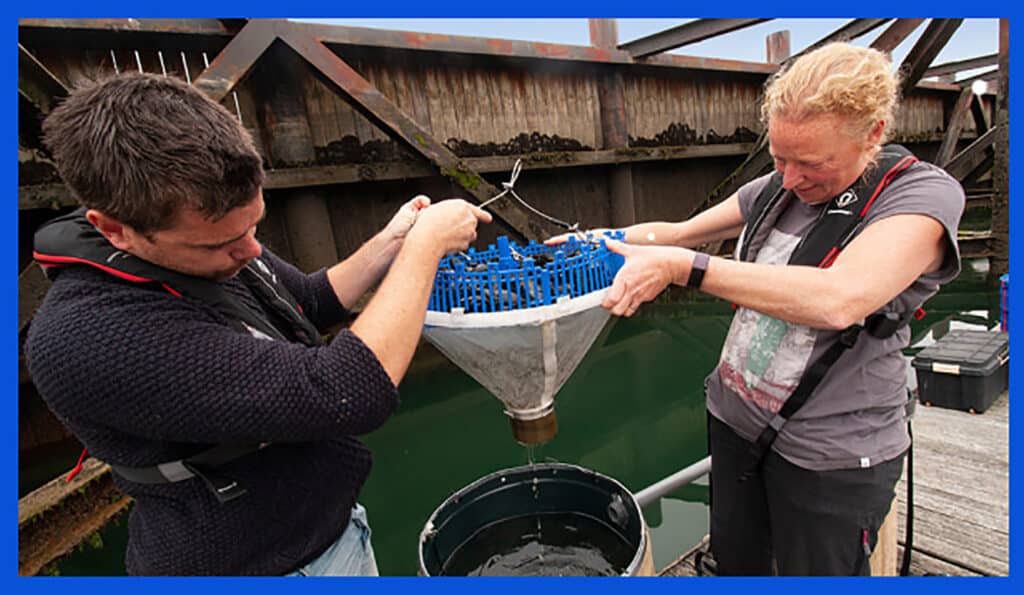
Professor Pennie Lindeque, Head of Science for the Marine Ecology and Biodiversity Group, said, “The trials so far have been extremely promising, and we’re very excited about the positive impact systems like these could potentially have on estuarine areas, particularly in places where microplastics might accumulate such as marinas, harbors, or near wastewater treatment works.”
Fortunately, nano plastics can pass straight through the mussel’s membranes and into their limited anatomy. At the same time, microplastics are too large to harm them at the levels currently found in the sea. “This has been a really exciting experiment because we always hoped that mussels would have the capacity to filter out microplastics, but they do it really well, and they do it without harming themselves,” Prof. Lindeque added.

So far, the trials are proving a success, with experiments confirming that blue mussels readily filter microplastics out of the water column. These microplastics are either ejected by the mussels in their ordinary fecal matter or rejected within ‘pseudofaeces.’ In addition, tests revealed that when the feces contained high levels of buoyant plastic, it rapidly floated to the water’s surface. This is good news. It means the mussel feces can be collected for removal, thus eliminating microplastics from the system entirely.
In November 2019, a study published in Limnology and Oceanography Letters found that for every 1,000 liters of ocean water or 264 gallons tested, they found 8.3 million pieces of “mini-microplastic.” That’s a lot of microplastic.


