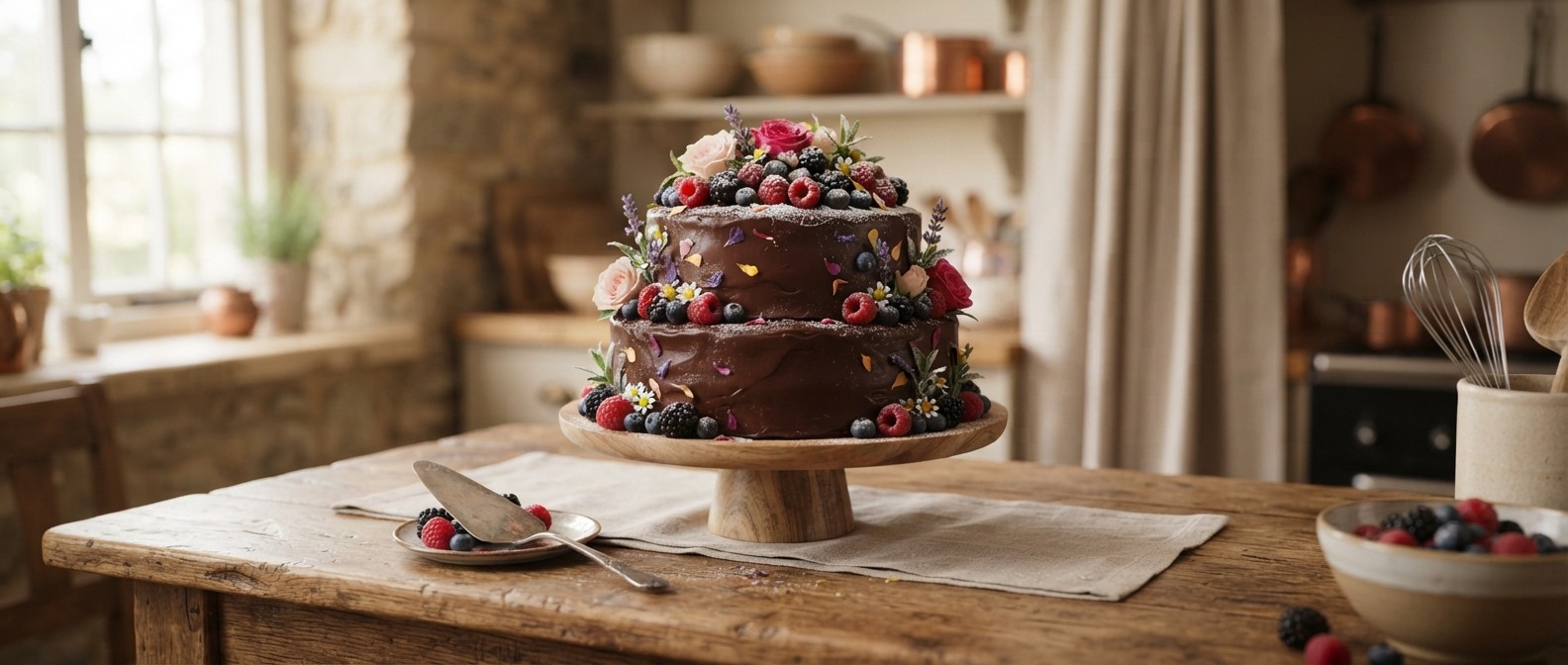
Vegan and gluten-free desserts have long been seen as a compromise. The cake ordered because one guest cannot eat the standard option; the cookie that was supposed to fall apart; the pastry that got praise for being “not bad for what it is.”
This attitude is starting to change. Improved ingredients, techniques, and an overall better understanding of the fundamentals of pastry-making mean that a well-executed vegan or gluten-free dessert no longer has to be an inferior option.
It can be rich, tender, crisp, airy, fudgy, or delicate.
The crucial difference comes from a shift away from substitution and towards design. Good bakers no longer have to ask themselves, “What can I use instead of the egg, butter, or wheat flour?” They can ask, “What properties do I need to replicate?”
Vegan and Gluten-Free Baking Solve Different Problems
“Vegan” and “gluten-free” are sometimes grouped together but describe completely different alterations to a given recipe.
A vegan cake or pastry means that dairy products and any animal byproducts have been removed. These ingredients contribute a number of different properties to a given recipe. Eggs can aerate and stiffen batters and dough while providing moisture and binding power. Butter and cream provide fat and flavor and can add a certain lightness to a dessert.
A gluten-free cake or pastry, on the other hand, requires different modifications. Gluten provides elasticity to wheat-flour-based batters and dough. This property is needed to provide structure to a given dessert. Remove wheat flour and one has to find other ways of getting the needed elasticity.
That is why a single “replacement ingredient” will rarely be sufficient. Applesauce may provide moisture but won’t perform the other tasks that an egg would. A nut-flour blend might produce a rich, tender cake, but it won’t create the needed elasticity for a well-made pie crust. Substitutions often require multiple ingredients to provide the desired effects, and it is this combination that makes up a good recipe.
This also means that a dessert can be “vegan,” but not “gluten-free,” or vice versa. The two terms should always be considered separately.
Texture Comes From Function, Not Tradition
Traditional pastry-making has a number of time-proven techniques, but most often they were developed around the properties of wheat, eggs, butter, and dairy. Alternative baking requires the same attention to technique, but with more options.
A vegan chocolate cake, for example, will still need to have a certain degree of richness and moisture but will lack the fat and binding power usually provided by eggs and dairy. A number of different ingredients can be utilized, from plant milks to neutral oils and from fruit purees to commercial egg replacements, depending on the desired effect.
Gluten-free baking tends to make use of other starches, as a single carbohydrate source rarely performs all the tasks that wheat flour does. A combination of rice, oat, and almond flour might be needed, along with extra binding agents, to produce a satisfactory result.
The best results, however, are not reached by simply replacing wheat with another grain. It is important to remember that the goal is not to have a dessert that is “free from,” but one that contains ingredients that perform the needed functions.
A blind taste test of two slices of chocolate cake, one traditional, the other either vegan or gluten-free, will rarely reveal the presence of a substitution just from the flavor. It is the feel of a properly made moist, but not gummy, crumb, the balance of sweetness and richness in the frosting, and the overall quality of the flavor and ingredients that determine if a dessert is well-made.

Flavor Still Has to Lead
Dietary labels can be eye-catching, but the flavors of a dessert are going to make someone want more.
Salt still aids the development and balance of chocolate flavors; vanilla still provides balance and weight to a dessert; fruit still needs to showcase its acidity and sweetness. Nuts, spices, coffee, citrus, caramelized elements, and contrasting textures can all be used to provide interest and depth to a dessert, regardless of the ingredients used.
An oversight in specialty baking tends to be the reliance on sweetness to provide richness and flavor. An overly sweet cake is rarely a rich cake, and a thick frosting is rarely a satisfying frosting. The same principles that apply to traditional pastries still apply to vegan and gluten-free ones: balance, contrast, aroma, texture, and restraint.
This is also where the improvements in modern vegan baking can be seen. Rather than being limited by what ingredients are traditionally used, bakers are free to pick and choose the elements that will enhance a given recipe. Coconut can provide richness to a filling, fruit purees can add flavor and moisture, and dark chocolate doesn’t always need to contain dairy.
The goal is not to hide the fact that a dessert is vegan or gluten-free. Rather, the ingredients can be picked to highlight other elements of the recipe.
Buying Specialty Desserts Requires More Than Reading One Label
Customers also have a responsibility to get the dessert that they want. “Vegan,” “gluten-free,” “dairy-free,” and “allergen-friendly” are not interchangeable terms, and assumptions can lead to disappointment.
It is important to clearly identify the requirements. Does the guest avoid animal byproducts? Do they need a gluten-free dessert? Do they require both? Is this a preference, or are they unable to consume these ingredients?
These factors will alter the questions that need to be asked.
For shoppers who are comparing vegan and gluten free cakes in Los Angeles, the important step is to look at the individual cake and not assume that one label implies another. Check the product descriptions, ask about ingredients when necessary, and identify the exact requirements.
If the order is for someone with celiac disease or with other dietary restrictions, more questions should be asked. In cases where a customer does not know much about ingredient handling procedures, it is best to ask a bakery directly about preparation and cross-contact practices, rather than relying on a marketing label.
Once these factors are identified, the other familiar questions come into play: flavor, size, presentation, pickup/delivery, and how many people need to be fed.
A specialty dessert still needs to be part of a satisfying experience.
The same level of scrutiny applies when ordering mini vegan cakes online: confirm the ingredients and allergen handling before placing an order.
Presentation Is Part of the Experience
A dietary dessert should not feel apologetic about its ingredients.
Modern celebration cakes can make use of vibrant colors, minimalist presentation, piped designs, fruit, flowers, chocolate accents, textured frosting, and playful motifs just as effectively as a traditional cake. A dessert table can include a variety of desserts without making the vegan or gluten-free desserts stand out as “different.” People will first experience a dessert with their eyes.
Presentation is also a good opportunity to highlight a recipe’s strengths. A rich, dense, fudgy cake does not have to try to mimic a lighter, fluffier cake. A crisp cookie has the opportunity to show off its texture. A rich, intensely flavored vegan ganache tart has the opportunity to capitalize on those qualities rather than attempt to recreate a buttercream-layered cake.
The strongest specialty desserts embrace their ingredients and characteristics.
This also helps to simplify the process of entertaining. There is no longer a need to create a “normal” dessert and a “special” dessert. Hosts can pick desserts that appeal to the most people and that still meet any dietary requirements. The requirements still need to be clearly communicated, but the foods themselves should not feel like special accommodations.
Planning Matters as Much as the Recipe
Even an excellent cake can be let down by poor planning.
Specialty desserts might require specific storage considerations, depending on the type of ingredient. Find out if a given cake requires refrigeration, and if so, how much time should be given for it to come to room temperature before cutting. Ask about serving and storage requirements for leftovers.
Portion planning should also be kept in mind: a tall, layered cake will serve a much smaller group than a similar-looking, but denser, cake. If ordering for a gathering, it is best to ask the bakery for a recommended number of guests, based on the size of the cake rather than selecting a size based on how something looks.
Ordering ahead also provides more flexibility. A baker might need to set aside ingredients, prepare special decorations, or have time to complete a custom order. Waiting until the last minute might result in compromises that would not have been made otherwise.
For mixed groups, it can be useful to consider whether a single dessert will meet all the requirements or if multiple desserts are a better option. There are no right or wrong answers. The circumstances of the guests and the occasion will be the best guides.

Better Baking Has Changed the Comparison
Vegan and gluten-free baking is most interesting when it stops thinking like an imitation.
The focus has to shift from “Can a dessert made from non-traditional ingredients be close enough to a traditional dessert?” to “What qualities do I want in my dessert?”
The right ingredients, presentation, and planning will ensure that a vegan or gluten-free dessert is as satisfying as one made with wheat and dairy. Sometimes that entails replicating a traditional layered cake as closely as possible, while other times it means taking advantage of the differences between traditional and alternative baking.
Neither approach requires lowering standards.
Modern specialty baking reaches its peak when the baker understands the properties of the ingredients, the buyer knows the requirements, and both are focused on more than the lack of wheat, dairy, or eggs.
That is the point at which vegan and gluten-free pastries stop being substitutes. They simply become good desserts.