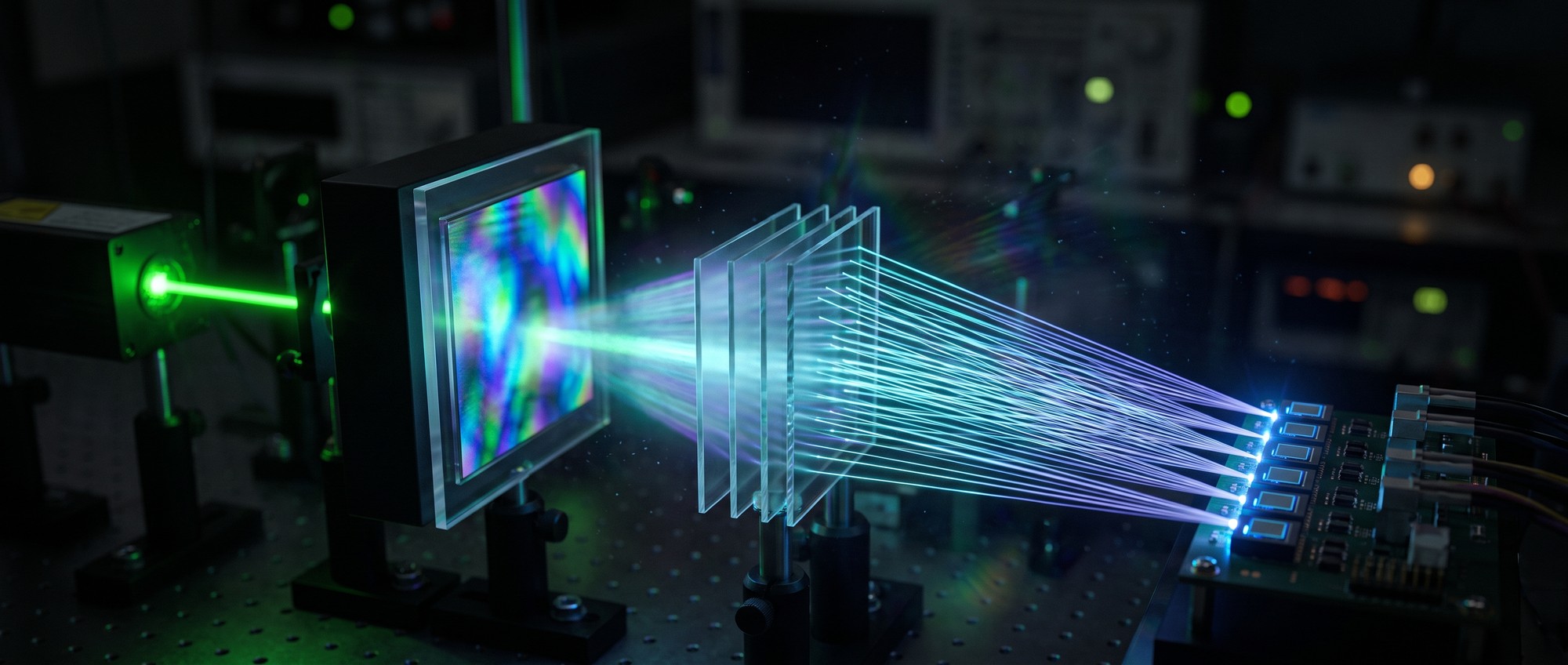
A pair of physicists from the University of Copenhagen and Nanyang Technological University in Singapore have done something remarkable that has never been done before. These pioneers have discovered a way to get non-magnetic materials to make themselves magnetic – with the aid of a laser light! They believe this is only the beginning, that the phenomenon may also be used to endow many other materials with new properties.
Any material in the world is how it is because of its chemistry – from the types of atoms that are present and the way that they are arranged. All of its properties are, in a sense, a representation of very specific atomic arrangement and type. These criteria are therefore a determining factor in the characteristics of a material. For example, they determine how well a material may conduct electricity or whether or not it is magnetic. This is why the traditional route for changing or achieving new material properties has been through chemistry.
What’s so special about the new discovery is that the route to transforming a materials’ properties is not through chemistry – it’s physical. When the material is stimulated by laser light, a metal can transform itself from within and suddenly acquire new properties. The research has been published in the journal Nature Physics.
Associate Professor Mark Rudner, a researcher at the University of Copenhagen’s Niels Bohr Institute, explained:
For several years, we have been looking into how to transform the properties of a matter by irradiating it with certain types of light. What’s new is that not only can we change the properties using light, we can trigger the material to change itself, from the inside out, and emerge into a new phase with completely new properties. For instance, a non-magnetic metal can suddenly transform into a magnet.
Rudner made the discovery with his colleague Justin Song of Nanyang Technological University in Singapore. Scientists in the past have used light to transform the properties of a material but only to the point of manipulating the properties already found in a material. Now, to give a metal its own “separate life,” allowing it to generate its own new properties, that’s something that has never been done before.
Their research proves that “when a non-magnetic metallic disk is irradiated with linearly polarized light, circulating electric currents and hence magnetism can spontaneously emerge in the disk.”
As reported by Phy.org:
Researchers use so-called plasmons (a type of electron wave) found in the material to change its intrinsic properties. When the material is irradiated with laser light, plasmons in the metal disk begin to rotate in either a clockwise or counterclockwise direction. However, these plasmons change the quantum electronic structure of a material, which simultaneously alters their own behavior, catalyzing a feedback loop. pioFeedback from the plasmons’ internal electric fields eventually causes the plasmons to break the intrinsic symmetry of the material and trigger an instability toward self-rotation that causes the metal to become magnetic.

According to Rudner, not only does this new theory pry open an entirely new mindset, but it also opens a wide range of applications:
It is an example of how the interaction between light and material can be used to produce certain properties in a material ‘on demand.’ It also paves the way for a multitude of uses, because the principle is quite general and can work on many types of materials. We have demonstrated that we can transform a material into a magnet. We might also be able to change it into a superconductor or something entirely different.
You could call it 21st century alchemy. In the Middle Ages, people were fascinated by the prospect of transforming lead into gold. Today, we aim to get one material to behave like another by stimulating it with a laser.
There are many ways this discovery could be useful. For example, in a situation where one needs a material to alternate between behaving magnetically and not; or it could be useful in optoelectronics, where light and electronics are combined for fiber-internet and sensor development.
The researchers’ current plans are to expand the catalog of properties that can be altered in analogous ways. They are also furthering experimental investigation on the new materials so to unearth any possible utilization.