
A chemical used for over a century to strip grease from metal parts is currently center stage in environmental health circles. Recent coverage highlighting research on trichloroethylene—commonly identified as TCE—has renewed urgent questions regarding whether long-term exposure to this industrial solvent correlates with an elevated risk of Parkinson’s disease. A widely circulated report on the 500-percent increased risk of Parkinson’s disease framed the claim in viral terms, utilizing a headline-friendly figure that prompts critical questions about its real-world implications.
Neurological vulnerability factors represent an increasing concern for households evaluating the long-term impact of their local environments. TCE is not a rare laboratory compound; rather, it has been foundational in metal degreasing, dry cleaning spot treatments, and heavy industrial operations for decades. Because it can linger in soil and groundwater, its legacy is persistent. Under specific subterranean conditions, volatile organic compound migration allows it to infiltrate indoor air through a process known as vapor intrusion. Active vapor migration shifts the public health conversation from distant industrial sites directly into living rooms, schools, and workplaces.

Current Research: TCE Exposure, Environmental Risk Factors, and Parkinson’s Disease
Latest Scientific Findings: TCE and Neurological Health Trends
Investigating the Origins of the 500-Percent Parkinson’s Risk Claim
Connecting the dots between chemical exposure and movement disorders reveals a complex picture that scientists are still working to explain: research has linked TCE exposure to Parkinson’s disease, a progressive neurological disorder that affects movement and coordination. In a 2023 overview, clinical evidence linking TCE exposure to Parkinson’s risk aligns with a small twin analysis where the exposed twin had higher odds of Parkinson’s disease, a relationship sometimes paraphrased as a 500-percent increase.
Statistical Context: Interpreting Odds Ratios in TCE Exposure Studies
While such a stark figure resembles a definitive verdict, statistical context is essential for accurate interpretation. In clinical research, scientists often utilize an odds ratio to compare disease frequency across different populations. The clinical definitions of odds ratios clarify why this metric signals a statistical association rather than a deterministic forecast for any individual.
Statistical figures change depending on your specific situation. When you look at these risk levels, consider a few key things:
- How many people were actually in the study.
- Whether researchers tracked exactly how long people were exposed.
- If other chemicals like benzene or vinyl chloride were in the air too.
- Your own personal health history and DNA.
Real risk isn’t just about one scary number; it’s about the whole mix of what’s happening in your environment.
This measure does not promise that exposure leads to illness; instead, it provides a signal that requires careful calibration before drawing broad conclusions about personal health risks.
Case Study: Camp Lejeune Water Contamination and Parkinson’s Prevalence
Public discussion has revived focus on contamination cases where exposure history is documented over time. A major cohort analysis of service members revealed that Parkinson’s disease was significantly more prevalent among those stationed at Camp Lejeune compared to a control group at a base with a clean water history.
Research into Camp Lejeune service member Parkinson’s prevalence details a 70-percent higher risk within this veteran population.
Lessons from military sites show that the danger isn’t just about old factory spills—it’s about how invisible vapors can affect your health for years to come. These insights illustrate that the narrative extends beyond legacy factory solvents, highlighting exposure pathways with significant long-tail health implications. This complexity highlights why isolating a single chemical cause is difficult in legacy industrial environments.

Quick Facts: Why are TCE, Parkinson’s, and indoor air quality frequently searched together?
Search intent trends highlight a critical intersection between trichloroethylene exposure and neurological vulnerability. These core terms demonstrate that the environmental threat has evolved from historic industrial solvent use to current vapor intrusion pathways, highlighting how legacy chemical footprints continue to threaten residential air quality and long-term health.
Solvent exposure outcomes typically depend on specific variables such as timing, location, and cumulative dose.
- Trichloroethylene, or TCE, is a man-made chlorinated solvent long used for metal degreasing and certain cleaning tasks.
- Vapor intrusion is a pathway where solvent vapors can move from contaminated soil or groundwater into indoor air.
- The “500-percent” figure repeated online comes from a small twin study reporting higher odds for exposed participants, not a forecast for any one person.
- Evidence also comes from military base exposure histories where mixed contaminants were studied, including Camp Lejeune.
- Specific TCE phaseout and regulatory compliance schedules show how different industrial applications are being wound down, with timelines that vary by application.
- Indoor chemical exposure is not only industrial, and debates over proposed warning labels for VOC-emitting products reflect how everyday sources can degrade indoor air quality.
Taken together, these facts point to a practical reality: risk often depends less on a single headline and more on how exposure happens, how long it lasts, and whether indoor air is trapping gases that are easy to overlook.
When the topic is neurological health and long-lag exposures, the most reliable headlines are the ones that keep the uncertainty visible while still taking the signal seriously.
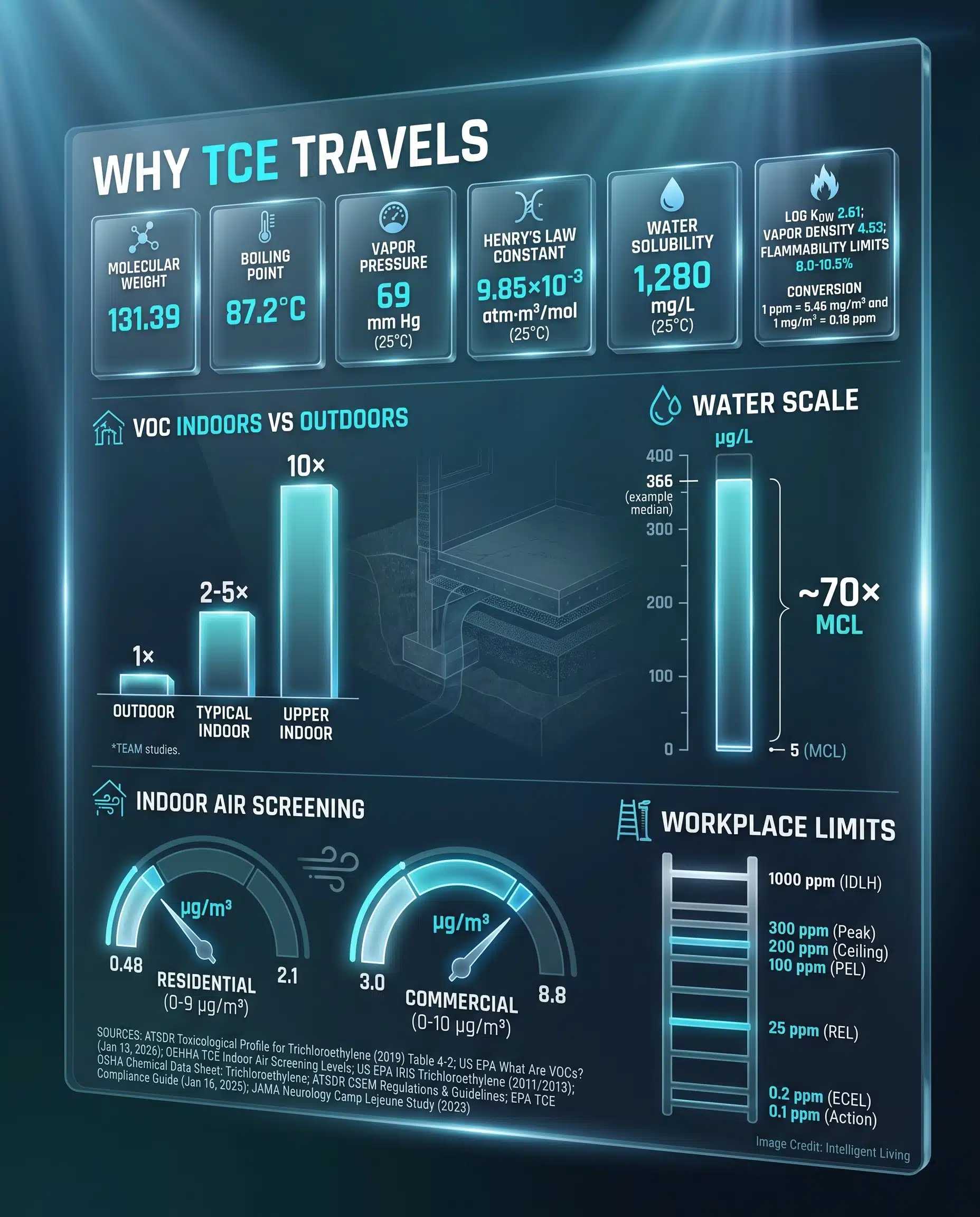
How TCE Shows Up and How it Can Reach Indoor Air
Chemical Profile: Trichloroethylene (TCE) and Volatile Organic Compounds
Historical Uses: Industrial Degreasing and Dry Cleaning Applications
Trichloroethylene is a volatile organic compound that turns into a gas easily at room temperature. Because it dissolves grease so fast, it became a go-to tool for heavy work:
- Stripping oil and grime off metal engine parts in factories.
- Lifting tough spots and stains in professional dry cleaning.
- Serving as a strong ingredient in old-school household glues and cleaners.
While many of these industrial uses are disappearing, the chemical footprint stays behind in the soil.
For decades, it was valued for its ability to dissolve grease fast. In factories, it stripped oil from metal parts. In some dry cleaning settings, it helped lift stubborn stains. It has also appeared in certain consumer products, though many uses have declined over time.
Common Exposure Routes: Inhalation, Ingestion, and Dermal Contact
Medical research into physiological TCE exposure pathways identifies several methods for solvent entry into the human body. Because these chemicals are often invisible, detection usually requires specialized testing rather than relying on sensory cues.
Primary exposure pathways include:
- Inhalation of contaminated indoor or outdoor air.
- Ingestion of groundwater or tap water containing solvent residues.
- Direct dermal contact during industrial or household tasks.
Neighborhoods situated near legacy industrial zones rarely exhibit outward signs of chemical contamination. Tap water appears clear, and the air lacks any distinct chemical odor.
Yet if solvents seeped into groundwater decades ago, low levels can persist and move through the environment in ways that are easy to miss.
Evaluating Legacy Risk: Persistent Solvents in Soil and Groundwater
In older industrial regions, former machine shops frequently undergo conversion into modern residential or office spaces. While aesthetic upgrades like open floor plans take priority, the invisible chemical legacy within these repurposed structures often goes unexamined.
Legacy contamination stays dangerous because these cleaning solvents can hide in the dirt and water for decades without breaking down.
This historical footprint remains significant because chlorinated solvents can persist in soil and groundwater for decades. Even when the original industrial activity has ceased, lingering residues pose a risk, particularly where cleanup efforts are partial or ongoing.

Mechanics of Migration: Comparing TCE Vapor Intrusion to Radon Gas
Defining the Vapor Intrusion Pathway for Residential Buildings
The phrase “vapor intrusion” may sound technical, but the idea is straightforward. When TCE contaminates soil or groundwater, it can evaporate into a gas. That gas can travel through tiny cracks in foundations, gaps around pipes, or porous building materials and accumulate indoors.
Public health guidance regarding subsurface vapor migration mechanics explains how legacy contamination can infiltrate indoor air.
Where Vapor Intrusion Shows Up in Real Life
Across the U.S., subsurface TCE at Superfund remediation sites has made vapor intrusion a recurring priority for environmental cleanup, especially near former industrial and disposal areas. This is one reason environmental testing can focus not only on groundwater but also on indoor air in basements, ground floors, schools, and workplaces near known plumes.
Parallel Risks: Understanding Invisible Gases in Home Environments
Think of TCE vapors like radon gas. Both are invisible and have no smell, meaning they can creep into your house without you ever knowing. One comes from nature and the other from factories, but the warning is the same: air that looks clean can still be full of hidden dangers.
The difference is that radon is natural while TCE is industrial. The shared lesson is the same: clean-looking air is not always measured air. A homeowner might seal a basement to stop drafts and lower energy bills, then notice that the space smells musty on humid days, a pattern that often correlates with persistent foundational moisture and crawl space dampness that disrupts airflow.
Practical Indoor Air Habits that Reduce Overall Risk
In everyday terms, questions like “How do I know if my home has vapor intrusion?” often come up after a local site is flagged for contamination or a neighbor mentions groundwater testing.
Implementing targeted residential ventilation and filtration improvements helps keep the focus on managing common indoor air burdens.

What Does the Research Actually Say About Parkinson’s Risk?
Multifactorial Origins: Genetics and Environmental Triggers in Parkinson’s
Parkinson’s disease involves the gradual loss of dopamine-producing neurons in a region of the brain that helps control movement.
Health experts now believe that your genes and your environment work together to trigger Parkinson’s. That is why scientists are looking so closely at how common chemicals can slowly damage the brain over a lifetime. Clinical research indicates that a synergy between genetic predispositions and environmental triggers drives the progression of movement disorders, which is why exposure studies often focus on chemicals that can reach the brain over time.
Clinical Evidence: Lessons from the TCE Solvent Twin-Pair Analysis
The twin study most often cited in this debate compared twins where one developed Parkinson’s disease and the other did not. Data from the clinical twin-pair solvent exposure analysis reported an odds ratio of 6.1, signaling a meaningful statistical correlation.
How to Read the Odds Ratio without Overreading It
An odds ratio of 6.1 means that within that specific study population, Parkinson’s disease was far more common among those reporting exposure than among those without it. However, the number of exposed participants was limited, and the confidence interval was wide. That is why careful reporting treats the finding as a serious association, not a settled cause.
Mitochondrial Dysfunction: Laboratory Models of TCE Brain Toxicity
Ongoing research provides additional evidence without completely eliminating scientific uncertainty. A comprehensive chlorinated solvent environmental risk synthesis illustrates why experts treat trichloroethylene as a significant neurological threat. Most clinicians avoid making simplistic cause-and-effect claims, focusing instead on the cumulative impact of chemical exposure.
In laboratory models, TCE-linked activation of LRRK2 kinase has been observed alongside structural damage to mitochondria, the cell’s energy-producing machinery. When energy systems strain, neurons that rely heavily on a constant energy supply become significantly more vulnerable to degeneration.
This biological plausibility does not definitively prove cause and effect in humans. However, it provides a mechanistic explanation that helps scientists understand why the epidemiological signals are so persistent.

Regulatory Updates: EPA Phaseout Timelines and TSCA Risk Management for TCE
In response to health concerns, the Environmental Protection Agency finalized a risk management rule addressing TCE under the Toxic Substances Control Act. The EPA risk management rollout for TCE tracks how regulatory enforcement has shifted over time due to legal stays. New EPA safety rules cover many different jobs and products, which means some industries have to stop using the chemical sooner than others.
The legal framework is established within the federal Toxic Substances Control Act regulations, defining which uses are strictly prohibited and how compliance dates are staged.
This matters because the rule language defines the scope, the exceptions, and the terms regulators and companies must follow.
For workplaces trying to swap solvents without guessing, revised industrial safety standards for trichloroethylene compliance summarize the necessary steps for process redesign.
It also signals how substitution often involves more than picking a new label, since ventilation, protective equipment, and process redesign can change alongside the chemical.
Legal challenges and administrative stays have created significant confusion regarding exact compliance deadlines for the new EPA rulings.
For businesses that previously relied on TCE for manufacturing or degreasing, the transition requires a comprehensive approach. This often involves selecting alternative solvents or implementing complete process redesigns to meet safety standards.
Regulation often moves more slowly than public concern. Community engagement intensifies when residents realize that comprehensive cleanup plans include both indoor air sampling and traditional water testing.
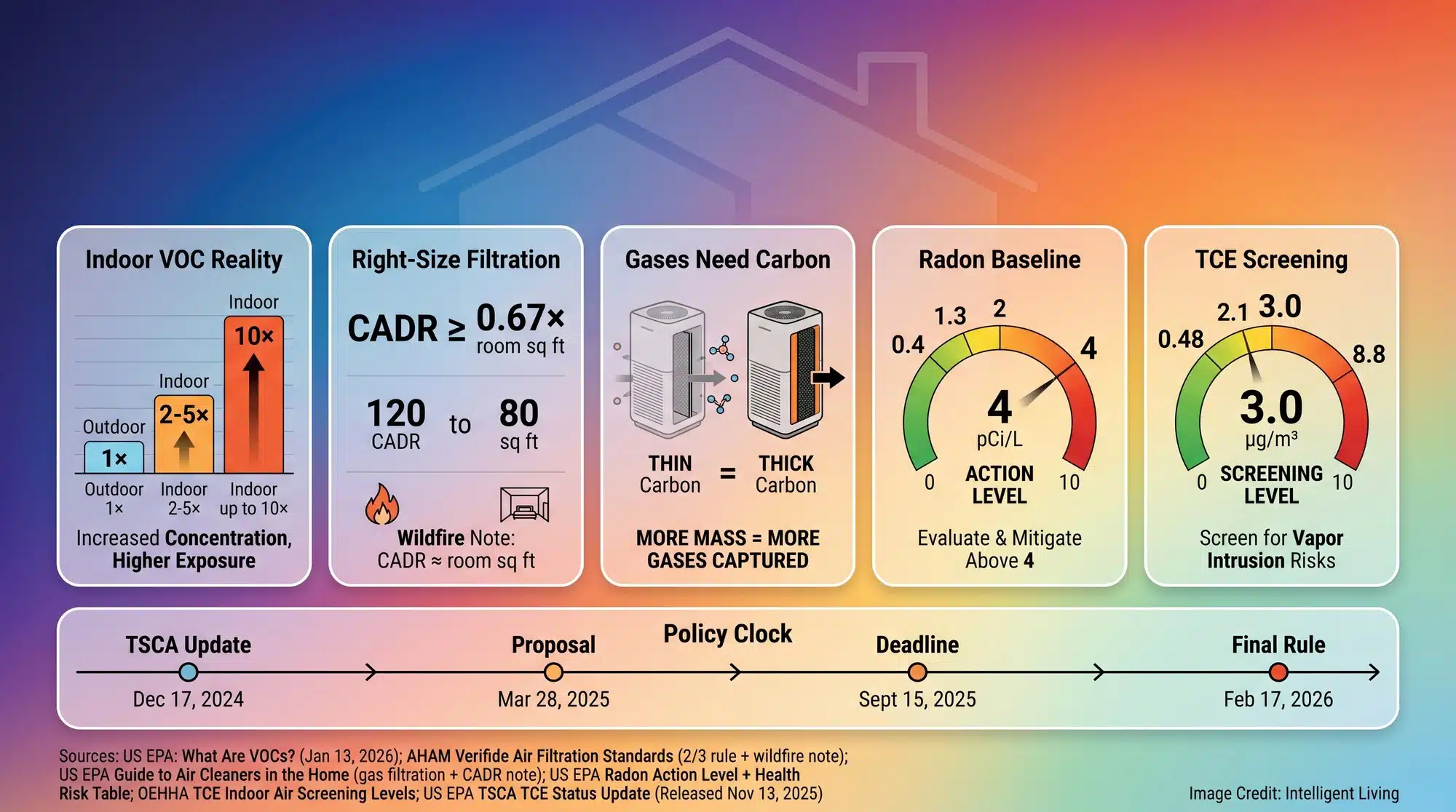
5 Ways This News Could Affect People and What to Do Next
Environmental health news influences household decisions regarding cleaning products, ventilation standards, and structural renovations. A practical strategy for reducing risk involves evaluating where exposure might occur and implementing small changes to lower the total indoor chemical load:
- Prioritize Indoor Air Quality: Vapor intrusion narratives highlight why air is something worth measuring. Focus on active ventilation habits, regular filter maintenance, and humidity control in basements or ground-floor units. Portable filtration systems are most effective when they meet Clean Air Delivery Rate (CADR) requirements specific to the room’s dimensions.
- Establish a Radon Baseline: Since radon and TCE vapors behave similarly, many households find this a logical time to get a baseline reading. Establishing initial home radon and chemical gas screenings transforms vague anxiety into a measurable environmental mitigation plan.
- Opt for Low-Emission Renovations: Modern coatings can introduce new VOCs into your living space. Utilizing low-emission VOC standards for residential paint helps families select products that minimize long-tail off-gassing.
- Switch to Greener Cleaning Routines: Reducing reliance on harsh industrial-grade fumes lowers the daily chemical burden. Adopting eco-friendly cleaning habits and solvent alternatives creates a safer environment even without confirmed contamination.
- Review Occupational and Service History: Veterans or industrial workers with known exposure histories should discuss these factors with their healthcare providers. Context is vital, as documented in the legacy Camp Lejeune water contamination history, where mixed chemical exposures are a primary concern.
These steps do not diagnose risk, but they do lower the odds of living with unnecessary indoor chemical exposure. They also fit the way most families handle health decisions in real life, with small changes that feel manageable rather than disruptive.
If a community has an identified plume or a known cleanup site nearby, local environmental and health agencies are still the best source for site-specific guidance, especially on whether indoor air sampling is recommended.

Summary: Proactive Steps for TCE Exposure and Brain Health
This narrative exists at the intersection of environmental science, occupational history, and proactive neurological health. A solvent developed for industrial efficiency now prompts deep inquiries into long-term neurological health and dopamine-producing neuron stability. Current research signals a meaningful statistical association, not an inevitability, yet it underscores the importance of minimizing chemical burdens in our immediate environments.
Knowing the facts about trichloroethylene and how it moves through the ground helps you cut through the scary headlines and focus on what really matters for your home.
Protecting your family doesn’t have to be a major project. You can start with a few simple, everyday habits:
- Open windows and use fans to keep fresh air moving.
- Keep your basement or crawl space dry to block rising gases.
- Use air purifiers with carbon filters to catch invisible fumes.
Taking these small steps makes a big difference in lowering your total chemical exposure.
A precise understanding of trichloroethylene and vapor intrusion mechanics enables households to distinguish verified environmental data from viral sensationalism. For most households, the first useful move is a simple routine: improve ventilation where possible, control subsurface moisture, and treat indoor air quality as a manageable factor. Focusing on these repeatable habits helps mitigate the risks associated with latent chemical legacies.
When indoor air smells linger, it is often because particles and gases behave differently, which highlights the limitations of standard HEPA filtration for VOCs and explains why carbon-based air purification is necessary. By understanding how gases bypass standard HEPA filters, families can make more informed decisions about carbon-based air purification to address VOCs effectively.

Frequently Asked Questions: TCE Exposure and Parkinson’s Risk
What is Trichloroethylene Commonly Used For?
Trichloroethylene (TCE) is a chlorinated solvent historically utilized for degreasing metal parts and in various industrial cleaning applications. While its use is being phased out, it remains a legacy contaminant in many soil and groundwater sites near former manufacturing facilities.
What Does the 500-Percent Higher Parkinson’s Risk Figure Mean?
In clinical terms, this figure represents an odds ratio from a specific study population where participants with TCE exposure showed significantly higher rates of Parkinson’s disease. It serves as a statistical signal of association rather than a direct personal forecast of illness.
How Does the Vapor Intrusion Pathway Work?
Vapor intrusion occurs when liquid chemicals in contaminated soil or groundwater evaporate into gas. These vapors migrate upward through cracks in building foundations and utility gaps, potentially concentrating in indoor air where they can be inhaled.
Is Trichloroethylene Still Legally Permitted in the United States?
The EPA has finalized rules under the Toxic Substances Control Act to restrict or phase out most uses of TCE. However, compliance dates vary by industry, and some specific applications remain legal during the transition period.
Should Homeowners Test for Indoor TCE Contamination?
Testing is generally recommended only for properties located near identified environmental plumes or Superfund sites. If you live in an industrial legacy area, contact local health agencies to determine if indoor air sampling for vapor intrusion is necessary.