
Painting a room often feels like a simple aesthetic refresh, yet a new colour choice shifts more than just the look of your walls—it alters the chemical makeup of your living space. While a fresh coat brings immediate brightness, the invisible gases left behind can linger long after the “new paint” smell vanishes. Recent EU Ecolabel updates focus on these hidden emissions, giving you a scientific way to ensure your home remains a safe haven rather than a source of pollution.
This guide simplifies complex EU regulations into a step-by-step repainting routine, building on sustainable interior coatings with a strict focus on measurable safety. We replace common guesswork with tested standards, helping you identify which products truly protect your family. Check actual test data rather than trusting vague marketing stickers. This habit helps you align DIY projects with the EPA indoor air quality guide for a noticeably cleaner home.
Knowing the difference between liquid content and actual airborne exposure is the first step toward a cleaner home. Most people worry about the wet paint phase, but the real health impact comes from the weeks that follow. Using professional chamber emissions testing (EN 16516) as a benchmark, this protocol ensures the air you breathe while sleeping or playing is free from toxic spikes.

Core Standards for the 2026 EU Ecolabel Paint Update
- The EU updated its paint and varnish criteria with a focus on emissions over time, covering the three paint families listed in the EU Ecolabel paints and varnishes product scope:
- decorative paints, performance coatings, and water-based aerosol spray paints.
- New benchmarks track total volatile organic compounds (TVOC) at the 3-day and 28-day marks.
- These results determine the R-value, a critical ratio for judging long-term health risks.
- The EU’s 2026 paint and varnish criteria update highlights why day-28 limits matter for indoor air quality after the obvious smell fades.
- Snapshot of key thresholds to look for in test reports:
- TVOC ≤ 3,000 micrograms per cubic metre at day 3 and ≤ 300 micrograms per cubic metre at day 28; R-value ≤ 1.0 at day 28;
- formaldehyde ≤ 10 micrograms per cubic metre at day 28, a pollutant also highlighted in WHO indoor air guidance on formaldehyde as a health-relevant indoor contaminant.
- These thresholds come from the Commission Decision (EU) 2025/2607 criteria document and form the core of the checklist below.
- Rules now include strict screens for harmful chemicals and provide clear tips to prevent waste.
- The rules are valid through 31 December 2032 unless revised, consistent with how the Commission sets EU Ecolabel criteria by product group on a fixed update cycle.

Understanding the EU Ecolabel Framework and Recent Safety Revisions
Think of the EU Ecolabel as a scientific lifecycle assessment programme that tracks a product’s impact from start to finish. For paints, the label no longer focuses only on ingredients or marketing terms. The recent update focuses heavily on measurable indoor air emissions. It also broadens its reach to include specific aerosol products.
Specific Product Categories Under the Updated EU Criteria
The updated scheme organises coatings into three distinct families, each designed for specific environments and safety needs. Identifying which category your project falls into helps you narrow down the right emissions test data:
- Decorative Interior Paints: Standard coatings used for typical home and office walls.
- Performance Coatings: High-durability options for high-traffic areas or specialised surface needs.
- Water-Based Aerosol Sprays: Convenient spray formulations now subject to stricter safety limits.
Focusing on these separations ensures that testing and limits match how you actually apply the product. Spray cans bring extra waste challenges. Supporting the sustainability of aerosol packaging helps keep your project truly green.
Scientific Drivers Behind the Stricter Paint Emission Limits
Scientists now confirm that the initial smell doesn’t tell the full story. Many low-VOC products continue releasing chemicals long after that fresh-paint scent vanishes. The scientific rationale for stricter emission rules confirms why we need stronger rules. It also shows how health-based reference values help buyers make better choices for their families.

Why Long-Term Paint Emissions Matter More than Low-VOC Labels
Low VOC as a label often refers to the concentration of volatile compounds in the liquid product. Emissions testing is different, and European frameworks commonly rely on EN 16516 chamber emissions testing to measure what enters indoor air after application. It places a coated surface into a controlled chamber and measures what escapes into the air over days and weeks. Select your paint based on what you’ll actually breathe, not just the ingredients listed on the label.
Differentiating Liquid Chemical Content from Airborne Exposure
Think of it this way: content measurements answer a chemistry question, while emissions tests answer a safety question. The difference matters because:
- Liquid Content: Tells you what was mixed in the factory.
- Airborne Emissions: Tells you what your lungs actually absorb over weeks.
Products that look clean in the can often leak pollutants slowly, raising chemical levels in your home for days.
elevated indoor VOC concentrations are a common risk during home renovations, according to EPA findings. This risk grows when stripping old paint causes chemical spikes. To combat this, the EU measures TVOC and hazardous substances at both day 3 and day 28. This approach captures the immediate chemical release and the long, invisible tail of off-gassing.
Measuring Long-Term Air Quality Risks with the Day 28 Benchmark
Test results from the 28-day mark allow specialists to predict a product’s long-term impact on your indoor environment. These estimates help determine if a coating stays within safe health limits after the initial drying phase. Experts use 28-day chamber data to estimate a product’s likely contribution to long-term indoor concentrations. Those estimates are compared against EU-LCI health reference values so that a numerical R-value can show how close a product comes to levels of concern. The Commission explains EU‑LCI and how the R-value helps link laboratory measurement to health-based context through EU‑LCI values used for 28-day chamber assessments, which serve as health-based reference concentrations in evaluation schemes.

The Pro-Active Buyer Checklist for Selecting Low-Emission Paint
Follow this copy-friendly checklist to turn complex rules into simple shopping habits. Keep these points handy when reviewing technical sheets or speaking with suppliers.
Critical Emission Limits and Chemical Thresholds to Check
- Verify the product’s chamber test results for TVOC at day 3 and day 28. Aim for concentrations at or below 3,000 µg/m³ initially and 300 µg/m³ for the long-term reading.
- Look for an R-value at day 28 of 1.0 or less, which indicates the product’s emissions stay within the health-based benchmarks used by the EU.
- Check for formaldehyde results at day 28 and verify they are ≤ 10 µg/m³.
- Verify that there are limits or declarations for any category 1A/1B carcinogenic VOCs and that those substances meet the per substance caps defined in Commission Decision (EU) 2025/2607.
Identifying Safe Chemistry Indicators in Paint Technical Data
Blocking these chemicals stops them from building up in your home over several months. Confirm that the label or the technical dossier screens for restricted groups such as persistent fluorinated substances and problematic preservatives, often found when screening for toxic additives in home goods, ensuring your living space remains free from cumulative exposures. Restriction of these classes reduces the chances of persistent or cumulative indoor exposures.
Prefer products whose technical documents declare the absence of intentionally added microplastic particles used as fillers or glitter, aligned with new European goals to reduce microplastic pollution in consumer goods. Where polymers are required, favour water-based formulations and full material disclosure.
Balancing Surface Durability with Optimal Indoor Air Safety
The ecolabel requires that products meet minimum performance characteristics. For many buyers, a balance of low emissions and good scrub resistance or film performance reduces the need for frequent repainting, and that in turn reduces the total lifetime emissions for the space.
Collect both an emissions certificate and a performance certificate so the product is judged on function and safety together.

A Safe Painting Routine to Minimize Toxic Chemical Exposure
A straightforward routine reduces exposure during a repaint and for the days after.
Before Painting: Room Choice and Planning
- Plan your painting schedule around bedrooms and nurseries first. These sensitive spots require the cleanest products and the longest possible airing-out windows.
- Choosing a low-emissions product for a nursery stops harmful chemicals from building up where vulnerable family members sleep.
- New EU rules provide handy tips to help you avoid buying too much or using the paint wrong. Estimate paint volumes and buy only the amount needed to avoid storing opened cans in living spaces. General indoor air quality guidance stresses plenty of fresh air and extra fans during painting because VOCs can accumulate indoors when a room is closed up.
During Painting: Containment and Ventilation
- Keep windows open and use box fans to pull air directly toward the outdoors. Position your fans to exhaust air from the room rather than just circulating it, following a plan similar to room-by-room indoor air quality upgrades that focus on airflow and humidity.
- Use physical barriers like plastic sheeting or closed doors to trap dust and odours in the workspace. Even a small project in a tight apartment stays safer when you confine the work area and plan your air movement carefully.
After Painting: Re-Entry and Leftovers
- Allow sustained ventilation for at least 48 to 72 hours after painting, longer when rooms are poorly ventilated or when occupants are sensitive. Practical steps in the CPSC healthy indoor painting practices guidance emphasise cross-ventilation and safe fan placement.
- Transfer leftover paint to labelled, sealed containers and move them to a dry, out-of-the-way storage spot that is not used for regular living. Do not leave open cans in bedrooms or play areas.
Ten Immediate Action Steps for Healthier Indoor Painting
- Screenshot the checklist and save it to the phone before visiting a store. That makes the technical questions portable.
- Ask the paint supplier for chamber test certificates that report day 3 and day 28 TVOC and formaldehyde. Vendors who cannot produce test evidence should be treated with caution.
- Prefer products that publish both an emissions certificate and a durability test. The combination saves repaint cycles.
- For sleeping spaces, schedule the repaint at least a week before occupancy to allow extended airing. A temporary bedroom swap for a few days is a small inconvenience that materially reduces exposure.
- Combine natural breezes with local exhaust fans instead of relying on a ceiling fan. Remember that standard HEPA does not capture VOCs in most homes. You need active airflow and specialised gas filtration to truly clear the air.
- If a product label uses the EU Ecolabel logo, request the underlying decision compliance report or test data before assuming the product meets day 28 limits. Logos alone is not sufficient.
- Reduce leftover volumes by measuring twice and buying once. Small sample pots help confirm colour without committing to a full bucket.
- Keep pets and high-sensitivity individuals out of the painted room until ventilation has been sustained for 72 hours.
- For rentals and turnover projects, write the emissions and test data requirement into the work order to prevent greenwashing.
- If in doubt, fall back to well-ventilated application and choose slower-drying water-based formulas when possible, especially in homes already dealing with VOC sources like fragranced air fresheners that can complicate indoor air cleanup.
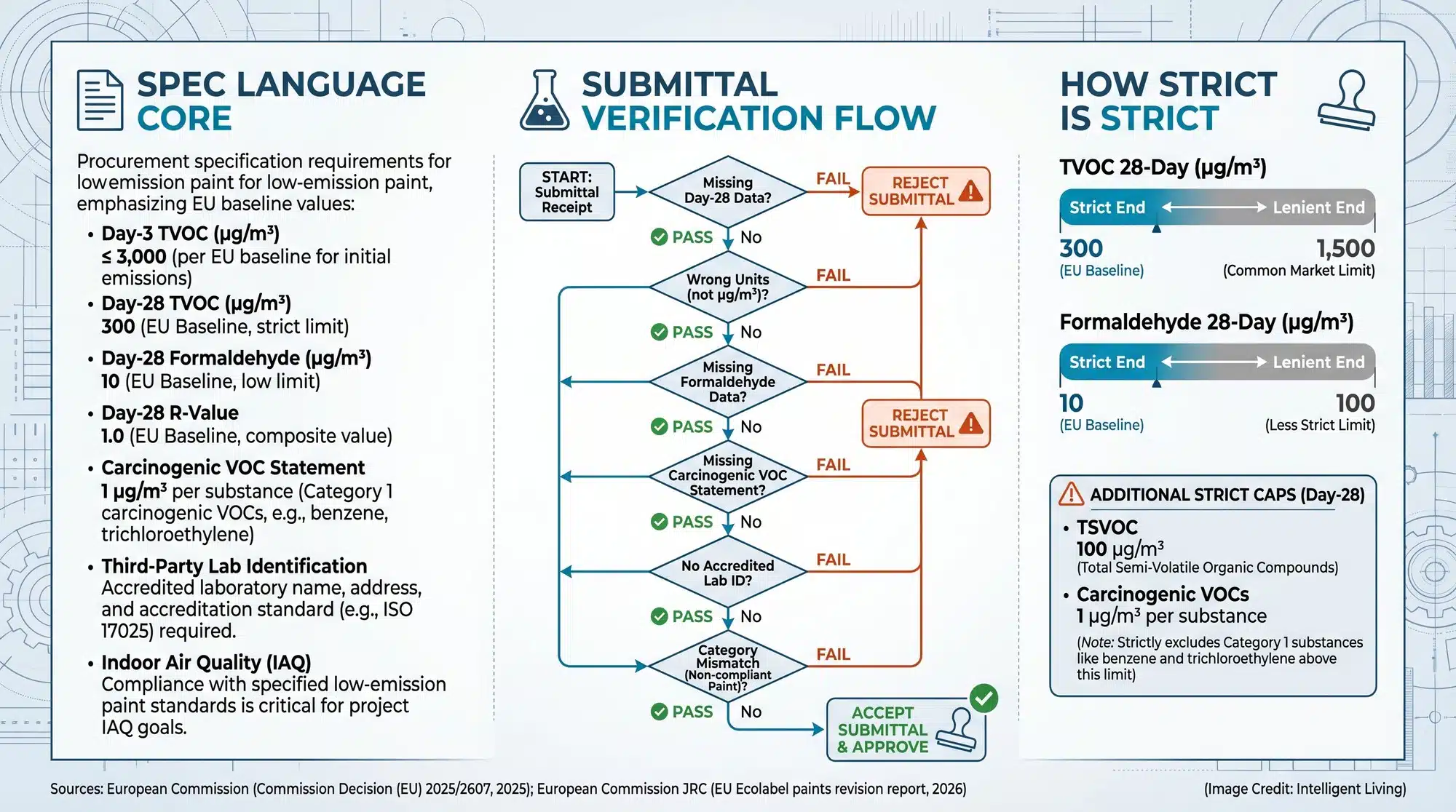
A Professional Spec for Low-Emission Paint Procurement
Teams that manage multiple properties or large projects will benefit from a short, enforceable spec that vendors can comply with and that auditors can verify. In workplaces where people spend long hours indoors, green workplace design often starts with low-emission finishes that protect employees.
Standard Contract Language for Low-Emission Paint Projects
- Interior paints must meet EU Ecolabel criteria or provide third-party test results that prove:
- Day 3 TVOC: Below 3,000 µg/m³.
- Day 28 TVOC: Below 300 µg/m³.
- R-Value: 1.0 or less.
- Vendors must also supply data on formaldehyde, restricted chemicals, and microplastic content.
Effective Verification Methods for Project Material Submittals
- Require certified laboratory reports and compare the reported values to the thresholds stated above. Confirm that the test method is the chamber method referenced in the decision and that the reporting units match those in the spec.
- Include a clause that disqualifies products where test reports cannot be validated through the issuing lab or third-party verification.
Alternative Safety Standards for Low-VOC Paint Outside the EU
For readers outside the EU, a widely used reference point in the United States is Green Seal GS-11, which sets emissions and safer chemistry requirements for architectural coatings. While the Green Seal GS-11 paint emissions standard differs from European rules, it offers a reliable safety framework for North American shoppers.

Transform Your Indoor Air Quality with Smarter Paint Choices
Refreshing your walls is a powerful chance to upgrade your environment when you treat ventilation and product safety as part of the primary plan. The EU Ecolabel criteria shift the focus from empty marketing promises to the measurable results that affect your daily health. By choosing products backed by emissions evidence and sticking to a solid airing-out routine, you bridge the gap between a beautiful room and wellness-focused living spaces that prioritise your long-term health.
Clean air depends on both the right chemistry and smart habits. You can reduce chemical exposure by picking durable finishes that don’t need frequent repainting. Small actions, like running a box fan or verifying an R-value, turn a simple renovation into a major upgrade for your family’s health.
Essential Facts for Safe Indoor Painting
What does the EU Ecolabel logo mean on a paint can?
The logo confirms the product passed strict tests for low emissions and safer chemistry. It ensures the paint doesn’t just look good but stays within the conservative health limits set by the European Commission, consistent with how the EU Ecolabel programme defines its lifecycle requirements.
Is low-VOC paint the same as low-emission paint?
Not exactly. Low VOC refers to what is inside the liquid, while “low emission” measures the actual chemicals that leak into your air. The EU focuses on emissions because that is what you actually breathe.
How long should I air out a room after painting?
Keep windows open and fans running for at least 72 hours. If you are painting a nursery or have sensitive family members, waiting a full week provides the safest margin for indoor air quality.
What are TVOCs, and why does day 28 matter?
TVOC stands for the total amount of chemicals in the air. Testing at day 28 is vital because it shows what remains after the initial smell is gone, helping you avoid long-term exposure.
Can I sleep in a room immediately after it is painted?
It is best to wait. Even with low-emission paints, sleeping in a freshly painted room is not recommended until you have sustained strong ventilation for at least three days to clear out residual gases.


