
R3 Bio’s public pitch for brain-free, whole-system biology landed like a live wire. These constructs, often termed headless bodies or bodies without heads, present a radical shift in how we approach biological modeling. The company’s claim that engineered non-sentient multi-organ systems could replace animal testing sits at the intersection of fast-moving policy, supply pressures in biomedical research, and a growing ladder of human-relevant lab models.
This shift toward human-relevant lab models prioritizes biological accuracy over traditional surrogate species. As supply pressures for nonhuman primates continue to climb, the search for predictable, brain-free alternatives has moved from a niche academic pursuit to a high-stakes industrial race. This convergence of bioengineering ambition suggests we are entering a new era of whole-system biology where bodies without heads serve as the ultimate testbeds for human drug response.
The core promise of R3 Bio rests on bridging the gap between isolated organoids and the full organism. By attempting to replicate metabolism and inflammation cascades without neural circuitry, the startup is testing the boundaries of what counts as a ‘test subject. ‘These headless organ sacks could redefine the preclinical safety roadmap, providing a more precise look at how new drugs interact with integrated human systems before they ever reach a clinical trial.

The Bodyoids Phenomenon: Key Industry Players and Rapid News Cycles
Quick Facts: Bodyoids, Organ Sacks, and Non-Animal Testing in Plain English
- Recent industry coverage highlights how R3 Bio’s organ sack concept is being optimized for immediate research use cases.
- Regulatory agencies are now defining how draft guidance for non-animal testing alternatives earns validation during the drug development lifecycle.
- Federal safety protocols now utilize a staged path for reducing animal testing while maintaining rigorous evidence standards.
- The fact that over 100,000 nonhuman primates are used annually in domestic research underscores the urgency of finding headless alternatives.
- Current data on national organ transplant scarcity reveals that thousands of patients remain on waiting lists while facing severe supply shortages.
- Bioethical experts are currently calling for enhanced oversight for stem cell embryo models to keep pace with rapid engineering milestones.
Biotech Market Trends: Analyzing the Stakeholders in Bodyoid Development
The news cycle centers on a stealthy startup describing a new class of biological platform. In the most widely cited coverage, R3 Bio is presented as pursuing whole-organ-system constructs built to exclude brain tissue, a design that proponents say avoids the ethical problems tied to sentient subjects. Independent experts weigh in with a vital caveat, noting that the scientific community still lacks the detailed, reproducible methods required for broad validation.
The widespread adoption of headless bodyoid terminology transitioned a niche biotech pitch into a global ethical debate.
Modern biotechnology often scales along two distinct tracks simultaneously. The first track is technical progress, measured in protocols and validation studies. The second is the public narrative, where a visceral headline can often outpace a year of peer-reviewed data.
Defining Bodyoids: The Engineering Behind Brain-Free Biological Systems
Comparing Biological Models: What Distinguishes Bodyoids from Organoids?
“Bodyoids” is shorthand for an engineered biological system designed to capture multi-organ interactions without forming brain tissue. Engineered biological systems often vary significantly in their structural complexity and intended use cases. You might notice several distinct models currently advancing in the lab:
- Isolated organoids: Small, simplified models that mimic the features of a single organ.
- Organ-on-chip platforms: Microfluidic devices where researchers control flows and mechanical forces.
- Bodyoids: Integrated systems that integrate multiple tissues without neural circuitry.
These distinctions help scientists choose the right scale for their specific research questions. Focusing on the right tool ensures that data remains both accurate and human-relevant.
Initial benchmarks from the earlier wave of lab-grown organoid testing reveal how miniature tissues capture cellular responses while still lacking full organism feedback.
The pitch, as described, aims for something more integrated: a coordinated system that can show organism-level responses such as metabolism, inflammation cascades, and cross-organ toxicity signals. The “no brain” claim matters because it is doing double duty. It is a technical design constraint, and it is also a moral boundary meant to reassure the public and ethics reviewers.
Technical Challenges: Mapping the Build Path for Multi-Organ Systems
A Plausible Build Path
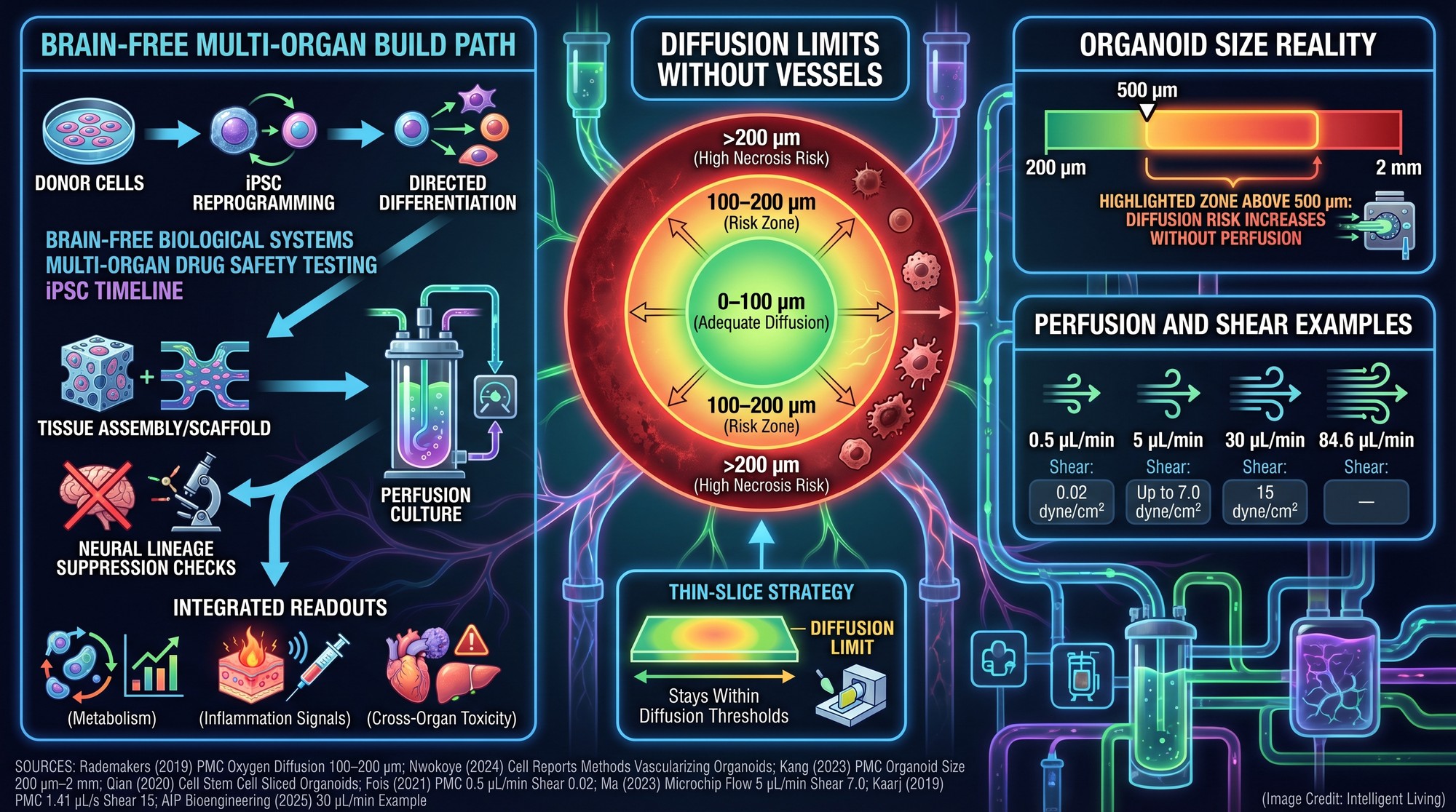
A plausible build path for these headless constructs relies on a sophisticated toolkit of bioengineering methods. Scientists often combine several layers of technology to reach these multi-organ goals:
- Induced pluripotent stem cells (iPSCs) for universal cell sourcing.
- Guided differentiation protocols to shape specific tissue types.
- Scaffolded growth to provide physical structure for organ sacks.
- Gene edits to suppress neural lineage and prevent consciousness.
Mapping the Non-Sentient Platform
Layering these advanced tools allows researchers to pursue a stable, non-sentient biological platform. This coordinated approach is what separates a true bodyoid from simpler, single-tissue models.
Biological labels must be clarified to separate industrial hype from laboratory reality. For example, the NIH’s human stem cell research guidelines detail how pluripotent stem cells are treated in federally funded research.
The Vascularization Problem
Engineering functional tissue poses challenges beyond simple growth; the primary obstacle involves ensuring the system behaves like a coordinated body.
Notice how vascularization remains a persistent engineering bottleneck. Without robust vessel-like networks, these multi-organ systems struggle to mature and remain stable during long-term perfusion. Research that uses continuously perfused models, including a 3D-printed proximal tubule system built to mimic renal reabsorption, shows why controlled flow and structure matter for human-relevant readouts.
Reproducibility and Validation
Maturation and reproducibility also bite. Two batches of stem cells can behave differently even when the recipe looks identical on paper. That is why cross-lab validation is so brutal and so important. When a group claims system-level biology, regulators will want proof that the response is stable enough to support real decisions.
In many drug development labs, a compound can look clean in a single-tissue screen and then turn problematic when metabolism is modeled more realistically, which is exactly the kind of gap integrated systems hope to close.

Why Non-Animal Testing is Accelerating and Where Bodyoids Fit
Regulatory Momentum: Navigating the FDA’s New Approach Methodologies Policy
NAMs, in Plain Language
U.S. regulators are now synchronizing their oversight to formalize how non-animal testing methods earn credibility. “New approach methodologies” is the umbrella term for lab and computational tools meant to predict human biology without defaulting to animal models. Recent shifts in the preclinical safety roadmap show that U.S. regulators are now formalizing how non-animal testing methods earn credibility.
How Evidence Packages are Built
Modern safety assessments increasingly rely on an IATA and NAMs framework that combines multiple human-relevant models.
The Scaling Problem Nobody Puts in the Headline
Such regulatory policy momentum also changes what feels fundable. When agencies provide a validation vocabulary, investors can map a startup’s claims to specific milestones instead of relying on intuition.
At the same time, the non-animal testing ecosystem is advancing in concrete ways. Engineered methods like animal-free synthetic brain tissue testing help researchers reduce biological noise and improve reproducibility in complex trials.
And when teams try to scale these methods across sites, the practical reality is boring but decisive: Maintaining high fidelity across different sites requires automated laboratory protocols that ensure consistency regardless of instrument or staff changes.
Strategic Applications: 7 Ways Headless Systems Could Reshape Drug Testing
- Drug Toxicity Screening (Near Term): Integrated models flag organ interactions that single-tissue assays miss. For example, they could detect a liver metabolism effect that triggers downstream cardiac risk.
- Reducing Primate Use (Near Term): Severe nonhuman primate supply constraints continue to drive the industry toward brain-free alternatives, especially for studies that historically relied on macaques.
- Disease Modeling (Midterm): Coordinated tissues could better represent chronic multi-organ disease processes than a single organoid can on its own.
- Validation Infrastructure (Mid-Term): If reproducible, bodyoid platforms could become standardized testbeds for comparing NAMs across labs and for documenting consistency.
- Biomanufacturing of Tissues (Mid to Long Term): The path to viable transplant components remains steep, though advancements in 3D bioprinting continue to expand the biological design space.
- Personalized Pharmacology (Midterm): Patient-derived cells could enable individualized toxicity profiles, improving trial stratification and reducing late-stage failures.
- Longevity and High-Risk Investment (Long Term): The idea naturally attracts investors who chase radical biological manufacturing as a path to extending healthy life span.
A clinician who has watched a trial stall because toxicity signals arrived late will recognize the practical stakes. If earlier models had caught the issue, months of recruitment and exposure could have looked very different.

Establishing Guardrails: Ethics, Validation, and Emerging Signals
Bioethical Frameworks: Defining Sentience in Engineered Biological Models
Calling a construct “non-sentient” narrows certain ethical questions, but it does not erase the need for oversight. Critical governance challenges now center on:
- How sentience is technically defined in integrated systems.
- Who verifies the absolute absence of neural processing.
- How donor consent and cell sourcing are managed at industrial scales.
Strategic regulatory oversight must ensure these multi-organ systems meet ethical standards as they move toward mass production.
The global policy landscape is shifting, as seen in new human-animal embryo experiments in Japan, showing how oversight adapts to technological breakthroughs.
Maintaining public trust requires transparent review structures that can evaluate model complexity and provide clear, evidence-based oversight.
Scientific Reality Check: Validating Predictive Data in Integrated Systems
Establishing regulatory readiness requires publicly accessible evidence that confirms reproducibility, predictive value, and safety across the intended context of use.
Engineers also face the daunting task of ensuring consistent, reproducible biological behavior across different laboratory environments. Breakthroughs in high-fidelity vascular structure, such as lab-grown human blood vessels from stem cells, highlight the level of iteration required before a model earns widespread trust.
A parallel lesson comes from functional organ work that had to survive real biological environments, including lab-grown human mini-livers in animals that focused on whether engineered tissue keeps doing its job after transplantation.
The most responsible way to read the “bodyoids” story is as a stress test for the entire NAM ecosystem. It forces the question that matters: what evidence will count and who decides?
Future Outlook: Key Milestones for the NAMs Policy Roadmap
- Follow the official NAMs guidance updates to see how final expectations translate into daily review practice.
- Recent federal efforts, including a major investment in human-based research, show exactly where validation work is being pushed at scale.
- Watch for peer-reviewed disclosures from R3 Bio or independent teams that detail how neural lineage suppression is confirmed during long-term perfusion.

The Future of NAMs: Navigating the Bodyoids Frontier and Organ Scarcity
The R3 Bio bodyoids story represents a critical flashpoint for the entire new approach methodologies (NAMs) ecosystem. These bodies without heads demonstrate how scientific ambition and regulatory change are converging to solve some of the most persistent bottlenecks in drug development. While brain-free integrated systems aren’t yet a settled breakthrough, their potential to transform preclinical safety testing and reduce the burden on animal models is becoming harder for the industry to ignore.
Scaling these platforms depends on the NAMs policy stack’s ability to deliver reproducible data. High-fidelity results, rather than provocative headlines, will determine if human safety remains the center of bioengineering innovation. This trajectory also forces a more honest conversation about long-term organ scarcity. As supply gains from 48,149 U.S. organ transplants show the life-saving impact of population-scale interventions, the push for manufactured headless alternatives feels increasingly urgent.
Bodyoids and Non-Animal Testing: Your Essential FAQ
Are R3 Bio-bodyoids currently used in drug trials?
Not yet. While the concept of integrated organ sacks is gaining momentum, R3 Bio has not yet released the peer-reviewed validation data required for regulatory acceptance in human drug trials.
How do bodyoids improve on traditional organoids?
Organoids typically model single tissues, whereas bodyoids aim for whole-system biology by integrating multiple organs to capture complex metabolism and cross-organ toxicity signals.
Does removing the brain eliminate all ethical oversight?
No. Robust oversight relies on how scientists define neural complexity boundaries and verify that donor consent and cell sourcing for these multi-organ systems meet global standards.
Can these constructs help solve the organ transplant shortage?
In principle, yes. Parallel developments in genetically engineered xenotransplantation show that multiple paths to solving the organ crisis are advancing simultaneously.
When will the FDA fully replace animal models with NAMs?
The shift is staged. Regulators are currently validating how non-animal testing earns credibility for specific use cases, meaning animal-free pathways will likely open gradually as performance data matures.


