
Sharks are famous for senses that seem almost supernatural. They can feel the faint electrical field of a hidden fish, smell a trace of blood carried on a current, and strike a target from out of nowhere. Yet one of their most fundamental senses, hearing, has been surprisingly hard to pin down.
A new study from Florida Atlantic University has now attached a hard number to it. In the clear, shallow waters off Southeast Florida, wild blacktip sharks reacted to low-frequency sounds from almost 250 feet away, then turned and swam in the opposite direction.
The findings, published in the journal Integrative Organismal Biology, offer the first hard evidence that free-swimming sharks can both hear a sound and turn away from it. This happens in the “acoustic far field,” the zone far enough from a source that sound behaves very differently from how it does up close.
A Rare Test of Shark Hearing in the Wild
Sound travels remarkably well underwater, and for a shark it can carry information about events far beyond its field of view. The commotion of a struggling fish, the splashing of a wounded animal, or the approach of a larger predator can all reach a shark as pressure waves and particle motion long before the source comes into sight.
Until now, however, scientists had little direct evidence of how far a freely swimming shark can actually hear or whether it can work out where a distant sound is coming from. Most of what was known came from laboratory tanks, which struggle to reproduce the open ocean. The new work stands out as the most rigorous field test of shark hearing yet carried out on free-swimming animals.
Why Blacktip Sharks Were the Ideal Subjects
Blacktip sharks (Carcharhinus limbatus) turned out to be perfectly suited to the experiment. Large numbers gather along the Palm Beach County coast each winter, and smaller groups stay in the area year-round. The water there is shallow and clear, which let researchers watch individual sharks from above without disturbing them.
“Their abundance and accessibility made it possible for us to observe them from above without disturbing their natural behavior, while also presenting controlled underwater sounds,” said Stephen Kajiura, Ph.D., senior author and a professor of biological sciences in FAU’s Charles E. Schmidt College of Science.
How the Experiment Worked
Rather than testing captive animals, the team studied wild sharks going about their normal business. After anchoring a boat, they lowered an underwater speaker into the water and let it drift with the current, as far as 19 meters from the vessel. That distance mattered: it kept the sound of the boat itself from contaminating the experiment.
To capture the sharks’ reactions, the researchers flew a drone 40 to 50 meters above the water, filming free-swimming sharks during both the test sounds and a control sound. Every frame was then analyzed to work out how far each shark was from the speaker, and how sharply it changed direction.
A set of calibrated hydrophones measured sound levels at different distances, so the team could calculate exactly what each shark heard at the moment it reacted.

What Sounds the Sharks Heard
The researchers played three bands of low-frequency sound: 100 to 200 hertz, 200 to 400 hertz, and 400 to 800 hertz. They also used a 10 kilohertz control, which sits beyond the known hearing range of sharks. Crucially, the sounds were played loudly enough to startle the animals rather than to lure them in, so any reaction would be a genuine response to an unexpected noise.
The Key Result: 243 Feet and a Sharp Turn
The sharks responded to all three low-frequency bands but showed no reaction at all to the 10-kilohertz control. They detected the sounds from as far as 74 meters, or about 243 feet, considerably farther than had ever been demonstrated in freely swimming sharks. Every one of the three sound ranges triggered reactions from at least 62 meters, or roughly 203 feet. Just as striking, the animals often spun away from the speaker in sudden turns ranging from 20 to 160 degrees.
That reaction suggests the sharks were doing more than simply registering that a sound existed. They could also tell which direction it was coming from. The main results, in short:
- Low-frequency sound was detected from up to 74 meters, or about 243 feet, away
- The sharks reacted to all three low-frequency bands but not to the 10 kilohertz control
- They turned away from the source at angles of 20 to 160 degrees
- About 72 percent of all recorded responses occurred in the acoustic far field
- They were most sensitive to the lowest frequencies, at the lowest sound levels
- Calibrated hydrophones and an aerial drone captured every response
One caveat is worth keeping in mind: these were sudden, intense sounds chosen to trigger an unmistakable startle response, not a test of the faintest sound a shark can detect.
Distance counts just as much as the reaction itself. Because the acoustic near field shrinks as frequency rises, the team could tell whether each response began in the far field, where sound pressure dominates over the movement of water particles. Most of the time, it did:
“What makes this finding particularly interesting is that the sharks were responding to sounds beyond the acoustic near field, where the sound behaves differently than it does close to the source,” Kajiura said. “This suggests that they are detecting the particle motion associated with sound even at considerable distances from the source, something we have not previously been able to demonstrate in free-swimming sharks.”
How Sharks Hear Without a Swim Bladder
The result is especially notable because sharks lack the gas-filled swim bladder found in many bony fish. In those species, the bladder can help transmit sound pressure to the ear. Sharks are thought to rely largely on their inner ears, including a specialized structure called the macula neglecta, which may help them sense the motion and vibrations created as sound moves through water.
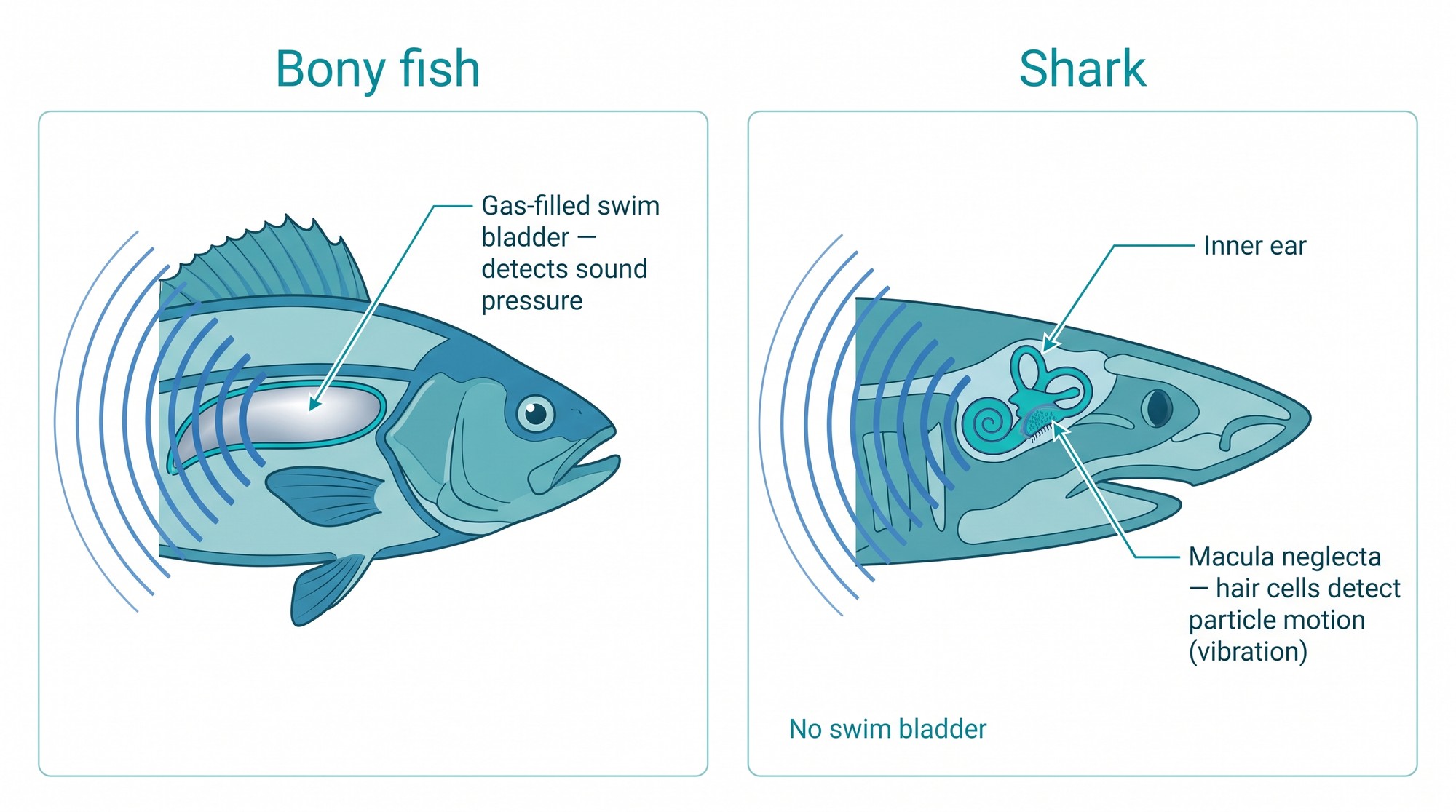
Detecting “particle motion” rather than pressure is exactly what the new results point to, and it is a reminder that the shark nervous system is tuned to a channel of information that is easy for humans to overlook.
Why the Open Ocean Beats a Laboratory Tank
The study also makes the case for doing this kind of work in the sea rather than in a tank. Inside an enclosure, sound bounces off the walls again and again, producing a tangle of overlapping signals that can make an animal’s response impossible to read cleanly.
“Trying to do hearing experiments in a tank results in the sound bouncing off the walls which causes complex and confusing signals, it is like being in a house of mirrors,” said Caroline Sullivan, lead author, who conducted the work as part of her master’s degree in biological sciences. “This is why it is so important to do these types of experiments in the ocean with wild sharks to get a natural response.” Study co-author is Edmund Gerstein, Ph.D., a research director at the Charles E. Schmidt College of Science.
What This Means for Sharks and Ocean Noise
Sound may give sharks a head start, warning them about prey, rivals, or hazards hundreds of feet away before anything comes into view. That same sensitivity cuts both ways. As shipping, construction, and other human activity fill the ocean with noise, the acoustic channel sharks rely on is becoming crowded. Sharks already contend with a gauntlet of human pressures, including ocean acidification that damages their skin.
There is growing evidence that this matters. Earlier research has shown that human-caused noise pollution is already harming marine creatures, while scientists are increasingly using drone-based shark surveillance to track these animals. Even sound itself has become a conservation tool, with researchers deploying underwater speakers to revive damaged coral reefs. If a shark can pick out a single meaningful sound from nearly 250 feet away, the question of how it copes with a noisier ocean becomes more urgent, not less.
A Hidden Acoustic World Beneath the Waves
For now, the study answers one long-standing question while opening several new ones. The team wants to understand precisely how the shark sensory system detects and processes these distant signals and how that ability shapes hunting, navigation, and social behavior.
“The ocean is an acoustic environment, and sharks are clearly tuned into it in ways we are only beginning to understand,” Kajiura said. “Being able to detect and respond to sounds from hundreds of feet away gives these predators an important source of information about their surroundings. The next question is how their sensory system allows them to pick up and interpret these distant sounds.”
The work was supported by the Colgan Foundation and the National Save the Sea Turtle Foundation. As research continues, one thing is already clear: to a shark, the sea is never silent, and the world it senses stretches far beyond what it can see.

