
A lithium-ion battery depends on an element that is scarce, geographically concentrated, and increasingly expensive to extract. Calcium, which makes up a large share of Earth’s crust and is best known for building bones and limestone, has looked like an obvious substitute for decades. The catch was always the same: calcium refuses to cycle reliably inside a battery. A research team in Hong Kong has now reported a design that keeps a calcium-ion cell running for 1,000 charge cycles, a milestone that pushes an overlooked chemistry closer to the mainstream.
The work, led by researchers at the Hong Kong University of Science and Technology (HKUST), replaces the liquid electrolyte that normally sabotages calcium with a porous solid framework. The result is not a battery you can buy yet. It is laboratory proof that one of the oldest obstacles in battery science can be engineered around.
This article explains what a calcium-ion battery is, how the new design works, how it compares with lithium-ion and sodium-ion, and where it might realistically be used first.
What Is a Calcium-Ion Battery?
A calcium-ion battery stores and releases energy by shuttling calcium ions (Ca2+) between two electrodes, much as a lithium-ion battery moves lithium ions. Calcium sits one row below lithium on the periodic table and behaves in some ways like a heavier cousin.
The most important difference is charge. Calcium is divalent, meaning each ion carries two positive charges instead of lithium’s one. In principle, that lets each ion move twice the electrical charge, which can translate into more energy stored per unit of volume.
Researchers first explored calcium batteries in the 1960s, when early versions served as high-temperature thermal batteries for military and space use. Those cells were bulky and degraded quickly, so the idea was largely set aside. Only in the past decade have scientists identified electrode and electrolyte materials that function near room temperature, which is why calcium is back on the table.
Several obstacles remain. Calcium ions are bulky and doubly charged, so they move slowly through a battery and can react with the electrolyte to form a crust on the anode that blocks further cycling. Until now, that passivation, plus the growth of needle-like dendrites at high current, kept calcium cells from lasting.
Calcium also has a quirk that cuts both ways, sometimes called the calcium paradox. Its ion is larger than those of other multivalent metals such as magnesium, which lowers its charge density. That lets calcium ions diffuse more easily through a battery, but it also makes them harder to hold reversibly inside an electrode. As a bonus, calcium metal melts at around 842 °C, far above lithium’s roughly 181 °C, which researchers regard as an inherent safety advantage.
Calcium-ion cells are one branch of a wider field. Researchers have also demonstrated rechargeable calcium-sulfur, calcium-oxygen, and calcium-chlorine batteries, each with distinct trade-offs. The HKUST work focuses on the standard calcium-ion design that most closely mirrors a lithium-ion cell.
The Breakthrough: A Porous Framework That Finally Tamed Calcium
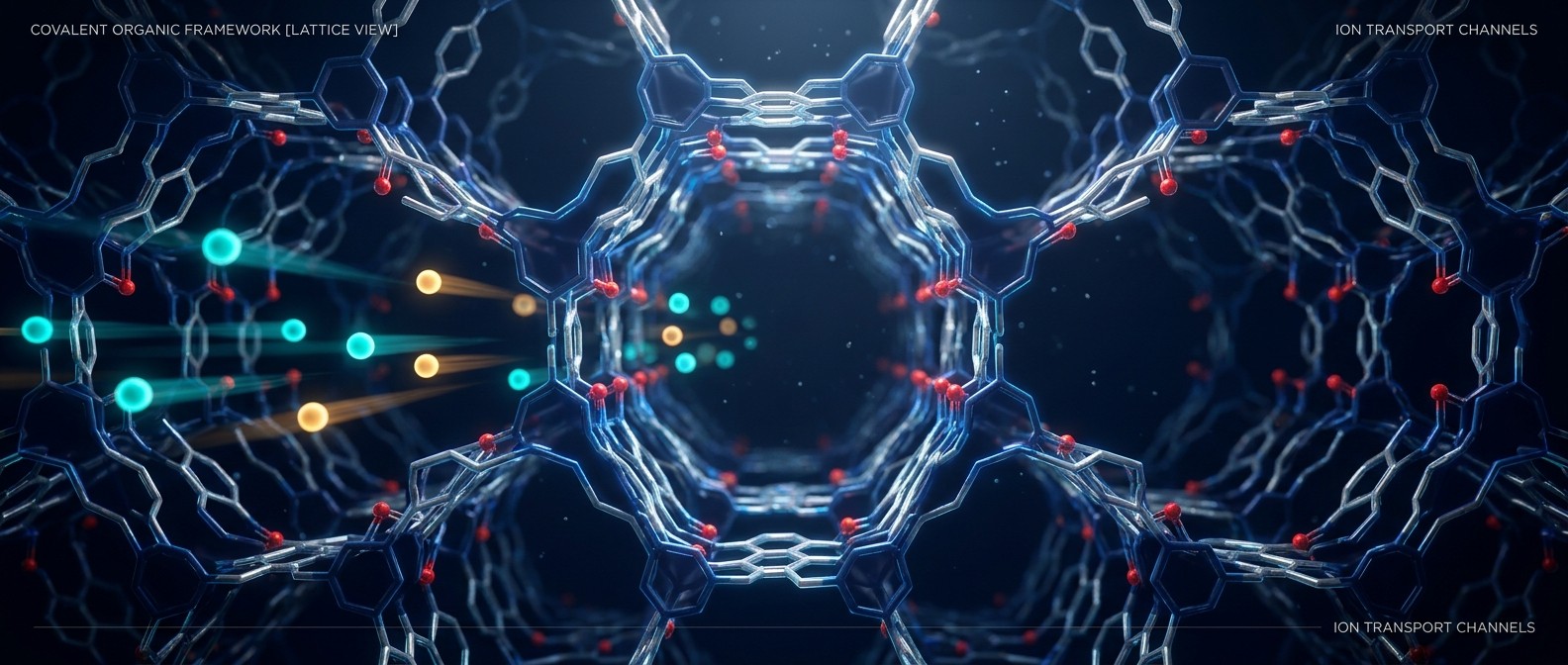
The new study, published in the journal Advanced Science, targets that exact weak point. The team, led by Professor Yoonseob Kim in HKUST’s Department of Chemical and Biological Engineering, replaced the usual liquid electrolyte with a quasi-solid-state electrolyte built from covalent organic frameworks (COFs), according to the university’s announcement of the findings.
COFs are crystalline, sponge-like materials riddled with tiny, ordered pores. By lining those pores with dense carbonyl groups, the researchers created aligned internal lanes that calcium ions can hop along. The design produced an ionic conductivity of 0.46 mS per centimeter at room temperature, rising to 5.05 mS per centimeter at 80 °C, and a calcium-ion transference number of 0.532, both strong results for this chemistry.
In a full test cell, the improvement was dramatic. The battery delivered a reversible specific capacity of 155.9 mAh per gram and held on to more than 74.6 percent of that capacity after 1,000 charge and discharge cycles at a high current. Earlier calcium cells with liquid electrolytes typically collapsed within about 50 cycles.
The framework did more than speed up ion transport. It also suppressed the anode reactions that had been destroying earlier cells, and it allowed a thin, stable calcium carbonate layer to form on the anode surface, where it acted as a protective shield. The research was carried out with collaborators at Shanghai Jiao Tong University.
Calcium-Ion vs. Lithium-Ion vs. Sodium-Ion
Calcium is not the only challenger to lithium. Sodium-ion batteries are already moving from laboratories into factories, and Intelligent Living has covered how sodium-ion technology works and where it fits. Here is how the three chemistries compare in broad strokes.
| Lithium-ion | Sodium-ion | Calcium-ion | |
|---|---|---|---|
| Charge carrier | Li+ (monovalent) | Na+ (monovalent) | Ca2+ (divalent) |
| Crustal abundance | Very low (about 20 ppm) | High (about 23,600 ppm) | Very high (about 41,500 ppm) |
| Gravimetric energy density | Highest | Lower than lithium | Lower than lithium |
| Cycle life demonstrated | 1,000 to 3,000+ cycles | 1,000+ cycles | 1,000 cycles (new lab cell) |
| Raw material cost | High and supply-constrained | Low | Low |
| Commercial status | Mature | Early commercial | Laboratory stage |
Calcium’s headline advantage is abundance. It is the fifth most abundant element in Earth’s crust and roughly 2,000 to 2,500 times more plentiful there than lithium, estimates cited in coverage of the HKUST work suggest. It is also cheaper and less geographically concentrated.
Its headline weakness is weight. Calcium atoms are roughly six times heavier than lithium atoms, so a calcium-ion battery tends to store less energy per kilogram even though it can pack more energy into a given volume. A calcium metal anode has a theoretical volumetric capacity near 2,073 mAh per milliliter, a touch above lithium metal’s, but its gravimetric capacity of about 1,337 mAh per gram sits well below lithium’s 3,861 mAh per gram. That makes calcium a better fit for stationary storage, where size and cost matter more than weight, than for aircraft or long-range cars.
Are Calcium Batteries Any Good? The Promise and the Problems
It depends on the application. Calcium offers genuine advantages, but it is not yet a drop-in replacement for lithium.
Advantages:
- Abundance and cost: calcium is cheap and widely available, which eases supply-chain pressure.
- Volumetric energy: because calcium is divalent, it can store more charge per unit of volume than lithium.
- Safety potential: a solid or quasi-solid electrolyte is far less flammable than the liquid electrolytes in today’s lithium-ion cells.
- No cobalt or nickel requirement, avoiding some of the ethical and price problems tied to those metals.
Disadvantages:
- Lower gravimetric energy density than lithium, so it is heavier for the same amount of stored energy.
- Immature electrolytes and cathodes, which remain the central research bottleneck.
- Calcium metal anodes can still form dendrites at high current.
- No commercial products exist; everything so far is laboratory scale.
The HKUST result is best understood as removing one major roadblock, not crossing the finish line. The team solved the electrolyte problem well enough to demonstrate 1,000 cycles, but a finished battery also needs a matching cathode and a manufacturable design.
What Are Calcium Batteries Used For?
Today, the honest answer is research. There is no calcium-ion battery on the market, and the technology has not been commercialized.
When it does arrive, the most likely first home is grid-scale energy storage, where batteries sit in fixed installations and weight matters far less than cost, safety, and cycle life. Utilities are already building enormous stationary battery farms, and America’s first grid-scale sodium-ion plant in Sacramento shows how quickly an alternative chemistry can move from pilot project to construction.
Longer term, calcium-ion batteries could compete for electric vehicles, where the promise of cheaper, safer cells is attractive. Replacing lithium entirely, however, is a much harder ask given the weight penalty.
One common source of confusion: “calcium batteries” also refers to a type of lead-acid car battery that uses calcium alloys in its grid plates. That is an entirely different technology from the rechargeable calcium-ion batteries discussed here.
How Close Are Calcium-Ion Batteries to Store Shelves?
Not close, in the way that matters to a buyer. The HKUST cell is a laboratory demonstration, and the team is explicit that scale-up, cost validation, and a shift toward a fully solid-state design still lie ahead.
The trajectory mirrors other post-lithium chemistries. Sodium-ion batteries took roughly a decade to move from promising paper results to early commercial plants. Calcium-ion research sits earlier on that curve, but the new electrolyte gives it a stable foundation that earlier attempts lacked. Related progress in solid-state battery designs shows that the same push toward safer, denser cells is reshaping the whole field.

Expect the first calcium-ion products, when they appear, to be stationary storage units rather than phones or cars. That is where a heavier, cheaper, safer cell makes the most sense.
Frequently Asked Questions
What are the disadvantages of a calcium battery?
Calcium batteries store less energy per kilogram than lithium-ion batteries, because calcium atoms are heavier. They also depend on electrolytes and cathodes that are still being developed, and calcium metal anodes can grow dendrites at high current. No calcium-ion battery has been commercialized yet.
Are calcium batteries rechargeable?
The calcium-ion batteries described here are designed to be rechargeable, and the HKUST cell cycled 1,000 times. Note that the “calcium” car batteries sold today are lead-acid batteries, which are also rechargeable but use a completely different chemistry.
Is a calcium-ion battery better than a lithium-ion battery?
Not yet. Calcium-ion batteries promise lower cost, greater material abundance, and better safety, but they currently trail lithium-ion on energy density and have not been manufactured at scale. For stationary storage, those trade-offs could favor calcium; for lightweight devices and vehicles, lithium still leads.
What is the holy grail of battery technology?
Researchers often describe a battery that is simultaneously cheap, safe, fast-charging, long-lasting, and energy-dense as the field’s holy grail. No single chemistry has achieved all of those at once. Solid-state lithium, sodium-ion, and multivalent chemistries such as calcium and magnesium are all attempts to get closer.
The Bottom Line
Calcium has hovered at the edge of battery research for 60 years, held back by an electrolyte problem that made stable cycling nearly impossible. The HKUST team’s covalent organic framework appears to have cracked that problem, delivering 1,000 cycles from a material that is thousands of times more abundant than lithium.
The result will not replace the battery in your phone anytime soon. But it moves a genuinely promising, lithium-free chemistry from theoretically interesting to worth building on, and that is how every major battery shift has started.

