
Tesla’s driverless two-seater made its first public appearance in Japan on 11 September 2026, unveiled in Tokyo’s Aoyama district at the start of a four-stop national tour. By the time the Cybercab Japan Tour wrapped up in Shinjuku on 28 September, the car had been shown at four venues across three cities. At every stop it was a static display: no rides, no test drives, and no way to buy one.
The Cybercab has no steering wheel, no pedals, and no wing mirrors. It was designed from scratch as an unmanned taxi rather than as a car a human might occasionally drive. That single design decision is why the vehicle’s Japanese future depends less on Tesla’s engineering than on a regulatory framework Japan spent years building and on a rival consortium already testing against it.
What Tesla actually showed in Japan
Tesla Japan announced the tour on 5 September and displayed the Cybercab at four venues across the country:
- Tokyo, Aoyama (OMAKASE Aoyama Garden by GMO): 11 to 14 September
- Osaka (Tesla Grand Front Osaka): 17 to 20 September
- Nagoya (Tesla Nagoya Noritake): 22 to 23 September
- Tokyo, Shinjuku (Tesla Shinjuku): 26 to 28 September
The event also put Tesla’s existing Model 3 and Model Y on display, but the Cybercab was the draw. The Japan stops were one leg of a wider Asia-Pacific showcase: Tesla’s own event page schedules seven Australian cities and 14 locations between September and December 2026, and the car’s Chinese debut followed in Beijing and Shanghai from 17 September. The pattern repeats in every market, because the vehicle cannot legally drive on public roads in any of them yet.
It is a two-seat vehicle with upward-opening butterfly doors, a large central touchscreen, and a cargo area where a rear bench would normally sit. Eight cameras handle the perception job a human driver’s eyes would otherwise do.
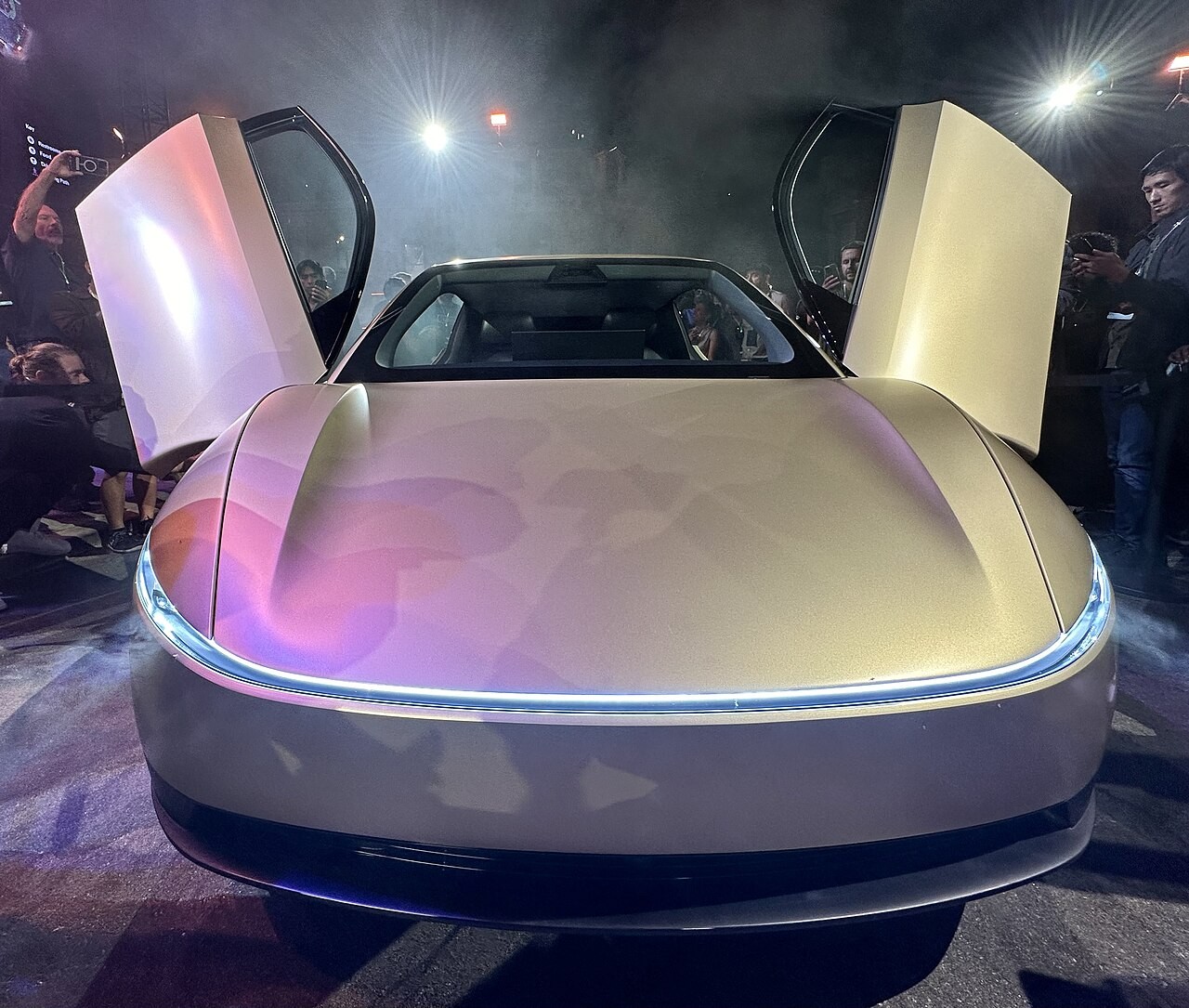
Richi Hashimoto, who heads Tesla in Japan, told reporters the company would like to launch a self-driving taxi business in Japan “if the opportunity arises.” He said any launch would depend on Japanese law and the safety of Tesla’s vehicles being reconciled and framed the approach as gradual, beginning with Full Self-Driving in cars Tesla already sells.
Tesla Cybercab specs at a glance
| Specification | Cybercab |
|---|---|
| Seats | 2 |
| Steering wheel, pedals, mirrors | None |
| Doors | Butterfly, opening upward |
| Perception | Eight cameras, no lidar |
| Ground clearance | 5.8 inches |
| Step-in height | 16.5 inches |
| Rear trunk | 20.2 cubic feet |
| Status in the United States | Mass production under way; rides available in limited areas of Austin, Texas |
Tesla publishes those dimensions on its own Cybercab support page, which also confirms the vehicle has no steering wheel because it is fully autonomous.
How much is the Tesla Cybercab?
Tesla has never published a retail price for the Cybercab. At the 2024 unveiling, Elon Musk said the vehicle would be priced under $30,000 and that running it would eventually cost about 20 cents a mile, but no figure has been confirmed since and no consumer ordering has opened. The company’s own support page describes Cybercab rides as available in limited areas of Austin rather than offering a vehicle for purchase. The vehicle was first shown in 2024, and mass production only began this year.
Can you purchase a Tesla Cybercab?
No. Tesla has not opened consumer orders, and its Japanese arm confirmed there are currently no plans to sell the vehicle in Japan. The fleet and business interest forms that circulate online are aimed at commercial inquiries, not private buyers.
Has Tesla released the Cybercab?
It is in production. Tesla started dispatching Cybercab rides in parts of Austin on 3 September 2026, days before the Japan tour began. Its wider Robotaxi service, which also uses Model Y vehicles, operates in Austin, Dallas, Houston, Tampa, and Miami.
Is the Tesla Cybercab street legal?
In Japan it cannot be operated on public roads at all yet. A vehicle with no manual controls cannot satisfy the ordinary safety standards that apply to a roadgoing car, so it needs a specific exemption and a specific operating permit before it can carry a paying passenger.
The American route has been the opposite, and the contrast is instructive. Rather than clearing vehicles before launch, the United States lets manufacturers certify their own compliance with federal safety standards and scrutinizes them afterwards. Texas then adds a state layer: Senate Bill 2807, enforceable from 28 May 2026, requires a company to hold an authorization for commercial automated driving, but the state does not approve individual vehicle models. Tesla simply added Cybercabs to its authorized fleet, without a model-level review.
That approach is now being tested. On 4 September 2026, the day after Cybercab rides began in Austin, the National Highway Traffic Safety Administration opened an audit query into how Tesla concluded the vehicle complies, noting that US standards require a steering wheel, brakes, and rearview mirrors. The agency has ordered Tesla to answer a list of questions by 30 September. Japan’s rules, by contrast, are designed to settle those questions before a passenger ever gets in.
Japan’s Level 4 rulebook: the two gates
Japan is not starting from zero. It amended both its Road Traffic Act and its road-vehicle law in 2019 to create a regime for Level 3 cars, the stage at which a vehicle can drive itself within limits while a human remains available to intervene. Honda used that framework in November 2020 to win the world’s first type designation for a Level 3 car, a milestone Intelligent Living covered at the time.
Level 4 is a different category. Here the automated system, not a person, is responsible for the driving task within set conditions. Japan legislated for it in April 2022, and according to the National Police Agency, the provisions took effect in April 2023, creating a permission system for what the law calls specified automated operation. For a driverless taxi to launch, two approvals stand between Tesla and paying riders.
Gate 1: vehicle certification
The vehicle itself must be certified for public roads by the Ministry of Land, Infrastructure, Transport and Tourism. Because a Cybercab has no steering wheel or pedals, it cannot be approved as an ordinary model. It would need an exemption from the safety standards or a type designation built around its automated driving equipment, along with the operating conditions under which its system is allowed to function, covering factors such as location, weather, and speed.
Gate 2: a permit for specified automated operation
The operator then needs a permit from the public safety commission in the prefecture where the service runs. This is where the rules bite hardest for a service business. An operator must set out a specific automated operation plan covering the vehicles used, the nature of the service, the location where the operation is supervised, and how the legal requirements are met.
Vehicles must also carry an operating status recording device, and those records must be retained for a set period, currently six months. Large software updates delivered over the air require approval under the Road Transport Vehicle Act, a detail that matters for a company that treats its vehicles as continuously updated computers. The operator must also either station a supervisor inside the vehicle or staff a remote monitoring post, and a permit can be suspended or revoked if the rules are broken.

A rival is already further down the road
Tesla is not the only company eyeing Tokyo’s streets, and it is not the furthest along. On 15 September 2026, Waymo, the taxi app operator GO, and the taxi company Nihon Kotsu announced a partnership to commercialize fully driverless Level 4 taxis in Tokyo, targeting a launch during 2027 with a fleet of roughly 100 vehicles. Waymo is no newcomer to commercial autonomous rides: it launched Waymo One, America’s first commercial autonomous ride-hailing service, back in 2018.
The three companies have been testing on public roads in seven central wards since 2025, including Minato, Shinjuku, Shibuya, Chiyoda, Chuo, Shinagawa, and Koto. The planned service would be hailable through both the GO app and the Waymo app.
GO would handle service design and coordination with local operators, Waymo would provide the autonomous driving system and fleet management, and Nihon Kotsu would run day-to-day operations. The partners have said the launch depends on validating safety and obtaining the licenses and approvals required under Japan’s Road Traffic Act and Road Transportation Act, the same gates Tesla would face.
Why Tesla’s approach differs from Waymo’s
Tesla and Waymo are chasing the same destination by different routes, and the difference has practical consequences for how quickly each can clear Japan’s approval process.
Tesla’s Cybercab leans on cameras alone. Eight camera modules feed a vision system that the company trains on data gathered from its own customer fleet, and the vehicle is engineered to be built cheaply and at volume. Under this model, Tesla owns the vehicle, the driving software, and the ride service itself.
Waymo’s vehicles pair cameras with lidar and radar, and they operate against detailed maps of the areas they serve. That approach has supported commercial service in the United States since 2018, and it is the one now being adapted to Tokyo’s streets alongside a licensed taxi operator rather than inside a single vertically integrated company.
For regulators, the distinction is procedural rather than philosophical. Japan’s Level 4 framework is built around a defined operational design domain, recorded operating status, and approved software updates, all of which favor a system whose behavior and permitted conditions can be documented in advance. A fleet-learning model, in which driving software changes frequently, has to fit inside that same paperwork.

What happens next
The practical near term for Japan is Tesla’s driver assistance software, not driverless taxis. The company has said it intends to prioritise bringing Full Self-Driving to its existing vehicles in Japan during 2026, a step that requires no new vehicle category and no operator permit. A Cybercab service is a later, harder project that depends on certification, a prefectural permit, and a business model that can survive Japanese taxi regulation.
That leaves the Cybercab’s Japanese debut as something closer to a demonstration of intent than a product launch. Tesla has shown the country what its driverless taxi looks like and confirmed it would like to operate one here. Whether it does may depend more on how quickly a rival with an established taxi partner gets there first.


