
What if the insulation that keeps future astronauts alive through a freezing lunar night comes from two things they already have: moon dust under their boots and cardboard boxes left over from supplies? Chemists at Purdue University have turned that idea into a real material, an ultralight aerogel made from lunar soil simulant and recycled cellulose, with lab-measured insulation as low as 30 milliwatts per meter-kelvin.
The work, led by professor Alexander Wei and graduate researcher Jacob Staker and published in ACS Sustainable Chemistry and Engineering (volume 14, issue 38, pages 17277 to 17287, September 2026), is a practical test of living off the land on the Moon. The eight-author team spans Purdue, NASA’s Glenn Research Center, the University of Akron, and the Universities Space Research Association (USRA). Their moon dust aerogel shows a crew could grind local regolith with paper waste into a slurry, then freeze-dry it into panels that protect habitats from temperature swings of more than 500 degrees Fahrenheit.
Why lunar homes face brutal temperature swings
Insulation is not a comfort item on the Moon; it is life support. Daytime highs near 260 degrees Fahrenheit plunge to minus 280 degrees Fahrenheit at night, a swing of roughly 540 degrees. Without an atmosphere to soften those extremes, habitats radiate heat away quickly once the Sun sets.
That is why steady heat and power are being planned together. Concepts for continuous fission power through the 14-day lunar night solve the energy side, but walls still need to hold that heat inside. An aerogel layer does that job by trapping mostly empty space, so there is very little solid material for heat to travel through.
What Purdue actually made
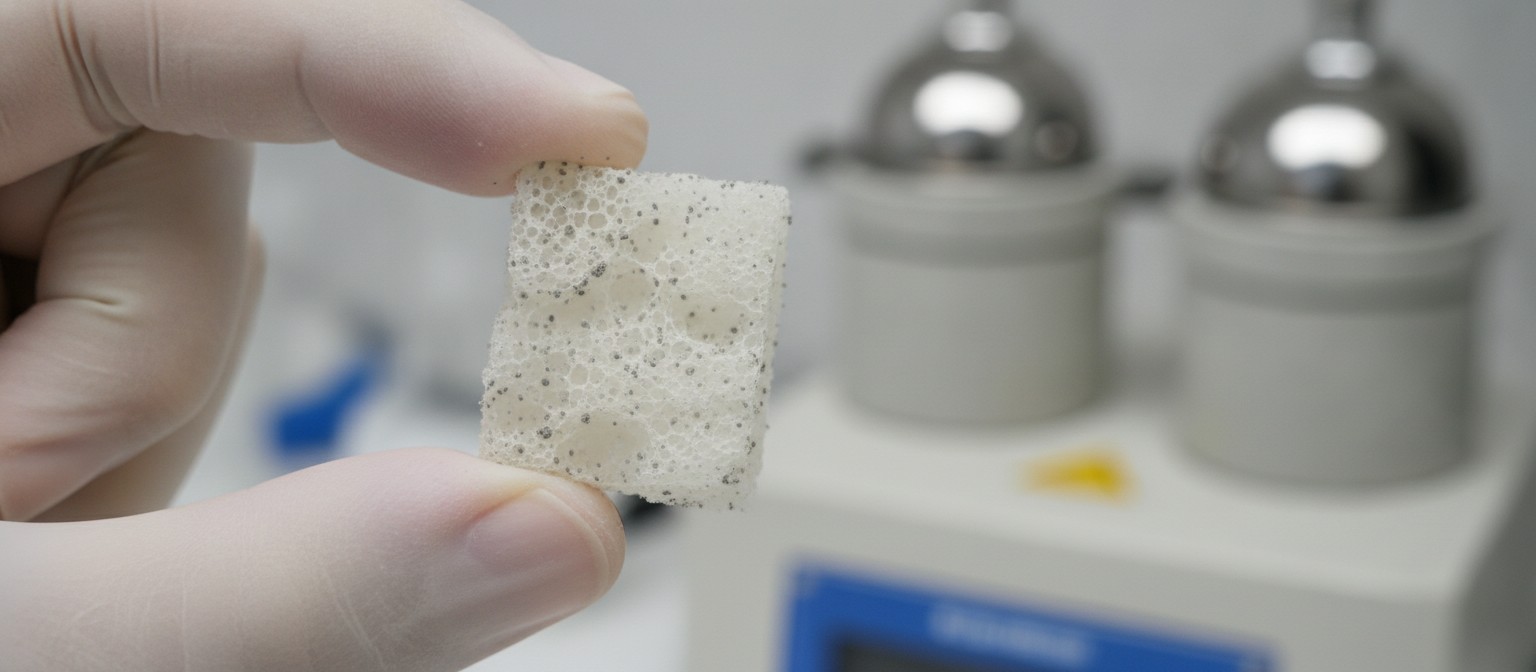
Wei and Staker mixed two unlikely ingredients: nanofibrillated cellulose, ultrafine fibers made from shredded paper or cardboard, and LHS-1, a commercial lunar highland simulant that mimics the chemistry and mineralogy of moon dust. The regolith used in the study is rich in orthosilicates and aluminosilicates, minerals common in the lunar crust.
The team prepared a range of formulations to find the balance between insulation and strength. Their peer-reviewed abstract reports composite aerogels with thermal conductivities as low as 30 mW/m·K, with the full sample set falling between about 30 and 45 mW/m·K. For context, still air is about 26 mW/m·K, so the best samples insulate almost like trapped air while holding a solid shape.
“Sustaining a long-term presence on the moon will require us to rethink how we use local resources,” said Wei, a professor in the James Tarpo Jr. and Margaret Tarpo Department of Chemistry. “Rather than relying on Earth to supply everything we need, we’re exploring how materials already available on the moon, including waste generated by its inhabitants, could be upcycled into something essential for safe and livable habitats.”
How mineral-assisted ball milling shreds fibers
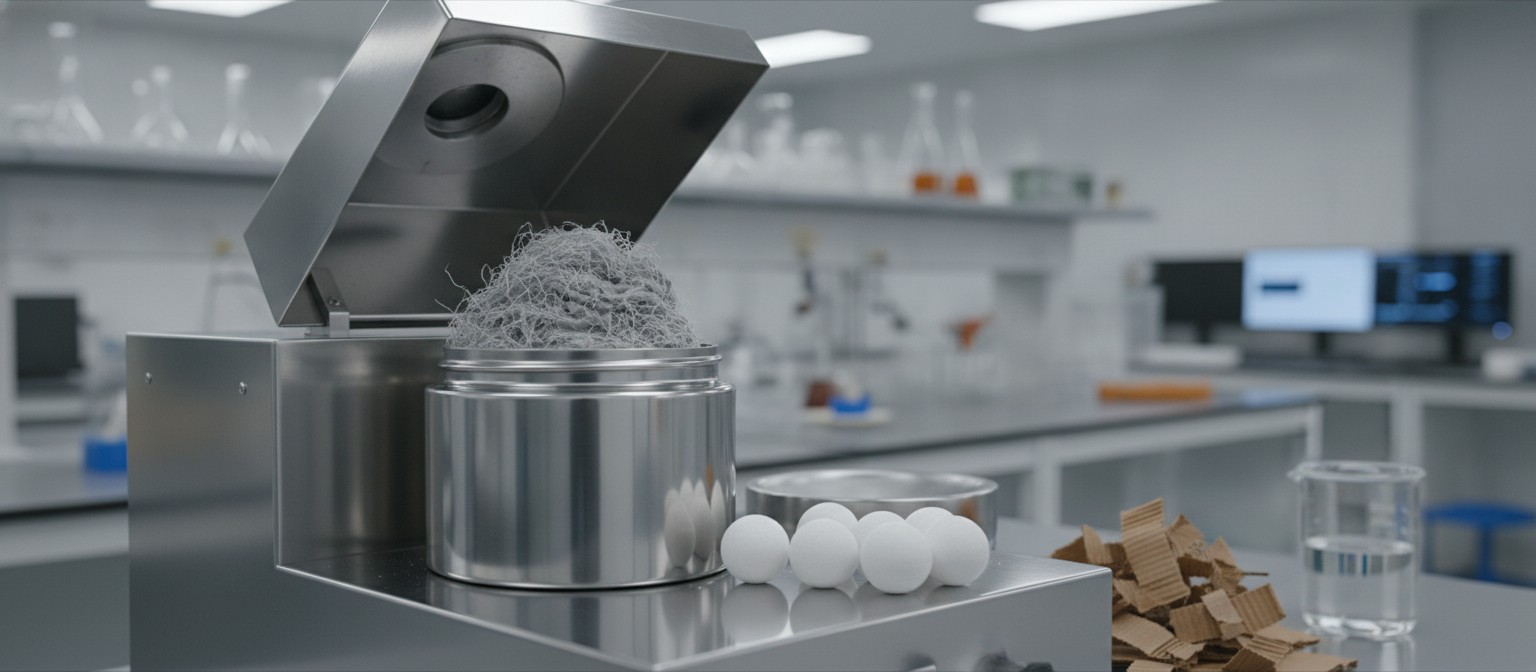
The clever step is the grinding. Regolith, cellulose fibers from shredded paper, and water go into a planetary ball mill with heavy ceramic balls. The hard mineral grains help tear the cellulose apart into threads less than 1 micron wide, a process the team calls mineral-assisted milling.
Those ultrafine strands, known as nanofibrillated cellulose, act as the binder that holds dusty regolith particles in a connected network. More surface area means better mechanical integrity, so the finished aerogel can be handled without crumbling while still staying mostly empty space.
“The mineral-assisted milling process is attractive because the equipment is relatively simple with low energy requirements, making it compatible with the resource constraints faced on the moon,” Wei said.
How well does it insulate?
Lower cellulose content generally gave better insulation and lower density. Higher cellulose content gave better strength. More regolith is also desirable simply because it is abundant on site. The sweet spot, predicted by design-of-experiments optimization, was around 4.3 percent cellulose in water with 25 percent LHS-1 in the aerogel, according to the NASA technical summary of the peer-reviewed paper in ACS Sustainable Chemistry and Engineering.
| Formulation direction | What improves | What gets worse |
|---|---|---|
| Less cellulose, more regolith | Lower density, thermal conductivity near 30 mW/m·K | Weaker, more fragile panels |
| More cellulose, less regolith | Stronger, easier to handle | Higher density, thermal conductivity toward 45 mW/m·K |
| DOE optimum near 4.3% cellulose, 25% LHS-1 | Best tested balance of insulation and strength | Still lab scale, needs freeze-dry validation |
“We want the aerogel to be lightweight, sturdy and have low thermal conductivity,” Staker said. “By systematically changing the formulation, we can optimize the material ratio to support the best combination of those properties.”
There is also a likely vacuum bonus the lab numbers do not fully capture. On Earth the pores hold air; on the Moon they would hold vacuum, so effective conductivity should fall further once tested in flight-like conditions.
Why freeze-drying beats supercritical drying on the Moon
The published samples were finished with supercritical drying at NASA’s Glenn Research Center, working with researchers Haiquan Guo and Jamesa Stokes. That method makes high-quality aerogels without shrinking, but it needs high pressure equipment and carbon dioxide, neither of which is readily available on the Moon.
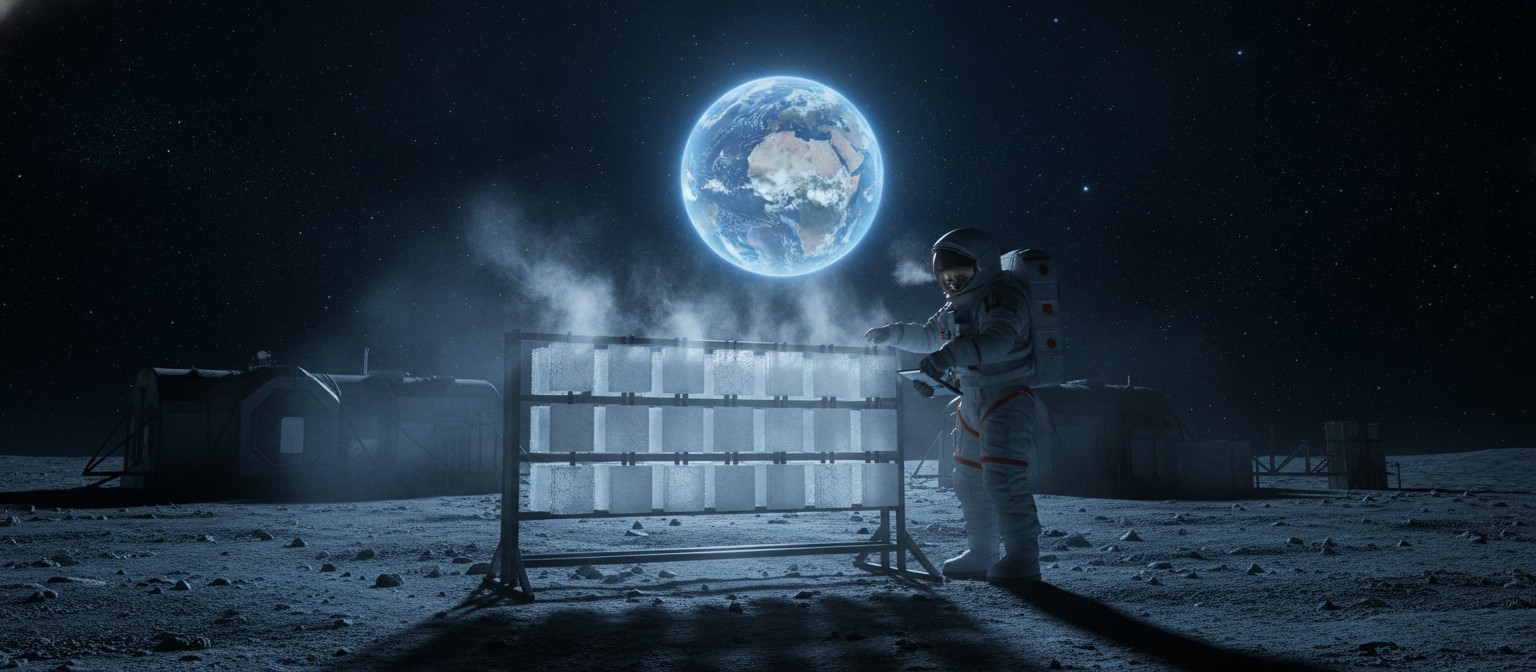
Wei and Staker are therefore studying lyophilization, or freeze-drying, for future lunar production. The slurry is frozen, then placed in vacuum so ice turns directly to vapor through sublimation, leaving a dry porous block. The Moon offers natural vacuum and subfreezing night temperatures, and the released water can be captured and reused.
- Grind on site: Mill regolith with shredded packaging and a little water using simple ball-mill hardware.
- Freeze the slurry: Shape panels or blocks, then freeze them during the cold lunar night.
- Dry in vacuum: Let ice sublimate directly to vapor in ambient lunar vacuum, with no carbon dioxide needed.
- Recover the water: Capture the vapor and condense it for the next batch, closing the loop.
- Wrap the habitat: Fit lightweight panels outside pressure shells to blunt day-night swings.
- Reuse the trash stream: Keep feeding cardboard and future crop waste back into new panels.
“Freeze-drying is ultimately more practical and sustainable for production on the moon because the equipment is much simpler,” Wei said. “The lunar surface provides a natural vacuum and subfreezing temperatures at night, and the water removed during sublimation can be recovered and reused for a circular manufacturing process.”
The idea fits a wider shift toward making supplies on site. Other teams have shown how to extract oxygen and metals from moon rocks and how reactive lunar soils could one day feed oxygen farms, so insulation from dust and trash extends the same in situ resource logic to the habitat shell itself.
Limits: simulant is not real moon dust
This is lab work with simulant, not samples returned by Apollo or Artemis. LHS-1 reproduces highland chemistry and particle character well enough for materials testing, but real regolith varies by site, contains sharp agglutinates and implanted solar-wind gases, and has never seen water or air. Strength, dust release, and long-term stability will need retesting with flight-relevant material.
The paper also describes optimization by statistical design rather than a single perfect recipe. The authors state the goal plainly: “Rather than trying to make the world’s best aerogel,” Wei said, “we’re looking for the sweet spot where we can get the properties we need with the limited resources we have available.” Funding came from the Indiana Space Grant Consortium and the National Science Foundation, according to Purdue’s research announcement.
Frequently Asked Questions
What is aerogel insulation?
An aerogel is a solid foam so porous it can be up to 99 percent empty space. Heat struggles to cross because there is little solid to conduct it and the pores trap gas or, in space, vacuum. It is used today in spacecraft, buildings, and electric vehicles.
Is aerogel really 99% air?
Close. High-quality aerogels can be more than 90 percent porous, with some approaching 99 percent. The pores hold air in Earth labs and vacuum on the Moon.
How much does aerogel cost for a lunar base?
Terrestrial aerogel is expensive to dry and ship, which is exactly why the Purdue approach matters. The raw inputs on the Moon, regolith and packaging waste, are effectively free once crews arrive, while simple ball milling and freeze-drying could avoid costly supercritical equipment.
Where would lunar cellulose come from?
From trash. Wei notes that a settled base would naturally accumulate cellulose-rich waste from paper or cardboard packaging, and eventually from lunar agriculture. Grinding that waste with regolith turns a disposal problem into building material.
Will this aerogel work better in lunar vacuum?
Likely. The 30 to 45 mW/m·K lab range was measured in air, so removing gas conduction in vacuum should lower the effective value further. Determining the exact drop requires flight-like vacuum testing.
The road to a lived-in Moon
Turning dust and trash into a thermos for a habitat will not by itself build a moon base, but it removes one more reason to launch mass from Earth. If freeze-dried panels hold up in vacuum, handle launch vibration, and survive abrasive dust, they could line habitats, cover propellant tanks, or shield equipment through the long lunar night. The next steps are scale-up, vacuum thermal tests, and proving the water loop truly closes.

