
What if you could get real whey protein without a cow, without lactose, and with a far smaller climate footprint? That is the promise of fermentation dairy protein. Using precision fermentation, food companies are brewing beta-lactoglobulin, the main protein in whey, in fermentation tanks instead of milking herds. The result is animal-free whey protein that behaves like dairy in shakes, ice cream, and cheese, while leaving lactose behind.
For lactose-sensitive eaters and climate-conscious shoppers, that sounds like the best of both worlds. But this topic goes wrong fast when headlines skip the details. Fermentation dairy protein is a real milk protein, which means it is not safe for people with a milk allergy; it cannot legally be called milk in many markets, and its climate advantage depends heavily on how it is made. Here is what it is, who it suits, and where the industry really stands.
How Precision Fermentation Dairy Works
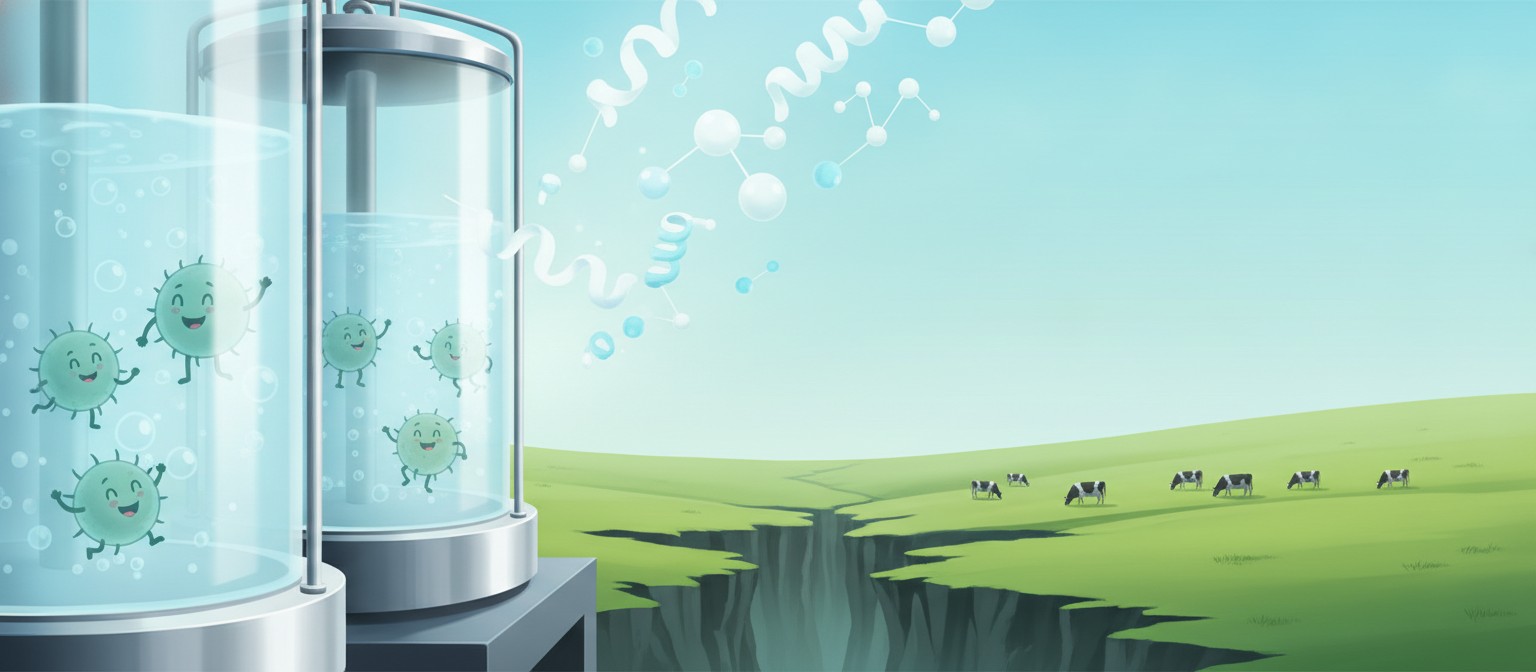
Precision fermentation dairy borrows its method from brewing and medicine. Scientists take the DNA sequence for bovine beta-lactoglobulin and insert it into a food-grade microbe such as Trichoderma reesei or Aspergillus oryzae. Fed on plant sugars in a fermenter, those microbes produce beta-lactoglobulin, which is then purified into a white to cream powder containing more than 90% of the protein as beta-lactoglobulin.
This is the same broad approach already used for decades to make vegetarian rennet (chymosin) and insulin. A 2025 review in PMC on allergenicity assessment of precision-fermentation food proteins notes that recombinant beta-lactoglobulin and ovomucoid have received US regulatory approval and entered the market, and that assessment centres on equivalence to the native protein rather than a novel hazard.
What is identical: the amino acid sequence of the beta-lactoglobulin, when correctly folded, matches bovine beta-lactoglobulin. That is why it foams, gels, stretches, and delivers complete amino acids, including leucine, much like conventional whey.
What is absent: the cow, the rest of the milk, and lactose itself. The purified protein contains no lactose unless lactose is added later as an ingredient in a finished product. The microbe host proteins, residual sugars, and process impurities differ from milk, which is why regulators assess each production strain separately.
Is It Safe for Lactose Intolerance or Milk Allergy?
This is the most important distinction to understand, so let us be exact.
Lactose intolerance: fermentation dairy protein itself contains no lactose, so people who avoid dairy because of lactose may tolerate the pure protein. Always check the finished product label, because a shake or ice cream made with it can still contain added milk, lactose, or flavourings.
Milk allergy: fermentation dairy protein is NOT safe for people with a cow’s milk allergy. If the sequence is identical, it is the same allergen. In its GRAS response for Imagindairy beta-lactoglobulin from Aspergillus oryzae (GRN 1145), the US Food and Drug Administration includes an allergen-labelling section stating that food containing this ingredient must declare milk as a major food allergen and describes beta-lactoglobulin as a major whey protein component of bovine milk. The PMC allergenicity review likewise describes recombinant beta-lactoglobulin as a known allergen designed as an exact structural copy of its native homolog.
In plain terms, animal-free means no animals were milked. It does not mean allergen-free. Anyone with a milk allergy should treat these products like milk protein and look for a “Contains: Milk” statement.
What About the Climate Numbers?
The most quoted figures come from a lifecycle assessment commissioned by pioneer Perfect Day, summarised in a Mitsui industry report: compared with conventional bovine whey protein, its fermentation-derived whey protein could reduce water consumption by 96 to 99%, energy demand by 29 to 60%, and greenhouse gas emissions by up to 97%.
Those figures are best-case, company-specific, and conditional. Precision fermentation still needs sugar feedstock, sterilisation, aeration, and drying, all of which cost energy. The carbon advantage depends on the electricity source powering the fermenters, the feedstock used to feed the microbes, the scale and yield of the run, and what conventional dairy system it is compared against. A plant running on coal-powered electricity and first-generation sugar will look very different from one running on renewable power with efficient downstream processing.
So use the numbers as direction, not destiny: fermentation uses far less land and water than keeping dairy herds because it skips the cow entirely, and greenhouse savings can be large, but only when the energy behind it is clean. Any percentage without a cited lifecycle assessment, stated energy mix, and stated baseline should be read as marketing.
Can It Legally Be Called Milk, Whey, or Dairy?
Not always, and it varies by market. In the United States, specific fermentation-derived beta-lactoglobulin ingredients have received FDA GRAS no-questions letters for the substances and uses described in their notices: GRN 863 covers Perfect Day beta-lactoglobulin from Trichoderma reesei, and GRN 1145 covers Imagindairy beta-lactoglobulin from Aspergillus oryzae. Each letter applies only to the notified substance and use, not to precision fermentation whey as a general category. But products containing it that carry milk-allergen labelling still sit in a contested naming space, and challengers have sued over terms like milk-identical and animal-free dairy.
In the European Union, beta-lactoglobulin as a novel food has been assessed by the European Food Safety Authority, but EU dairy naming rules reserve terms such as ‘milk’, ‘whey’, and ‘cheese’ for mammary secretions in most contexts. Expect labels like animal-free whey protein, non-animal whey protein, or fermentation-derived dairy protein rather than milk. Trade names from individual companies are brand names, not legal categories, and should not be used as generic terms.
Where to Find It and Who Makes It
The pioneer was California-based Perfect Day, which developed fermentation-derived beta-lactoglobulin and launched products through its former consumer arm The Urgent Company (including Brave Robot ice cream) and supplied partners making ice cream, cream cheese, and protein powder.
That history also shows why hype needs context. The Urgent Company was acquired by Superlatus in August 2023, Brave Robot disappeared from shelves, and Perfect Day went through funding and staffing turmoil and shifted focus toward business-to-business protein supply. Venture interest in alternative proteins cooled, and several adjacent startups closed or pivoted. This sector has real science and real setbacks.
Current activity includes business-to-business suppliers such as Remilk (Israel), Imagindairy (Israel, GRN 1145), and Vivici (Netherlands, backed by Fonterra and dsm-firmenich, self-affirmed GRAS in the US for its Vivitein beta-lactoglobulin), alongside New Culture working on fermentation-derived casein for stretchy mozzarella. Products appear mainly as protein powders, ice creams, and cream cheeses in the US and Singapore, with EU rollout slower because of novel-food approvals. Availability changes quickly, so check current brand labels rather than old launch announcements. A related fermentation path skips animal proteins entirely, such as Solar Foods Solein protein, which shows how broad the food made from CO2, water, and electricity field has become.

Should You Try It?
Consider fermentation dairy protein if you avoid conventional dairy because of lactose or climate concerns, you tolerate milk protein, and you want real whey function rather than a plant-based alternative. Pea, soy, and oat proteins remain cheaper and more widely available, and they are the safer choice for anyone with a milk allergy. Surveys such as GFI reporting on US consumer attitudes find shoppers are curious but unconvinced on identical taste and function, so treat bold taste parity claims as marketing until you taste it yourself.
If you try an animal-free whey protein powder or ice cream, read it like this: Confirm “Contains: Milk” on the allergen line, check for added lactose or milk ingredients if you are lactose-sensitive, look for third-party lifecycle data behind any climate claim, and remember that “fermentation-derived” means brewed by microbes, not milked from cows. Real protein, no cow, still a milk allergen. Precision has to run both ways, in the fermenter and on the label.


