
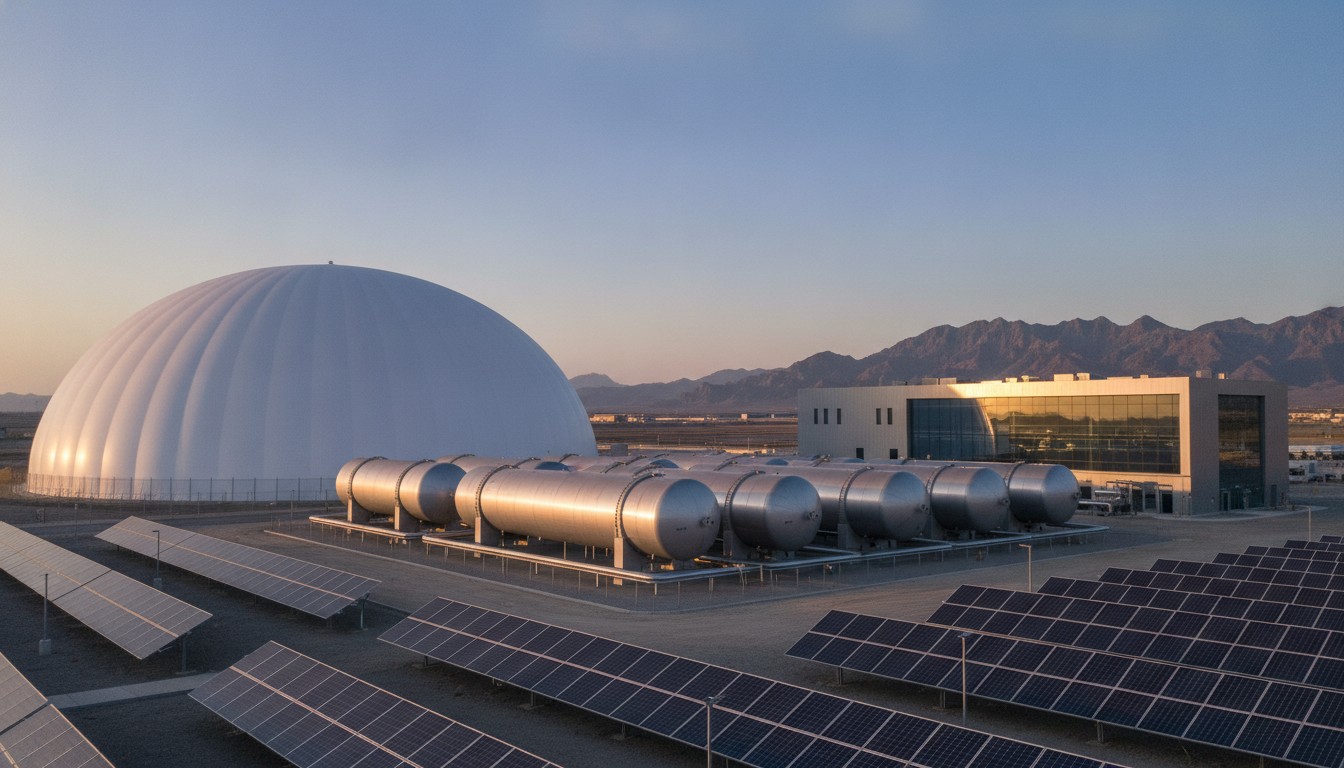
On a windy afternoon in Sardinia, a giant fabric dome breathes in while steel tanks nearby fill with liquid. No lithium is charging, no hydrogen is splitting, and no hillside reservoir is filling. The system is storing solar and wind energy as carbon dioxide squeezed from a gas into a liquid, then releasing it hours later to spin a turbine. This is CO2 battery storage, a long-duration mechanical system built by Italy-based Energy Dome that uses only CO2, steel and water in a closed loop.
It matters because the grid does not just need short bursts of power. Lithium-ion batteries excel at 2 to 4 hours. Solar nights, cloudy stretches, calm winds, and evening peaks in homes and data centers often need 8 to 24 hours of firm capacity. The CO2 battery is designed for exactly that gap, with 70% plus round-trip efficiency, a 30-year life with no capacity fade, and standard industrial parts instead of scarce minerals.
How a CO2 battery turns surplus power into grid power
The idea is simple to picture, even though the thermodynamics are clever. The system shuttles the same CO2 back and forth between a gas holder at atmospheric pressure and pressurized liquid storage tanks.
Charging, when electricity is cheap and abundant:
- Surplus wind or solar power runs a compressor that draws CO2 gas from a large atmospheric holder, often called the Dome.
- Compression creates heat. That heat is captured and kept in a thermal energy storage system based on water and steel.
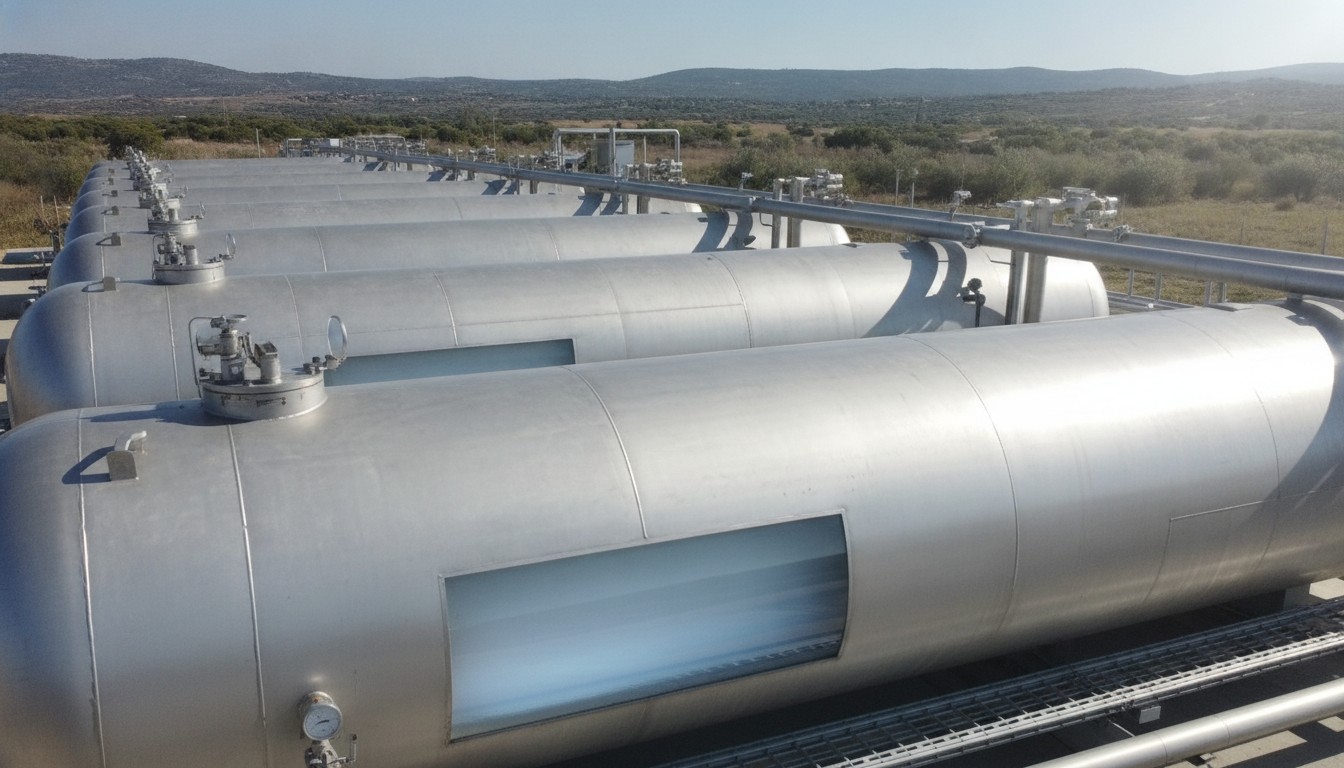
- The compressed CO2 cools and condenses into a dense liquid at ambient temperature. It is held in pressure vessels until needed.
Discharging, when the grid needs power:
- The stored heat warms the liquid CO2, turning it back into high-pressure gas.
- The gas expands through a turbine, which drives a generator and sends carbon-free electricity to the grid.
- The CO2 returns to the Dome at atmospheric pressure, ready for the next cycle. Nothing is vented to the atmosphere during normal operation.
Energy Dome describes this as a closed thermo-mechanical transformation that manipulates CO2 between its gaseous and liquid phase, with zero CO2 emissions into the atmosphere during the entire process. The company explains the full charge and discharge cycle of its CO2 Battery as using off-the-shelf turbomachinery with no cryogenics and no combustion.
Why liquid CO2 beats compressed air and liquid air
This is really a smarter cousin of compressed air energy storage, which parks energy as pressurized air in underground caverns. Air stays a gas unless you go to extremes, so you need huge volumes or salt domes and depleted reservoirs. Liquid-air systems solve density by going cryogenic, cooling air to around minus 196 degrees C, which adds cost and complexity.
CO2 hits a sweet spot. Around 31 degrees C, its critical point, it can be liquefied at manageable pressures at ordinary ambient temperatures. That one property changes everything:
- Liquid CO2 holds roughly 66.7 kWh per cubic meter in published engineering breakdowns, compared with about 2 to 6 kWh per cubic meter for typical compressed air storage. That is more than ten times the energy in the same volume.
- Storage stays at ambient temperature, so there is no cryogenic plant and no constant boil-off battle like liquid air.
- The plant can sit almost anywhere on about 5 hectares for a standard 20 MW module, with manufactured steel vessels instead of a suitable geology. The dome itself takes about half a day to inflate and the full facility can be built in under two years.
- Because the same fluid loops in a sealed circuit, there is no self-discharge the way a lithium cell slowly leaks charge, and no electrochemical aging.
Founder Claudio Spadacini has said he came to CO2 precisely because it liquefies at ambient temperature, which lets a relatively small pressure vessel hold a huge amount of energy and keeps costs competitive.
The numbers: efficiency, duration and lifetime
For storage, three numbers decide whether utilities take you seriously: how much energy you get back, how long you can deliver it, and how long the asset lasts.
- Round-trip efficiency: 70% plus net AC to AC at the system level, with Energy Dome reporting 75% or greater for its full-scale Ottana plant. Early company guidance discussed 75 to 80% as the technology matured.
- Duration sweet spot: 8 to 24 hours of continuous dispatch. The standard commercial module is 20 MW with 200 MWh, configured to charge in about 10 hours and discharge for 10 hours.
- Lifetime: 30 plus years of operating life with no degradation of capacity or performance, because the working fluid does not wear out and the machinery is conventional rotating equipment.
- Build time and parts: Under two years to construct from off-the-shelf components drawn from the oil, gas and power industries, with no lithium, cobalt, nickel or rare earths.
Efficiency here is net of the whole plant, power in versus power out at the grid connection, not just a turbine test. That distinction matters when comparing marketing sheets. Lithium-ion still wins on raw round-trip efficiency at around 85%, but lithium economics get worse as duration stretches, because you must buy more cells for every extra hour. A steel tank of liquid CO2 gets cheaper per hour as you add duration.
No lithium, no caverns: just steel, water and CO2
The bill of materials reads more like a brewery than a battery gigafactory: carbon dioxide as the working fluid, carbon steel pressure vessels, a large low-pressure gas holder, intercooled compressors, a turbine-expander, heat exchangers, water-based thermal storage, and controls.
That simplicity brings three practical advantages:
- Supply chain: All major parts exist in established global supply chains, which avoids lithium price swings and bottleneck minerals. Energy Dome says this allows rapid global deployment with locally sourced assembly, a point that helped win interest in India under Make in India manufacturing goals.
- Safety and siting: No flammable electrolytes, no thermal runaway, no open flames, no cryogenic spills. The CO2 stays sealed inside. Projects do not need a salt cavern, mountain reservoirs, or mine shafts, unlike many mechanical storage concepts.
- Grid services: Because power comes from spinning turbomachinery rather than inverters, the plant provides natural inertia to stabilize grid frequency. Inverter-based iron-air batteries built for multi-day storage and lithium plants must synthesize that service with software. The tracker for the Ottana project specifically notes inertia services as a feature not available from battery-based storage.
The CO2 charge comes from an industrial gas supplier and then lives permanently inside the closed system. It is neither captured from a smokestack to sequester carbon directly nor consumed during operation. Instead, the same molecules recirculate for decades, delivering their climate benefit indirectly: cheap, long-duration storage lets more wind and solar replace gas peakers and coal baseload, while the storage plant itself adds no combustion emissions.
From Sardinia to Wisconsin, India and Google data centers
Laboratory thermodynamics only convince utilities so far. Energy Dome has spent the last four years turning a demonstrator into contracted projects.
The proof point is Ottana, Sardinia. A 2.5 MW and 4 MWh first-of-a-kind demonstrator started operation in 2022 to test and refine the turbomachinery, controls and CO2 handling. The full-scale Ottana CO2 Battery, rated at 20 MW and 200 MWh, began commercial operations in July 2025 on a 5-hectare site holding about 2,000 metric tons of CO2, according to the project tracker detailing the Ottana full-scale plant specifications. It charges at about 24 MW over 10 hours and discharges at about 18 MW for 10 hours, with round-trip efficiency at or above 75%.
Since then the pipeline has widened quickly:
- United States: Utility Alliant Energy contracted the same 20 MW and 200 MWh configuration for a plant in Wisconsin.
- India: National Thermal Power Corporation, the country’s largest power producer, awarded a 20 MW and 8-hour system totaling 160 MWh at its Kudgi super thermal plant in Karnataka, built turnkey with Triveni Turbine and overseen by NTPC’s NETRA research wing.
- Google: In July 2025 Energy Dome announced a global commercial partnership plus a strategic investment from Google to deliver carbon-free power around the clock. Follow-on projects include a 19 MW and 10-hour system with Salt River Project in Arizona under a 20-year tolling contract and a project with Lumcloon Energy in Ireland, plus early work with Victoria’s State Electricity Commission in Australia.
The Google angle is revealing. Data centers need flat, reliable blocks of clean power, not just midday solar. The recent coverage of Google’s long-duration storage projects frames these CO2 batteries as reliable capacity assets able to sign long tolling agreements (contracts where a buyer pays a fixed fee to use the plant’s storage capacity), the same model utilities use for gas plants. Google itself describes the CO2 Battery as dispatchable for 8 to 24 hours, bridging when renewables generate and when power is needed. That is exactly the market long-duration storage must crack.
CO2 batteries vs the rest of long-duration storage
No single storage type wins everywhere. Short spikes favor lithium, seasonal heat favors thermal stores like Finland’s sand battery that keeps buildings warm with heated sand, and multi-day lulls favor iron-air or hydrogen. CO2 sits in the middle daily-cycle window.
| Technology | Best duration | Round-trip efficiency | Footprint and siting | Strengths and limits |
|---|---|---|---|---|
| CO2 Battery | 8 to 24 hours | 70 to 75% plus | Modular, about 5 hectares per 20 MW, no cavern needed | No lithium, no degradation, spinning inertia; needs heat management and pressure vessels |
| Lithium-ion | 2 to 4 hours | About 85% | Compact, anywhere | Fast and efficient, but costs scale with every hour and cells degrade |
| Advanced compressed air | 8 to 12 hours plus | About 60% for advanced designs, 40 to 52% conventional | Needs underground cavern or large vessels | Very long life; geology limits sites and energy density is low |
| Liquid air, or CryoBattery | 5 to 10 hours | About 50 to 60% | Industrial site, no cavern | Uses free air as fuel, as seen in the UK liquid-air plant built to power 200,000 homes; cryogenics add complexity |
| Iron-air | 100 hours, multi-day | Lower, traded for ultra-cheap energy capacity | Large but modular | One-tenth lithium cost for long durations; slower response, best paired with lithium |
On cost, Energy Dome has projected a levelized cost of storage (the all-in lifetime cost per megawatt-hour delivered) below $100 per MWh for its first commercial plants, with a path toward $50 to $60 per MWh at scale. Independent reporting has contrasted that with Lazard-style ranges of $132 to $245 per MWh for lithium-ion at longer durations. Treat those as company targets and third-party benchmarks rather than guaranteed tariffs, since every site, financing structure and duty cycle changes the math. The U.S. Department of Energy assessment of long-duration storage costs makes the same broader point: mechanical, thermal and flow systems can beat lithium on long durations once innovation and manufacturing scale arrive.
Frequently Asked Questions
Will CO2 batteries replace lithium batteries?
No, they complement them. Lithium remains better for fast frequency response, electric vehicles and 2-hour evening peaks. CO2 storage takes the longer 8 to 24-hour shift, such as carrying midday solar into the night and through cloudy mornings, so fewer gas peakers are needed.
Is this the same as turning CO2 into fuel?
No. E-fuels chemically convert CO2 into methane, methanol or jet fuel using hydrogen and lots of energy. A CO2 battery never changes the chemistry. It only squeezes CO2 into a liquid and lets it expand again, like a spring. The same CO2 loops for years.
Does a CO2 battery capture carbon or count as CCS?
No. Carbon capture and storage pulls CO2 from smokestacks or air and buries it. A CO2 battery recirculates a fixed charge of industrial CO2 in sealed tanks. It helps decarbonization by making renewables dispatchable, not by sequestering carbon.
How long can it store energy and how efficient is it?
The commercial sweet spot is 8 to 24 hours, with the standard 20 MW module storing 200 MWh. Round-trip efficiency is above 70% net, with 75% or more reported at full scale, and no capacity degradation over a 30-year life.
Is pressurized CO2 safe next to communities?
CO2 is non-flammable and the system has no combustion, no lithium fire risk and no cryogenic liquids. Like any pressure system, it needs proper engineering, leak detection, ventilation and setbacks, and CO2 can displace oxygen in confined spaces. Developers use standard industrial gas codes, off-the-shelf pressure vessels and utility permitting for that reason.
Can CO2 itself be turned into energy?
Not as a fuel. CO2 is fully oxidized, so burning it releases nothing. A CO2 battery does not burn CO2 at all. It uses electricity to compress it, stores that mechanical and thermal energy, then recovers most of it by expanding the gas through a turbine. The CO2 is the working fluid, like steam in a power station, not the energy source.
Why do some communities oppose battery storage sites?
Opposition to battery energy storage usually centers on lithium sites: fire risk and thermal runaway, noise and traffic during construction, visual impact, and questions about recycling and mineral supply. Long-duration mechanical systems answer part of that concern with no flammable cells, no exotic minerals and a conventional industrial footprint, but they still need transparent permitting, safety plans and grid benefits explained locally. Duration also differs: most lithium BESS installations provide 2 to 4 hours, while CO2 and compressed-air plants target 8 to 24 hours for daily cycling.
What this means for a wind and solar grid
Think of the CO2 battery not as a better phone battery, but as a time machine for electricity. It buys midday abundance and sells it after sunset, using physics textbook hardware and a gas we already handle by the millions of tons. If Ottana’s first full-scale performance holds through years of cycling, and if Wisconsin, Karnataka, Arizona and Ireland repeat it, utilities will have a modular, lithium-free tool for the hardest part of decarbonization: the 10-hour stretch when everyone needs power and the sun is gone. That is worth watching, because it turns the intermittency problem from a chemistry scramble into plumbing, steel and smart thermodynamics.
Note: This mechanical CO2 battery is different from experimental lithium-CO2 electrochemical cells, such as the lab prototype for a rechargeable lithium carbon dioxide battery that uses CO2 in battery chemistry. Energy Dome’s system contains no lithium battery cells at all.

