
Grid-scale storage has become increasingly essential now as the world transitions away from fossil fuels towards renewable energy. Technologies like carbon thermal batteries, which heat solid carbon blocks to 2,400 degrees Celsius for industrial and grid use, are joining the mix alongside established approaches. Getting carbon emissions to net-zero will demand a patchwork of technologies—including thermal bricks, massive lithium-ion batteries, tanks packed with molten sodium or silicon, moved hydro, geothermal loops, and heavy blocks stacked up in towers or suspended in mineshafts. They will smooth out renewables’ inconveniently unpredictable generation curves.
The most commonly used today is moved hydro (95%), but it requires a lot of land and concrete, which isn’t eco-friendly. There is, however, yet another method of grid-scale energy storage not yet mentioned that holds excellent potential called compressed air energy storage (CAES). The cost-effective, emissions-free storage solution has been used for decades and is as reliable as pumped hydro minus the site constraints.
California will soon house two new CAES facilities (one in Central California and the other in southern Kern County) developed by the Canadian cleantech company Hydrostor. The state has a goal set to achieve 100% carbon-free electricity by 2045. It needs large-scale, long-duration storage to integrate its soon-to-be annually-increasing levels of renewable generation capacity.
Curtis VanWalleghem, Hydrostor’s CEO, stated, “Long-duration storage is essential for decarbonizing the California electricity grid and integrating the renewable energy that is already developed in the state. Our A-CAES technology utilizes only existing, proven components repurposed from conventional power generation into an entirely emissions-free and low-impact storage technology. Not only are we providing a clean, reliable, and affordable long-duration energy storage solution, but we’re also providing Californian workers and suppliers a more direct opportunity to be part of the clean energy transition.”
Both facilities will claim the position of the world’s most extensive non-hydro energy storage system. They’ll each be capable of storing 5 GWh of energy and have an output of 500 MW (together, that’s 10 GWh / 1 GW of long-term storage). At the moment, Alabama’s McIntosh Plant (running since 1991) is one of the world’s largest energy storage plants, at 2.86 GWh storage capacity and 110 MW output.
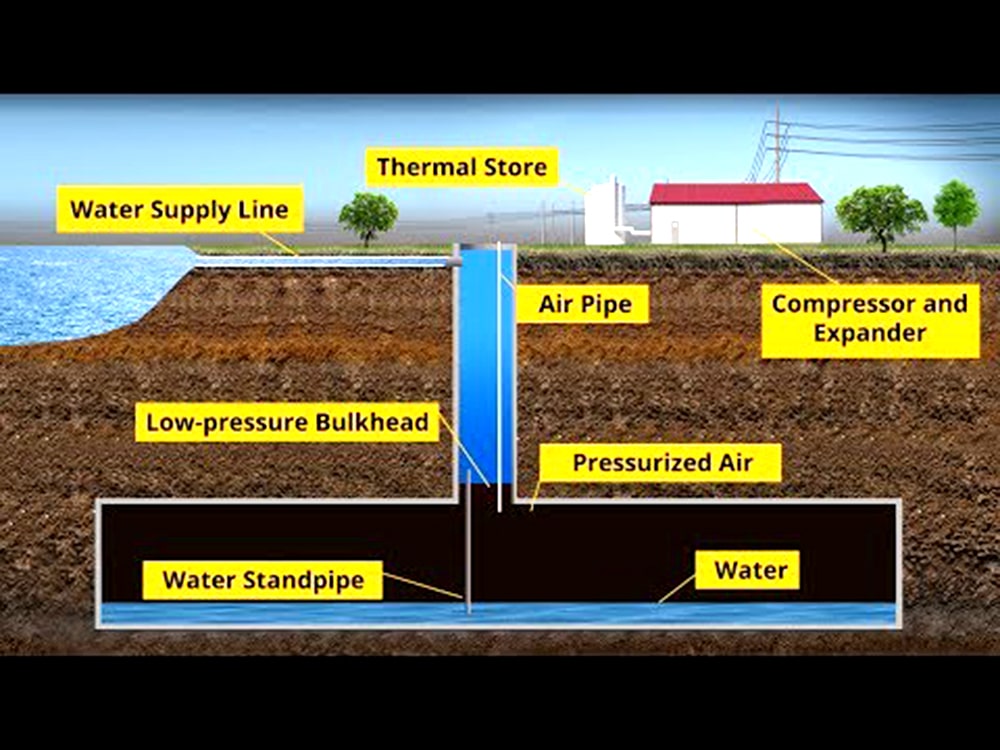
Hydrostor’s new facilities in California will operate on an updated form of the technology called advanced compressed air power storage space (A-CAES). It uses surplus electricity to run an air compressor, then stores the compressed air in a big tank underground until energy is required. At this point, the air is released through a turbine to generate electricity and feed it into the grid.
The technology also captures the heat created during this process and saves it in a separate thermal storage tank when reheating the air as it’s fed into the turbine phase. This increases the system’s efficiency. Typically, CAES systems provide round-trip efficiencies between 40% and 52%, but it’s around 60% with this technique.
Hydrostor’s patented and commercially proven A-CAES provides 8 to 12 hours or more of energy storage, while present battery technologies can only provide 1 to 4 hours feasibly. This sort of long-term energy storage is what will pave the way for California’s decarbonized power grid.
Furthermore, A-CAES has a longer useful life (over 50 years) than the mainstream alternative available today, with zero degradation and lower ecological impact. Such remarkable longevity could significantly influence the cost equation compared to lithium-based battery facilities being installed at an increasing rate worldwide.


