
Every year, farmers spread millions of tonnes of phosphorus fertilizer across their fields. A large share of it never reaches a crop. Instead, it binds to soil particles, washes into streams and lakes, and feeds the algal blooms that choke waterways and starve them of oxygen.
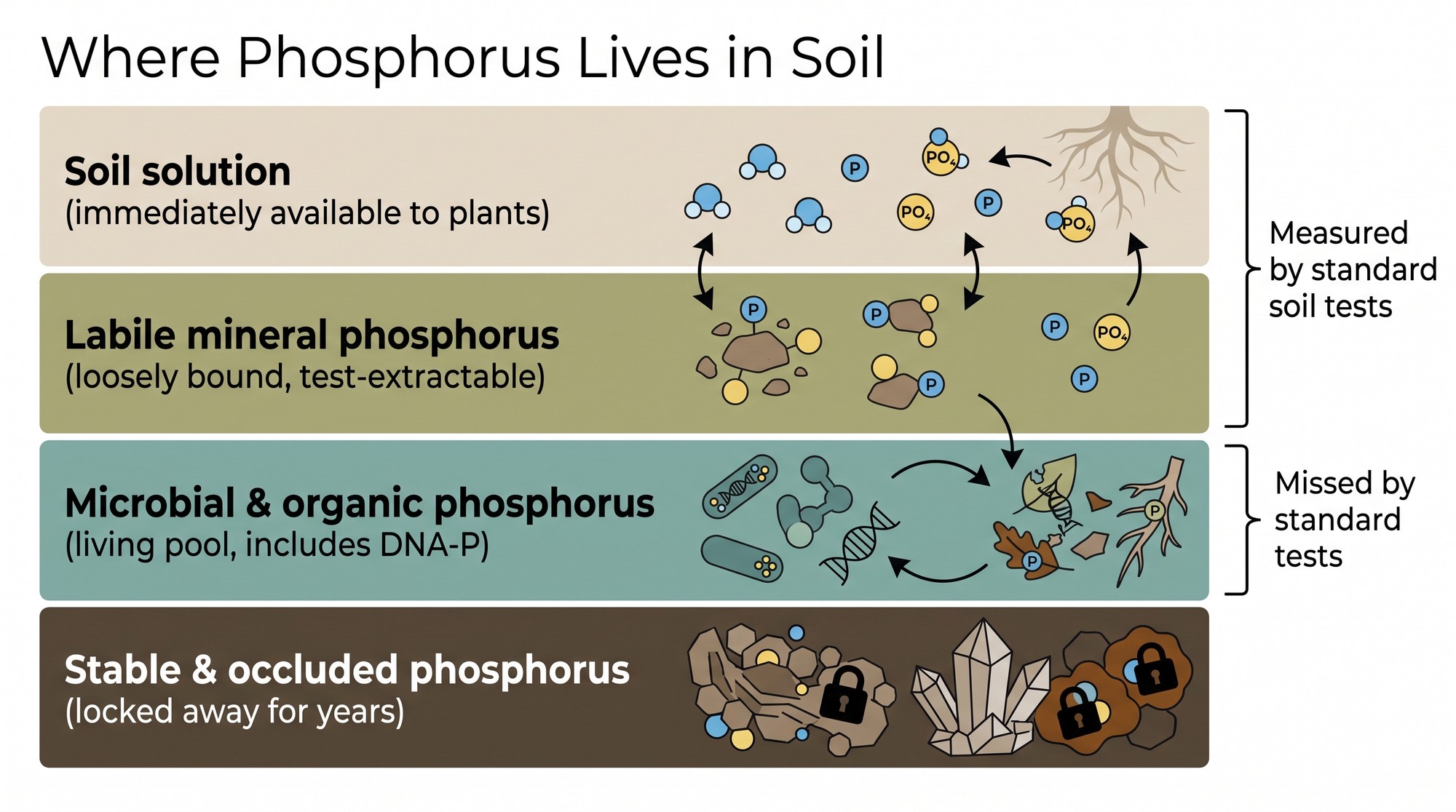
The problem starts with measurement. The soil phosphorus test used to set fertilizer rates mostly captures the mineral phosphorus that plants can take up right now. It largely overlooks a second, more dynamic pool held inside the bodies of soil microorganisms.
An international research team has now made that overlooked pool cheaper and easier to measure. Their refined method, published in the Journal of Agricultural and Marine Sciences, targets DNA-bound phosphorus, or DNA-P, and it could sharpen how we understand one of agriculture’s most consequential nutrients.
Why Phosphorus Is a Problem Hiding in Plain Sight
Phosphorus is essential to life. It forms the backbone of DNA, powers the ATP molecules that cells use for energy, and helps build every cell membrane. Crops cannot grow without it.
The catch is that phosphorus is also finite. The world’s supply comes mainly from phosphate rock, a mined material concentrated in a handful of countries. Once it is spread on a field, it does not vanish when the crop is harvested. Some is taken up by plants, and much of the rest either accumulates in the soil or leaves the field entirely in runoff.
That escape is where the environmental damage happens. Even modest amounts of excess phosphorus reaching rivers and lakes can trigger eutrophication, a surge of algal growth that strips oxygen from the water and creates dead zones.
Soil also holds a vast, slow-moving reservoir of phosphorus left over from decades of fertilizer and manure. Managing that legacy well depends on knowing which forms are available, which are locked away, and which are cycling through living organisms right now.
How Soil Phosphorus Tests Work, and What They Miss
Most soil phosphorus tests follow the same logic. A small sample of dried soil is shaken with a chemical solution, called an extractant, that pulls out a fraction of the phosphorus. The amount recovered is measured and reported as an index of how much phosphorus should be available to a crop.
The choice of extractant matters, because different soils hold phosphorus in different chemical forms. The USDA’s Natural Resources Conservation Service notes that acidic soils tend to bind phosphorus with iron and aluminium, while alkaline soils bind it with calcium, so no single extractant works everywhere.
The Three Most Common Soil Phosphorus Tests
| Test | Best suited to | What it extracts |
|---|---|---|
| Bray-1 | Acidic and neutral soils | Readily soluble and loosely bound mineral phosphate |
| Olsen (bicarbonate) | Calcareous, alkaline soils, usually above pH 7.4 | Available phosphate, including calcium-bound forms |
| Mehlich-3 | A wide range of soils; multi-nutrient testing | Available phosphorus alongside other nutrients |
Each of these tests was calibrated for particular soil types and crops, and each reports an index of relative availability rather than an absolute amount. That is why a soil test result only carries meaning next to the crop response it was calibrated against.
Crucially, all three focus on mineral and extractable phosphorus. None of them directly measures the phosphorus locked inside soil microbes, even though that microbial pool is one of the most active parts of the cycle.
What the New DNA-Bound Phosphorus Method Changes
The research team, drawn from Sultan Qaboos University, the James Hutton Institute, and Oman’s Environment Authority, worked from a laboratory protocol first described in 2013. Their aim was not to invent new chemistry but to simplify an existing one.
Their most useful finding was that a set of enzyme treatments, long assumed to be necessary, could be removed entirely without losing accuracy or sensitivity. Ultrafiltration, the step that isolates DNA-bound phosphorus from other phosphorus-containing compounds, had to stay, because without it the measurement becomes unreliable.
The researchers tested the revised procedure on 32 soil types collected across the United Kingdom, starting with two contrasting soils before applying it to the full set. The streamlined method was cheaper and simpler to run while still meeting the precision needed for research.
Their results showed that DNA-P levels track closely with soil pH, microbial biomass phosphorus, organic matter content, and phosphorus dissolved in soil water. That pattern suggests DNA-P reflects the living, fast-turnover side of the soil phosphorus cycle rather than the stable reserves that accumulate over decades.
Why the Microbial Pool Matters
Soil microbes are not passive passengers. Bacteria and fungi take up phosphorus, transform it, and release it again as they grow, die, and decompose. That constant churn keeps a portion of soil phosphorus in circulation instead of locked into unavailable minerals.
Fungi extend this reach further. Mycorrhizal fungi form partnerships with plant roots and act as microscopic extensions of the root system, helping plants reach phosphorus that would otherwise be out of range. Research on tomato crops has shown that pairing plants with the right fungi can meaningfully cut how much fertilizer a field needs.
A measurement that captures this biological activity could help farmers time applications more precisely, and it could help scientists understand why two fields with the same test result sometimes behave very differently. It also fits a wider push to work with soil biology rather than against it, from coating seeds in beneficial microbes to breeding crops that partner more effectively with fungi.
Signs Your Soil Has Too Much Phosphorus
Excess phosphorus rarely shows up as an obvious plant symptom. Instead, the warning signs usually appear off the field.
- Persistently high or rising soil test phosphorus levels despite steady or reduced applications.
- Algal blooms, green scum, or unusually murky water in nearby ponds, ditches, and streams.
- Heavy reliance on manure or compost, which adds phosphorus even when nitrogen is the target nutrient.
- Visible erosion, runoff channels, or bare ground that lets soil and nutrients leave the field.
Because phosphorus accumulates slowly and moves mainly with eroded soil, a field can carry a surplus for years before the consequences show up downstream.
How to Lower Phosphorus Levels in Soil
Bringing phosphorus back into balance is a long game, since the nutrient does not leach away easily. Practical steps include:
- Reduce or pause phosphorus fertilizer and manure applications where tests already show high levels.
- Base decisions on regular soil tests rather than habit or a fixed calendar.
- Keep soil covered with cover crops and residue to hold phosphorus in place and prevent erosion.
- Maintain buffer strips along waterways to intercept runoff before it reaches the water.
- Support soil biology with organic matter and reduced tillage, which can improve how efficiently plants use the phosphorus already present.

Better nutrient accounting can also close loops in other ways, such as turning dairy waste into fertilizer and bioplastics instead of spreading it on fields in raw form.
Do Any Plants “Fix” Phosphorus in Soil?
Not in the way legumes fix nitrogen. No plant can pull phosphorus out of the air, because the element is not present there in a usable form. Plants can only take up phosphorus that is already in the soil.
Some plants, however, can mobilize it. Deep-rooted cover crops such as buckwheat and certain clovers can draw up phosphorus from lower in the soil profile and return it to the surface when they decompose. Others release organic acids from their roots that unlock bound phosphorus. Many crops, in turn, rely on mycorrhizal fungi to extend their reach. The right cover-crop mix can therefore make existing soil phosphorus more available, rather than creating new phosphorus.
Why This Matters Beyond the Farm
Phosphorus sits at the intersection of food security and environmental health. Fertilizer prices respond to global supply shocks, while runoff from over-fertilized fields drives some of the most persistent water-quality problems in the world.
A cheaper way to measure the biologically active pool of soil phosphorus gives researchers a new tool for both problems. It could help identify fields where phosphorus is already plentiful and further applications are simply wasted, and it could track whether soil biology is doing more of the work of feeding crops.
Other lines of research point in the same direction. Work on agricultural liming shows how carefully managed soil chemistry can reshape a farm’s environmental footprint, and studies of recovering soil microbiomes reveal how quickly microbial communities can rebuild nutrient cycles when conditions allow. Other non-GMO crop technologies are already helping farmers work with soil biology to reduce their reliance on purchased inputs.
Frequently Asked Questions About Soil Phosphorus Tests
How do you test phosphorus levels in soil?
Soil is sampled, dried, and shaken with a chemical extractant, and the amount of phosphorus released is measured and reported as an index. The extractant changes with soil type: Bray-1 for acidic soils, Olsen for alkaline soils, and Mehlich-3 for a broad range of soils. The new DNA-bound method adds a measure of the microbial phosphorus pool that those tests miss, using ultrafiltration to isolate the DNA-bound fraction.
What are the signs that soil has too much phosphorus?
Plants rarely show direct symptoms. The clearer signals are off the field: rising soil test values despite steady applications, algal blooms or green scum in nearby water, heavy manure use, and visible erosion or runoff. Excess phosphorus tends to build up quietly for years, so regular testing is the most reliable warning.
How do I lower the phosphorus level in my soil?
Cut back or pause phosphorus fertilizer and manure where tests show a surplus, test regularly to guide decisions, keep the soil covered to prevent erosion, maintain buffer strips along waterways, and build soil organic matter. Because phosphorus does not leach away easily, lowering it takes time and usually depends on crops gradually drawing down the surplus.
What plants fix phosphorus in soil?
Strictly speaking, no plant fixes phosphorus, since it cannot be drawn from the air. What some plants do is mobilize it. Buckwheat, certain clovers, and other deep-rooted cover crops bring phosphorus up from deeper soil and release it at the surface, and many plants work with mycorrhizal fungi to reach phosphorus that roots alone could not access.
The Bottom Line
Phosphorus is too valuable to waste and too damaging to lose. The standard soil phosphorus test still answers a narrow question about what is immediately available, but it leaves the most active part of the cycle in the dark. A cheaper way to measure DNA-bound phosphorus will not fix fertilizer management on its own. It does, however, give farmers and researchers a clearer view of the living soil that quietly decides how much of that finite nutrient a crop ever sees.

