
Every day, the world spends a fortune in electricity cleaning water that bacteria could, in principle, clean for free.
Wastewater treatment is one of modern life’s invisible energy hogs. Pumping, aerating, and filtering the water we flush away takes a lot of power, and much of that power still comes from burning fossil fuels. All of it is spent undoing the waste we create in the first place.
Microbial fuel cells turn that logic on its head. These are bio-electrochemical devices that use living bacteria to break down organic matter and pull a small electric current out of the process. The idea is more than a century old. Only now is it close to doing real work.
What Exactly Is a Microbial Fuel Cell?
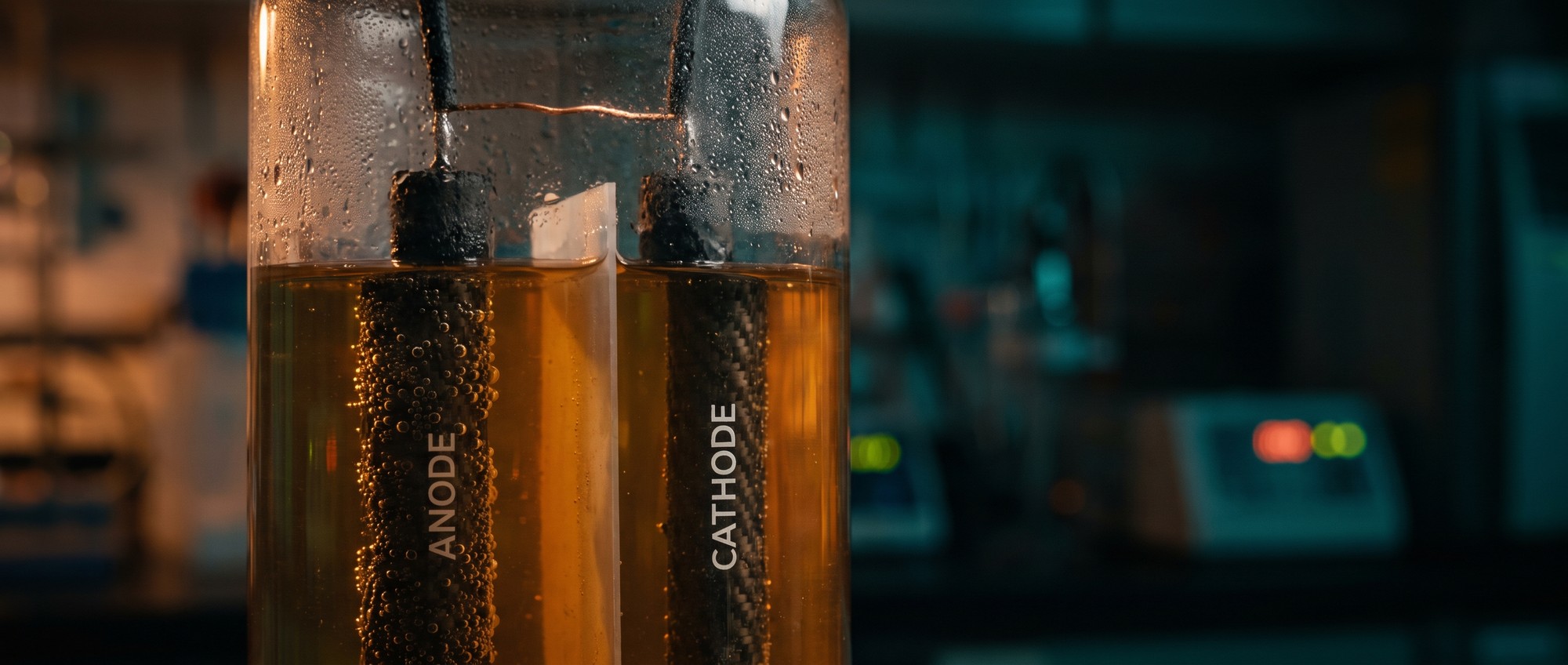
An MFC works a little like a battery that runs on waste. It has two electrodes, an anode and a cathode, separated by a membrane and joined by an external circuit. Bacteria grow on the anode in an oxygen-free environment, where they feed on the organic matter around them.
As the microbes digest that food, they strip away electrons and release them. In a normal pond or pipe, those electrons would end up attached to oxygen. In an MFC, the anode captures them and pushes them through the circuit to the cathode, where they finally meet oxygen and form water. That steady flow of electrons is an electric current.
The elegance of the design is that two jobs we normally pay for separately, cleaning water and making electricity, happen in the same vessel and are powered by the same microbes.
A Century-Old Idea, Finally Getting Serious
The concept is older than most people assume. In 1911, Michael Cressé Potter, a professor of botany at the University of Durham, showed that yeast produced electricity as it metabolized sugar. His cell was little more than two platinum wires in a pair of glass tubes, and its voltage never rose above 0.5 volts. The work drew almost no attention.
Two decades later, in 1931, Barnett Cohen built microbial half-cells that could be stacked in series, reaching more than 35 volts at a current of just 2 milliamps. The field then stalled for decades, treated as a laboratory curiosity. Only in the 1970s did researchers work out how bacteria could hand electrons straight to an electrode without chemical help, and the modern era of the microbial fuel cell began.
- 1911: Michael Cressé Potter generates electricity from yeast using two platinum wires.
- 1931: Barnett Cohen stacks microbial half-cells to reach more than 35 volts.
- 1970s: Researchers discover how bacteria hand electrons directly to an electrode.
- 2007: The first benthic cells are deployed on the seafloor to power marine sensors.
- 2016: A £1 urine-powered cell from the University of Bath runs the lights on a demonstration toilet.
- 2022: A litre-scale cell treats municipal wastewater continuously for more than 400 days.
- 2026: New studies refine how cells perform on real wastewater in the lab and the field.
How Bacteria Turn Waste Into Watts
The Exoelectrogens Doing the Work
Not every microbe can hand electrons to a solid electrode. The ones that can are called exoelectrogens, and they rely on a set of biochemical tricks known as extracellular electron transfer. Some species, such as Geobacter and Shewanella, grow microscopic protein filaments often described as nanowires and wire themselves directly to the anode. Others release soluble molecules that shuttle electrons back and forth. In real wastewater, a whole community tends to form a conductive biofilm on the electrode surface and do the job together.
It is a trick nature has been running for far longer than we have: bacteria in river mud can generate electricity from thin air.
From Anode to Circuit
Once electrons reach the anode, the rest is engineering. The current flows through the external circuit, where it can power something small, while the bacteria break the organic matter down into simpler compounds. The water gets cleaner as a side effect of the microbes eating.
That coupling is the technology’s real appeal. A treatment plant is built to remove organic matter. An MFC treats that matter as fuel.
How Much Power, Really?
Here is where enthusiasm meets physics. A microbial fuel cell produces very little power for its size, and the numbers matter.
The field has still come a long way. Early cells managed power densities of around 0.001 milliwatts per square meter. Today’s research systems typically reach 250 to 740 milliwatts per square meter, and some specialized designs have topped 6,800. Optimized single-chamber cells with air cathodes have reached 1 to 2 watts per square meter, while dual-chamber designs sit lower, at 0.2 to 0.8 watts per square meter.
Those figures still look small next to a solar panel, which converts well over 20 percent of sunlight into electricity. MFCs also face a punishing scale-up penalty. A tiny 20-milliliter lab reactor can exceed 1,000 watts per cubic meter. Blow it up to 500 milliliters, and the output can collapse to around 20 watts per cubic meter. Making the reactor bigger has, so far, made each liter work harder for less.
What the Latest Research Shows
Most current research targets that gap between lab promise and field performance. A 2026 study in the journal Sādhanā, by Harshada Wagh and Amit Sharma, tested how a cell behaves across a range of realistic wastewater strengths in India, from 500 to 2,000 milligrams per liter of organic matter, over 20 days. The most interesting result was a counterintuitive one. The highest voltage, near 300 millivolts, came from the weakest feed, on day 15. Stronger wastewater produced lower and more erratic output. The practical lesson is that these cells may prefer dilute, steady streams to concentrated ones.
A separate 2026 modelling study in PLOS ONE underlined how much the hardware matters. Electrode material had an outsized effect on voltage, with platinum delivering the highest output. That is encouraging, because it means design choices count. It is also a warning, because platinum is expensive.
Out in the real world, the evidence is quietly building. A one-liter-scale, single-chamber air-cathode system ran on primary effluent at a municipal wastewater plant for more than 400 days. It removed up to 70 percent of the organic load and produced 150 to 200 milliwatts per square meter at the cathode, all without added aeration or chemicals.
Why Wastewater Treatment Is the Real Prize
Conventional treatment is energy- and chemical-intensive. Aeration, the step that pumps oxygen into tanks so bacteria can work, is often the single largest electricity consumer at a treatment plant. Add pumping and sludge handling, and a facility can spend a large share of a city’s energy budget simply staying ahead of its sewage.
MFCs flip that logic. Instead of spending electricity to add oxygen and then paying to manage the leftover sludge, an MFC lets bacteria oxidise the organic matter at an electrode and captures some of the energy as current. Even a modest harvest changes the accounting. A plant that recovers part of its own load edges closer to energy neutrality.
| Approach | Energy | Chemicals | Best suited to |
|---|---|---|---|
| Conventional treatment | Consumes large amounts of electricity, mainly for aeration | Requires chemical dosing and produces sludge | High-volume municipal and industrial plants |
| Microbial fuel cell | Produces a small electric current while treating water | No added chemicals; microbes do the work | Dilute, steady waste streams and remote, low-power sensors |
Where Microbial Fuel Cells Are Already Working
The niche where MFCs already shine is where power demands are tiny and grid access is impossible. Several applications are moving from the lab toward the field.
Powering Sensors at the Bottom of the Sea
The clearest success story is in the ocean. Benthic microbial fuel cells sit on the seafloor, where bacteria in the sediment feed on natural organic matter and generate a trickle of power. The first were deployed in marine sediments around 2007, and they have since become a niche but proven way to run equipment far from any grid. In one notable test, two seafloor cells powered oceanographic sensors and acoustic modems for nearly a year at a remote observatory off California, reaching peak power densities around 35 milliwatts per square meter. Companies such as Trophos Energy have commercialized the idea for long-term marine monitoring.
Urine, Plants, and the Developing World
Smaller cells have found a different calling. In 2016, researchers at the University of Bath built a miniature fuel cell that runs on urine and costs just £1 to £2 per device. Crucially, they replaced the usual platinum cathode with a cheap carbon catalyst made from glucose and a protein found in egg white. As corresponding author Dr. Mirella Di Lorenzo put it, “If we can harness the potential power of this human waste, we could revolutionize how electricity is generated.” The team later demonstrated a urine-powered toilet with the charity Oxfam, whose lights ran on the electricity the waste produced.
A related idea harvests power from living plants. The Dutch company Plant-e, spun out of Wageningen University, places electrodes among the roots of growing plants and captures electrons released as soil bacteria break down the organic compounds the roots exude. A 15-square-meter system can generate enough to run a laptop, and the company is developing larger installations in wetlands and rice paddies, where food and electricity could be produced side by side.
Biosensors: When the Current Becomes the Signal
Because the current from an MFC rises and falls with how much food the bacteria have, the device can double as a living sensor. Feed it wastewater and the electrical signal tracks the organic load in real time, offering a fast way to gauge pollution strength that traditional lab tests can take days to deliver.
That makes MFCs attractive as low-maintenance biological oxygen demand sensors for treatment plants and rivers, where an early warning of a pollution spike can matter far more than a few watts of power.
Energy-Recovering Treatment
Bigger pilots aim to blur the line between a treatment tank and a battery, cleaning water while offsetting part of a plant’s own demand. This is the same logic behind devices that use sewage and light to generate clean energy, and behind a biofilm that generates electricity from human sweat. Rather than centralising energy production, the aim is to distribute it into the systems we already run.
The Honest Limits
It is worth being clear-eyed about the obstacles. Platinum remains the benchmark catalyst for the oxygen reaction at the cathode, but it is costly, scarce and prone to fouling and poisoning in real wastewater. Cheaper alternatives, from transition metals to doped carbons and potassium permanganate, are promising but not yet equal to it at scale. Membranes foul over time. And the scale-up penalty means that a design that shines in a beaker can disappoint in a tank.
No one is going to run a city on sewage. The realistic prize is not bulk electricity but self-powered systems that earn their keep by treating water and running their own sensors.
The Road Ahead
The path from promising to practical runs through materials science. Cheaper catalysts to replace platinum, electrodes with more surface area for biofilms to colonise, and membranes that resist fouling are all active areas of research. So is stacking MFCs with other technologies, such as constructed wetlands, anaerobic digesters and conventional treatment stages, so each handles the job it does best.
A parallel shift is toward hybrid systems that use the same bacterial metabolism to make useful chemicals or to drive desalination, rather than chasing pure electricity. The common thread is that the microbes, not the hardware, are the engine, and the fuel is a waste stream we are generating anyway. It is part of a wider wave of research into strange new uses for bacteria, from living batteries to finding tumours.
The Takeaway
Microbial fuel cells will not light up a city. But they may do something quietly important: turn the plant a city already runs, and the sensors it already needs, into systems that partly power themselves. In a world where clean water and clean energy are two of the defining challenges of the century, a technology that addresses both at once, with bacteria doing the heavy lifting, is worth watching closely.


