
Stand in a forest on a still morning, and the air around the leaves is close and damp. Stand there on a windy afternoon, and that pocket of damp air has been stripped away and replaced by drier air from somewhere else. The difference is small at the scale of a single leaf. Multiplied across a continent, a new study argues, it is large enough to shift how much water the land hands back to the sky.
The research, published in Nature Climate Change on 15 October 2026, was led by Zheng Fu at the Institute of Geographic Sciences and Natural Resources Research, part of the Chinese Academy of Sciences. Xiang Wang is the first author, with 19 co-authors including Josep Peñuelas and Philippe Ciais. Their conclusion is that wind speed is an underappreciated regulator of the carbon and water cycles and one that Earth system models have been treating as background weather.
The team analyzed observations from 146 monitoring sites worldwide, spanning forests, grasslands, croplands, and wetlands, and cross-checked them against model simulations. Once temperature, rainfall, solar radiation, atmospheric dryness, and carbon dioxide were taken into account, water-use efficiency fell as winds strengthened at nearly 80 percent of those sites.
Then comes the twist. Winds over land have been weakening for decades, a trend known as global stilling. If weaker wind really does suppress water loss, then the stilling has been quietly doing ecosystems a favor, and any recovery in wind speeds would run against them. That second part is where the story stops being simple, because nobody can yet say with confidence which way wind speeds will go.
What the Study Actually Found
The team did not run a wind tunnel over a forest. They analyzed existing measurements from eddy-covariance towers, the standard instrument for this kind of question. Each tower samples the turbulent air above vegetation many times a second, and from those fluctuations researchers calculate how much carbon dioxide a landscape is absorbing and how much water vapor it is releasing. The records come from four international networks: FLUXNET2015, AmeriFlux, ICOS, and OzFlux.
The observational base covers 146 sites across nine vegetation types. The distribution is uneven: 36 evergreen needleleaf forest towers, 26 grassland, 23 cropland, 14 deciduous broadleaf forest, 14 shrubland, 12 savanna, eight evergreen broadleaf forest, eight wetland, and five mixed forest. That imbalance matters when reading the finer results, and it is worth keeping in mind for the vegetation-specific claims.
For each site the researchers asked a deliberately narrow question. Once air temperature, precipitation, shortwave radiation, vapor pressure deficit, and carbon dioxide concentration are accounted for, does wind speed still tell you anything about water-use efficiency? It did, and the association was negative almost everywhere.
Wind’s median standardized response was also larger than that of any other environmental variable examined, including precipitation, temperature, radiation, vapor pressure deficit, and carbon dioxide. A standardized response measures how far a variable moves per unit of its own natural variability, so this is a statement about sensitivity per typical swing rather than about which factor explains the most variation overall. It does not mean wind governs the carbon cycle. It does mean that, per unit of change, it moved the ratio further than the drivers that usually get the attention.
Two finer patterns emerged. Evergreen needleleaf forests were the most sensitive vegetation type. Humid ecosystems also responded more strongly than arid ones, which is the less obvious result. The paper does not settle why, and one plausible reading is that dry systems are already limited by water supply rather than by air movement, leaving less for extra wind to carry away. That is an interpretation, not a finding.
The headline number needs care. Nearly 80 percent of the sites showed the negative relationship, which means roughly one site in five did not. The figure describes a network of research towers chosen by scientists, not a survey of the world’s land surface, and it says nothing directly about the hectare of farmland or the patch of woodland outside your window. What it establishes is a consistent pattern across a wide but finite sample, not a universal law.
The chart explains why the study’s broad conclusion is firmer than its vegetation-specific ones. Nine ecosystem types are represented, but three of them account for more than half the sites, and the two forest types that differ most in their reported sensitivity are supported by very different amounts of data.
Why a Breeze Makes a Forest Thirstier
The mechanism is the same one that dries laundry on a windy day, and it comes down to a layer of air you cannot see.
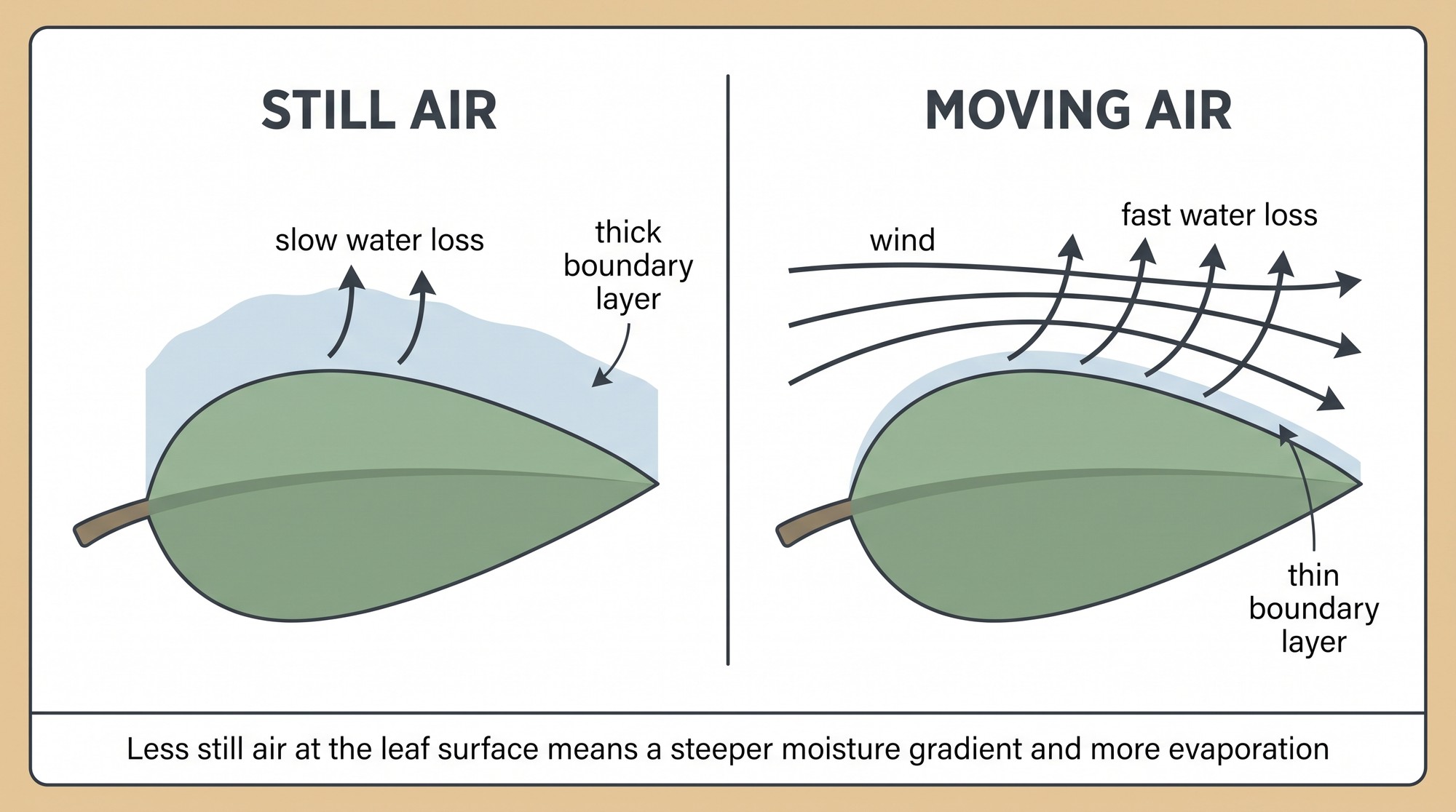
Every leaf sits inside a thin film of still air, its boundary layer kept humid by the water vapor escaping through the leaf’s pores. That film slows further evaporation, because vapor has to diffuse across it to reach the open atmosphere. Wind thins the film, sometimes almost to nothing, and replaces humid air with drier air. The moisture gradient between the inside of the leaf and the world outside steepens, and water leaves faster.
In the language of micrometeorology, stronger wind raises aerodynamic conductance, the ease with which water vapor and heat move between the canopy and the atmosphere. The study describes the consequence as tighter coupling: the ecosystem becomes more closely tied to the dryness of the air above it than to the humid microclimate it has built for itself.
There is a carbon side too, but it is smaller. Wind can suppress gross primary production somewhat, partly through the mechanical strain it puts on leaves and partly through the drying that follows. The researchers found the water side did most of the work. Increased evapotranspiration drove the drop in water-use efficiency, with reduced photosynthesis a secondary contribution.
That distinction matters for how the result should be read. A windier world is not one in which plants photosynthesise dramatically less. It is one in which the same landscape loses more water for each unit of carbon it takes up.
What the Study Cannot Show
Several things are worth holding apart from the finding itself.
- It is a correlation, not an experiment. Nobody turned the wind up and down on 146 ecosystems and watched. The authors control for the obvious confounders statistically, which is a reasonable approach and not the same as holding everything else constant. Wind arrives with weather: fronts, dry air masses, and pressure changes all bring their own effects.
- The metric mixes two different kinds of water loss. Ecosystem water-use efficiency is usually calculated as gross primary production divided by evapotranspiration, and evapotranspiration includes water evaporating from bare soil and from wet leaves, not just water transpired by plants. A 2026 review of water-use efficiency definitions sets out why these measures are not interchangeable. Water that evaporates from soil is not water a plant chose to spend, so part of the signal may be about soil drying rather than about plants becoming less frugal.
- The grassland evidence points the same way on that detail. A separate 2026 study in Science Advances found that a one percent decline in wind speed cut evapotranspiration by about 0.65 percent but cut soil evaporation by 0.37 percent and transpiration by only 0.17 percent. Soil evaporation responded more than twice as strongly as the plant’s own water use.
- Some vegetation types rest on very few sites. Conclusions about mixed forest come from five towers and about evergreen broadleaf forest from eight. Broad patterns are robust in a way that the per-type ranking is not.
- One study is one study. This is a strong analysis with a clear physical mechanism, and no independent group has yet replicated it with different methods, though the data and code are posted openly for anyone who wants to try.
The deepest complication is a genuine contradiction in the literature, and it runs along a scale boundary. In 2016, Stanislaus Schymanski and Dani Or reported the opposite sign. Working with leaf energy balance and field experiments, they found that leaf water-use efficiency commonly rises with wind speed, by as much as 60 percent when wind speed doubled, because moving air cools the leaf efficiently and lets it keep its pores open longer.
They went further, arguing that the global decline in wind speeds could have reduced leaf-level water-use efficiency by a magnitude similar to the increase attributed to rising carbon dioxide. The new study implies the reverse at the ecosystem scale. Both cannot be the whole story, and the most likely reconciliation is that they are measuring different things: a single sunlit leaf in still air overheats and closes its pores, while a whole stand in wind loses soil water across a much larger surface.
That does not make the new result wrong. It does mean the sign of the wind effect is not settled science and that anyone quoting a single number for it is compressing a live disagreement. It is also worth knowing how the paper was reviewed. Nature Climate Change lists Stanislaus Schymanski himself among its two named peer reviewers, alongside Haohao Wu, who led the 2025 Nature Communications analysis of wind and vegetation productivity. The scientist whose leaf-scale work points the other way examined the ecosystem-scale paper that reverses it, which is about as direct a stress test as this finding could have had.
| Study | Scale | What it measured | Direction of the wind effect |
|---|---|---|---|
| Wang et al., Nature Climate Change, 2026 | 146 eddy-covariance sites worldwide, plus Earth system models | Ecosystem water-use efficiency, carbon gain per unit of total water loss | Higher wind, lower efficiency at nearly 80% of sites |
| Wu et al., Science Advances, 2026 | 991 weather stations and 13 flux towers, global grasslands | Grassland water-use efficiency and its long-term trend | Declining wind raised efficiency across more than 80% of grasslands |
| Schymanski and Or, Plant, Cell & Environment, 2016 | Single leaves, field experiments, and energy-balance theory | Carbon fixed per unit of water transpired through stomata | Higher wind raised leaf efficiency by up to 60% when wind doubled |
The Stilling Twist
Wind speeds over land are not a constant. Measurements from more than 1,400 weather stations in North America, Europe, and Asia show they fell by about 2.3 percent per decade from 1978, an accumulated decline of roughly 8 percent by 2010. Then the trend turned. A 2019 Nature Climate Change analysis found that stilling reversed around 2010, with wind speeds rising almost three times faster than they had fallen, enough to lift potential wind energy output by 17 percent between 2010 and 2017. The authors attributed the swing to decadal ocean and atmosphere oscillations rather than to changes in vegetation or urban growth.
The recovery is not a reprieve. A 2022 study in Earth’s Future projected, on the basis of CMIP6 climate models, that the stilling continues through the century across Northern Hemisphere mid-latitudes under mid- to high-warming, and that only substantial emissions cuts interrupt it and turn it around after mid-century. It also read the post-2010 upturn as a multi-decadal fluctuation tied to Pacific and Atlantic oscillations rather than a change of direction. A 2025 Nature Communications analysis agreed on the shape: decline from 1983 to 2010, a reversal through the 2020s, then decline again from 2031. These are model projections, and they disagree at the edges, but they point the same way in the middle of the century.
This is the part of the story that rarely makes the press release. If wind speed is a first-order control on water-use efficiency, then the long slide in wind speeds was not neutral background noise. It was a slow, unplanned brake on water loss.
The new study tested what that means for the future by running Earth system models under different emissions scenarios. Under high-emission pathways, the models project further reductions in wind speed, which enhance water-use efficiency. Under low and middle pathways, stilling is weaker, and the enhancement is correspondingly smaller.
Read carefully; that is not a claim that high emissions are good for plants. It is a claim that one component of the climate response happens to push in a helpful direction, while the other components, heat, drought, and rising atmospheric demand, push hard the other way. The paper is explicit that wind is one variable among several and that its effect must be weighed against the rest rather than substituted for them.
There is a further reason for caution. Wind projections are among the less certain outputs of climate models, and they vary by region and by height above ground. The grassland study found that models systematically underestimated the wind decline that has already been observed, which implies their estimates of the resulting water savings may be too small. A trend that has already reversed once, and that models disagree about at the edges, is not a stable foundation for any conclusion about the 2030s.
Both Directions, Weighed
So is this good news or bad news? The honest answer is that the evidence supports some of each, in different places. The case that slower winds help is the more solid of the two. Slower wind means less evaporative loss from the canopy and from bare soil, and so more water is left in the ground. The Science Advances grassland study quantified it: across 1983 to 2100, wind speed changes accounted for between 7.7 and 25.7 percent of the projected rise in grassland water-use efficiency, second only to carbon dioxide among climate factors. In a water-limited system, that is a real buffer against drought, and the study found the effect was strongest under arid conditions.
Notice that this sits awkwardly beside the global finding that humid ecosystems respond more strongly to wind than arid ones. The two results describe different quantities, one the sensitivity of efficiency to wind and the other the benefit of stilling, and they may both be right. They also show how much local detail still has to be worked out.
The case that slower winds are not simply a gift is less obvious but just as real. Evapotranspiration is not waste. Water that leaves a forest returns to the atmosphere and falls again somewhere downwind, and in heavily forested regions that recycling is a meaningful part of the rainfall supply. Landscapes that destabilize the water cycle can dry out their own region. A change that reduces water loss from a canopy may be good for that canopy and less good for the region beyond it, depending on where the moisture would have landed.
And if winds recover, the mechanism runs in reverse. More aerodynamic conductance, more evapotranspiration, less water retained, and lower water-use efficiency. In places already close to their moisture limits, that is a constraint on growth, and it arrives alongside warming rather than instead of it. The land carbon sink has been weakening for years, and anything that makes plants spend more water per unit of carbon tightens the squeeze.
What the evidence actually supports is narrower than either headline. Two independent 2026 analyses, using different data and different regions, agree that ecosystem-scale water-use efficiency falls as wind rises, and the physics is well understood. What neither study demonstrates is a measured change in river flow, groundwater recharge, or crop yield. Those consequences are modeled, inferred, or plausible. They are not yet observed.
It is also worth remembering that plants are not passive in this. Some tropical trees open their pores only after dark to keep water loss near zero, and leaf size itself responds to wind over generations, a feedback the 2016 leaf study flagged as a reason long-term wind trends may partly cancel themselves out. Biological adjustment is slow, but it is not absent.
Why Climate Models Should Care
The practical argument in the paper is about model structure, not about wind as a lever. Nobody can turn the wind up or down. What researchers can do is stop treating it as weather that averages out.
Earth system models already simulate winds, but they use them mainly as an input to energy and moisture exchange rather than as a variable that shapes water-use efficiency in its own right. If the study is right, that omission biases two things at once: projections of how much carbon the land will absorb and projections of how much water stress ecosystems will face as the climate warms.
Three lines of work would sharpen the picture.
- Separating the water budget. Instruments and models that distinguish soil evaporation from plant transpiration would show how much of the wind effect is plants tightening their belts and how much is bare ground drying.
- Longer and denser wind records. The stilling reversal was only visible because stations had decades of consistent data. Detecting whether wind is now a help or a hindrance requires the same continuity.
- Manipulation experiments. Wind is hard to control outdoors, but shelters and blowers can impose treatments on small plots, and the grassland study used exactly this approach to complement its statistical analysis.
There is a neat irony in the timing. Wind is becoming more valuable as a source of electricity at the same moment scientists are discovering it matters more to ecosystems than anyone had modelled. Both point at the same gap: surface wind is measured far less carefully than temperature, and it is doing more work than the record suggests.
Frequently Asked Questions
What is water-use efficiency?
It is the amount of carbon a plant or an ecosystem takes in for each unit of water it loses. At the leaf level it is usually carbon fixed per unit of water transpired through the pores. At the ecosystem level it is normally gross primary production divided by evapotranspiration, a broader measure that also counts water evaporating from soil and wet surfaces.
Does windier weather mean plants use more water?
At the ecosystem scale, the new study says yes: stronger wind is associated with more water lost per unit of carbon captured, at nearly 80 percent of the sites examined. At the scale of a single leaf, the answer can flip, because wind also cools leaves and can keep their pores open longer under strong sunlight. The two effects operate at different scales, and neither cancels the other.
Is wind really a stronger control than temperature or rainfall?
Not in the sense of explaining the most variation. What the study found is that wind’s standardized response was larger than that of the other environmental variables tested, meaning the ratio moves further per typical unit of change in wind than per typical unit of change in the others. Temperature and rainfall still matter enormously; they simply were not the largest per-unit signal in this analysis.
What is global stilling, and is it still happening?
Stilling is the decades-long decline in near-surface wind speeds over land. Records show a fall of about 2.3 percent per decade from 1978 in North America, Europe, and Asia, roughly 8 percent in total by 2010. A 2019 analysis found the trend reversed around 2010, and projections for the coming decades disagree on whether decline resumes, holds steady, or reverses again.
Does slower wind mean more water for people?
Not necessarily, and this is where the science stops short. Less evapotranspiration leaves more moisture in the soil locally, which can help vegetation through dry spells. But that water also fails to return to the atmosphere, and downwind rainfall can depend on it. Neither of the 2026 studies measured an effect on river flow, reservoir storage, or groundwater.
Why do some studies say wind makes plants more water-efficient?
Because leaf-level and ecosystem-level measurements are not the same quantity. A wind-cooled leaf in bright sun can fix more carbon per unit of transpiration, which is what a 2016 experimental study found, with gains of up to 60 percent when wind speed doubled. An ecosystem measurement adds soil evaporation across the whole stand, where the arithmetic often runs the other way.
The Bottom Line
Wind has been the quiet variable in the carbon and water story: present in every measurement, absent from most of the framing. This study puts it near the centre, with a mechanism that is easy to understand, a signal that appears at most of the sites examined, and a set of future scenarios in which the direction of the wind matters as much as its strength.
What it does not do is settle the question. The 80 percent figure describes research towers, not landscapes. The correlation is strong but not an experiment. A credible body of leaf-level work reports the opposite sign. And the most striking implication, that decades of weakening wind have been buffering ecosystems against drying, rests on a trend that has already reversed once and that models cannot yet predict with confidence.
The safest reading is also the most useful one. Wind is not a background condition. It is part of the machinery, and the machinery is currently being run without a full set of measurements.


