
Solid-state batteries are usually described by what they remove: the flammable liquid that carries lithium ions in a conventional cell. Replacing that liquid with a solid is supposed to make batteries safer and, eventually, more energy dense.
The harder problem is what the solid has to do instead. It must stay physically bonded to two electrodes that swell, shrink, and flex as the battery cycles. A ceramic that conducts ions beautifully can still fail at that job.
Researchers at Rice University have built a metal-organic framework, or MOF, around that neglected problem. Their material, ZnBTCA, uses a flexible aliphatic linker instead of the rigid aromatic linkers common in MOF electrolytes. In a symmetric lithium-metal cell, it operated for nearly 300 hours without short-circuiting, and about 79% of the ionic current passing through it was carried by lithium ions.
The trade-off is speed. ZnBTCA conducts lithium ions at 3.53 × 10⁻⁵ S/cm at 20°C, rising to 1.87 × 10⁻⁴ S/cm at 60°C. That is competitive for an all-solid metal-organic framework and roughly two orders of magnitude below the sulfide electrolytes that lead the field.
Those numbers are promising, and they are also a long way from a battery you can buy.
Why Solid-State Batteries Fail Where Two Solids Meet
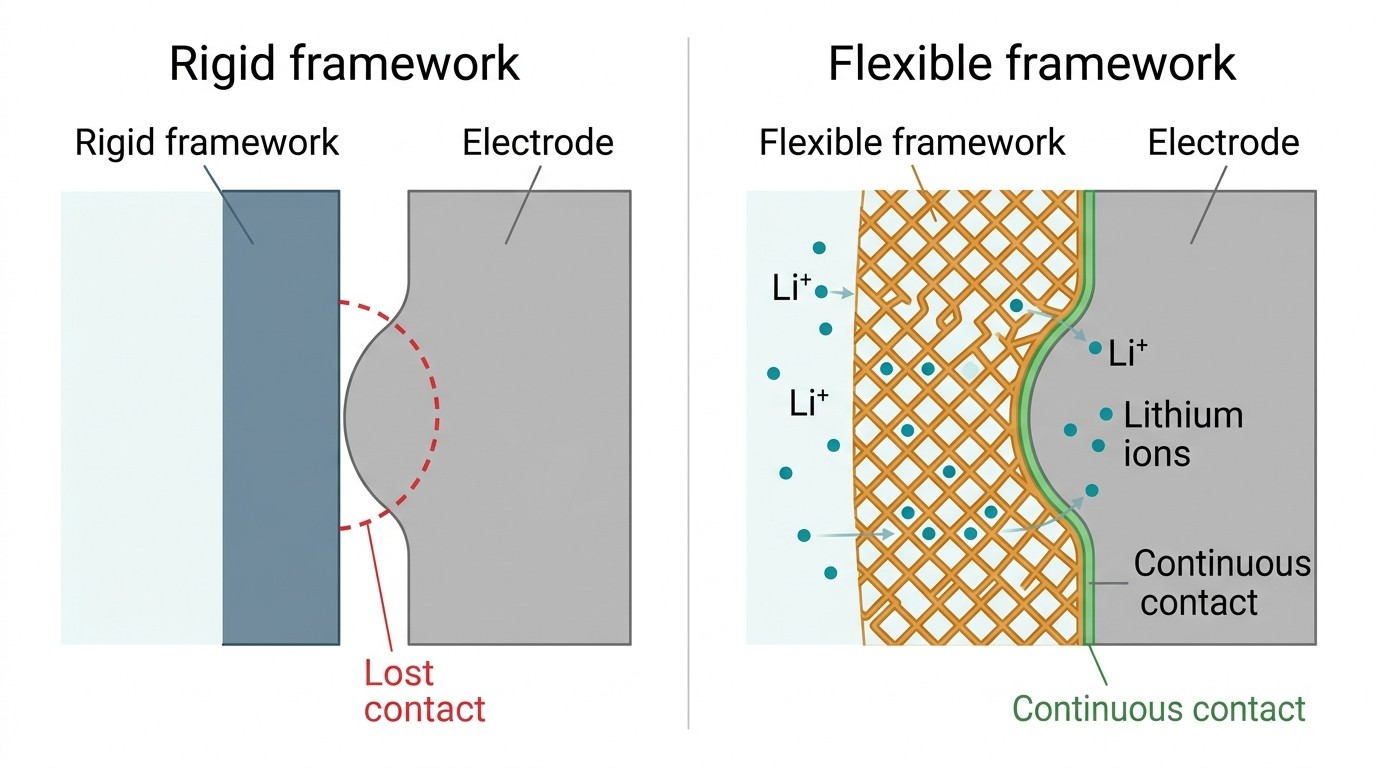
In a conventional lithium-ion battery, the liquid electrolyte has a quiet advantage. It seeps into every pore of the electrode, touches every active particle, and re-wets the surface as the electrode expands and contracts.
A solid electrolyte cannot do that. It has to be pressed against the electrode and stay in intimate contact for thousands of cycles. Where contact is incomplete, ions cannot cross, and the interface becomes a resistive bottleneck.
That resistance matters more than it sounds. It concentrates current, generates heat, and can encourage uneven lithium deposition. In lithium-metal cells, that is the path toward dendrites and short circuits. Research on interfacial effects in solid-state batteries has shown that incomplete physical contact creates high impedance at the electrolyte-electrode interface. As electrolytes become more conductive, work on interface potentials argues that resistance at the interfaces, rather than ion transport within the electrolyte, has become the bottleneck in many designs.
Manufacturers often compensate by stacking cells under pressure. That helps, but it adds weight and cost, and it does not guarantee contact where the electrode surface is rough or changing shape.
Materials scientists have therefore been chasing two properties that pull in different directions: a structure that selectively conducts lithium ions and a structure soft enough to maintain contact as the cell breathes.
What Rice’s ZnBTCA Actually Is
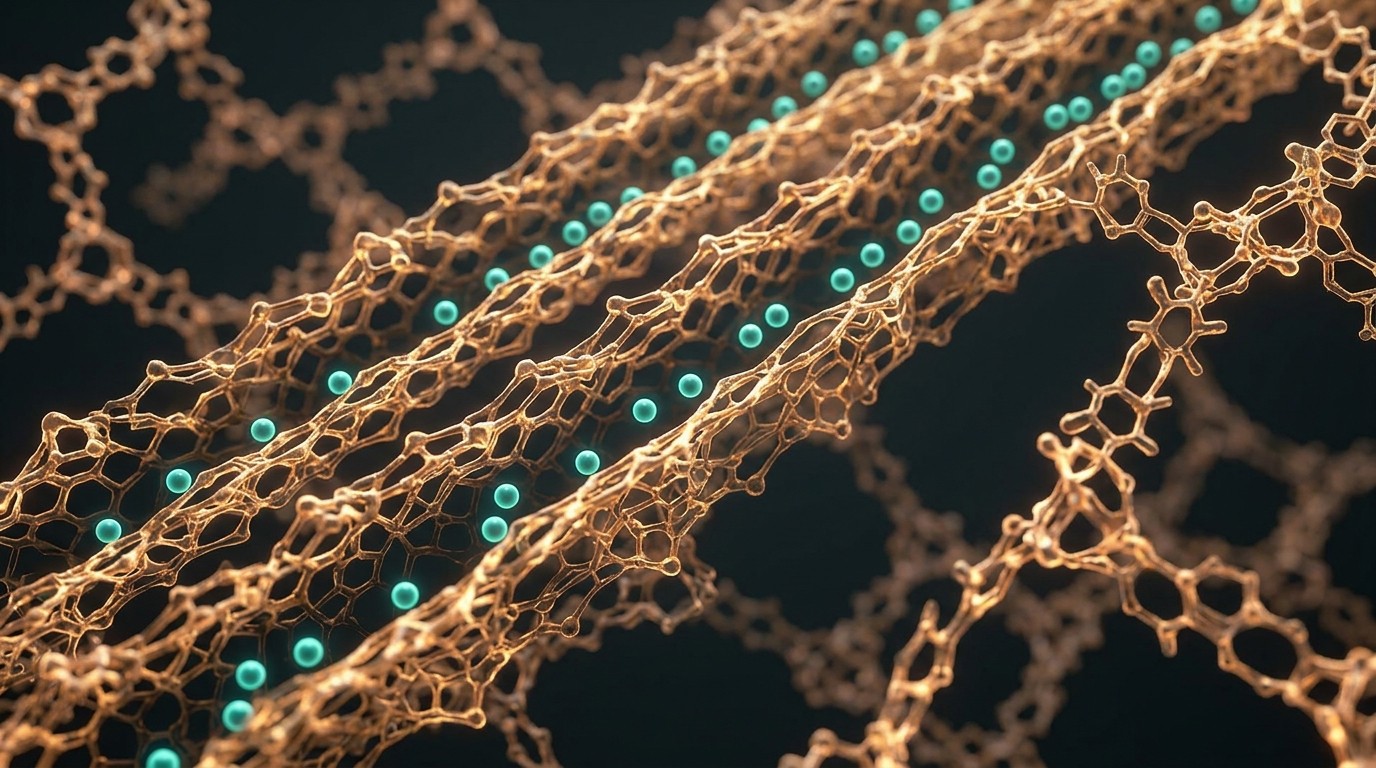
A metal-organic framework is a crystalline material built from metal nodes connected by organic linkers. The result is a porous lattice with ordered channels, a bit like a molecular scaffold with tunnels running through it.
MOFs are attractive electrolytes because those channels can be tuned. Pore size, framework charge, and the chemistry of the walls can all influence which ions move through and how easily.
The catch is mechanical. Most MOFs investigated for batteries use rigid aromatic linkers, which makes the lattice stiff. Stiffness is useful for holding a shape, but unhelpful when the material needs to deform slightly against an electrode surface.
Aliphatic linkers are carbon chains that can rotate and flex, unlike flat, rigid aromatic rings. That difference sounds small, but inside a lattice it changes how the whole material responds to stress. ZnBTCA is assembled from zinc nodes and a flexible aliphatic linker with a pliable carbon-chain backbone. The framework is therefore softer and more mechanically adaptable than its rigid counterparts. Its structure also carries a negative charge, which favors the movement of positively charged lithium ions through the channels.
Zinc and the aliphatic linker are both abundant and inexpensive, which matters for any material that would eventually need to be manufactured at scale. The team’s work was published by Rice University researchers across chemical and biomolecular engineering, chemistry, materials science, and nanoengineering.
“To our knowledge, ZnBTCA is the first MOF electrolyte built from an aliphatic linker with a flexible carbon-chain backbone,” said Sibani Lisa Biswal, chair of chemical and biomolecular engineering at Rice. “What this work shows is that we can think beyond just the chemistry and pore structure of these materials. Mechanical flexibility can also become a design tool for developing MOF electrolytes for solid-state batteries.”
The Four Numbers That Matter
The Rice team reported four results that are easy to conflate and worth separating.
First, conductivity. ZnBTCA reached 3.53 × 10⁻⁵ S/cm at 20°C and 1.87 × 10⁻⁴ S/cm at 60°C, with an activation energy of 0.36 eV. That is good for an all-solid MOF. It is also well below the sulfide electrolytes that lead the field, so this material is not competing on raw speed.
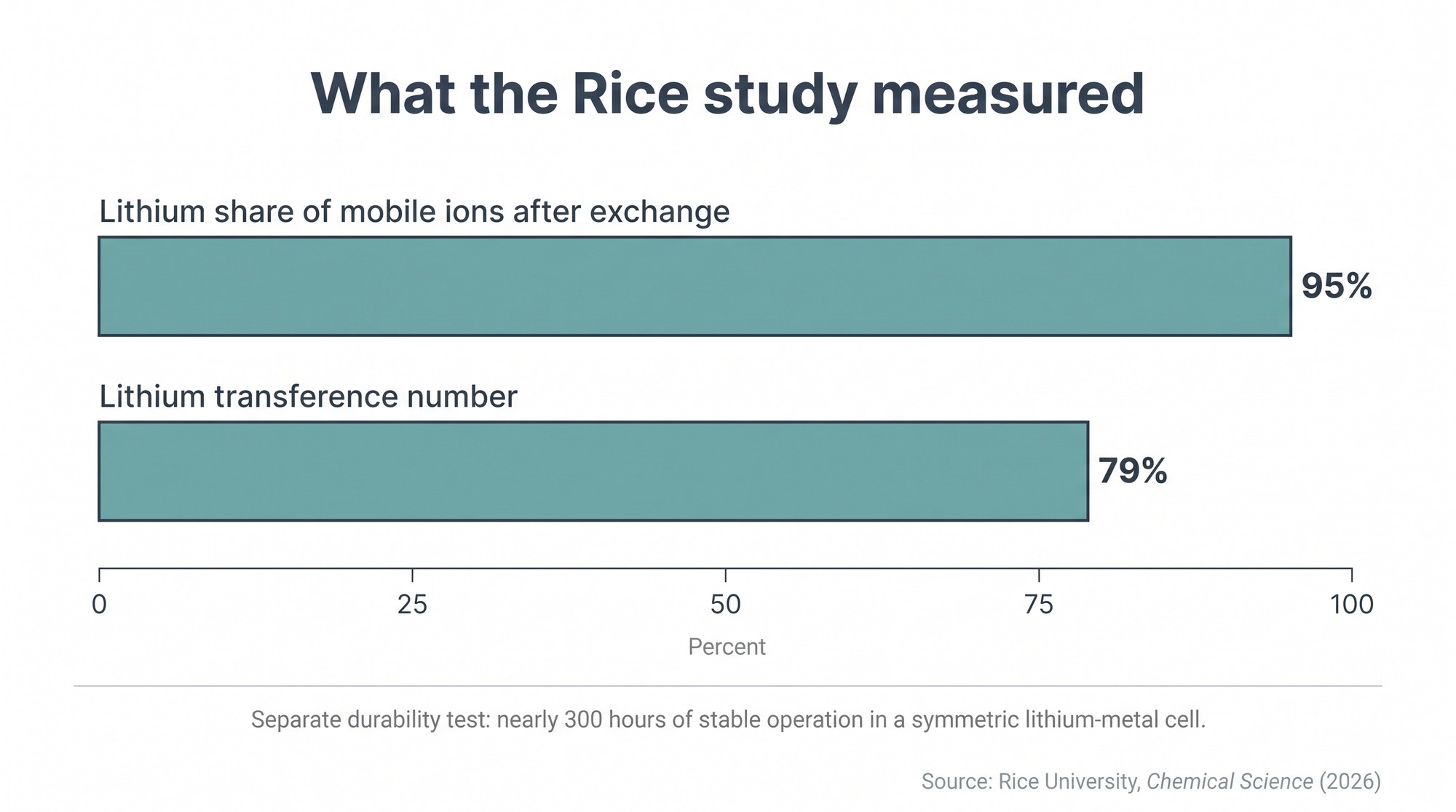
Second, the researchers exchanged the sodium ions in the framework for lithium. After the exchange, about 95% of the mobile charge-balancing ions were lithium, and the framework remained structurally intact. That measures how completely the material can be converted into a lithium-conducting form without collapsing.
Third, lithium ions carried about 79% of the ionic current through the material. This is the lithium transference number, and it describes selectivity rather than raw speed. A high value means the current is mostly carried by the ion you want, not by counterions drifting the other way.
Fourth, the team incorporated the MOF into a solid electrolyte membrane with a small amount of PEO and placed it between two lithium-metal electrodes. The cells operated stably for nearly 300 hours at current densities between 0.2 and 1.0 mA/cm2 as the current was progressively increased, with no evidence of short-circuiting under the conditions tested.
| Measurement | What it shows | What it does not show |
|---|---|---|
| 3.53 × 10⁻⁵ S/cm at 20°C; 1.87 × 10⁻⁴ S/cm at 60°C | Respectable conductivity for an all-solid MOF | Parity with sulfides or oxides, which sit one to two orders of magnitude higher |
| About 95% of mobile ions are lithium after exchange | The framework can be converted into a lithium-rich form without falling apart | How fast lithium moves, or how long the material lasts |
| About 79% lithium transference | Most ionic current is carried by lithium ions rather than counterions | Whether the same selectivity holds in a full cell with a cathode |
| Nearly 300 hours without short-circuiting | The composite membrane tolerated rising current in a symmetric cell | Full-cell performance, cycle life, or behavior at commercial current densities |
The distinction matters. A high transference number says the current is mostly lithium ions, not that there is much current. The conductivity figure sets the ceiling on rate.
The figures measure different things, and the durability result comes from a separate test.
A stable symmetric cell does not tell you how a full cell will behave with a cathode. And 300 hours is a durability signal, not a lifetime guarantee. The full paper is available in Chemical Science.
Why “Soft” Is a Design Variable, Not a Compromise
Battery materials are usually optimized around three properties: how well they conduct ions, how stable they are against the electrodes, and how cheaply they can be made. The Rice work argues for a fourth: how the material behaves mechanically.
The paper puts a number on that fourth property: a Young’s modulus of about 4.6 GPa. That is far softer than a dense oxide ceramic, which sits in the tens to hundreds of gigapascals, and far stiffer than a soft polymer electrolyte. ZnBTCA occupies an unusual middle ground.
Contact area is a mechanical variable, and it changes as electrodes expand and contract during cycling. Contact is not a binary state either. Even a nominally flat interface touches only at microscopic high points, so the real conducting area can be a fraction of the apparent area.
A rigid electrolyte can maintain high bulk conductivity and still lose contact at the interface. A softer framework can deform just enough to preserve that contact, even if its intrinsic conductivity is not record-breaking.
A trade-off remains. Softness helps with contact, but it does not automatically help with dendrite suppression, because a soft material can also be easier for lithium to push through. The team addressed that partly by combining the MOF with a flexible polymer in a membrane. The 300-hour test shows the composite resisted shorting under those conditions. It is not proof that the material is dendrite-proof in every configuration.
How It Compares With Other Solid Electrolytes
Solid electrolytes are not one category. Each family makes a different bargain between conductivity, stability, processing, and mechanical behavior, and the same trade-offs show up in any solid-state battery comparison with lithium-ion.
| Family | Lithium conductivity at 20–25°C | Typical strength | Typical limitation |
|---|---|---|---|
| Oxide ceramics such as LLZO | 10-4 to 10-3 S/cm | Stable, with a wide voltage window | Brittle; high interfacial resistance |
| Sulfide glasses and ceramics | 10-3 S/cm and above | Highest ionic conductivity; deformable | Moisture-sensitive; reactive interfaces |
| Halide electrolytes | About 5 × 10⁻⁵ to 5 × 10⁻³ S/cm | Stable against high-voltage cathodes | Less stable against lithium metal |
| PEO polymer electrolytes | Below 10-4 S/cm | Flexible and easy to process | Low room-temperature conductivity |
| All-solid MOFs, typical | 10-8 to 10-6 S/cm; best around 10-5 | Tunable pores and selective transport | Usually rigid and slow |
| ZnBTCA | 3.53 × 10⁻⁵ at 20°C; 1.87 × 10⁻⁴ at 60°C | 4.6 GPa soft framework; 0.79 transference | One to two orders below sulfides |
No single family wins on every axis. Oxides offer stability but resist deformation, sulfides conduct quickly but react with moisture, and polymers deform easily but struggle at room temperature. ZnBTCA does not win on every row either. Its significance is that it adds a design lever, not that it dominates the field. An MOF is also a different kind of material from a ceramic or a sulfide glass, so the comparison is about trade-offs rather than a single ranking.
Among all-solid MOFs, ZnBTCA is competitive rather than exceptional. An aluminium-based MOF reported 5.7 × 10⁻⁵ S/cm, a copper-azolate framework 4.4 × 10⁻⁵ S/cm, and a bilayer zwitterionic MOF 8.76 × 10⁻⁴ S/cm at 30°C. What sets ZnBTCA apart is not the conductivity figure but the combination of that figure with a 4.6 GPa modulus and a 0.79 transference number.
Earlier solid electrolyte research has already shown how much performance depends on the interface. A graphene-reinforced solid electrolyte took a different route to the same problem: making the material itself tougher.
The Other Ways to Solve the Contact Problem
ZnBTCA’s bet is to build compliance into the electrolyte itself. That is one option among several, and some of the alternatives are further along.
Stack pressure. The simplest fix is to clamp the cell together. Pressure improves contact, but it adds mass and hardware, and excessive pressure can promote lithium creep and uneven stress. Low-pressure operation has become a benchmark in its own right, because a cell that only works under heavy compression is hard to package.
Interlayers. Metallic, alloy, polymer, and conversion-type layers between the electrolyte and the lithium anode can improve wetting, lower the nucleation barrier, and stabilize the interface. They are added during assembly rather than designed into the bulk material, which makes them easier to trial but adds a process step.
Multilayer and gradient electrolytes. A compliant lithium-facing layer can preserve contact during plating and stripping, while a stronger or more oxidation-resistant cathode-facing region handles high voltage. The trade-off is more internal interfaces to control and a harder manufacturing route.
Structured composites. Aligning ceramic pathways through a polymer matrix has produced conductivities above 10 mS/cm at room temperature, with cells operated under very low external pressure. That approach chases speed and compliance at once, but it depends on controlling filler orientation across large areas. A 2026 review of solid electrolytes frames the field this way: the practical target is not the highest conductivity, but a thin, defect-tolerant electrolyte that holds low resistance under moderate pressure.
ZnBTCA sits at the opposite end of that design space: a single-phase framework that is soft by chemistry rather than by architecture. Its advantage is simplicity. Its limitation is that the same chemistry that makes it compliant also keeps its conductivity modest.
What the Study Does Not Show
The gap between a promising material and a battery is filled with tests that do not make headlines. This study leaves several open.
- No full-cell result. The demonstration used symmetric lithium-metal cells. A practical cell needs a cathode, meaningful areal capacity, and realistic current density.
- The conductivity is modest. At 3.53 × 10⁻⁵ S/cm and 20°C, ZnBTCA sits well below sulfide electrolytes and around an order below typical LLZO. The paper presents the material as a design strategy, not a conductivity record, and the numbers support that framing.
- The cycling test used a composite. The 300-hour result is for a ZnBTCA membrane containing PEO, not the neat framework. That is a normal way to build a test cell, but the durability figure reflects the composite, not the MOF alone.
- Limited cycling data. Nearly 300 hours is a useful early signal. Commercial cells are expected to last thousands of hours and hundreds to thousands of cycles.
- No cost or manufacturing analysis. Zinc and the linker are cheap in principle. Turning a lab-scale MOF into a uniform, pinhole-free membrane at roll-to-roll scale is a separate problem.
- No cell-level temperature or voltage-window data. Real cells run hot and cold, and they operate across a voltage range that can decompose the electrolyte.
None of these gaps invalidate the result. They define what kind of result it is: a materials design demonstration, not a product milestone.
What Would Make This Matter for Real Batteries
The next round of evidence is predictable, which is a good thing. The field knows what to ask for.
- Full-cell testing with a commercial cathode chemistry and realistic loading.
- Higher room-temperature conductivity, reported with full measurement conditions.
- Longer cycling at higher current densities, with post-mortem analysis of the interface.
- Scale-up trials showing the membrane can be made uniformly and without pinholes.
- A cost model that includes synthesis, purification, solvent handling, and yield.
If ZnBTCA or a related material clears those hurdles, the mechanical design idea could outlast the specific chemistry. That is often how materials science contributes: not by producing a drop-in product, but by adding a variable that other researchers begin to optimize. The same pattern is visible in US solid-state battery manufacturing efforts, where progress depends as much on process control as on chemistry.
Frequently Asked Questions
What is a solid electrolyte?
A solid electrolyte is a material that conducts ions while remaining solid, replacing the liquid or gel electrolyte in a conventional battery. It also acts as a physical separator between the anode and cathode.
What is a metal-organic framework?
A metal-organic framework is a porous crystalline material made from metal nodes connected by organic linkers. The structure contains ordered channels that can be tuned to hold or transport specific ions or molecules.
How soon will solid-state batteries be available?
Solid-state cells already serve small niche applications, but mass-market automotive cells remain limited by cost, manufacturing yield, and interface durability. Most announced automotive timelines target the late 2020s or early 2030s, and several have slipped. A new electrolyte material like ZnBTCA does not change those timelines on its own.
Is a solid electrolyte safer than a liquid electrolyte?
Generally, yes, because it removes the flammable liquid that can vent and ignite in a conventional cell. That does not make every solid-state design inherently safe. Interface reactions, thermal runaway paths, and mechanical failure modes still need to be tested.
What is the difference between a solid electrolyte and a liquid electrolyte?
A liquid electrolyte soaks into porous electrodes and maintains contact automatically. A solid electrolyte must be engineered to maintain contact mechanically, which is why interface resistance is a central challenge.
What is the solid electrolyte interphase?
The solid electrolyte interphase, or SEI, is a passivation layer that forms where a liquid electrolyte meets a reactive electrode. It is a different concept from a solid electrolyte. In solid-state cells, similar interphase layers can still form, and controlling them is part of the interface problem.
The Bottom Line
ZnBTCA is a useful reminder that solid-state batteries are not held back by one missing wonder material. They are held back by a set of coupled problems, and mechanical contact is one of the most stubborn.
A flexible MOF that maintains contact while selectively conducting lithium ions is a credible addition to the design toolkit. The 4.6 GPa modulus, the 95% lithium exchange, the 79% transference number, and the nearly 300-hour symmetric cell result are real evidence that the approach works at lab scale.
The catch is speed. At 3.53 × 10⁻⁵ S/cm, ZnBTCA gives up roughly two orders of magnitude to sulfide electrolytes. That trade-off may be worth it if it removes stack pressure or enables a simpler cell, but it is a trade-off, not a free win.
What comes next is the unglamorous part: full cells, higher conductivity, scale-up, and time. Until then, the honest description is a promising design principle, not a breakthrough battery.


