
Every day, thousands of ships sit at berth in the world’s ports with their engines running. Not to move, but to keep the lights on. Those auxiliary diesel generators power lighting, air conditioning, refrigeration, and crew quarters while the vessel waits, pumping exhaust into the surrounding city. Shore power is the obvious fix: plug the ship into the grid and switch the generators off.
It works, it is decades old, and yet it is still surprisingly uncommon. Here is what shore power actually is, how it works, and why a proven clean technology keeps losing to a tank of heavy fuel oil.
What Is Shore Power (or “Cold Ironing”)?
Shore power, also called onshore power supply (OPS), alternative maritime power (AMP), or “cold ironing,” lets a docked ship run on electricity from the land grid instead of its own fuel-burning engines. A heavy-duty cable connects the vessel to a shoreside supply point, and the ship’s auxiliary systems draw power from the local network. According to the US Environmental Protection Agency’s shore power assessment, this allows vessels to turn off their engines and plug into the local electricity grid while at berth, cutting pollution at the dock.
The name is a historical leftover, and “cold ironing” is still used interchangeably with shore power today.
How Shore Power Actually Works
Plugging in a cargo ship is not like charging a phone. The connection has to handle the electrical equivalent of a small town.
Most ocean-going vessels run onboard systems at 60 hertz (Hz), while many national grids, including across much of Europe and Asia, run at 50 Hz. A shore power installation therefore typically includes a frequency converter, high-voltage transformers, and a cable-management system such as a davit or trench arm. International standards in the IEC/IEEE/ISO 80005 series exist precisely so that a ship built for one port can safely connect in another.
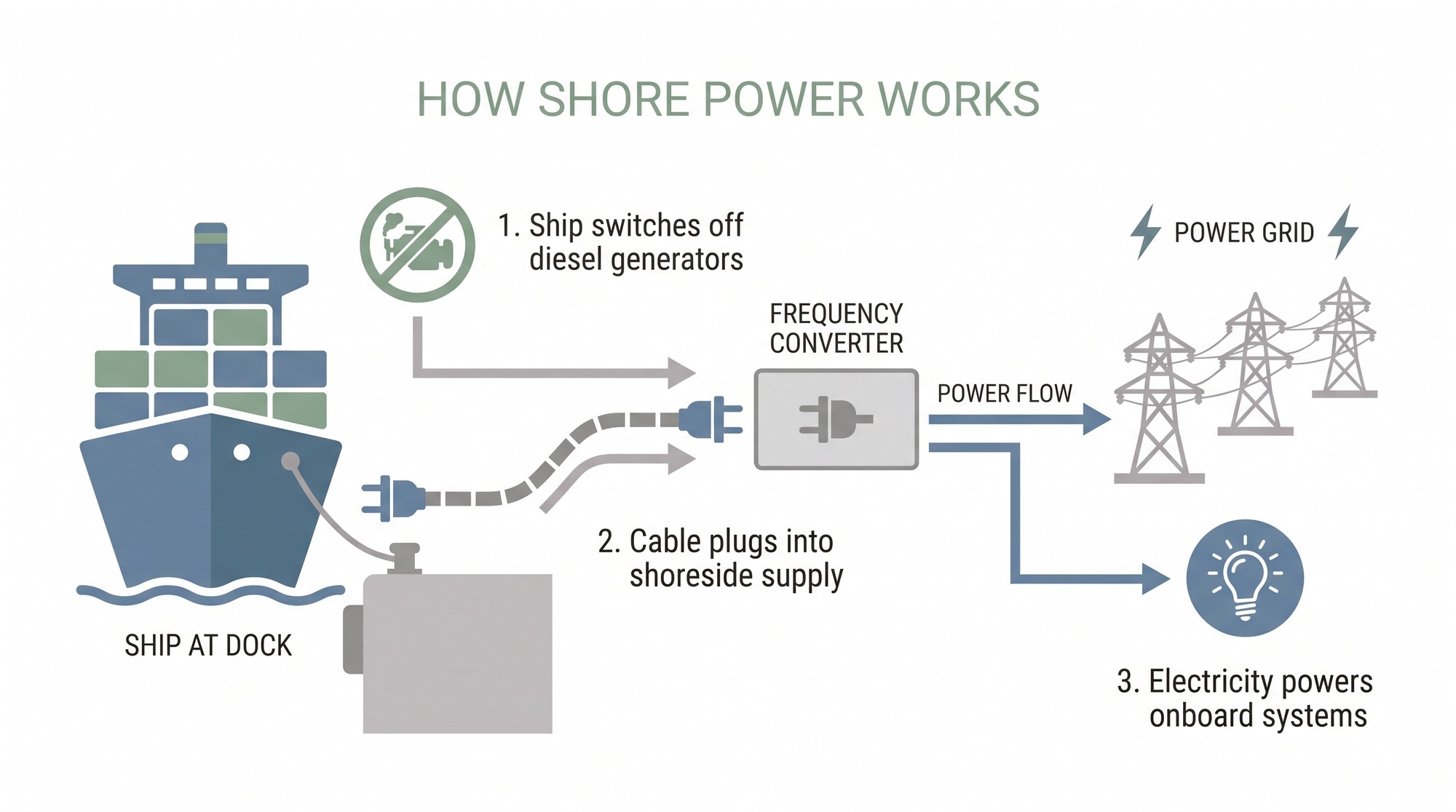
The power demand varies enormously by vessel type. These are approximate berth requirements:
| Vessel type | Typical berth power demand |
|---|---|
| Large cruise ship | 10 to 16 MW |
| Large container ship | 3 to 8 MW |
| Ro-Ro / Ro-Pax ferry | 1 to 4 MW |
| Bulk carrier / general cargo | 1 to 2 MW |
Shore power does not make a berth truly zero-emission, either. The same EPA assessment notes it cannot address boilers or other sources that must keep running while a ship is docked, and vessels still emit while connecting and disconnecting.

Why Port Air Pollution Matters
Ship exhaust is not just a local nuisance. Before cleaner marine fuels were mandated, researchers estimated that shipping-related fine particulate matter was linked to roughly 400,000 premature deaths from lung cancer and cardiovascular disease and about 14 million cases of childhood asthma every year, according to a study published in Nature Communications. Those burdens fall disproportionately on port cities and coastal communities.
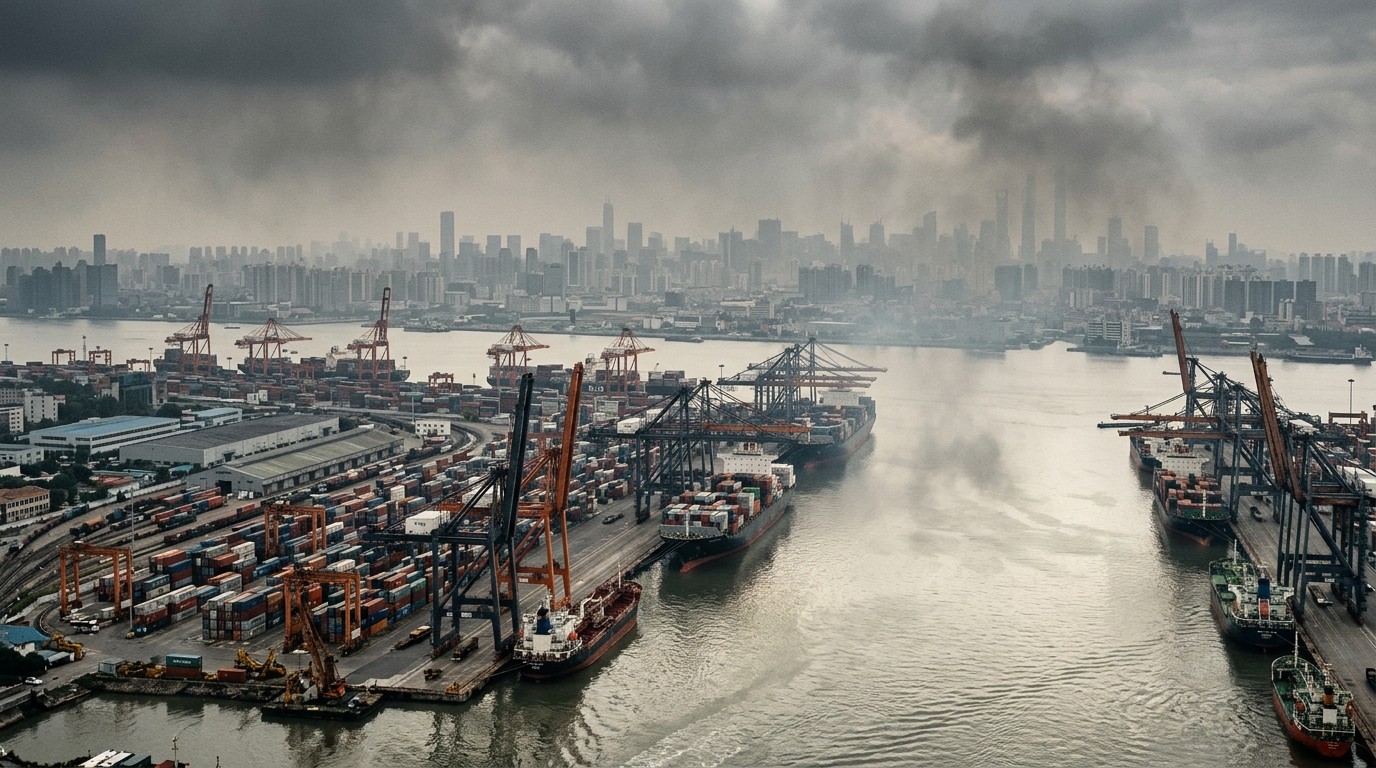
Shipping matters for the climate too. The IMO’s Fourth Greenhouse Gas Study found the sector accounted for about 2.89% of global anthropogenic greenhouse gas emissions in 2018. Because ships spend a large share of their time in port, cleaning up that idle time is one of the more direct ways to cut the pollution people actually breathe.
How Much Does Shore Power Actually Cut?
Because a ship running on shore power switches its auxiliary engines off entirely, the drop in local pollution at the berth is dramatic. The exhaust that would otherwise come from those engines largely disappears:
| Pollutant | Reduction at berth |
|---|---|
| Nitrogen oxides (NOx) | up to ~95% |
| Sulfur oxides (SOx) | up to ~95% |
| Fine particulate matter (PM2.5) | up to ~95% |
| Carbon dioxide from the auxiliary engines at berth | roughly 100% |
The exact figure depends on the vessel and on how quickly it connects and disconnects, which is why the EPA describes installed shore power as producing zero onsite emissions. The catch is what happens back at the power station. The net greenhouse gas saving ranges from a modest reduction on a coal-heavy grid to more than 90% where the electricity is low-carbon. In other words, shore power is cleanest where the grid is cleanest.
The Rules Driving Adoption
For decades, shore power was voluntary and stayed niche. Regulation is changing that.
In California, the Air Resources Board’s Ocean-Going Vessels At-Berth Regulation now requires most visiting ships to use a CARB-approved emissions control strategy, usually shore power, with requirements phased in by vessel type:
| Compliance start date | Vessel types |
|---|---|
| 1 January 2023 | Container, reefer, and cruise vessels (all regulated terminals) |
| 1 January 2025 | Ro-Ro vessels (all regulated terminals); tankers at Los Angeles and Long Beach |
| 1 January 2027 | Tankers (all regulated terminals) |
Europe is moving on a similar timetable. Under the EU’s FuelEU Maritime rules, container and passenger ships of 5,000 gross tonnage and above will have to connect to onshore power at major ports from 2030, while the parallel Alternative Fuels Infrastructure Regulation pushes ports to install enough capacity to serve the ships that call there. China now requires many newly built coastal and inland vessels to be shore-power ready and requires ships to plug in at equipped berths during longer stops. The International Maritime Organization, meanwhile, has published guidelines on onshore power supply to standardize how it is delivered across borders.
Why Uptake Lags: The Economics Problem
Here is the uncomfortable part. In principle, shore power should be cheaper than burning fuel. In practice, the math often flips.
Electricity accounts for roughly 80 to 85% of the total cost a vessel pays when using shore power, with port charges making up only 15 to 20%. When grid power is expensive, plugging in can cost more than running the ship’s own generators. That is exactly the situation in the UK, where electricity prices ran about 18% above the EU average in the second half of 2025, according to the House of Commons Library, and network charges are still climbing.

The distortion runs deeper. Three factors keep the math unfavorable to shore power:
- Fuel is largely untaxed. Marine bunker fuel burned in auxiliary engines is mostly exempt from the energy taxes and grid tariffs that shoreside electricity carries.
- Ports pay upfront. A single high-voltage berth can cost tens of millions for substations, switchgear, and civil works.
- Shipowners pay too. Vessels need costly retrofits to connect, and owners are reluctant to invest before enough berths exist.
The result is a chicken-and-egg standoff: ports wait for equipped ships, and shipowners wait for equipped berths.
Analysts, including at the classification society DNV and the European Sea Ports Organisation, have argued that voluntary incentives and subsidies alone have failed to scale shore power and that binding mandates are needed to make the economics work for ports that invest in it.
Where It’s Already Working
Shore power is not a new idea. Gothenburg, in Sweden, is widely credited with the first modern high-voltage ferry connection, in 2000, and Juneau, Alaska, followed with an early cruise-ship system in 2001; the US Navy had used shoreside power for decades before that. Today the technology is spreading fast:
- Hamburg has expanded shore power connections with the carrier Hapag-Lloyd.
- Rotterdam has trialled mobile shore power for vessels at berth.
- The Port of Québec is building a 16 MW cruise connection due in 2028.
- Peru’s Port of Callao received Latin America’s first shore power system, launched by DP World.
In October 2026, Portsmouth International Port switched on what has been described as the UK’s first high-voltage, multi-berth shore power system, letting docked ships shut down their generators. Even that showcase came with a caution: because UK electricity is so expensive, the connection can cost more than the diesel it replaces.
It is one front in a broader effort to clean up marine transport. IL has charted how electric ferries are becoming real transit infrastructure across the same period.
Where Shore Power Falls Short
Shore power is not a universal fix, and it is worth being clear about the gaps.
- The grid has to cope. A single large ship can draw several megawatts at once, so ports often need costly grid reinforcements before a single cable is laid. In the UK, those network upgrades are one of the biggest barriers to installing shore power at all.
- Emissions move before they vanish. Because the auxiliary engines are switched off, local pollution at the berth falls sharply, but the net climate benefit still depends on how the electricity was generated.
- Not every berth can connect. Retrofits, cabling, frequency converters, and vessel scheduling all have to line up before a ship can plug in.
- There are stopgaps. Where shore power is unavailable, ports and operators fall back on exhaust-capture barges that duct funnel gases through scrubbers, floating LNG power barges, or ships’ own batteries and fuel cells.
Frequently Asked Questions
Why is shore power called “cold ironing”?
The term is older than the technology it now describes. When coal-fired steamships docked and shut down their boilers, the engine’s iron literally went cold. The phrase, popularized in navy and steamship circles, stuck even after ships moved to diesel, and it is still used interchangeably with “shore power” today.
Is shore power the same as charging an electric ship?
No. An electric car stores energy in a battery and drives away with it; a ship using shore power stays plugged in and draws electricity live to run its systems, then disconnects before it sails. The power involved is also in a different league, often several megawatts rather than a few kilowatts.
Do smaller vessels use shore power too?
Yes. The shift is most visible on large cruise and container ships, but low-voltage systems have served tugs, fishing boats and offshore support vessels for years, and some ports run low- and high-voltage connections side by side.
The Bottom Line
Shore power is one of the few shipping fixes that is proven, available, and directly improves the air in port cities. The technology is not the bottleneck; the gap between the price of grid electricity and the price of largely untaxed fuel is. As mandates tighten in California and Europe, the incentive shifts from a nice idea to a required kit, and the ports that move first stand to gain. For a wider view of how trade is being cleaned up, IL’s reporting on the industry’s interest in hydrogen for shipping and on clean transport corridors is a good place to start.


