
A viral tech claim has circulated for over a decade: that NASA computers browse the web at 91 gigabits per second, or occasionally an even more improbable 91 gigabytes per second. Anyone asking how fast NASA internet is usually encounters memes suggesting employees download entire game libraries in a blink over office Wi-Fi.
The reality is both more grounded and more impressive from an engineering perspective. That 91 Gbps figure came from a single, finely tuned wired experiment in November 2013 between a Maryland research center and a conference floor in Colorado. Across its day-to-day facilities, NASA does not run on one mythical super-connection, nor does it beam 91 Gbps through wireless routers. Instead, the agency separates everyday office Wi-Fi, internal mission traffic, shared national science backbones like ESnet, and deep-space radio links that often operate closer to early broadband speeds.
Where the 91 Gbps Claim Comes From
The famous 91 Gbps number dates back to November 2013 at the SC13 supercomputing conference in Denver, Colorado. Engineers from NASA’s High-End Computer Networking team staged a 91 Gbps wired data transfer (GSFC SC13 report (PDF); ESnet recap) between NASA’s Goddard Space Flight Center in Greenbelt, Maryland, and the Denver convention floor.
That test moved data disk-to-disk across a dedicated 100 Gbps research fiber link under ideal, controlled conditions. There were no competing office laptops, no consumer web servers throttling the connection, and no wireless hop in the path. Reaching 91 Gbps over a 100 Gbps pipe was a demonstration of how efficiently high-performance computing workstations could push raw scientific files near the physical limit of the circuit.
Over time, social media posts distorted the benchmark in two major ways. First, commentators began describing the wired fiber experiment as NASA’s Wi-Fi speed. Second, viral graphics frequently swapped the lowercase b in gigabits (Gb) for an uppercase B for gigabytes (GB). Because one byte equals eight bits, a 91 GBps transfer would require 728 Gbps of bandwidth, more than seven times the capacity of the 100 Gbps circuit used in the 2013 demonstration.
NASA Does Not Have One Internet
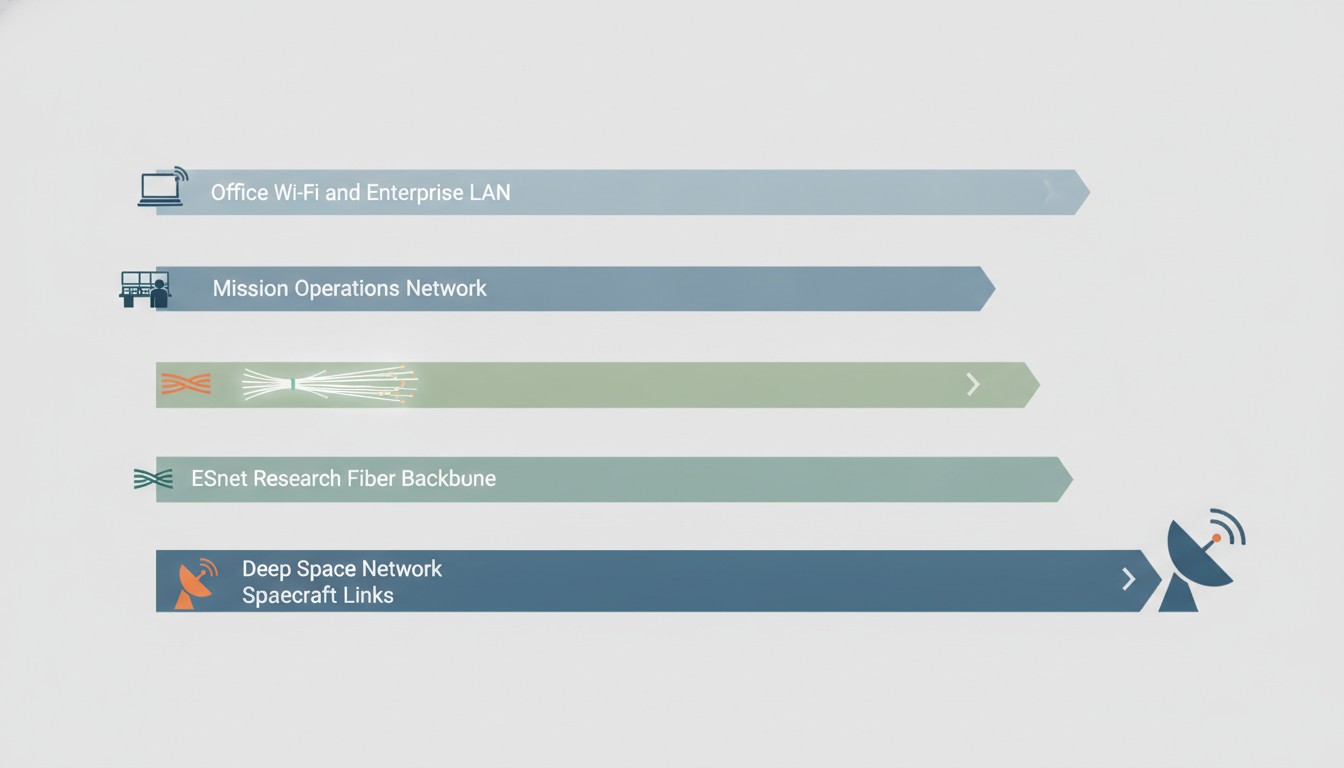
Asking for a single NASA internet speed is like asking for the top speed of a city’s entire transportation system. The answer depends entirely on whether you are looking at a sidewalk, a commuter rail line, or a dedicated freight corridor. NASA routes data across four distinct layers depending on security, file size, and destination.
- Corporate and public internet access: Standard enterprise connections used by employees and contractors for email, web browsing, video calls, and public websites.
- NASA Integrated Services Network (NISN): The agency’s internal institutional and mission communication backbone that connects field centers, tracking stations, and control rooms under strict routing and security controls.
- Shared scientific research backbones: High-capacity optical networks, including the Department of Energy’s ESnet, used to move massive climate simulations, astrophysics datasets, and satellite imagery between supercomputing hubs.
- Spacecraft and deep-space links: Radio and optical laser connections through systems like the Deep Space Network that prioritize signal survival across millions of miles over raw throughput.
Online blogs sometimes refer to NASA’s research infrastructure as a secret shadow network. In practice, there is nothing clandestine about it. High-capacity research networks are simply private, high-performance optical backbones kept separate from public consumer traffic so a multi-terabyte telescope dataset does not get stuck behind evening video streaming.
What ESnet Actually Is
Many articles claiming NASA operates a private 91 Gbps network are actually pointing to the DOE ESnet research network, short for the Energy Sciences Network. Funded by the U.S. Department of Energy Office of Science and managed by Lawrence Berkeley National Laboratory, ESnet is an unclassified, high-performance network built specifically for large-scale scientific data movement.
NASA does not own ESnet, though NASA researchers and supercomputing facilities peer with it to exchange climate models, Earth-observation records, and space-science data with national laboratories and universities. Because scientific instruments generate massive continuous files rather than millions of tiny web page requests, ESnet engineers its optical fiber paths to move huge blocks of data with minimal packet loss.
During the 2013 Goddard-to-Denver demonstration, 100 Gbps optical links represented the leading edge of national research backbones. Since then, ESnet has upgraded its core infrastructure to a 400 Gbps-class per-link backbone architecture to keep pace with next-generation physics, genomics, and earth-system modeling. Even so, a 400 Gbps backbone is a shared multi-lane highway connecting major institutions, not a speed delivered to an individual scientist’s laptop.
Why Lab Records Are Not NASA’s Speed
Another source of confusion comes from experimental optical-fiber milestones that get mislabeled online as NASA’s new internet. In August 2020, researchers at University College London, working with Xtera and KDDI Research, achieved a 178 terabits per second transmission record (178,000 Gbps) by utilizing a much wider spectrum of light wavelengths across S, C, and L bands than commercial fiber systems typically use.
That 2020 breakthrough was an optical physics achievement conducted in a laboratory setup, not a NASA operational upgrade. You can examine how the engineers modulated those wavelengths in our breakdown of the 178 Tbps optical fiber record. Less than a year later, researchers in Japan pushed experimental multi-core fiber capacity even further, setting a 319 terabits per second transmission milestone over a simulated 3,001-kilometer loop.
Comparing a single-fiber laboratory experiment to an operational network like ESnet misses the engineering gap between a test bench and a production grid. Lab trials send carefully amplified light pulses through a single dedicated fiber line with custom transponders at each end. An operational backbone must run 24 hours a day across thousands of miles of buried cable, routing live traffic through production switches, surviving construction accidents, and maintaining redundancy within a real-world hardware budget.
What About NASA’s Wi-Fi and Offices?
Walk into an administrative building at Ames Research Center or Johnson Space Center with a standard laptop, and the wireless network looks very much like the enterprise Wi-Fi at any major university, hospital, or corporate campus. The laws of radio physics and commercial networking standards apply equally inside federal facilities.
Even modern Wi-Fi 6E routers have a theoretical maximum channel throughput of around 9.6 Gbps under laboratory conditions across multiple spatial streams. Real-world wireless speeds on a single laptop or phone are a fraction of that figure, typically ranging from a few hundred megabits per second to just over 1 Gbps depending on wall interference, distance from the access point, and how many colleagues are connected nearby. Emerging Wi-Fi 7 hardware raises the theoretical ceiling higher, yet it still comes nowhere near 91 Gbps.
Even if a wireless access point could somehow transmit at 91 Gbps, standard office laptops lack the internal storage and networking hardware to absorb data that fast. Writing data at 91 Gbps (roughly 11.375 gigabytes every second) exceeds the sustained write speed of a standard consumer solid-state drive. To capture a 91 Gbps stream without dropping data, engineers have to stripe transfers across specialized arrays of enterprise drives or high-speed system memory connected via server-grade 100GbE optical network interface cards.
Space Links Are Slow by Design
If terrestrial office speeds surprise people expecting sci-fi numbers, spacecraft communications are an even sharper reality check. When NASA communicates with rovers on Mars, probes at Jupiter, or telescopes in deep space through its Deep Space Network of giant radio antennas in California, Spain, and Australia, data rates drop into the megabits-per-second range, and at extreme solar system distances, into kilobits per second.
Spacecraft transmitters operate on tight power budgets over vast distances where radio signals spread out and weaken by the square of the distance traveled. Engineers have steadily pushed those limits with optical laser experiments: NASA’s Lunar Laser Communication Demonstration hit 622 Mbps from lunar orbit in 2013, and the Deep Space Optical Communications experiment aboard the Psyche mission has demonstrated high-bandwidth laser downlinks from millions of miles away. For shorter surface ranges, NASA has even partnered with telecommunications engineers to deploy a 4G cellular network on the Moon to connect lunar landers and rovers.
Yet no matter how wide the bandwidth pipe becomes, deep-space networking hits a hard physical wall: latency. Radio waves and laser pulses travel at the speed of light, roughly 186,282 miles per second in a vacuum. Because light-speed latency across cosmic distances takes anywhere from about four to twenty-four minutes one way between Earth and Mars, a spacecraft cannot use standard internet protocols that wait for an instant acknowledgment before sending the next packet. NASA instead relies on Delay and Disruption Tolerant Networking, a store-and-forward architecture that caches data bundles at intermediate nodes until a clear line-of-sight window opens.
So How Fast Is It, Honestly?
Putting all the pieces together shows why no single number describes NASA’s connectivity. A researcher transferring climate simulation outputs between supercomputing centers over a dedicated optical path operates in a completely different tier from an accountant checking email over office Wi-Fi or a flight controller downloading telemetry from a lunar orbiter.
| Network Tier / Connection Type | Typical or Demonstrated Speed | Environment Status | Primary Use Case |
|---|---|---|---|
| Everyday US Home Broadband | ~100 to 300 Mbps | Operational consumer | Household streaming, browsing, remote work, and gaming |
| NASA Office Wi-Fi and Enterprise LAN | Hundreds of Mbps to ~1 Gbps per user (Wi-Fi 6E theoretical max ~9.6 Gbps) | Operational enterprise | Day-to-day employee laptops, video meetings, and administrative work |
| Spacecraft and Deep Space Network | Kbps to Mbps range (up to 622 Mbps in 2013 LLCD lunar laser demo) | Operational / Flight demo | Telemetry, scientific instruments, and commands across space latency |
| 2013 NASA SC13 Demo | 91 Gbps peak disk-to-disk | Controlled wired demonstration | Point-to-point scientific file transfer over a dedicated 100 Gbps link |
| DOE ESnet Research Backbone | 100 Gbps to 400 Gbps-class per core link | Operational research backbone | Moving multi-terabyte datasets between national labs and supercomputers |
| 2020 UCL / Xtera Optical Fiber Record | 178 Tbps (178,000 Gbps) | Single-fiber laboratory test | Experimental wavelength-division multiplexing over standard fiber core |
In short: no 91 Gbps office Wi-Fi, and no lab-record throughput on everyday networks, just dedicated research backbones plus pragmatic office and space links built for their own jobs.
Frequently Asked Questions
Does NASA have the fastest internet?
No. While NASA supercomputing centers connect to high-speed national research backbones like ESnet that operate 100 Gbps to 400 Gbps core links, those speeds are shared across major research institutions. The fastest data transmission speeds ever recorded, such as the 178 Tbps and 319 Tbps optical fiber milestones, were achieved by university and telecommunications physics laboratories in the UK and Japan, not on NASA’s everyday networks.
Does Tbps internet exist?
Terabit-per-second data transmission exists in two places: inside laboratory fiber-optic experiments that push hundreds of terabits through a single strand of glass, and as the combined aggregate capacity of major undersea cables and national internet backbones. However, no individual home, office desktop, or consumer Wi-Fi router connects to the internet at terabit speeds.
How fast can the internet travel?
It helps to separate bandwidth (how much data arrives per second) from propagation speed (how fast a signal physically moves from point A to point B). Signals in vacuum travel at nearly the full speed of light, while light inside glass fiber-optic cable slows by roughly one-third because of the refractive index of glass.
Is 1000 Mbps fast?
Yes. A 1000 Mbps connection, commonly sold as 1 gigabit per second (1 Gbps) fiber internet, is roughly three to ten times faster than typical U.S. home broadband connections of 100 to 300 Mbps. A 1 Gbps connection can easily handle multiple 4K video streams, large cloud backups, and fast software downloads across an entire household simultaneously.

