
Antarctic blue whales are increasing. A new assessment estimates 4,018 animals in 2024, with a wide range of 1,874 to 8,395. That is about ten times the 418 animals estimated in 1973, with a range of 147 to 1,099, yet it remains only 1.9% of pre-whaling abundance, with a range of 0.7% to 4.8%.
The study is the first circumpolar assessment in more than 20 years. It was led by Zoe Rand at the University of Washington and published November 5 in Endangered Species Research. It fuses historical catch records with modern survey data. The message is steady and sober. Growth is real, and absence remains vast.
How Many Antarctic Blue Whales Are Left
The estimate is 4,018 Antarctic blue whales in 2024, with a range of 1,874 to 8,395. The central value sits near 2% of the estimated pre-whaling population of 205,905 animals. That pre-whaling figure also carries a wide range, from 168,473 to 276,342.
In plain words, a range is not a mistake. It shows what the data can and cannot pin down. Counting whales across the Southern Ocean is difficult. The model gives a best estimate and the bounds around it. Readers should hold both together.
The low point came after the last reported catch in 1973. The model estimates 418 whales then, with a range of 147 to 1,099. That was about 0.20% of pre-whaling levels, with a range of 0.08% to 0.42%. Whaling had reduced the population by 99.8%. The rise since then is roughly tenfold, from a remnant.
- 2024 estimate: 4,018 whales, with a range of 1,874 to 8,395
- 1973 low point: 418 whales, with a range of 147 to 1,099
- Share of pre-whaling levels: 1.9%, with a range of 0.7% to 4.8%
- Growth rate: 4.5% per year, with a range of 1.6% to 7.3%
- Pre-whaling abundance: 205,905 whales, with a range of 168,473 to 276,342
How Scientists Counted Whales They Rarely See
Antarctic blue whales spend little time at the surface. They roam a vast ocean. No single survey can count them all. The team built a Bayesian theta-logistic population model. That is a statistical tool that reconstructs population change year by year, from 1904 to 2024.
The model joins three kinds of evidence. The first is historical catch data, including revised records of Soviet catches. The second is ship-based line-transect surveys, in which observers sail straight courses and record sightings and distances to estimate density. The International Whaling Commission ran circumpolar survey series from 1978 to 1984, 1985 to 1991, and 1991 to 2004. The third is photo identification from 2003 to 2019, which uses natural markings to recognize individual whales and estimate abundance through recapture.
Growth is estimated at 4.5% per year, with a range of 1.6% to 7.3%. That is slower than the 7.3% per year reported in the 2004 assessment. A lower growth estimate does not mean the whales faltered. It reflects more data, revised catches, and a longer view. The team traced much of the difference to updated survey numbers and the new photo-based count. Sensitivity tests found the results robust to model assumptions. If anything, the numbers may sit low. Ship surveys can miss diving whales, which may bias estimates 4% to 25% downward, and photo recapture assumes wider mixing than the whales show.
Why Whaling Nearly Erased Them
Antarctic blue whales, Balaenoptera musculus intermedia, are the Southern Ocean subspecies of the blue whale. They are the largest animals known to have lived. Adults can exceed 400,000 pounds and stretch past 100 feet. They feed almost entirely on Antarctic krill, taking several tons per day in the feeding season. They can live 80 to 90 years.
Size made them a target. Whaling fleets prized them for oil yield. The hunt peaked with more than 30,000 taken in a single year around 1930, and in many seasons whalers removed between 10% and 40% of the whole population. In total, whalers killed 347,662 Antarctic blue whales. The International Whaling Commission banned killing them in 1964. Soviet fleets continued illegal whaling for about another decade, until 1973. By then the population had fallen to hundreds.
The scale is hard to picture. Hundreds of thousands once moved through Southern Ocean feeding grounds. Then came roughly 99.8% removal. What survives today descends from a narrow remnant. Protection stopped the killing. Recovery has been slow ever since.
Why Tenfold Growth Still Leaves an Absence
Blue whale biology sets a slow pace. Females mature at around 5 to 10 years of age. They carry a calf for 10 to 11 months. They give birth to one calf at a time, usually every two to three years. A population built this way cannot rebound quickly, even under full protection.
The contrast with another recovery is instructive. Western South Atlantic humpback whales fell to about 450 animals in the mid-1950s and later rebuilt to around 25,000, or about 93% of pre-exploitation size, as described in Intelligent Living’s account of humpback whales returning from the brink. Antarctic blue whales tell a different story. Tenfold growth sounds large. Against a starting point of 418 animals, with a range of 147 to 1,099, it still leaves about 98% of the past population missing.
Lead author Zoe Rand described the 4.5% growth figure as relatively realistic for this species. She added that it remains an open question whether the population will ever return to pre-whaling levels. Some projections place 60% recovery around the year 2102. That date is not a promise. It is a measure of how long the road remains.
Ecosystem Engineers of the Southern Ocean
Rand calls Antarctic blue whales ecosystem engineers. The term fits. While alive, they move nutrients through feeding and waste. When they die, their bodies sink thousands of feet. Entire communities feed on the carcass. This process is called whalefall.
Whalefall matters in two ways. It delivers food to the deep ocean floor, where falls can sustain scavengers for years. It also moves carbon downward and stores it. A recovered whale population would therefore restore more than numbers. It would restore a cycle of feeding, sinking, and storage that whaling had thinned.
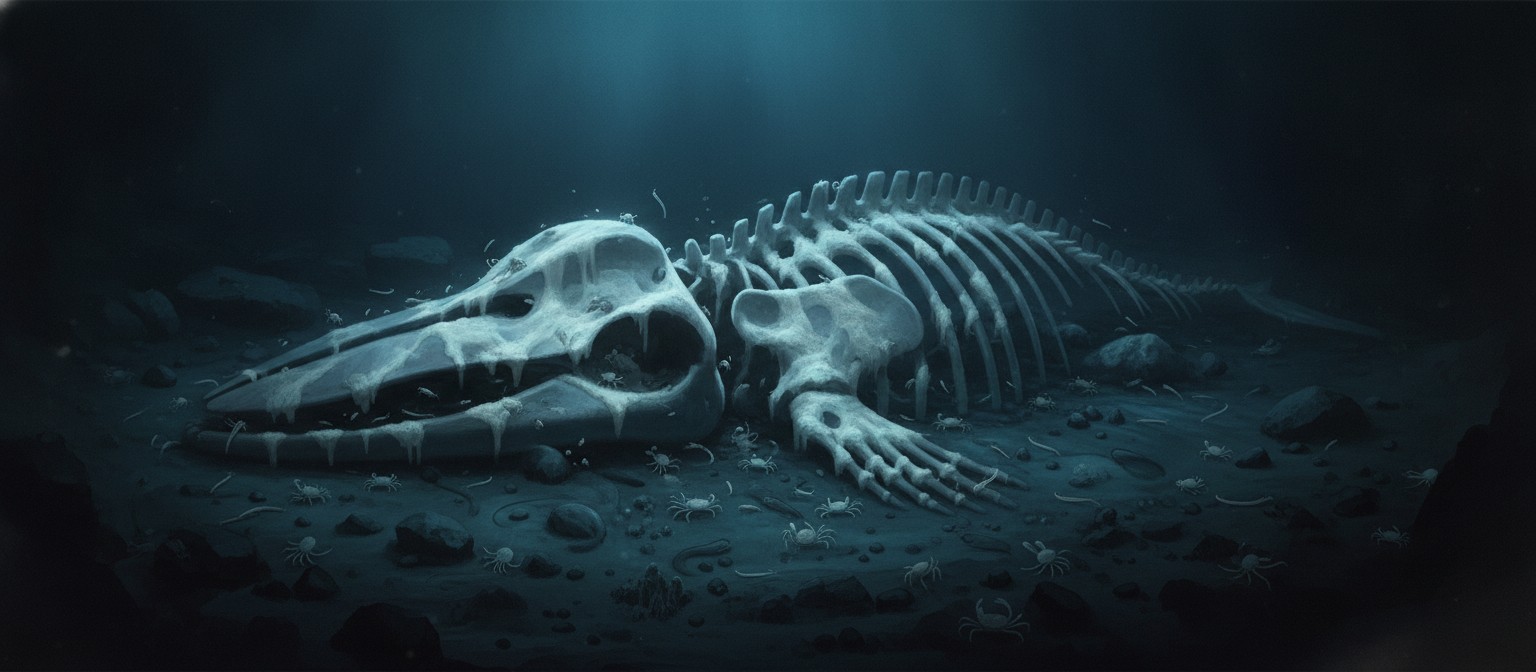
The scale of that role depends on abundance. Each additional whale adds feeding, movement, and eventual fall. Absence here is ecological, not only numerical.
What Recovery Needs Next
Antarctic blue whales remain listed as critically endangered. The status has not changed with the new estimate. Growth at 4.5% per year, with a range of 1.6% to 7.3%, offers cautious ground for hope. It does not remove risk. Krill supply may set a limit. Whale waste carries iron that feeds the tiny ocean plants krill depend on, so removing the whales may have reduced the food web that supports them. Returning blues now compete with faster recovering humpback, fin, and minke whales, alongside growing krill fishing and shrinking sea ice. How these whales will respond to warming waters, shifting krill, ship noise, and ship strikes is not yet clear.
Monitoring is the central need. Line-transect surveys are costly and rare. Photo identification covers limited areas and years. Rand points to passive acoustic monitoring as a possible path forward. Blue whale calls carry vast distances. Researchers already use recordings to estimate density, as explored in work on tuning into whale song to protect whales from ships. They have not yet learned how to convert call density into total animal counts. That step will take further study.
Governance adds complexity. As Rand notes, Antarctica is a large region and not one country’s ocean. Continued and coordinated surveys will be needed to tell whether the population keeps rising or meets new pressure. Broader ocean restoration efforts share that logic, including the case for global conservation that could help restore the oceans by 2050. For now, the record shows tenfold growth from 418, with a range of 147 to 1,099, to 4,018, with a range of 1,874 to 8,395. It also shows how much remains missing.
Frequently Asked Questions
How many Antarctic blue whales are left?
About 4,018 in 2024. The range runs from 1,874 to 8,395, or about 1.9% of pre-whaling abundance. The estimate comes from a model, not a head count, so the range is part of the answer.
Is the Antarctic blue whale bigger than other blue whales?
The Antarctic subspecies is the largest form. Females can reach about 110 feet. Males are slightly smaller. Pygmy blue whales of the Indian and South Pacific oceans are distinctly smaller, at around 79 feet.
Are there blue whales in Antarctica?
Yes. Antarctic blue whales feed near the edge of the pack ice zone during the Southern Hemisphere summer. They migrate to lower latitudes in winter. Their scientific name is Balaenoptera musculus intermedia.
What do Antarctic blue whales eat?
Almost entirely Antarctic krill. An adult can consume several tons per day during peak feeding. Feeding follows krill abundance, which may shift as waters warm.
Are Antarctic blue whales friendly?
They are not aggressive toward people, and there is no record of attacks. They are wild, pelagic animals that generally stay far from shore. Encounters are rare and should remain distant and quiet.
Are blue whales still endangered?
Yes. The Antarctic subspecies is listed as critically endangered. The species as a whole is listed as endangered. The new estimate of 4,018, with a range of 1,874 to 8,395, does not change that standing.
A Quiet Measure of Return
Four thousand animals can seem like many. Set against two hundred thousand, it reads differently. The Southern Ocean holds more whale song than it did in 1973. It holds far less than it held a century ago. The new assessment, detailed in the University of Washington announcement of the findings, gives both facts room. Tenfold growth deserves attention. So does the quiet that remains.


