
Watching one ion hop inside a solid is relatively easy. Watching a crowd of ions interact is much harder, and that crowd behavior may decide how well a future solid-state battery works. A team led by Argonne National Laboratory has now shown a way to see both at once with a method called 4D quasielastic neutron scattering, or 4D-QENS. Quasielastic neutron scattering means bouncing neutrons off a material and measuring tiny changes in their energy and direction to track atomic motion. The test material was single-crystal strontium chloride, a salt, not a commercial battery, so this is a measurement advance rather than a new cell.
Why Ion Traffic Matters for Solid-State Batteries
A solid-state battery replaces the flammable liquid electrolyte of a conventional lithium-ion cell with a solid layer that carries ions between electrodes. Ions are charged atoms or molecules. How quickly and smoothly they move through that solid sets limits on charging speed, power, and efficiency. To learn more about that tradeoff, see our solid-state battery vs. lithium-ion comparison.
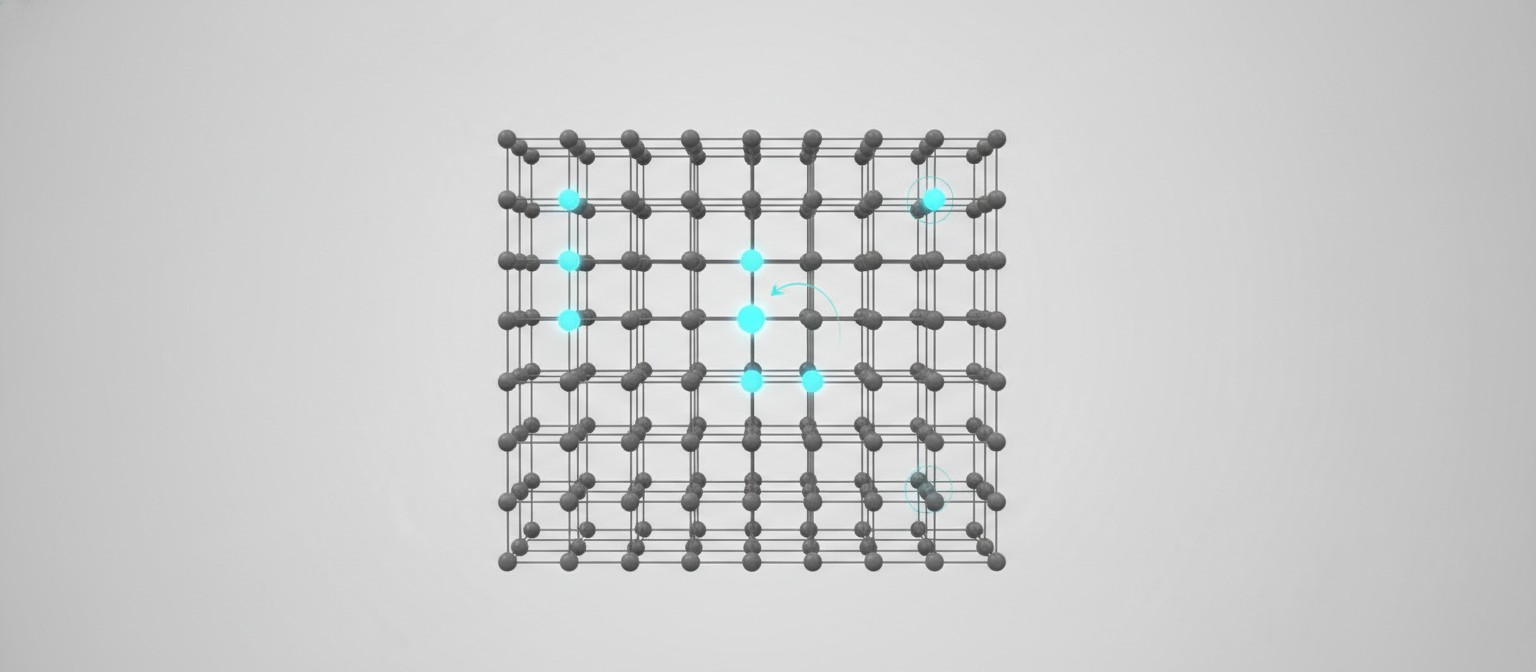
For many years, researchers often modeled ion motion as independent hopping. In that picture, each ion jumps from one open site in the crystal lattice to the next, like a person stepping between floor tiles. The lattice is the repeating grid of atoms that forms the crystal. What the new work adds is a direct look at correlated motion, where ions influence each other. Sometimes one moving ion helps its neighbors move. Sometimes ions get in each other’s way and form a traffic jam.
What Ordinary QENS Sees, and What It Misses
Quasielastic neutron scattering, usually shortened to QENS, sends neutrons at a sample and records how they scatter. Neutrons are useful because they carry no electric charge and weigh about as much as atoms, so small exchanges of energy show up clearly as broadening in the scattered signal. That broadening reveals how fast atoms or ions are moving.
Standard QENS has been very good at measuring single-ion behavior, such as how long an ion rests on a lattice site before it hops, and which neighboring site it favors. What it has captured less well is coordination between ions. Two samples can show similar average hopping rates yet behave very differently if ions in one sample move together while ions in the other block each other.
How Rotating the Crystal Adds the Fourth Dimension
The Argonne-led team added a simple mechanical idea to a powerful instrument. They placed a single-crystal sample in the neutron beam and rotated it step by step while recording scattering in three dimensions of momentum plus energy transfer. Three spatial dimensions plus energy is what makes the dataset four-dimensional. This 4D neutron scattering approach ran at the Cold Neutron Chopper Spectrometer at the Spallation Neutron Source, a Department of Energy user facility at Oak Ridge National Laboratory, with analysis supported by Argonne computing resources.
Rotation matters because a single crystal looks different from different angles. The idea of rotating samples at pulsed neutron sources has been discussed for about 15 years, but this is its first application to QENS, according to Osborn. By collecting large, continuous volumes of data instead of isolated slices, the researchers could separate two kinds of signal. Incoherent scattering tracks individual ion motion. Coherent scattering is sensitive to pairs and groups of ions moving in relation to each other. The study was described by Argonne in a November 3, 2026 feature and detailed in the paper in PRX Energy.
Single Hops Are Easy, Traffic Jams Decide Performance
The team tested 4D-QENS on strontium chloride, which becomes a fast ion conductor above about 900 kelvin, or roughly 1,200 degrees Fahrenheit. Above that transition, the crystal enters a superionic phase, where chloride anions hop almost like a liquid while the crystal frame stays solid. Strontium chloride is not a battery electrolyte candidate. Its value here is that it is well studied, so the team could check the new method against known results.
| What was measured | What it tells us | Result in strontium chloride |
|---|---|---|
| Incoherent QENS, single-ion hops | Rest time on a site, favored jump direction, jump rate | Nearest-neighbor hops dominate, matching earlier work |
| Coherent QENS, ion-ion correlations | Whether ions help or hinder each other | Clear sign of correlated motion, including de Gennes narrowing |
De Gennes narrowing is a telltale dip in broadening at certain spacings that appears when motion is coordinated rather than random. It is named after physicist Pierre-Gilles de Gennes. In plain terms, it means the ions are not hopping alone. Their movements are linked across short distances, and that linkage can either open a path or close one.

As Argonne senior physicist Raymond Osborn put it: “With 4D-QENS, we show new effects that we would never have seen without such large, contiguous volumes of data.” Argonne Distinguished Fellow Stephan Rosenkranz added: “Now we are measuring 3D volumes plus energy transfer, making it 4D.” Both quotes come from the laboratory feature linked above.
Why a Salt Crystal Helps Future Battery Electrolytes
Better measurements lead to better models. Battery designers rely on computer models to predict which crystal structures, defect levels, and dopants will let ions flow quickly without getting stuck. A defect is a missing or misplaced atom that creates an open seat for ions to hop into. A dopant is a small chemical addition that tunes how many seats are open. If models assume independent hopping when real ions move in coordinated groups, the predictions will miss.
This highlights the need for improvements both in the theory of ionic transport in fluorite compounds and the modeling of coherent 4D-QENS in single crystals, the authors note. The immediate value of 4D-QENS is therefore diagnostic. It gives modelers both the hop rates and the interaction fingerprint from the same experiment. The researchers say the same approach should apply to more complex materials closer to real solid electrolytes, as well as fuel cells, sensors, and related devices that depend on ionic conduction, which is the movement of charge carried by ions. That work is still ahead. No commercial cell was tested here, and no product timeline follows from this paper.
Frequently Asked Questions
What is quasielastic neutron scattering?
It is a method that fires neutrons at a material and measures very small changes in neutron energy and direction after scattering. Those small changes reveal slow atomic motions such as ion hops between lattice sites.
What does 4D mean in 4D-QENS?
It means the dataset spans three dimensions of momentum, which encode direction and spacing in the crystal, plus one dimension of energy transfer, which encodes how fast ions move.
Why did scientists use strontium chloride?
Because it is a well understood fast ion conductor at high temperature and forms good single crystals. That let the team verify the hopping results against older studies while testing whether the new coherent signal revealed correlations.
Does this mean safer, higher-energy batteries are near?
Not directly. This is a tool for understanding ion transport, not a battery chemistry. It may help designers find and refine solid electrolytes that could store more energy with greater safety, but commercial timing depends on many later steps.
Where was the experiment done?
The measurements were made at the Spallation Neutron Source at Oak Ridge National Laboratory, described by the Department of Energy as the world’s most powerful pulsed neutron source. Computing support included the Argonne Leadership Computing Facility.
What Comes Next for the Ion Camera
The next test is to point this ion camera at candidate electrolytes with more complex structures, where several types of sites, defects, and lattice vibrations interact at once. If 4D-QENS can map both hops and jams there, designers will have a clearer guide to which structures help ions flow and which ones invite congestion. For a measurement made on a simple salt at high heat, that is a practical kind of progress.


