
First, the vocabulary
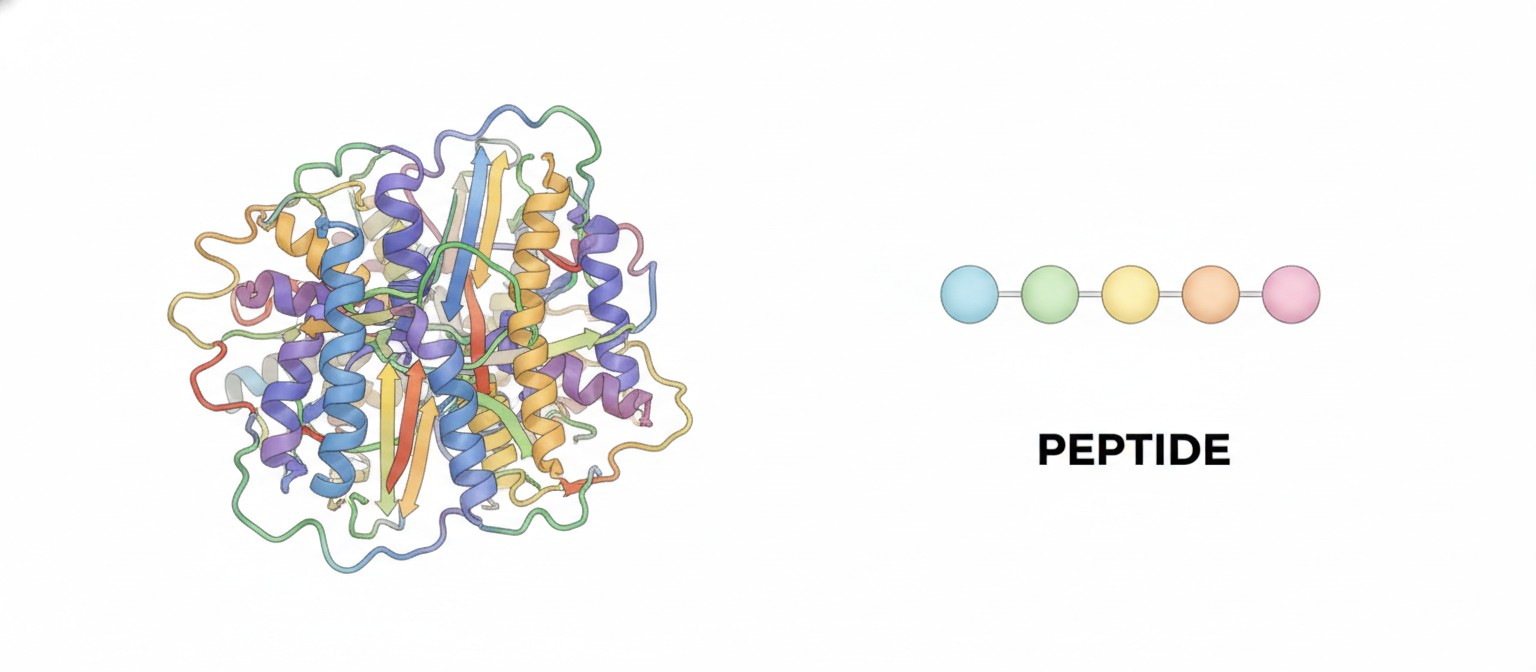
A protein is a long chain of amino acids, often hundreds of them, folded into a precise three-dimensional shape that lets it do a structural or mechanical job: hemoglobin carries oxygen, collagen holds tissue together, enzymes drive chemical reactions. That fold is fragile, which is why proteins unfold under heat and why keeping protein-based medicines stable is a research field of its own. A peptide is a short chain of the same building blocks. The dividing line is fuzzy, but chemists generally call a chain of fewer than about fifty amino acids a peptide. The shortest ones, with only two, three or four amino acids, are so small that they barely fold at all.
That size difference matters. Small molecules are made quickly, move easily between cells and are broken down rapidly. In the body, this makes peptides ideal messengers rather than building materials. Insulin, oxytocin and the releasing hormones of the hypothalamus are all peptides. Their job is to carry a signal, not to build a structure.
Why aging researchers care about messengers
For most of the twentieth century, aging was studied one organ at a time. That changed when researchers started asking how the whole system stays coordinated. A widely cited 2013 review in the journal Cell proposed a list of “hallmarks of aging,” and one of them was altered intercellular communication: with age, the signals that tissues send each other become noisier and less reliable, and the body’s ability to respond to them weakens. The same logic explains why something as ordinary as gum recession with age is driven more by habits and tissue signaling than by the calendar alone.
If communication is part of the problem, the molecules that carry the messages become an obvious thing to study. Peptides are among the most important of those molecules, which is why you will find them in research on the immune system, the endocrine system, the skin and the brain. Most of this work has nothing to do with supplements; it is basic biology.
The Khavinson hypothesis, stated carefully
One strand of peptide research is associated with Vladimir Khavinson and colleagues at the St. Petersburg Institute of Bioregulation and Gerontology in Russia. Beginning in the 1980s with extracts of animal organs such as the thymus and pineal gland, and later with very short synthetic peptides of two to four amino acids, the group proposed that each tissue type releases its own short peptides, and that these peptides help regulate gene activity in that same type of tissue. The term they adopted was “peptide bioregulators.” If you want the background on what that term covers and where it came from, there is a clear overview of peptide bioregulators explained that walks through the history and the terminology.
The careful way to describe the state of this research is as a hypothesis under investigation. The supporting evidence comes largely from cell culture studies, animal work and small human studies, most of it produced within one research network and much of it published in Russian. Independent replication in large trials is lacking. In the United States, products based on these peptides are sold as dietary supplements. An intelligent reader can hold both ideas at once: the concept is scientifically interesting, and it is not established.
Five questions to ask about any peptide claim
- What kind of peptide is it? A signaling peptide, a collagen fragment in a face cream and a prescription peptide drug are completely different things that happen to share a word.
- Where was the evidence generated? In a test tube, in mice, or in people? Each step up the ladder is harder, and most ideas do not survive the climb.
- Who did the research, and has anyone else reproduced it? Consistent results from a single group are a reason to look closer, not a reason to be convinced.
- What would change your mind? Genuine science names the evidence that would overturn it. Sales copy never does.
- How is it being sold? A prescription drug, a face cream and a dietary supplement face very different levels of testing and regulation, so the same word on the label does not mean the same level of evidence.

How to think about all this
The point of understanding peptides is not to decide whether to buy something. It is to be able to read a headline about “peptides and aging” and know which part is settled biology, which part is a reasonable hypothesis and which part is marketing. Peptides as messengers: settled. Intercellular communication as a feature of aging: well supported. Tissue specific short peptides as regulators of gene activity: a hypothesis with early stage evidence.
That is a more interesting picture than either the hype or the dismissal, and it is the one the evidence actually supports.
This article is for educational purposes only and is not medical advice. It does not recommend the use of any product. Dietary supplements are not intended to diagnose, treat, cure or prevent any disease. Consult a qualified health professional about your individual situation.

