
A wind turbine blade can outstretch a rail car, tip past 170 mph, and power homes for a quarter century. Until recently, Japan mostly buried them. That ending is changing fast, as wind turbine blade recycling turns retired blades into cement, steelmaking carbon, highway walls, and even a solar micro home.
This is the solutions update to our earlier look at what happens to old wind turbines and why the answer was not so eco-friendly. The landfill problem it described is still real, but Japan now expects 2,000 to 2,500 tons of waste blades every year in the 2030s, and four working exits have emerged in Japan, the United States, Britain, and the Netherlands.
Why a 96 Percent Recyclable Turbine Still Buries Its Blades
About 90 to 96 percent of a wind turbine by weight already has a recycling route. Towers are steel scrap, cables are copper, and many nacelle parts are aluminum and other recoverable metals. The blade is the exception.
Most blades are glass fiber reinforced plastic, or GFRP. Glass fiber gives stiffness, epoxy resin locks the layers in place, and the bond is permanent once cured. A Vestas materials passport for the V80 blade puts the mix at roughly 60 percent glass fiber and about one quarter epoxy resin, with wood, adhesives, coatings, and foam cores making up the rest. Once bonded together that way, the parts cannot be melted apart.
Burning does not solve it cleanly. The resin holds a lot of carbon, so simple combustion releases that carbon as carbon dioxide, while glass fiber remains as ash. Cutting is also hard work. Blades must be sectioned on site; they are bulky for their weight, and transport cost often decides whether any recovery happens at all. That is why turbine blade recycling focused first on grinding blades for low-value fill, then moved toward smarter chemical and whole reuse routes.
How Big Is Japan’s 2030s Blade Wave?
Scale helps explain the urgency. Yokohama’s Hama Wing turbine sweeps a circle 80 meters across; each blade measures about 39 meters, and each blade weighs about 6.5 tons. A single rail car is about 25 meters long, so one blade is roughly 1.5 rail cars. At full speed the tip can exceed 280 kilometers per hour, close to a Shinkansen running speed.
Offshore blades are far larger. A blade under development by China’s Dongfang Electric reaches a reported 153 meters and 83.5 tons. Blades that size cannot be stored casually or landfilled forever.
Most onshore blades retire after 20 to 25 years for design life or economic reasons. Japan installed much of its early fleet in the 2000s, so replacements cluster in the 2030s. Shimizu’s May 2026 announcement puts the coming volume at 2,000 to 2,500 tons of waste blades per year in Japan, or roughly 100 to 200 turbines per year. Landfill space in Japan is already tight, and Europe is moving to restrict composite landfilling, so burial is a shrinking option.
Exit 1: Ground Into Cement
The first large-scale exit runs through a cement kiln. In March 2024, demolition contractor Ibakin and wind developer Achiya announced what they described as Japan’s first 100 percent recycling of a wind blade. A blade dismantled in Hyogo Prefecture in 2023 was pretreated at Ibakin’s plant, then shipped to Tsuruga Cement in the Taiheiyo Cement group.
Inside a rotary kiln the logic is simple. The resin burns as fuel, and the glass-rich ash melts into the clinker as raw material. One waste stream supplies both heat and minerals.
The United States proved the same path at a larger scale. Under a multiyear agreement announced in December 2020, GE Renewable Energy sends blades from repowering projects to Veolia North America, which shreds them in Missouri for cement co-processing. GE’s account of the process reports that more than 65 percent of blade weight can replace sand, clay, and similar kiln feed, while about 28 percent replaces coal as fuel, with a modeled 27 percent cut in carbon dioxide from cement making and about 90 percent of blade weight reused overall.
Cement co-processing is not closed-loop recycling. The fiber loses its structural strength and becomes silica in cement. Independent life cycle work still ranks it well above landfill, but our earlier reporting on turning wind turbine blades into bridges made the same point researchers keep repeating: keeping the fiber whole preserves more value than burning it when reuse is possible.

Exit 2: Baked Into Steel
The most surprising Japanese exit ends in steel. In May 2026, Shimizu Corporation said it had established Japan’s first chemical recycling route that turns used blades into a carbon additive for steelmaking, developed with industrial waste handler Otaki Shoten.
A carbon additive is a precise ingredient, not bulk fuel. Steelmaking adjusts hardness and strength by adding small amounts of carbon, usually from coke, graphite, or petroleum coke. Shimizu cuts and crushes GFRP and carbon fiber blades, controls quality and blend ratio, then compresses the material into molded additive.
The climate claim rests on where the carbon ends up. Burned as waste, blade resin carbon enters the air as carbon dioxide. Used as an additive, more of that carbon is absorbed into steel, while also displacing limited coke resources. Shimizu’s announcement carries a corporate caveat worth stating plainly: as of this writing the public record for the steelmaking route is the company’s May 2026 release plus trade press summaries of it, not an independent technical paper or lifecycle study. The Japan-first claim should be read as the company’s claim until peer data or plant-level results appear. Shimizu spent more than a year optimizing cutting, crushing, molding, and quality control and describes the route as lower impact than landfill and lower combustion emissions than simple thermal recycling.
The business model is bundled. Shimizu proposes blade disposal together with turbine replacement, targeting about 20 billion yen per year in wind-related orders, including new construction. That matters because Japan’s blade wave is not a waste problem alone; it is a repowering pipeline. If the company that rebuilds the turbine also takes the old blade, the logistics gap that kills many recycling plans gets smaller.
Exit 3: Used Whole, Cut But Not Crushed
Grinding destroys strength that took enormous energy to create. A second family of projects avoids grinding entirely and uses blades almost whole.
Britain tested the industrial version. Starting in 2021, the Skanska Costain Strabag joint venture building part of HS2 worked with the National Composites Centre on a world-first pilot to cut sections from retired blades for use as concrete reinforcement instead of steel rebar. HS2’s net zero reporting says the approach could cut carbon emissions for reinforcement by up to 90 percent. The first uses were deliberately low stress, including temporary roads, top sections of walls, and plinths for site cabins, not primary structural frames. That limit is important. The 90 percent figure covers the reinforcement portion, not the carbon footprint of all concrete on site.
The Netherlands went bigger and more visible. In July 2025 the Dutch infrastructure agency Rijkswaterstaat unveiled the Blade Barrier along the A58 near Oirschot, a 60-meter noise wall built from two whole blades plus a cut section, standing 3 to 4 meters high. Six-month acoustic measurements reported in February 2026, carried out by engineering firms M and P and Demcon, found performance comparable to a standard concrete barrier about 3.3 meters high. Monitoring continues through the end of 2026 for cost, safety, and maintenance.
The builder, Rotterdam-based Blade-Made, calls this slowing the loop. A turbine may retire after 25 years for economic reasons while the composite still has decades of technical life. Placed in infrastructure for perhaps 50 years, the material keeps its structural value while recycling chemistry gets another half century to mature. The same portfolio includes playgrounds and other reuse concepts, a theme familiar from earlier Re-Wind bridge and transmission tower trials.

| Second life route | What happens to the blade | Key example | Strength | Limit |
|---|---|---|---|---|
| Cement co-processing | Shredded, burned as fuel and melted as raw material | Ibakin to Tsuruga Cement, 2024; GE to Veolia, 2020 | Handles large volumes, displaces coal, sand, and clay | Fiber strength is lost, still emits carbon dioxide |
| Steelmaking additive | Cut, crushed, and molded into carbon additive | Shimizu and Otaki Shoten, May 2026 | Carbon enters steel, saves coke | New process, needs quality control and scale |
| Whole reuse in infrastructure | Cut into sections, used almost whole | HS2 rebar pilot; 60-meter Blade Barrier on A58 | Preserves strength, very low reprocessing carbon | Only fits low-stress or custom structures so far |
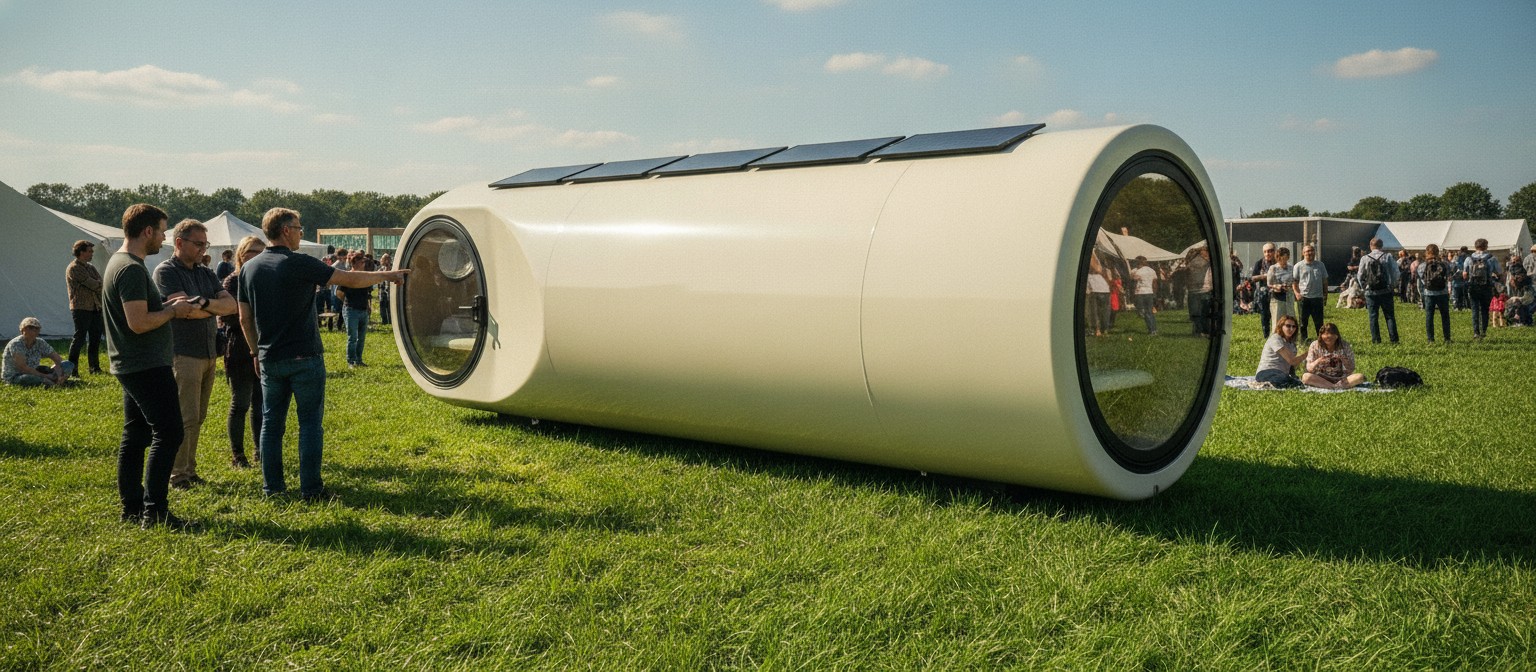
| Nacelle reuse as shelter | Capsule refitted as a micro home | Nestle from a Vestas V80 nacelle, 2024 | Highest value reuse, tangible and durable | One nacelle equals one home, not mass volume |
Exit 4: Lived In as a Tiny Home
The most human scale exit does not use the blade at all. It uses the nacelle, the capsule at the hub that houses the generator. Like blades, many nacelles are also GFRP composites.
At Dutch Design Week in October 2024, Blade-Made showed Nestle, a wordplay on “nacelle,” built from a Vestas V80 nacelle that had operated in Gols, Austria, for 19 years until October 2023. The concept came from Superuse Studios in a What If Lab project with Vattenfall and the Dutch Design Foundation, with transport by Business in Wind and Vlastuin, structural work by IMD engineers, and fit-out by Woodwave and Feenstra.
The numbers make the appeal clear. The nacelle shell is about 10 meters long, 4 meters wide, and 3 meters high, yielding roughly 35 square meters of living space inside, with glass doors at both ends, full plumbing and electricity, and four rooftop solar panels rated at about 1,800 watts peak. The Dutch Design Foundation account of the build says the team first tested whether a nacelle could meet Dutch housing rules for daylight, insulation, kitchen, and bathroom, reasoning that if a permanent home works, simpler uses will follow.
Hama Wing watchers will get the connection. Hama Wing belongs to the same V80 family, although its nacelle alone reportedly weighs about 67.6 tons, so moving any nacelle home is the hard part. Still, a turbine head becoming a home reframes waste as housing stock, even if only a small share of nacelles will ever take this path.
Frequently Asked Questions
How long do windmills last?
Most commercial turbines are designed for 20 to 25 years, although towers and foundations can last longer and some machines run longer with refurbishment. In Japan the practical driver is economic renewal in the 2030s, when turbines installed in the early 2000s reach replacement age. Turbines also repay their manufacturing carbon far sooner, often in under two years, as our wind power carbon footprint lifecycle analysis shows.
How do they recycle windmill blades?
There is no single method. Cement co-processing shreds blades for fuel and raw material, Shimizu’s new route bakes them into steel, British and Dutch pilots reuse cut sections whole as rebar and noise walls, and designers refit nacelles as shelters. For future blades, manufacturers are developing separable resins, including Siemens Gamesa RecyclableBlade technology covered in our report on recyclable blades generating power at Kaskasi, and Vestas work toward 100 percent recyclable blades. Today’s retirements, however, are almost all conventional thermoset blades that need the four exits above.
How environmentally friendly are wind turbines?
Very, on a lifecycle basis, with one visible waste flaw. Turbines generate low-carbon electricity for decades after a short carbon payback, and most mass is recycled steel, copper, and aluminum. Blades were the gap that sent disproportionate volume to landfill because they are light, huge, and hard to separate. The new routes do not erase impacts; cement kilns still emit, but they displace virgin coal, sand, clay, coke, steel rebar, concrete, and building materials.
How big are wind turbine blades?
Onshore blades like the Hama Wing run about 39 meters each with an 80-meter rotor diameter, already longer than a 25-meter rail car. Modern offshore blades exceed 80 meters, and the longest in development exceed 150 meters. That size is why whole reuse for bridges, barriers, and buildings is attractive. The curve and strength are already engineered.
What Still Needs Solving
None of these exits is a silver bullet. Cement and steel routes handle volume but destroy the fiber’s structural value. Whole reuse preserves value but needs custom design, transport, certification, and a nearby demolition site. Tiny homes inspire but absorb only a handful of nacelles. And Japan’s coming wave of 2,000 to 2,500 tons a year will test collection networks more than chemistry.
The deeper fix is design for disassembly, as documented in our guide to what actually works in recyclable blades in 2026. Separable resins, material passports that tell recyclers what a blade contains, and procurement rules that reward recyclability will decide whether today’s pilots scale. Blade-Made’s time-buying idea captures the strategy: park durable composites in 50-year infrastructure while recycling technology catches up, rather than burying 25-year-old machines with decades of material life left.
Retired at 25 does not have to mean wasted at 25. Ground, baked, laid along a highway, or lived in, the second life of a wind blade is finally getting as engineered as the first.


