
A rust-red slurry left over from making aluminium has become the main ingredient in a concrete binder that kept its strength through frost, soaking and salty water in lab tests. The team behind it, led by Trinity College Dublin with Irish firms Gannon Eco and McGrath Quarries, reports carbon cuts of 67.8% to 79.8% against a standard cement, measured across raw material supply, transport and manufacturing in early assessments.
Those percentages describe lab mixes and early industrial trials, not a product builders can order yet. That distinction matters, because concrete lives or dies on long-term proof and approvals. Still, the combination here is unusual: a waste stream with few good outlets, a dry binder designed to run through existing factory equipment, and durability results that matched conventional concrete in the tests reported so far.
This piece walks through what red mud is, what the team actually made, what the numbers show in plain terms, and what still has to be proven before it could matter on building sites.
What red mud actually is
Red mud is the common name for bauxite refining residue. It is what remains after bauxite ore is digested in hot caustic soda to extract alumina, the feedstock for aluminium. The process is called the Bayer process, and for every tonne of alumina it typically leaves 1 to 1.5 tonnes of residue, according to industry technical summaries.
The mud is red because it is rich in iron oxides. It is also strongly alkaline when fresh, with pH values often above 13, which is why it is stored in large managed ponds or stacks rather than released. Global stockpiles reached about 5 billion tonnes in 2021 and were growing by roughly 200 million tonnes per year, according to a review of bauxite residue disposal and reuse. Use rates remain low, often cited below 1% in that literature, so most of it simply accumulates.
That history explains the interest in construction uses. A review of red mud use in construction materials lists three broad paths: making aggregates, replacing part of the cement, and synthesising geopolymers. The Trinity project tried the second and third paths side by side, joining a wider run of waste streams tested as cement replacements, from food scraps to industrial residues.
What the Trinity team built
The work was led by Prof. Sara Pavia with Dr Zehao Lei and doctoral researcher Yingjie Pan in Trinity’s School of Engineering, with Gannon Eco and McGraths Limestone (Cong) Ltd as industry partners. It was funded through Enterprise Ireland’s Innovation Partnership Programme and described in a Trinity announcement on October 22, 2026, as having moved from lab development to real-world industrial trials.
The team pursued two routes. The simpler route uses red mud as a supplementary cementitious material, a reactive mineral powder that replaces part of the Portland cement. In lab testing, replacing 20 to 30% of conventional cement with bauxite residue gave compressive strength comparable to standard reference concrete, in the team’s reported results.
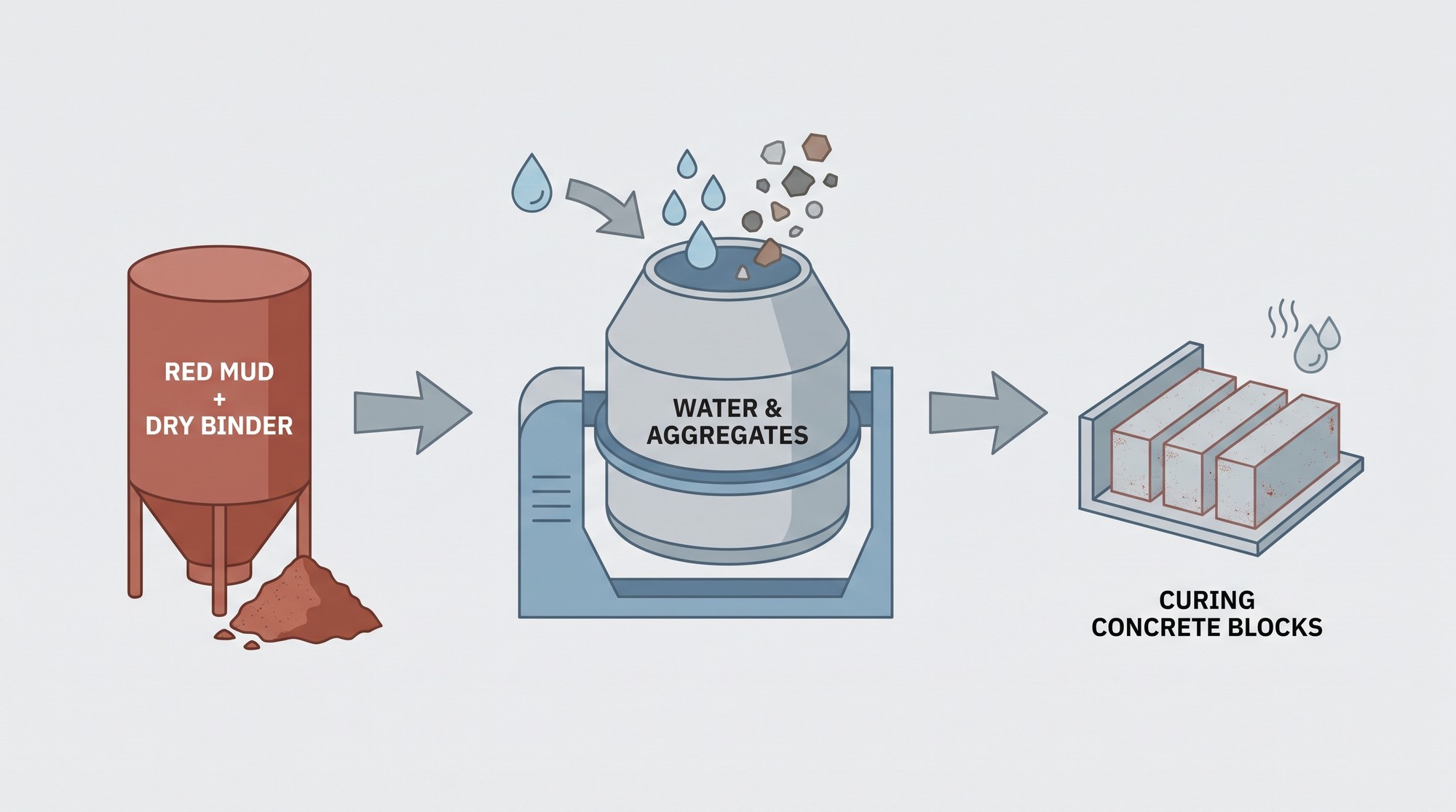
The deeper cut came from the second route, a one-part geopolymer, a dry powder binder that includes red mud plus other ingredients and is mixed with water and aggregates. The attraction is practical: it is designed to pass through ordinary batching equipment.
Pavia put the aim in plain terms: “This project demonstrates that with rigorous science and industry collaboration, we can transform this by-product into a high-performance structural material. We are not just reducing the carbon footprint of concrete; we are actively building a circular economy.”
How the one-part geopolymer works
Ordinary cement hardens when calcium silicates react with water. A geopolymer hardens differently. Aluminium- and silicon-rich powders dissolve in an alkaline environment and then re-form into a three-dimensional network that binds aggregates together. The word sounds technical, but the job is familiar: glue sand and gravel into stone.
Most geopolymers come in two parts, a powder plus a caustic liquid activator that is awkward to store and dose. A one-part geopolymer folds the activator into the dry powder, so the plant only adds water. That small change matters for adoption, because it avoids new liquid handling and lets producers use familiar mixers, silos and trucks.
The trade-off is control. Setting behaviour is sensitive to the exact residue chemistry, which varies by refinery source. Cost is covered where it showed up, in factory trials, below.
What the numbers show
The headline figures belong to the geopolymer route, not to every red mud mix. The team’s carbon assessments indicate a 67.8% to 79.8% reduction in carbon footprint compared with standard CEM II-A/L cement, counted across raw material supply, transport and manufacturing. CEM II-A/L is a widely used Portland limestone cement, so it is a realistic baseline for Ireland and much of Europe rather than an unusually dirty comparator.
To put that in everyday terms, if a standard cement carried 100 units of carbon for a given job, these lab formulations carried roughly 20 to 32 units. That is close to taking four car trips off the calendar and keeping one, though the exact saving for a building would depend on the mix, transport distances and what it replaces.
The comparison below keeps the baseline at 100 so the range is easy to read. These are indexed values derived from the reported percentage cuts in early assessments, not independently verified lifecycle results.
| Route | What was replaced | Reported outcome in early testing |
|---|---|---|
| Red mud as supplementary material | 20 to 30% of Portland cement | Compressive strength comparable to reference concrete |
| One-part red mud geopolymer | Cement binder, using dry red mud blend plus water and aggregates | 67.8 to 79.8% lower carbon than CEM II-A/L across supply, transport and manufacture |
| Geopolymer durability checks | Same geopolymer mixes under sulphate, wet-dry and frost exposure | Matched or exceeded conventional concrete; 109.7% strength retention after 56 freeze-thaw cycles vs 28-day baseline |
Context helps here. Cement production accounts for around 8% of annual global carbon dioxide emissions, according to analysis of cement emissions and growth, because both fuel burning and the chemical release from heating limestone emit carbon. The IEA notes cement emissions intensity has stayed broadly flat in recent years, which is why researchers chase binder replacements rather than small efficiency tweaks.
How it handled frost, water and sulphates
The team tested its geopolymer formulations under sulphate exposure, wetting and drying cycles, and frost action, under controlled lab conditions. The formulations matched or exceeded conventional concrete in those checks, as reported. The eye catching figure was frost: after 56 freeze-thaw cycles, the red mud geopolymer showed 109.7% strength retention relative to its 28-day baseline. In plain terms, it tested slightly stronger after repeated freezing and thawing than it had at 28 days, which can happen when binder reactions continue during the test period.
A related family of approaches, hybrid mixes that combine supplementary materials with recycled content, shows the same pattern: lab durability can look strong while field validation still takes years. That is normal for construction materials, where specifications move on measured service life rather than early promise.
Why running it through real factory equipment matters
Many low-carbon binders work in a lab mixer and fail in a plant. Lab batches are small, precisely dosed and quickly placed. Factory batches must stay workable during transport, set on a predictable schedule, and clean out of trucks and pumps without drama.
This project ran mixes through industrial batching equipment with McGrath Quarries and Gannon Eco, which is where two practical limits showed up. The first is slump retention, the industry term for how long fresh concrete stays soft enough to pour after mixing. The second is activator cost, since the alkaline ingredients that make geopolymers harden can be pricey.
Padraic McGrath, industrial lead at McGraths Limestone (Cong) Ltd, framed it as a usability test: “From a manufacturer’s perspective, any new low-carbon material must be practical for everyday use.” He added: “What makes this geopolymer so promising is that it can run through our existing batching equipment. By addressing real-world challenges like workability and set times, we are paving the way for this to become an industry standard.”
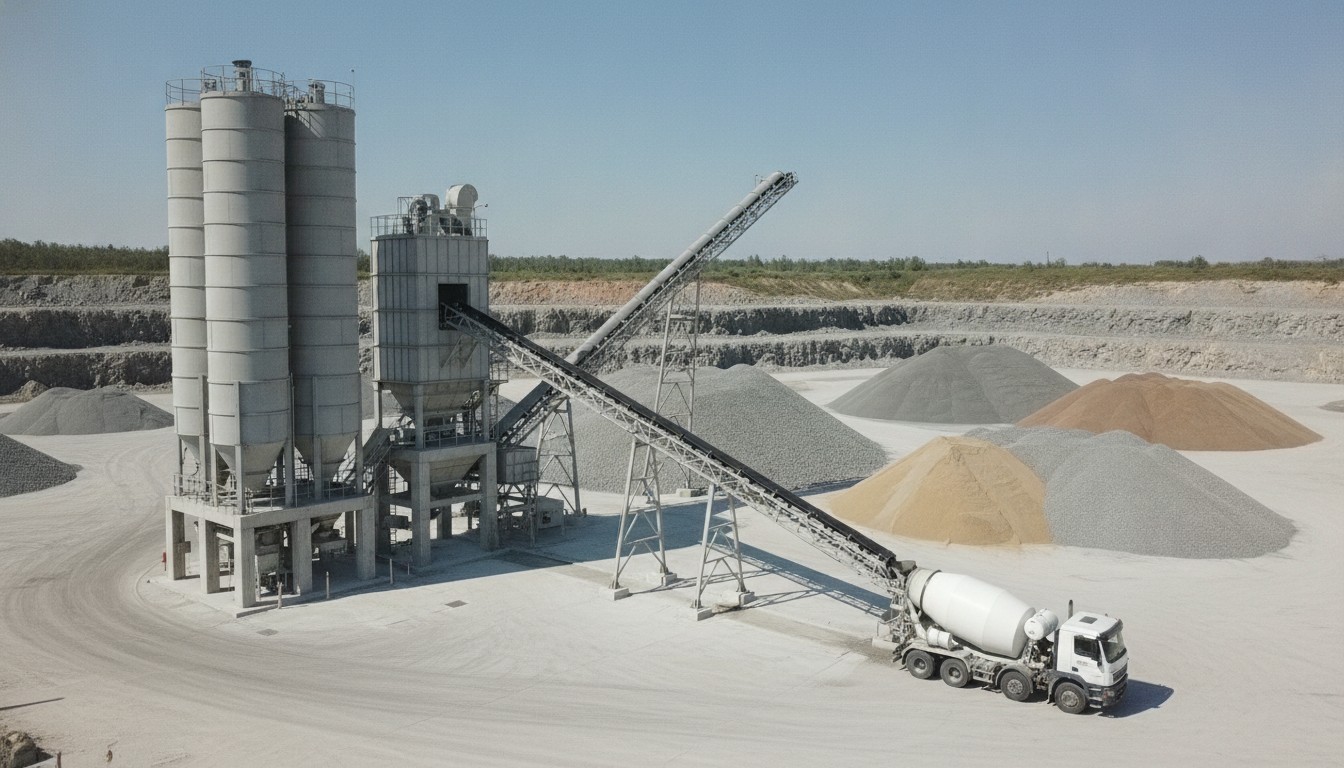
Compatibility with existing plants is arguably the most commercially relevant finding so far, even more than the carbon percentages. A dry powder that uses current silos, weigh hoppers and trucks could, if the remaining issues are solved, be trialled on real pours sooner. That is still an if, not a schedule. A UK pilot with recycled concrete fines replacing 20% of clinker at industrial scale shows what that next proof step looks like: same plant, same performance bar, published results.
A second Trinity report adds concrete detail the main announcement only hints at: the September 28, 2026 workshop covered full-scale concrete blocks and ready-mix applications alongside the industrial trials, with material samples and demonstration products shown to industry attendees. So the scale-up under discussion includes block products and ready-mix, not only lab cylinders through a plant mixer.
What still has to be proven
The responsible way to read this story is as a strong interim result with a to-do list attached, which the team states openly. Four gaps stand out.
- Long-term performance: Freeze-thaw, wet-dry and sulphate results reported so far are lab tests. Outdoor exposure, creep, shrinkage, steel reinforcement behaviour and decades of weathering still need validation.
- Consistency of the waste feed: Chemistry varies by bauxite source and refinery, so a recipe tuned on one residue may need retuning for another, with leaching and screening redone per source.
- Cost, distance and approvals: Activator cost, additive dosing, transport from refinery regions to pour sites, and regulatory qualification remain open, with no commercial date given.
- Carbon accounting boundary: The stated range covers raw material supply, transport and manufacturing; the product stage only. Until project-level environmental product declarations appear for a specific plant and haul, treat it as a lab-based signal of potential rather than a guaranteed saving on every job.
On the residue itself, buyers face a question cement rarely raises: what exactly is in this waste, at this dosage, from this refinery, for this jurisdiction, including leaching and radiological screening? The announcements published so far do not include that file, so it sits on the to-do list with the field data.
That caution applies to earlier cement-free ideas too, including cement-free mixes using industrial by-products such as fly ash. The pattern is consistent: promising chemistry first, then the slower work of codes, costs and field years.
Frequently Asked Questions
What is red mud used for today?
Very little, relative to how much exists. Small volumes go into cement, bricks, road bases and experimental binders, but the large majority remains stockpiled. That mismatch between supply and reuse is why construction researchers keep returning to it.
What is a geopolymer in plain English?
A binder that glues aggregates into concrete without relying on Portland cement chemistry. Instead of forming calcium silicate glue, it forms an aluminium-silicon network when the dry powder meets its activator and water. A one-part version simply packs that activator into the dry powder so crews only add water.
Does the near 80% carbon cut apply to all concrete made this way?
No. It applies to the tested geopolymer formulations versus CEM II-A/L in the team’s assessments across supply, transport and manufacture. The simpler 20 to 30% cement replacement route would save less, and real project savings will vary with transport, energy and the exact recipe.
What does 109.7% strength retention after freeze-thaw mean?
After 56 lab freeze-thaw cycles, samples tested slightly stronger than they had at 28 days. Think of it as coming through a harsh winter simulation without losing strength, with some continued hardening along the way. It is encouraging, but it is not proof of decades of frost resistance.
When could builders specify this material?
Not yet on the evidence published so far. The team points to further long-term testing and regulatory qualification first. Watch for field pour data, independent durability reports and formal product declarations before treating it as a specification option.
What it could mean
If the durability holds up outdoors and the activator costs come down, the appeal is twofold. Builders would get a lower carbon binder that fits current plants, and alumina regions would get a productive outlet for a residue that currently sits behind dams. Neither outcome is assured, but both are now easier to test because the mixes have survived the jump from bench to batching plant.
The next milestone to look for is not a bigger percentage. It is a boring one: a documented trial pour, left outside through real winters, with independent test data attached. That is how waste materials earn their way into standards and into structures. The same path is visible in performance-based routes bringing low-carbon cements toward specifiable use and in unfired bricks made from 90% construction waste now in commercial use.

