
Ecocem’s Advanced Cement Technology (ACT) now meets ASTM C1157 performance requirements, offering a clear signal that the industry is ready for change. Technical shifts now move beyond laboratory wins and into real-world bid documents. Recent ACT screening life cycle assessment results show an embodied-carbon figure near 345 kgCO2e per metric ton.
Performance-based specifications shift the focus toward how concrete actually behaves. Standard legacy specifications often act as a gatekeeper, blocking new materials simply because they don’t match a century-old recipe. Performance-first logic focuses on how the concrete behaves on the job—its strength, durability, and setting time—rather than just what is inside the mix. Strategic adoption pathways of this kind turn a pilot purchase into a repeatable, scalable purchase for infrastructure projects.
Project teams can now specify low-carbon cement without losing engineering quality. Aligning with recognized test categories moves the conversation with procurement from debate to proof. This shift makes it easier for owners to meet climate goals while keeping projects on schedule.

The Breaking Update: ASTM C1157, Ecocem ACT, and the 345 vs. 844 Baseline
Industry Stakeholders and the Move Toward ASTM C1157 Performance Standards
Major technical announcements now point toward a decisive leap for U.S. project adoption because performance acceptance can reduce the need to rewrite every legacy recipe before a buyer can even consider a new binder. Recent embodied-carbon comparison data emphasizes that this procurement logic aligns with broader industry trends.
Current carbon data reflects a screening life cycle assessment rather than a universal, plant-by-plant environmental product declaration, which makes it a strong directional signal but not the final word for every jobsite. A design team staring at a bid tab tends to ask two questions right away: does it meet the performance thresholds for this exposure, and can the carbon documentation survive procurement review?
Essential Benchmarks: Comparing ACT Carbon Reduction and ASTM Performance Logic
Clear benchmarks explain key numbers often hidden by standard reporting cycles: ASTM language determines what can be specified, and carbon numbers only matter when they can be compared. The figures below are the core reference points that keep showing up in low-embodied-carbon concrete conversations across the United States.
- Claimed ACT embodied carbon: 345 kgCO2e per metric ton of cement in a best-case screening LCA, consistent with a screening LCA comparison showing up to a 60% reduction in carbon manufacturing.
- Common PLC baseline used in U.S. procurement conversations: 844 kgCO2e per metric ton, often referenced as an industry-average benchmark.
- Why ASTM C1157 matters: It is a performance specification that classifies cements by how they behave in tests, not by a fixed ingredient list.
- Main emissions lever: Lowering clinker content by substituting limestone and supplementary cementitious materials (SCMs).
- Where adoption starts: Owners with clear performance language, infrastructure pilots, and projects that already demand EPD-style documentation.
- Why homeowners should still care: Material choices cut embodied emissions, while rebates and tax credits target the operating-energy bill after the building is occupied.
Compare this to the difference between a barrier that stops progress and a checkpoint that simply asks for proof. When a project team can point to test categories and documentation formats that procurement already recognizes, the conversation shifts from debate to verification.

Bridging the Specification Gap for Low-Embodied-Carbon Concrete Adoption
Overcoming Procurement Barriers with ASTM C1157 Performance Acceptance
ASTM C1157 is widely treated as a pathway for innovation because it centers acceptance on performance outcomes such as strength development, heat of hydration behavior, and sulfate resistance. In practice, established performance categories for cement matter because they translate into something procurement can enforce without demanding a single legacy chemical.
Public agencies often proceed with caution. Concrete durability failures carry high financial and reputational costs.
A performance-first rulebook changes the workflow. Instead of checking if a mix matches a century-old recipe, reviewers check if it meets strength and durability needs.
This shift often happens in a single meeting. Engineers want durability, contractors want predictability, and owners want language that holds up if anything goes wrong.
Analyzing the 345 vs. 844 Benchmark: Documenting Real Embodied Carbon Reduction
A practical window into how owners think about cement types shows up in paving guidance, where an FHWA summary of C1157 cement types maps “general use” and “high sulfate resistance” style categories to specific technical stressors. These performance markers ensure the material can handle the environmental realities of a modern jobsite.
Consider how these categories address common exposure concerns:
- Deicing salts and chemical penetration during winter months.
- Freeze-thaw cycling that can lead to surface scaling.
- Heat management during massive structural pours to prevent cracking.
Extreme weather and chemical exposure are not academic concerns, as they determine whether a bridge deck remains intact or if a repair cycle begins prematurely. Choosing the right cement for specific jobsite conditions ensures long-term structural health.
Why Defensible Spec language Accelerates Adoption
The Federal Highway Administration notes that performance-based cement specifications can reduce prescriptive bottlenecks that traditionally keep lower-carbon binders out of mainstream use. In plain terms, a performance-based pathway can reduce the odds that a low-carbon binder gets rejected for being unfamiliar rather than for failing a relevant test.
Analyzing the 345 vs. 844 Benchmark: Documenting Real Embodied Carbon Reduction
Buying decisions now favor carbon accounting over vague green adjectives to ensure fair bid comparisons. A benchmark of 844 kgCO2e aligns with documented industry averages within the Portland-limestone cement EPD table, which provides a transparent baseline for comparison.
Screening LCA Versus Product EPD
Ecocem’s 345 kgCO2e claim comes from a screening life cycle assessment, which is useful for directional comparisons but is not automatically the same thing as a product-specific EPD for every plant configuration. Any procurement officer familiar with value-engineering sessions understands this dynamic: the moment a material becomes real is when documentation becomes standardized, repeatable, and hard to dispute. Standardization allows risk managers to relax, because they can compare bids without decoding incompatible metrics.
When Carbon Numbers Become Comparable
That is why programs focused on embodied-carbon disclosure reinforce why consistent documentation becomes the language of procurement. In transportation procurement, EPD standardization has pushed toward common measurement and clearer labels, because carbon numbers only work when buyers can compare them without guesswork.
Accelerating Clinker Reduction and Scaling SCM Supply in Modern Concrete Mix Designs
SCM Supply as a Primary Driver of Material Availability
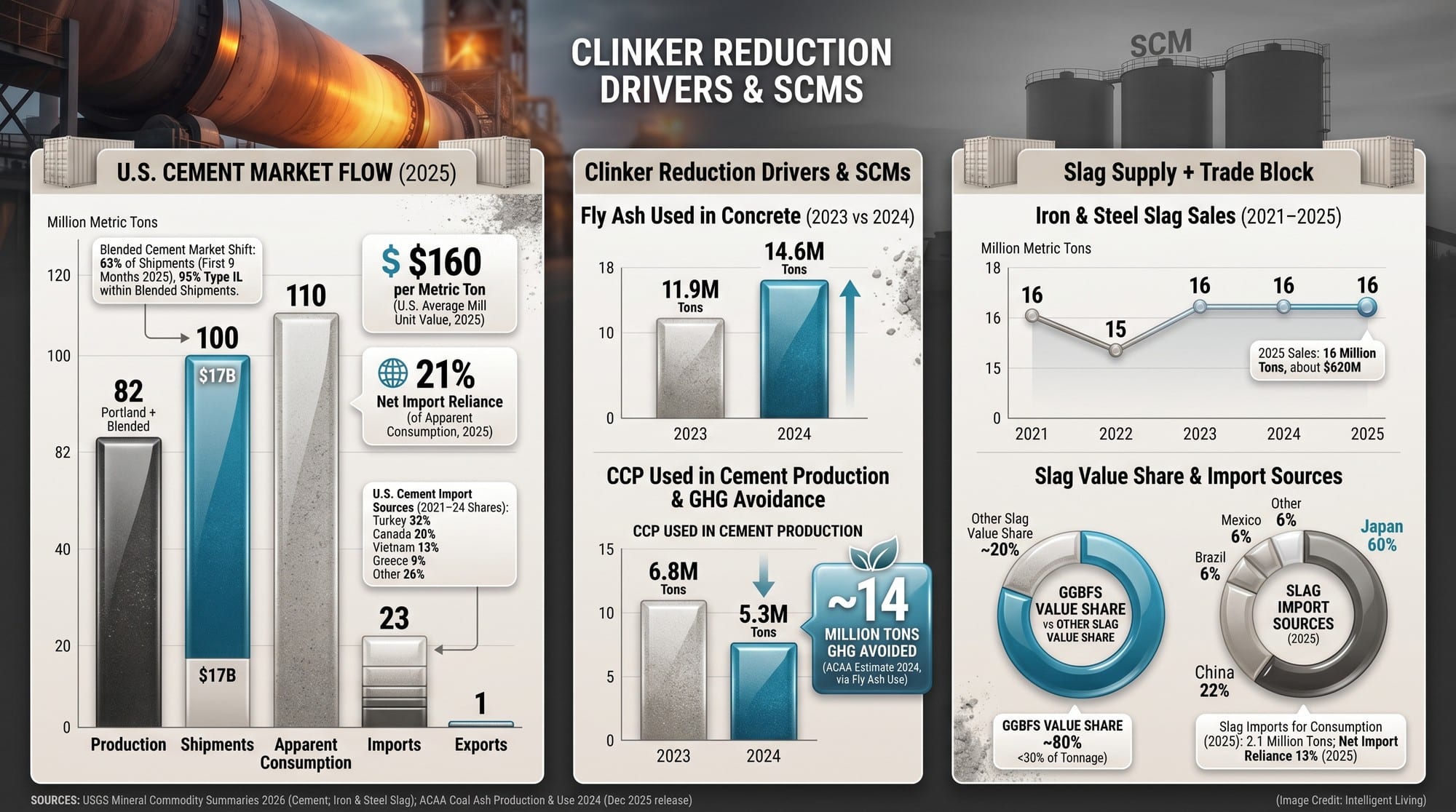
Clinker acts as the main source of carbon emissions in cement production. These emissions result from the extreme heat needed to process limestone. Cement sector tracking confirms that cutting clinker per ton is essential for deep emissions reductions. Future strategies for low-carbon cement treat performance-focused standards as a key enabler for market transition because they widen which cementitious constituents can be used without locking markets into one chemistry.
SCM Supply Is a Regional Constraint, Not a Footnote
Material availability often dictates project success, as not every region has the same access to fly ash or slag. Not every region has the same access to fly ash, slag, or alternative SCMs. These regional constraints often act as a quiet limiter on how fast clinker reduction scales. Bidding on a project in the Northeast requires a different material mix than bidding on one along the Gulf Coast. Beyond supply, the carbon profile shifts significantly based on transport distance and local material availability.
Circular Feedstocks Enter the Mix
One practical circular pathway is the rise of recycled concrete fines as clinker-replacement feedstock serving as clinker-replacement feedstock, which reframes demolition dust as a technical input rather than disposal. Market experimentation now includes multi-input blends and hybrid waste concrete mixes that pair SCMs with recycled plastics. This broad wave of green cement innovation focuses on clinker reduction and expanded supply.
Top Five Procurement Pathways for Low-Carbon Cement Integration
Specific procurement requirements turn low-carbon options into default bid items, especially when owners can request proof without rewriting the entire spec book.
- Federal and state procurement pilots where federal Buy Clean procurement turns lower embodied carbon into a verifiable procurement metric rather than a stylistic claim.
- GSA-funded construction work where contracting language can incorporate GSA concrete embodied-carbon limits as a practical threshold for qualifying materials.
- Transportation projects where reimbursement and incentives can flow through transportation material grants when approved materials meet program criteria.
- Large structural jobs where spec language often follows the pragmatic guardrails found in concrete specification guidance, ensuring durability expectations are defensible on paper.
- EPD-driven private bids where teams treat embodied emissions as a bid variable alongside cost and schedule, and various sustainable concrete technologies are chosen based on exposure conditions, risk tolerance, and local supply.
Federal agencies are also formalizing what counts as “low carbon” for funded purchases, and the interim determination on low-carbon materials shows how embodied-carbon boundaries are being defined for early rollout.

Decarbonizing the Built Environment: Material Selection and Federal Rebate Integration
The Second Carbon Bill: Rebates, Credits, and Point of Sale
Checkout savings, post-install rebates, and tax-season credits all shape how families choose to upgrade. Home energy upgrades funded by the DOE typically run through state programs while credits are managed through tax filings. Timing determines whether savings arrive at checkout, after installation, or during tax season, ultimately shaping household decisions.
Point-of-Sale Discounts and Contractor Quotes
Simplicity drives adoption, making the point-of-sale experience a critical factor for success. That is why point-of-sale heat pump rebates are becoming a practical bridge between policy and real contractor quotes. When a quote arrives with a clear discount line instead of a promise to reimburse later, it is easier for a household to say yes.
State-by-state differences in the home energy rebate rollout help explain why some regions feel ready while others are building capacity. A homeowner comparing bids in a major metro area may hear very different timelines than someone in a rural county, even when the underlying federal funding is the same.
The Paperwork Reality Behind Tax Credits
The IRS notes that the energy-efficient home improvement credit includes strict annual limits and documentation requirements. Starting in 2025, some claims now require reporting a Qualified Manufacturer Identification Number. While this detail seems small, it is often what delays reimbursement. Discovering these requirements after the work is complete can lead to unexpected financial gaps.
Future Trends in Low-Carbon Concrete and Decarbonization Policy
Keep an eye on these evolving trends in the concrete market:
- Plant-level EPDs that validate early carbon claims.
- Updated project templates that allow performance-based binders.
- Regional SCM availability as legacy byproduct streams tighten.
- Real-world durability data from freeze-thaw and sulfate exposure.
Tracking these metrics helps engineers ensure both strength and lower embodied emissions.
Standardizing Sustainable Building Material Selection for Large-Scale Infrastructure
The arrival of performance-based standards marks a turning point for the decarbonization of construction materials. Using a performance-first approach allows teams to evaluate low-carbon cement based on the same metrics as cost and schedule. Reliable consistency turns niche green options into standard line items that estimators trust. When the documentation matches what risk managers expect, adoption happens faster.
Lowering the carbon footprint of a project no longer requires rewriting every template. Instead, it relies on standardized carbon accounting and proven durability. As federal procurement pressure grows, the ability to specify and verify embodied carbon reduction becomes a core competitive advantage. Prioritize repeatable decisions that deliver both structural integrity and verifiable environmental impact.
Expert Answers on Low-Carbon Cement and ASTM Performance Requirements
How do ASTM performance specifications simplify low-carbon cement acceptance?
Standardization through performance-based testing judges cement by its behavior rather than a fixed list of ingredients. This allows for clinker reduction and the use of sustainable alternatives that still meet high durability standards.
What is the difference between a screening LCA and an EPD?
A screening Life Cycle Assessment provides an early look at potential carbon savings. A product-specific EPD is the standardized document used in final bid comparisons to verify the exact embodied carbon of a material.
Why is clinker reduction important for green building?
Clinker is the most carbon-heavy part of cement production. Lowering the amount of clinker in a mix is the fastest way to achieve major embodied carbon reduction while maintaining structural performance.
Where is low-carbon cement used first?
Infrastructure pilots and large public projects are the early leaders. These jobs often have clear performance requirements and federal incentives that encourage the use of sustainable building material choices.
Are low-carbon cement mixes as strong as traditional options?
Yes. Because they must meet the same ASTM C1157 performance requirements for strength and durability, these materials are designed to perform reliably under real-world exposure conditions.
Cement type classifications are built around real jobsite needs like early strength, sulfate resistance, and heat control.


