
In peptides, DAC stands for Drug Affinity Complex, a small chemical group added to a peptide so it can bind to albumin, the main protein in blood. Once bound, the peptide clears much more slowly and stays in circulation for days. CJC-1295 is the best-known example because it was built on this technology.
CJC-1295 with DAC includes the albumin-binding group, while CJC-1295 without DAC has the same peptide backbone without it. This single structural difference affects each form’s stability, which research designs suit it, and what the label should say. Both are laboratory research materials, and suppliers such as Kylo Peptides publish certificates matched to the lot ID on the vial so the paperwork can be checked.
What Is DAC in Peptides?
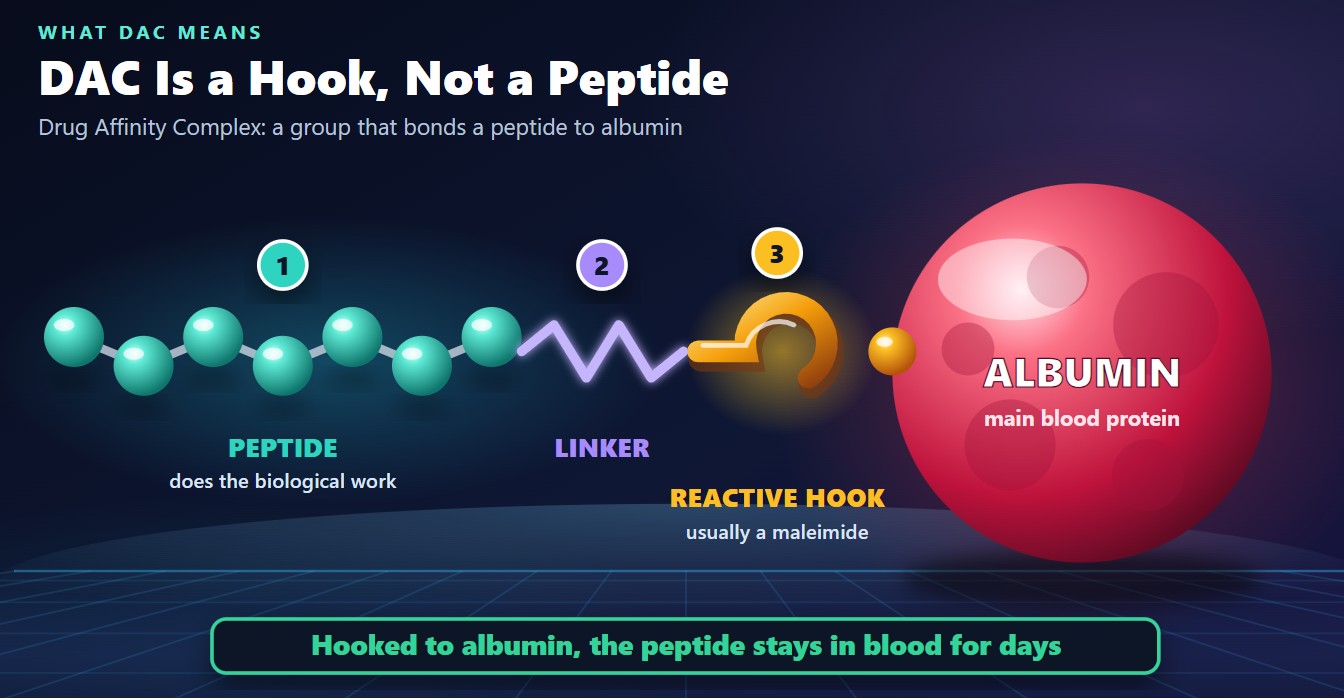
DAC is short for Drug Affinity Complex, a technology developed by ConjuChem to make short-lived peptides last longer. ConjuChem describes a DAC construct in three parts: the peptide that does the biological work, a linker, and a reactive group at the far end. The reactive group binds to albumin.
Researchers add it because natural peptides rarely survive long. A DAC changes the pharmacokinetic profile, how a compound moves through the body and is cleared.
CJC-1295 is the peptide most tied to the term because ConjuChem built it as a DAC version of a GHRH analog.
What Does DAC Do to a Peptide?
DAC lets a peptide bond to albumin so the body clears it more slowly. A tow hitch works the same way, linking a small load to a bigger vehicle.
- The DAC modification puts a reactive group on the peptide.
- The group bonds to albumin in the blood.
- The body clears the bonded peptide more slowly.
- Exposure lasts longer.
How Does DAC Work?
A DAC peptide works through one chemical bond. The reactive group, usually a maleimide, reacts with a free thiol on albumin at cysteine-34. ConjuChem describes the covalent attachment as permanent, so the peptide stays attached to albumin for as long as the protein circulates.
DAC and Albumin Binding
Albumin is the most abundant protein in plasma. It has an unusually long circulating half-life because of its size and recycling pathway, according to a review of albumin-based half-life extension. Small peptides fall below the kidney’s filtration threshold and are lost quickly. Bonding to albumin shields it from both the filter and the enzymes.
DAC and Peptide Half-Life
Half-life is the time it takes for a compound’s blood concentration to fall by half. Albumin binding stretches it because the peptide borrows the protein’s slow exit. Potency is a separate measure, so a longer CJC-1295 half-life only means the peptide stays in the body longer.
What Is CJC-1295?
CJC-1295 is a synthetic GHRH analog, a copy of growth hormone-releasing hormone, the signal that tells the pituitary to release growth hormone. A member of the wider family of HGH peptides, it is built on the first 29 amino acids of the human hormone, a fragment known as GHRH(1-29) or GRF(1-29). Four of those amino acids were swapped, and a DAC group was added at the tail.
The natural hormone breaks down fast. In a 1986 study in human plasma, an enzyme cut native GHRH into an inactive fragment, and its half-life after injection was 6.8 minutes.
The DAC sits at the C-terminus, the chain’s tail. The paper that first described CJC-1295 calls it a tetrasubstituted GRF(1-29) with an added maleimide-bearing lysine.
The original molecule is the DAC form, which is why the name and the technology became linked. The DAC choice also shapes how the peptide is paired with other compounds, as this review of CJC-1295 and Ipamorelin research explains.
CJC-1295 With DAC vs No DAC: What’s the Difference?
In a CJC-1295 with DAC vs. without DAC comparison, both forms share the same 29-amino-acid backbone. The only structural difference is the albumin-binding group on the DAC form’s tail. This single group determines whether the peptide binds to albumin and, therefore, how long it stays in circulation.
| Feature | CJC-1295 With DAC | CJC-1295 No DAC |
|---|---|---|
| DAC modification | Present | Absent |
| Albumin binding | Yes | No DAC-mediated binding |
| Pharmacokinetic profile | Longer-lasting | Shorter-acting |
| Exposure | Prolonged | More transient |
| Common alternative name | CJC-1295 | Modified GRF 1-29 |
| Main distinction | Extended exposure | Shorter exposure |
CJC-1295 With DAC
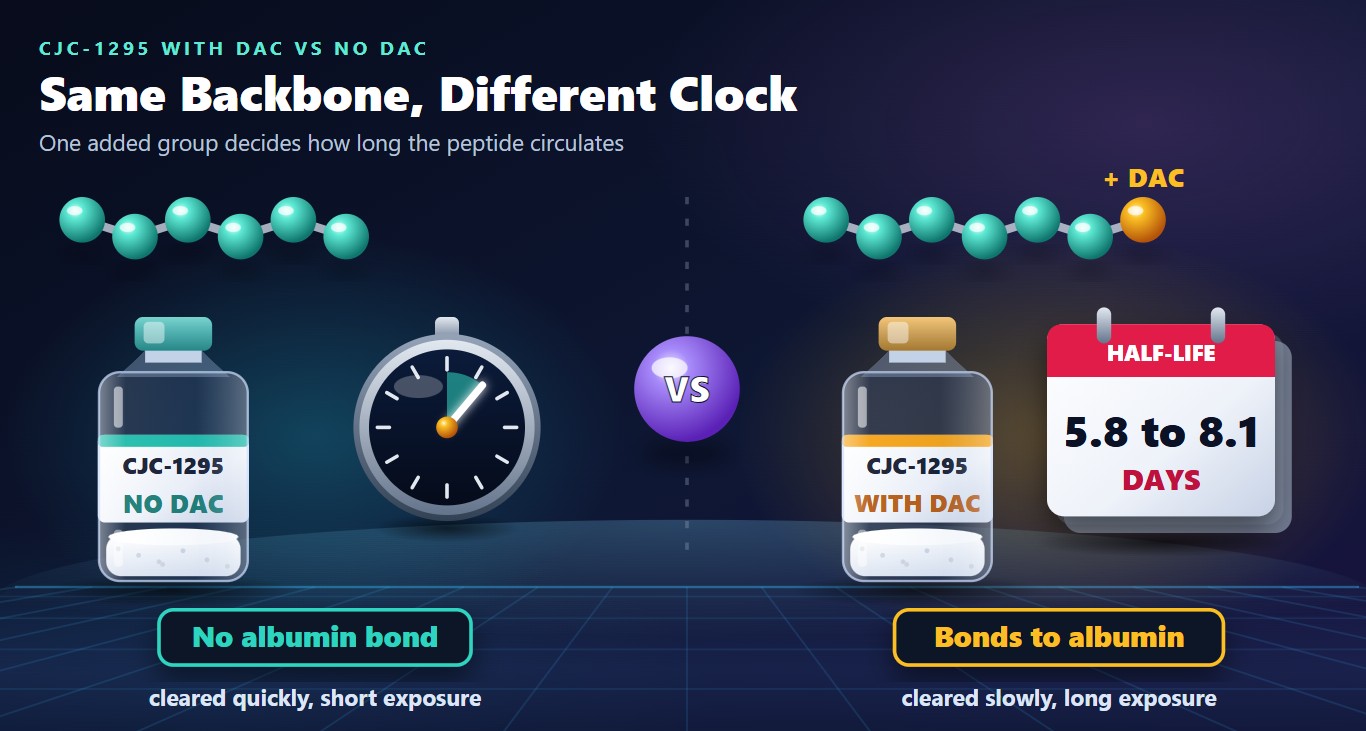
The DAC adds a lysine residue with a maleimide group that binds to albumin after injection. In a human trial of healthy adults, the estimated half-life was 5.8 to 8.1 days. A single injection raised mean growth hormone levels for 6 days or more.
CJC-1295 Without DAC
This form is the four-substitution backbone with no tail. Chemists call it Modified GRF(1-29) or Mod GRF 1-29, and suppliers market it as CJC-1295 No DAC. With no albumin bond, it lacks the extended half-life reported for the DAC form, and the human trials above used the DAC form.
Why Does CJC-1295 With DAC Last Longer?
CJC-1295 with DAC lasts longer because it stops traveling alone. The DAC bonds the peptide to albumin, so the kidneys and enzymes remove it slowly, and the peptide keeps circulating for days. Structure, binding, clearance, half-life, and exposure are separate things.
- Molecular structure: what the molecule is made of, including the DAC group.
- Albumin binding: the bond between that group and the blood protein.
- Clearance: how fast the body removes the compound.
- Half-life: the standard measure of that speed.
- Duration of exposure: how long a measurable amount stays in circulation.
CJC-1295 DAC vs No DAC: Side-by-Side Comparison
A full CJC-1295 DAC vs no DAC comparison comes down to seven points. The two forms match on most of the molecule and split on everything that follows from albumin binding. The human trials cited here all used the DAC form.
- Molecular structure. Both share the tetrasubstituted GRF(1-29) chain. The DAC form adds one modified lysine at the tail.
- DAC modification. Present on CJC-1295 with DAC and absent on the no-DAC form.
- Albumin interaction. The DAC form bonds covalently to albumin. The no-DAC form has no group that can make that bond.
- Pharmacokinetics. The DAC form shows multi-day exposure in humans. The no-DAC form lacks that extension.
- Signaling pattern. In a study of healthy men, growth hormone pulses continued after a DAC dose and trough levels rose 7.5-fold. The no-DAC form is expected to give more transient exposure.
- Research evidence. Human pharmacokinetic and pulsatility data come from the DAC form. PubChem’s CJC-1295 record lists a molecular weight of 3647.2, and its structure includes the maleimide group.
- Naming. Research catalogs use “CJC-1295 No DAC” and “Modified GRF 1-29” for the same no-DAC peptide.
Why Is CJC-1295 No DAC Also Called Modified GRF 1-29?
CJC-1295 No DAC and Modified GRF 1-29 are two names for one peptide. Modified GRF(1-29) is the chemical description: the 29-amino-acid GRF fragment with four substitutions. CJC-1295 was the code ConjuChem gave to the DAC version, and the marketplace now uses that code for the backbone alone.
The overlap causes real mix-ups. KMD Analytical, an independent testing lab, calls marketplace naming “notoriously sloppy” and says receiving the wrong DAC variant is the most common identity problem with this compound: the certificate and the measured mass settle which molecule is in the vial.
Does DAC Make CJC-1295 More Potent?
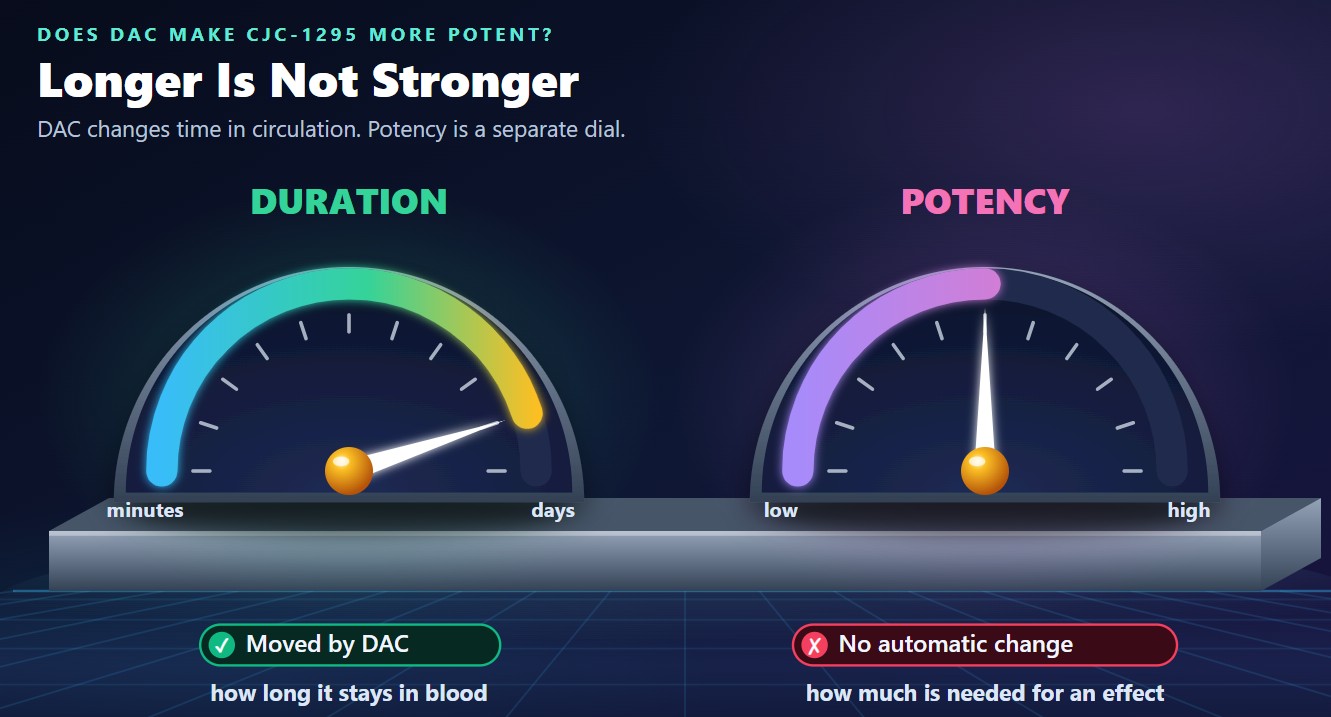
Not necessarily. DAC changes how long CJC-1295 stays in circulation, and potency is a separate property. The Merck Manual defines potency by where a compound sits on the dose axis of a dose-response curve, meaning how much is needed to produce a given effect.
Pharmacokinetics covers what the body does to a compound, such as clearance and half-life. Pharmacodynamics covers what the compound does at its receptor.
DAC works on pharmacokinetics. In the rat study that introduced CJC-1295, the compound produced a 4-fold larger growth hormone response over 2 hours than plain GRF(1-29). Longer exposure can raise a total response without making each molecule stronger.
CJC-1295 DAC vs No DAC: Which Has the Longer Half-Life?
CJC-1295 DAC has a much longer half-life. Its albumin bond keeps it in circulation for days, while the no-DAC peptide lacks that anchor and is cleared like most small peptides.
Exact CJC-1295 half-life figures shift with the study. The human trial reports a CJC-1295 DAC half-life of 5.8 to 8.1 days, and ConjuChem’s platform notes give 8 to 10 days for DAC peptides in humans. Albumin itself lasts 40 to 48 hours in rats and around 15 days in people, so species alone can move the number.
What Are the Main Research Differences Between CJC-1295 DAC and No DAC?
The main research differences between CJC-1295 DAC and no DAC come down to exposure time. One form suits experiments that need a steady, long-lasting signal, and the other suits experiments that need a brief one. Neither profile is the stronger choice by default.
| Research characteristic | DAC | No DAC |
|---|---|---|
| Exposure duration | Prolonged | Shorter |
| Clearance | Slower | Faster |
| Albumin interaction | DAC-mediated | No DAC-mediated interaction |
| Time-course profile | Sustained | Transient |
| Experimental interpretation | Long-exposure model | Short-exposure model |
A long-exposure model shows what a sustained signal does over days. A short-exposure model isolates the response to one brief signal.
How to Identify CJC-1295 DAC vs. No DAC
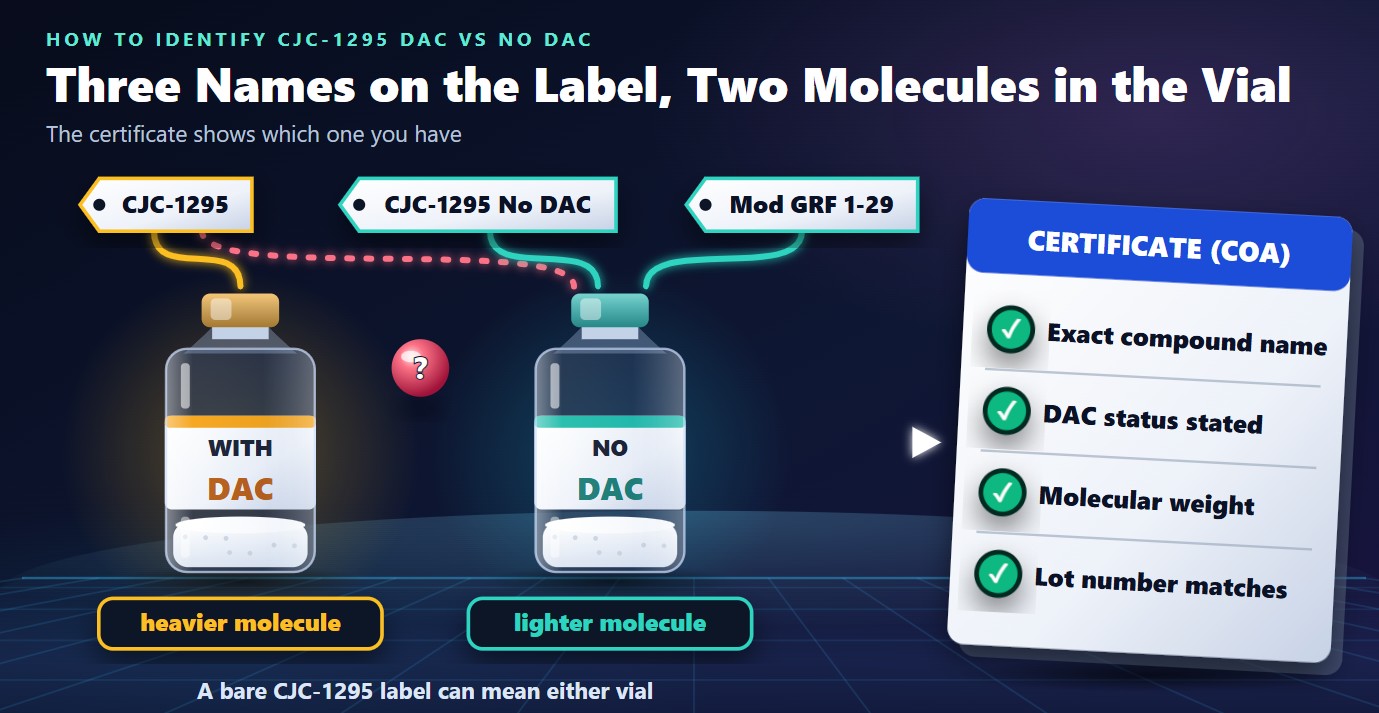
To identify CJC-1295 DAC vs. no DAC, check the documents, since the two forms look identical as white powder in a vial. The listing and the certificate of analysis (COA) show which molecule a lot contains, and each detail below can be checked in advance.
- Exact compound name
- DAC designation, stated as “with DAC” or “no DAC”
- Molecular weight
- Chemical structure or sequence
- Lot number
- COA for that lot
- Identity testing
- Purity testing
Why the Product Name Alone Isn’t Enough
A bare “CJC-1295” on a label can mean either form. The DAC group changes the molecule’s mass, so an identity test that reports mass separates the two.
Common Misconceptions About CJC-1295 DAC
CJC-1295 DAC misconceptions usually start when people treat the three letters as a product. DAC is a feature of one molecule’s structure, and sellers reuse the CJC-1295 name loosely. The same few mix-ups sit behind nearly all of them, and each has a short answer.
Is DAC another peptide? No. It is a chemical modification attached to a peptide.
Is CJC-1295 with DAC the same as Modified GRF 1-29? No. Modified GRF 1-29 is the backbone without the DAC group.
Is CJC-1295 without DAC the official name? It is a trade convention. The chemical name is Modified GRF(1-29).
Does DAC automatically make a peptide better? No. It makes the peptide last longer, which suits only some study designs.
Does DAC only apply to CJC-1295? No. ConjuChem built CJC-1131, a DAC version of GLP-1. CJC-1295 is the best-known example.
Does a longer half-life mean higher potency? No. Half-life measures time in circulation, while potency measures how much is needed to produce an effect.
What Should Researchers Look for When Comparing CJC-1295 DAC and No DAC?
When comparing CJC-1295 DAC and no DAC from different sources, researchers should first verify identity. A simple way to organize it is the Molecule-Then-Batch Check: confirm the molecule first, then confirm the batch.
Confirm the molecule
- Correct molecular identity
- DAC status stated outright
- Molecular weight that fits the stated form
- Clear product labeling
Confirm the batch
- Lot-specific COA
- Identity confirmation by a named method
- Purity testing
- Traceable batch information
Some vendors print the lot ID on the vial and include it on the certificate so researchers can match the paperwork to the material in hand. A listing that shows only a purity figure, with no lot and no identity method, leaves the DAC question open.
FAQs
What is DAC in peptides?
DAC is a chemical group that lets a peptide bond to albumin and stay in the blood longer. The bond can form in the body after injection or outside the body with purified albumin.
What does DAC stand for?
Drug Affinity Complex. ConjuChem, the Montreal biotech that developed the technology, uses the term as a trademark. Its papers use the same label for other compounds, such as DAC: GLP-1.
What does DAC do to CJC-1295?
It lets CJC-1295 bond to albumin in the blood. In rats, the bonded peptide appeared on the albumin band within minutes and remained detectable in plasma for several days.
Is CJC-1295 with DAC the same as CJC-1295 without DAC?
No. They share a backbone, and the DAC form carries an extra modified lysine. A testing lab can distinguish them by mass and HPLC retention time.
Is CJC-1295 No DAC the same as Modified GRF 1-29?
Yes. Both names refer to the same tetrasubstituted GRF(1-29) amide, and “Mod GRF 1-29” is common shorthand. Sellers list the DAC form under similar names, so check the certificate.
Does DAC increase peptide potency?
Not on its own. ConjuChem says a DAC peptide retains most of its original biological activity, so the gain is longer presence with broadly similar activity.
CJC-1295 DAC vs No DAC: Key Takeaway
The key takeaway on CJC-1295 DAC vs. no DAC is that one small chemical group separates two different research materials. DAC determines albumin binding, and albumin binding decides how long the peptide circulates. Everything else in the comparison follows from that.
- DAC stands for Drug Affinity Complex.
- It is a chemical modification, not a separate peptide.
- Its albumin interaction substantially changes CJC-1295’s pharmacokinetic profile.
- CJC-1295 with DAC and the material sold as CJC-1295 No DAC are different molecules and cannot be swapped.
- Modified GRF 1-29 is the name commonly tied to the no-DAC designation.
- Longer exposure does not automatically mean greater potency or better research outcomes.
A researcher who knows which form is in the vial can design the study around its real exposure profile. The label starts that check, and the certificate finishes it.
Disclaimer
This article is for educational and laboratory research purposes only. The compounds discussed are not approved for human use, and nothing here is medical advice or dosing guidance.


