
Most trees open the tiny pores on their leaves when the sun comes up. The trees of the genus Clusia do the opposite.
They open those pores after dark, pull in carbon dioxide while the night air is cool and damp, and seal them shut through the hottest hours of the day. Few trees breathe at night, and only these are known to capture carbon after dark. It is a water-saving trick that lets them ride out dry spells that would finish off an ordinary tree, and it has now been traced back to its genetic roots.
Researchers led by Wolfram Weckwerth at the University of Vienna compared the genomes of three Clusia species and found that this night-time strategy, known as CAM photosynthesis, did not evolve in one tidy step. Long-ago genome duplication and millions of years of genetic reshuffling produced several different versions of the same water-saving behavior. The findings were published in Nature Communications.
A 200-Year-Old Photosynthesis Mystery
In 1800, the naturalist Alexander von Humboldt was studying a tropical tree when he noticed something odd. He placed one of its leaves in water and watched. Even in bright sunlight, it produced none of the oxygen bubbles he was used to seeing. The leaf belonged to Clusia rosea, one of the three species in the new study.
The tree was keeping a different schedule. Its stomata, the microscopic pores that normally take in carbon dioxide and release oxygen during the day, stayed closed while the sun was up, sharply cutting evaporation from the leaf. Instead, the tree absorbed carbon dioxide at night, bound it chemically, and stored it as malic acid until morning.
Scientists named the process crassulacean acid metabolism, or CAM, after the stonecrop family in which it was first described. It is the same trick that lets cacti, agaves, and pineapples thrive where water is scarce, and it has evolved independently in at least 38 plant families. Among trees, though, it belongs to Clusia alone.
What stayed unclear for two centuries was how CAM evolved in the first place and why species sharing the same trick use it so differently.
How CAM Photosynthesis Works
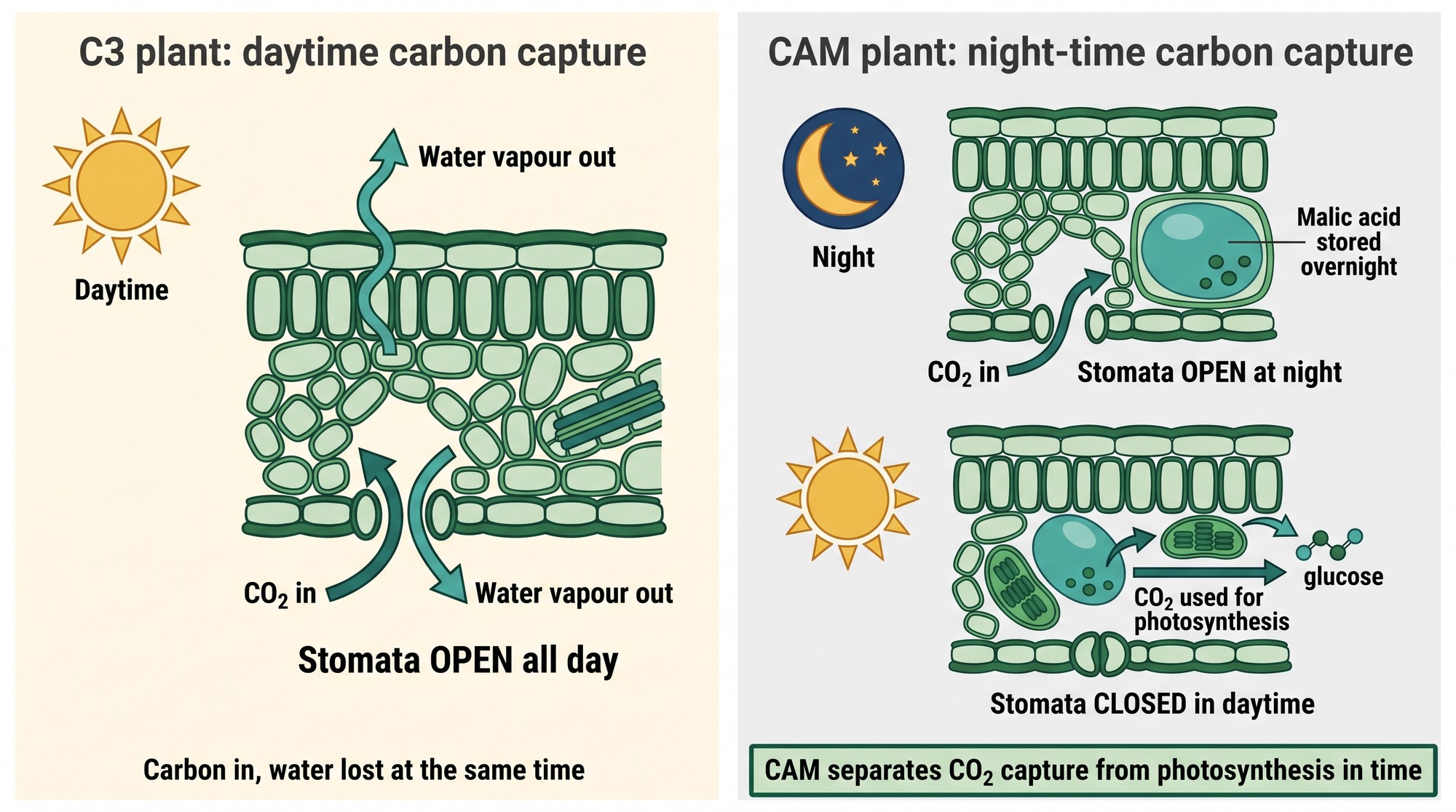
The trick is a matter of timing. Ordinary plants, including most crops, use what is called C3 photosynthesis: they open their pores and take in carbon dioxide while losing water all day long. CAM plants split those two jobs apart.
- At night: the stomata open. Carbon dioxide diffuses in and is fixed into malic acid, which is stored in the cell’s vacuoles.
- During the day: the stomata stay shut. The stored malic acid releases its carbon dioxide internally, feeding photosynthesis without any further water loss.
The trade-off is speed. Shutting the pores by day limits how much carbon a plant can gather, so many CAM plants grow slowly. What they buy in exchange is enormous water efficiency, which is exactly what a drought demands.
Three Trees, Three Different Strategies
The Clusia genus is unusual because it spans the whole spectrum. It also holds a distinction that the University of Vienna team calls unique in the plant kingdom: Clusia contains the only known trees able to fix carbon dioxide at night.
The researchers sequenced Clusia rosea, Clusia minor, and Clusia major, then monitored the living trees under near-natural greenhouse conditions while varying how much water they received. Measuring gene activity, proteins, and metabolic products alongside the plants’ behavior revealed three distinct approaches.
| Species | Strategy | What it does |
|---|---|---|
| Clusia rosea | Strong CAM | Runs CAM full time and stores large amounts of carbon dioxide as malic acid overnight |
| Clusia minor | Stress-triggered (facultative) | Behaves like a normal C3 plant when water is plentiful, then switches CAM on under drought stress |
| Clusia major | Hybrid | Runs C3 and CAM at the same time, blending both pathways |
The differences showed up not only in how the trees behaved but also in which genes were switched on and which metabolic products accumulated. That gave the team a rare chance to connect a plant’s daily routine to the DNA underneath it.

Ancient Genome Duplication Rewired the Recipe
The genetic explanation starts with a duplication event. All three species are ancient polyploids, meaning their genomes were multiplied at some point in their evolutionary past. Over very long periods, those oversized genomes were then reduced and reorganized in a process called diploidization. They did not all duplicate to the same degree: Clusia major is a diploidized tetraploid, Clusia minor a diploidized hexaploid, and Clusia rosea a diploidized octoploid.
Much of the reshaping came from transposons, mobile stretches of DNA that insert themselves into genes and disrupt them. The gene families hardest hit were those controlling how leaf starch is broken down to supply carbon for the night-time chemistry, the phosphorolytic route the authors single out as central to CAM. In Clusia major alone, the team identified more than 11,000 pseudogenes, genes that have lost their function, which suggests at least 27 percent of its former genes have been retired over time.
“In the process, gene copies are lost, deactivated, or take on new functions,” explains lead author Hannes Kramml of the University of Vienna’s Division of Molecular Systems Biology. Second lead author Johannes Herpell adds that the genes most crucial for storing carbon dioxide overnight in CAM metabolism were especially affected.
In other words, the trees did not simply carry extra copies of the same instructions. They gradually rebuilt those duplicated genomes into something new. “The genomes have not simply multiplied; over millions of years, they have been reorganized, reduced and functionally rewired,” says Weckwerth. That flexibility, he argues, is what explains the wide range of CAM behavior within a single genus.
The implication is that CAM in Clusia was not a single evolutionary event. Repeated rounds of genomic reorganization appear to have produced different versions of the same water-saving strategy, each suited to a different ecological niche.
Why This Matters Beyond the Tropics
CAM plants need far less water than plants that rely entirely on daytime carbon capture. As drought and heat extremes put pressure on staple crops, that efficiency looks increasingly attractive, and the new genomes offer a map of the metabolic processes involved.
It is worth being clear about how hard the engineering would be. In a survey of 40 plant families, Smithsonian Tropical Research Institute scientist Klaus Winter and University of Oxford plant scientist J. Andrew C. Smith found that night-time acid accumulation is confined to CAM species. The shift to storing acid overnight, they concluded, requires a fundamental metabolic reprogramming rather than a small adjustment to an existing pathway. It is better understood as a distinct evolutionary innovation than as a dial that ordinary plants can simply turn up.
Engineers have already tried. In 2025, a team reported installing a synthetic CAM-like shuttle into rice, the first attempt of its kind in a C3 food crop. The modified plants ran carbon fixation on a CAM-style schedule and produced roughly 20 percent more grain and biomass across two years of field trials. The surprise was that their water use efficiency and drought resistance did not improve at all.
That null result is exactly what makes the evolutionary evidence valuable. Gaining the carbon-fixing enzymes is not the same as gaining the water savings, because the benefit appears to depend on the broader sugar and acid machinery the Clusia genomes map out.
The Vienna results sharpen that picture further. If one genus reached the same water-saving outcome by several different genomic routes, engineers may have more than one template to work from. The facultative species, which switch only when stressed, are arguably the most instructive of the three.
- Identifying precisely which metabolic steps control water-efficient carbon capture.
- Highlighting the facultative species as possible templates for crops that switch strategy only under stress.
- Giving plant breeders measurable gene targets rather than a single elusive “drought gene”.
That matters for forests as well as farms. Tropical forests are a major land-based carbon sink, and their capacity to absorb carbon has been slipping as heat and drought stress intensify. Rising carbon dioxide in the atmosphere does not simply make plants grow better in compensation, which makes water-saving adaptations all the more consequential.

What the Study Doesn’t Prove
Three caveats are worth holding on to.
- It was a greenhouse study. The trees were monitored under near-natural conditions with controlled water, not in a wild forest facing competitors, pests, and real drought cycles.
- It covers three species out of a large genus. Clusia contains hundreds of species, so this is a detailed snapshot rather than the complete family tree.
- Crop applications remain unproven. Rice engineered with a CAM-like shuttle has produced more grain, but it did not become more water-efficient or more drought-tolerant, so the hoped-for payoff has not yet been demonstrated.
Frequently Asked Questions
Do trees really “breathe” at night?
Some do. “Breathing” here means gas exchange, not breathing as animals do. Most trees open their stomata in daylight, but Clusia species are the only known trees that open them at night to take in carbon dioxide, keeping them closed during the hot day to conserve water.
Which plants use CAM photosynthesis?
CAM is best known from desert and semi-arid succulents such as cacti, agaves and the stonecrops that gave the pathway its name, along with pineapple and many orchids and bromeliads. Clusia is the notable tree genus that uses it.
Is CAM photosynthesis better than normal photosynthesis?
Neither is universally better. CAM is far more water-efficient, a decisive advantage in dry conditions. But keeping the pores shut by day limits carbon uptake, so CAM plants typically grow more slowly than C3 plants when water is abundant.
Could this research lead to drought-resistant crops?
Possibly, but not quickly. The Clusia genomes identify the genes and metabolic steps involved in water-efficient carbon capture, which is useful groundwork. The first real test, a synthetic CAM-like pathway installed in rice in 2025, increased yields by about 20 percent in field trials but left water use efficiency and drought resistance unchanged. Converting a staple crop into something that genuinely saves water looks likely to require deep metabolic reprogramming, not a single genetic tweak.
Why is Clusia special among trees?
It is the only genus of trees known to perform CAM photosynthesis, and its species range from conventional daytime carbon capture to hybrid and full night-time strategies. That range makes it an unusually good natural laboratory for studying how photosynthesis can change.
The Bigger Picture
Von Humboldt’s leaf in a glass of water was a two-century-old hint that some plants run on a completely different clock. The new genomes explain how that clock was rebuilt, and rebuilt more than once, from the same ancestral machinery.
The practical payoff, if it comes, will arrive slowly through plant breeding and bioengineering. The more immediate value is conceptual: surviving water scarcity in the tropics was not a single invention. It was a set of solutions, and the trees that carry them are still, quietly, keeping a schedule of their own.

