
The headline writes itself: plastic bags become gasoline. Researchers at Oak Ridge National Laboratory have developed a way to convert polyethylene waste into gasoline- and diesel-like fuels using molten aluminum chloride salts, and the story circulated across science outlets this September.
The chemistry is genuinely interesting. It runs below 170 degrees Celsius, roughly the temperature of a moderately hot oven, where conventional pyrolysis needs 450 to 500. It uses no noble-metal catalysts, no organic solvents, and no external hydrogen. The team has applied for a patent.
It is also a laboratory result, published in the Journal of the American Chemical Society in April 2025, not a commercial process. And it belongs to a category of technology that has a documented history of failing, repeatedly and expensively, at exactly the scale the coverage is about.
That gap between the clean science story and the messy commercial reality is where the real tension lives.
What the Oak Ridge Breakthrough Actually Does
The research, led by postdoctoral researcher Liqi Qiu at the University of Tennessee, Knoxville, working in the laboratory of ORNL Corporate Fellow Sheng Dai, converts polyethylene into branched alkanes in the C6 to C12 range. Those fall squarely in the gasoline range.
Polyethylene is the plastic in carrier bags, plastic wrap, cutting boards, milk jugs, and shampoo bottles. It is a pure hydrocarbon chain, which makes it unusually clean feedstock from a chemist’s perspective. A long, simple chain of carbon and hydrogen is a tidy starting point.
The team’s reported gasoline yield is about 60 percent under mild conditions. To understand why that matters, it helps to know what the conventional approach looks like.
How molten salt cracking differs from pyrolysis
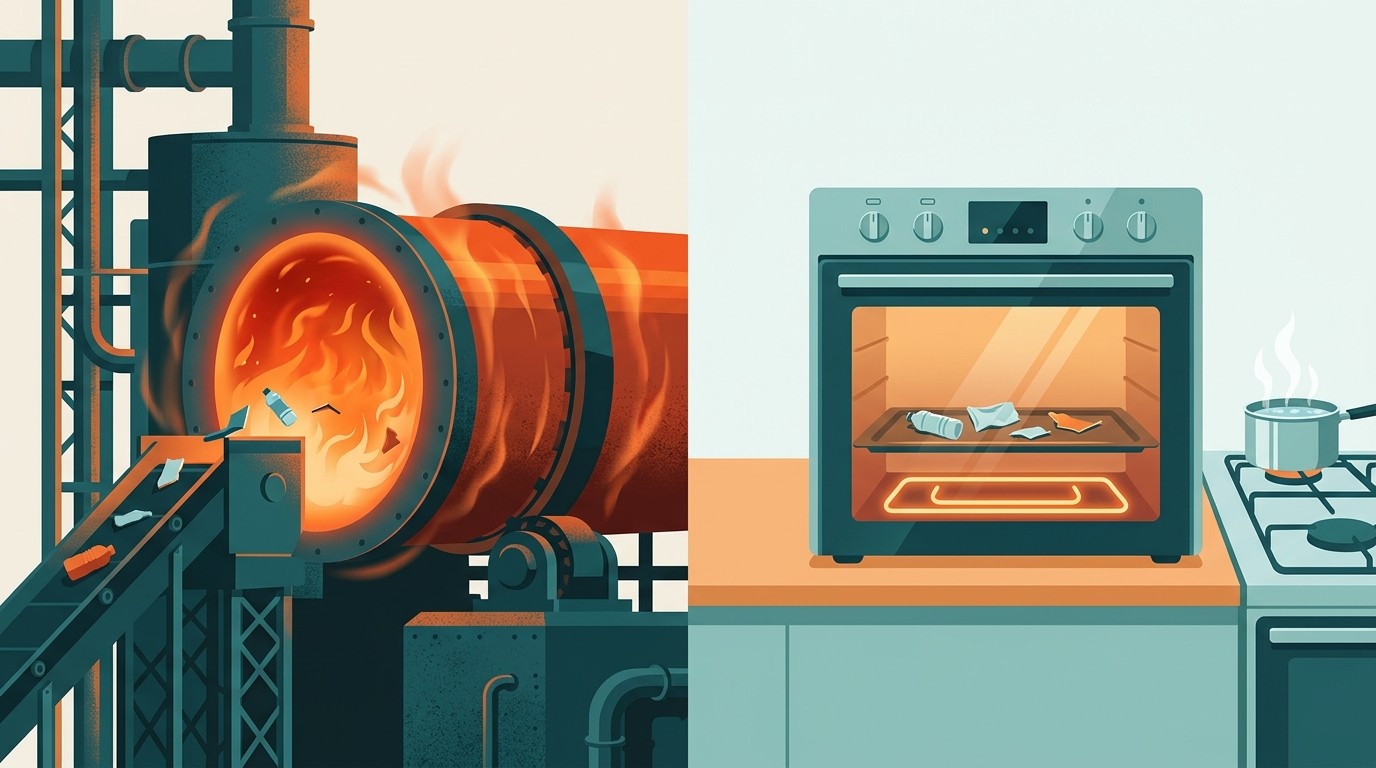
Pyrolysis breaks polymers apart using heat alone, typically between 450 and 700 degrees Celsius, with no oxygen present. It is well understood, commercially deployed, and genuinely expensive to run, because heating anything to those temperatures and holding it there costs real money.
The ORNL system takes a different route. Instead of using heat as the primary tool for breaking bonds, it uses a liquid medium that is also the catalyst.
- Temperature: below 170 degrees Celsius, a fraction of what the conventional route demands
- Catalyst: commercially available aluminum chloride molten salts, serving as both reaction medium and catalyst
- Noble metals: not required, unlike many catalytic processes that depend on platinum, palladium, or ruthenium
- External hydrogen: not required, which matters because hydrogen is expensive and difficult to handle at scale
- Organic solvents: not required
- Reported yield: approximately 60 percent gasoline-range product
According to Dai, the process addresses two fundamental issues: a stable system is radically easier to scale up, and unlike the previous approach, it needs no initiator to kick off the catalytic reaction.
Why Nobody Was Doing It This Way
The pivotal scientific detail is how the catalyst works.
Aluminum chloride molten salts are liquid, which means polymer can dissolve into them and react at every point rather than only on the surface of a solid catalyst pellet. That alone is a significant advantage in cracking long chains.
But the deeper reason molten salts work is chemical. The researchers found that the abundant aluminum sites in the salt carry strong Lewis acidity, comparable to the aluminum in acidic zeolites, one of the workhorse catalysts of petroleum refining. The highly ionic nature of the molten salt stabilizes carbenium ions, the reactive intermediates that form when a carbon-hydrogen bond breaks.
Carbenium ions are notoriously unstable. They want to rearrange, recombine, or crack in uncontrolled directions. Stabilize them and you get selective, controlled chain breaking. That is what the team did.
Verifying the mechanism required an unusual stack of instruments. The team used soft X-ray spectroscopy at Lawrence Berkeley National Laboratory’s Advanced Light Source to watch how aluminum sites changed during the reaction, nuclear magnetic resonance to track the aluminum chemistry, and neutron scattering at ORNL’s Spallation Neutron Source to follow hydrogen atoms through the reaction. They labeled carbon ions with deuterium, a heavy hydrogen isotope, to trace where they went.
That level of mechanistic clarity is impressive. It also tells you the process is not finished. ORNL’s own release notes the main unresolved problem: the aluminum salt system is hygroscopic, meaning it absorbs water and loses stability. The team’s next step is to explore ways to confine the molten salts, possibly using halogens or carbons, to improve separation and processing.

The Feedstock Problem Nobody Mentions
Here is the first thing almost every article about this breakthrough skips.
Polyethylene is a single polymer among many in the waste stream. It is not the whole stream, and in most waste streams it is not even the largest part.
Containers and packaging are the single largest category of plastic waste in the United States, and they are not polyethylene alone. They include polyethylene terephthalate, or PET, in drink bottles; polypropylene in tubs, lids, and containers; polystyrene in foam packaging; PVC in rigid pipe and blister packs; and multi-layer laminates that combine several of these with aluminum foil and adhesives.
Each behaves differently under heat. PVC releases hydrogen chloride gas when it decomposes, a corrosive and toxic contaminant that corrodes reactors and has to be captured. PET’s oxygen-containing backbone produces a different set of products than a pure hydrocarbon chain. Polystyrene tends toward aromatic products rather than the branched alkanes the ORNL process produces. Multi-layer films cannot be separated economically at waste-facility speeds.

So a process that elegantly handles polyethylene addresses a real and sizable part of the problem, but not all of it. And the sorting required to deliver clean, single-polymer polyethylene feedstock at industrial throughput is itself a substantial unsolved logistics problem.
The scale problem is just as real. The OECD’s Global Plastics Outlook found that only about 9 percent of global plastic waste is successfully recycled, with roughly 22 percent completely mismanaged. Most of the rest is incinerated, landfilled, or leaked into rivers and oceans. Cleaner feedstock exists in theory and is scarce in practice.
Not every alternative has the same weakness. Some researchers have gone after the biology instead of the chemistry, using fungi that digest plastic waste or mealworms that can consume styrofoam. Those approaches sidestep the carbon-accounting problem entirely, but they are considerably slower and operate at a different scale.
Plastic-to-Fuel’s Commercial Graveyard
This is the part the headline never reaches, and it is the reason the ORNL result deserves careful rather than celebratory framing.
Over roughly five years, the commercial chemical-recycling sector produced a remarkable number of shutdowns, cancellations, and write-downs. The pattern is consistent enough to be treated as evidence rather than anecdote.
- Pryme, Rotterdam: commissioning slipped from 2022 into 2023 and 2024, with early output below expectations. Large-scale expansion plans were scrapped in November 2024, and a February 2025 update confirmed production remained below projections.
- Quantafuel, Skive, Denmark: announced in 2020, started late in 2022, and ran below capacity, and the company was delisted in February 2024 after being acquired by Viridor.
- Brightmark and BlueCycle: declared bankruptcy before the end of the first quarter of 2025, with Brightmark’s bankruptcy in part affecting its pyrolysis subsidiary.
- Ioniqa, Agilyx via Styrenyx, and New Hope Energy: all shut down plants during 2024.
- Renewlogy and Dow, Boise, Idaho: ended their pyrolysis project because the plant could not handle plastic films. Boise now hauls plastic waste to a cement plant instead.
- Enerkem and Shell, Rotterdam: cancelled their gasification project amid uncertainty over securing a reliable waste supply.
One 2025 industry assessment of advanced plastic recycling concluded that more than half of the projects scheduled for completion in 2025 were expected to miss their deadlines, particularly those with six-figure metric-ton annual capacities.

The reasons are consistent: contaminated feedstock, reactor scale-up difficulties, capital costs that balloon against volatile oil prices, unclear regulatory treatment, and no reliable buyer willing to pay a premium for recycled feedstock over cheap virgin resin.
IL has followed plastic-to-fuel at every scale, from early independent reactor builders working in Argentina and Ghana to the wave of corporate investment that followed. Looked at together, the pattern of delay and retreat is clearer than any single company’s story reveals.
It is in that context that better chemistry starts to matter. Not because a better catalyst solves the commercial problem, but because better chemistry is one of the few variables that could change the cost curve.
The investment history deserves the same scrutiny as the technology. Corporate backing for plastic-to-fuel has been substantial, and it has not prevented the failures above. That is worth weighing when reading any announcement about a new process, including this one.
The scale of that backing is the reason this remains a live commercial question rather than a settled one. Coverage of how major corporations have invested in plastic-to-fuel operations shows how much capital has chased the promise, which cuts both ways: it validates the market, and it explains why so many projects were scaled before they were proven.
Why Pyrolysis Is Not Sustainable
Searchers ask this question directly, and the honest answer is uncomfortable.
Almost all plastic is made from oil and natural gas. Turning it into fuel and then burning that fuel returns the carbon to the atmosphere. The molecule was extracted from the ground, and it goes back out.
That is not the only problem. Pyrolysis oils and gases typically fail to meet transportation fuel specifications on their own, and require further refining. Their quality varies heavily with the feedstock, which is exactly what makes waste streams hard to process consistently. The process is endothermic, meaning it consumes more energy than it releases, and that energy has to come from somewhere.
There is a regulatory point that matters more than most coverage acknowledges. The European Union’s Waste Framework Directive defines recycling as reprocessing waste into products or materials, and explicitly excludes reprocessing into materials used as fuels. Under EU law, producing fuel from waste is classified as a different category of recovery entirely, not recycling.
A different approach to the same waste problem aims higher. A UCLA and South Korean research team has developed a process that converts mixed unsorted plastic into hydrogen while locking away most of the carbon as solid mineral, which sidesteps the carbon question entirely. The molten salt approach instead prioritises producing a drop-in liquid fuel at low temperature, a different bet on which problem is easier to solve first.
Advocacy groups have pressed this point hard, arguing that the term “chemical recycling” is used to blur the line between plastic-to-plastic recycling and plastic-to-fuel incineration. Whether you find that framing fair depends on how you weigh the claims, but the legal distinction itself is not in dispute.
Now, where does the ORNL process sit? It runs far cooler than pyrolysis, which is a genuine energy saving. But it is still converting a waste plastic into a fuel that will be burned, with no external hydrogen required, which is a real simplification. It sits closer to “better pyrolysis” than to “recycling” on the spectrum that matters for climate accounting.
For context, here is how the main conversion routes compare on the dimensions that decide whether a process survives contact with industry.
| Route | Typical temperature | Feedstock tolerance | Carbon outcome | Commercial status |
|---|---|---|---|---|
| Mechanical recycling | Low | Clean, sorted only | Material retained in cycle | Commercially deployed |
| Thermal pyrolysis | 450–700°C | Pre-sorted, contamination-sensitive | Large share released as CO2 | Deployed, with repeated plant failures |
| Steam gasification | 700–1,000°C | Handles mixed waste | Substantial CO2 release | Limited commercial deployment |
| Alkaline thermal treatment | Several hundred degrees lower than gasification | Handles mixed PET, PE, PP | >75% fixed as solid carbonate | Laboratory stage |
| Molten salt cracking | Below 170°C | Polyethylene only | Carbon released on burning | Laboratory stage, patent pending |
| Biological degradation | Ambient | Targeted polymers | Minimal, slower process | Early commercial pilots |
Who Is Actually Turning Plastic Into Fuel Right Now
Searchers want names, so here they are, with their actual status rather than their press releases.
- Plastic Energy, UK and Spain: operates commercial pyrolysis plants in Seville and Almería, producing TACOIL for petrochemical use. One of the more persistent operators.
- Quantafuel, Denmark: long-running mixed-plastics project at Skive, now under Viridor ownership.
- OMV ReOil, Austria: integrated refinery pilot at Schwechat, scaling toward demonstration capacity to produce synthetic crude for fuels.
- Indaver, Belgium: Plastics2Chemicals depolymerization plant in Antwerp, treating polystyrene and polyolefins, with a full-scale plant online in 2024.
- PlastikGas: licenses a proprietary process claiming roughly 48 percent gasoline and 28 percent diesel yields with no catalyst required. A commercial venture, not an independent validation.
None of these are using molten salt catalysis. The ORNL approach is novel in this field precisely because nobody else is pursuing it, which is also why there is no track record to point to.
What Would Actually Have to Be True
A bench result becomes an industrial reality through a long chain of unglamorous conditions. For molten-salt plastic-to-fuel, several would need to hold simultaneously.
Solving the water problem
That water sensitivity is the immediate blocker. An aluminum chloride salt that degrades on contact with moisture cannot process wet waste feedstock, which is most of it. Confining the molten salt so it survives real-world conditions is the team’s own stated next step, and it is the step most likely to determine the outcome.
Getting past the sorting wall
The process needs clean polyethylene. Industrial sorting that delivers pure, uncontaminated polyethylene at scale and cost does not currently exist for most waste streams. Multi-layer films and multilayer packaging remain largely unsolved.
Finding a buyer
Refineries buy cheap fossil feedstock. A pyrolysis oil has to beat that on price, or a mandate has to create a market. Several European jurisdictions have experimented with recycled-carbon-fuel support mechanisms, and the absence of a settled framework has been part of the commercial problem.
Surviving the scale-up curve
Molten salt handling at industrial volumes involves corrosion, containment, and continuous-feed engineering that simply has not been attempted at this scale for this application. The claim that the system is stable is encouraging, not conclusive.
None of this diminishes the science. It makes it fairer to describe it as an early-stage result with an unusually good cost profile, published by a national laboratory that has worked on molten salts since the 1960s, when the technology proved its worth as both fuel and coolant in a nuclear reactor.
Frequently Asked Questions
Can you actually turn plastic into gasoline at home?
No. Every credible process requires controlled industrial equipment: high-temperature reactors, or in the ORNL case, molten salt handling systems, catalysts, and separation stages. The frequently circulated home-brew plastic-to-fuel schemes do not produce usable fuel, and attempting them generates dangerous vapors rather than energy.
What temperature does plastic-to-fuel need?
It depends on the method. Conventional pyrolysis of plastics typically runs between 450 and 700 degrees Celsius. The Oak Ridge molten salt process is reported to operate below 170 degrees Celsius, which is a substantial energy saving and the most interesting feature of the work.
Is turning plastic into fuel better than recycling it?
Generally no, when the plastic can be mechanically recycled. The waste hierarchy puts reuse and recycling above energy recovery, because recycling keeps material in the material cycle rather than converting it into a one-time fuel. Plastic-to-fuel makes most sense for mixed or contaminated waste that cannot be sorted into a recyclable stream.
For the plastics that never made it into a recycling stream, understanding why mechanical recycling stalls is useful background. Sorting is the bottleneck, and contamination is largely a design problem: choices made upstream determine what is recoverable later. A material that is easier to separate at the point of disposal never needs a chemical process at all, which is why researchers are also working on recovering value from the hardest waste streams.
Is plastic-to-fuel renewable energy?
Almost never. Almost all plastic is manufactured from fossil feedstocks, and burning plastic-derived fuel releases that carbon. Some projects attempt to route the carbon into new products rather than the atmosphere, but conventional plastic-to-fuel does not do this.
Why is it called “chemical recycling” if the fuel gets burned?
The term is contested because the underlying processes differ. Turning plastic back into plastic keeps material in circulation; turning it into fuel produces something that is burned once and then gone. Industry groups prefer the broader label because it frames these plants as part of the circular economy. Critics argue it obscures the fact that much of the output ends up combusted. The distinction is not academic: it shapes which facilities are classified as recycling plants, and that classification in turn affects permitting, access to subsidies, and public standing.
Conclusion
The Oak Ridge result is a good piece of science with a real advantage: it cracks polyethylene at a temperature close to your kitchen oven instead of a furnace, using cheap salts instead of precious metals, and without needing hydrogen anyone has to manufacture.
What it does not do is solve the reasons plastic-to-fuel has struggled. Those reasons are mostly not chemical, and a cleverer catalyst touches none of them directly.
That is not a reason to dismiss the work. It is a reason to watch it honestly. If the water problem gets solved and the sorting economics hold up, this is one of the more plausible routes anyone has proposed. Until then, it is a promising laboratory result from a national laboratory that has been studying molten salts since before most people had heard the phrase chemical recycling.


