
The small battery size on a label can conceal a surprising amount of technology. An AA cell may contain a rechargeable chemistry that operates at 1.2V, another that provides a regulated 1.5V output, or a non-rechargeable lithium chemistry that also uses the familiar 1.5V name.
Linogy’s All-in-One Battery Management System offers a useful real-world example, but the lessons extend beyond one brand.
From Rechargeable Batteries to Battery Management
These differences affect which devices can use a battery, which charger it needs, and how its capacity should be interpreted. Solving those three questions is enough to buy a battery, but it is not enough to run a household that uses many of them.
Once a home accumulates a larger pool of rechargeable AA and AAA cells, a second problem appears. The difficulty is no longer only charging. It becomes knowing which batteries are actually ready to use, keeping two physical sizes and several chemistries straight, telling a fresh cell apart from a tired one, and storing charged cells where they will still be charged next week. A drawer of mixed cells is the usual result, and it slowly pushes people back toward disposables.
That is the reasoning behind describing this category as battery management rather than battery charging. Linogy states its positioning in four words: Charge. Test. Store. Reuse. Its All-in-One Battery Management System is built around that sequence, and the rest of this article examines each of those stages in turn, alongside the specifications and safety limits that apply to all of them.
What Is a 1.5V Lithium AA Battery?
AA and AAA are size names, not descriptions of chemistry or voltage. AA cells are physically larger than AAA cells, and each format can be available with several different electrochemical systems.
The term “1.5V lithium” needs an extra distinction. Some products are primary lithium batteries, designed for single use. Others are rechargeable lithium-ion cells that use internal electronics to regulate the output to a constant 1.5V. The rechargeable option is more closely related to the lithium-ion technology described by the US Department of Energy, but it adds a step: conventional lithium-ion cells typically operate at a substantially higher voltage, so electronic circuitry reduces that voltage before it reaches a device designed for 1.5V cells.
That circuitry is one reason rechargeable AA and AAA batteries cannot be judged by their physical fit alone. Their size may be standard while their charging requirements and electrical behavior are not.
The five-factor reading rule: size, output voltage, chemistry, charger compatibility, and capacity unit.
Checking all five prevents the most common category error: treating every cell that fits an AA compartment as if it can safely be charged or powered in the same way.
AA vs. AAA: What Changes?
An AA cell has room for more active material than an AAA cell, so energy capacity usually decreases when moving from AA to AAA within the same chemistry and voltage class. The smaller cell may still be the right choice simply because the device requires that physical format.
| Feature | AA cell | AAA cell |
|---|---|---|
| Physical format | Larger cylindrical format | Smaller cylindrical format |
| Typical capacity advantage | More energy in the same chemistry class | Less energy because of the smaller volume |
| Device fit | Only devices designed for AA cells | Only devices designed for AAA cells |
| What does not change | The need to match voltage, chemistry, and charger instructions | |
Linogy’s 1.5V rechargeable AA and AAA batteries are specified at 3,600 mWh for the AA Pro cell and 1,300 mWh for the AAA cell. Both provide a constant 1.5V output and use rechargeable lithium-ion chemistry. These are specifications for those cells, not a universal ranking of every AA or AAA battery on the market.
1.5V Lithium vs. NiMH and Alkaline Batteries
Voltage behavior helps explain why rechargeable cells from different chemistries can feel very different in the same device.
| Characteristic | Regulated 1.5V lithium-ion | NiMH rechargeable | Alkaline primary |
|---|---|---|---|
| Nominal output | 1.5V | 1.2V | 1.5V |
| Reusable | Yes | Yes | No |
| Voltage during use | Aim is a regulated 1.5V output | Nominal 1.2V, with a higher voltage immediately after charging | Voltage gradually falls as the cell is used |
| Best fit | Devices that benefit from stable 1.5V power | Devices that expressly accept NiMH cells | Occasional use or backup power |
| Main caution | Requires chemistry-compatible charging and proper device use | May cause early low-battery warnings in voltage-sensitive devices | Single use, with disposal and leakage considerations |
A camera, smart lock, security camera, game controller, or other device may estimate remaining charge partly from battery voltage. A 1.2V NiMH cell can therefore trigger a low-battery warning even while it still has usable energy. A regulated 1.5V lithium-ion cell is designed to reduce that mismatch, but it does not guarantee compatibility with every device.
Read the device manual first. A label saying “do not use rechargeable batteries” is a reason to investigate the voltage and chemistry requirements, not evidence that every rechargeable format will fail in exactly the same way.
How to Read Capacity, mWh, and Charging Claims
Battery specifications often mix units, which can make comparisons misleading. Milliamp-hours, abbreviated mAh, describe charge. Milliwatt-hours, abbreviated mWh, describe stored energy. Because cells can operate at different voltages, mWh is often the more useful unit for comparing batteries with different output voltages.
For example, a manufacturer may state 3,600 mWh for an AA cell with a regulated 1.5V output. It is tempting to convert that into an mAh figure, but the result depends on what voltage and discharge conditions the manufacturer used. A number calculated from the internal cell voltage is not the same as the usable output at 1.5V. Compare published mWh specifications, and do not convert a quoted mAh value without documentation.
Charging time is just as conditional. Linogy states that eight of its AA Pro batteries can reach full charge in about three hours under supported charging conditions. That claim should not be generalized to every battery, charger, power source, or state of charge. A useful charging specification names the battery type, starting condition, charger, and whether the charger is being powered as intended.
- Chemistry: Is the cell rechargeable, and which rechargeable chemistry is it?
- Voltage: Is it a regulated 1.5V cell or a different voltage format?
- Charging conditions: Which charger, adapter, and power source are supported?
- Capacity unit: Is the figure mWh or mAh, and is the measurement documented?
- Cycle conditions: Is “full cycle” a complete discharge followed by a full charge?
This framework is more useful than comparing one large headline number with another. A high mWh rating cannot compensate for an incompatible charger, and a fast charging claim means little if the battery cannot safely reach the stated condition.
What Does a Multi-Chemistry Charger Really Mean?
Charge the battery only with a charger designed for its chemistry. A standard NiMH or NiCd charger must not be used with a regulated 1.5V lithium-ion AA unless the charger manufacturer explicitly permits that combination. Conversely, a lithium-only charger should not be assumed to charge NiMH safely.
Do not place disposable alkaline or zinc-carbon cells in a charger. Do not mix rechargeable and disposable cells in the same device when their voltage curves differ, because the cells can become imbalanced. A rechargeable cell can drive the disposable cell beyond its safe discharge, while the disposable cell may drain more quickly and leave the rechargeable cell depleted.
“Multi-chemistry” can be useful shorthand, but it is not a guarantee of universal compatibility. It means the charger is designed to support named chemistries under defined conditions. It does not mean that disposable cells, damaged cells, or batteries from every brand can be inserted safely.
Linogy’s eight-slot station is designed for compatible rechargeable AA and AAA batteries using lithium-ion, NiMH, or NiCd chemistries. The company says it has tested compatible cells from brands including Eneloop, EBL, and Amazon Basics. That testing does not amount to an endorsement of those brands or a promise that every product sold under those names is supported.
There is also a physical distinction between charging AA cells and charging AAA cells. Linogy uses two types of AAA accessories: individual sleeves and station-mounted AA-to-AAA adapters. The station-mounted arrangement is limited to up to six AAA cells plus two AA cells when all three adapters are used. It should not be described as charging eight AAA cells simultaneously.
Independent slot control is a separate feature from chemistry support. It means users can charge any supported number of batteries without waiting for a complete set. It does not mean that the charger has inferred permission to charge an unsupported battery.
Cycle Life, Storage, and What a Battery Tester Can Tell You
Cycle life describes repeated charging and discharging, not calendar age by itself. A battery can age while it is in use, and it can also lose performance through storage conditions and heat. This is why phrases such as “up to” and “under tested conditions” matter.
Linogy states that its rechargeable batteries are designed for up to 1,200 full charge cycles, with at least 60% capacity retained after 1,200 full cycles under tested conditions. The company also states that the batteries are designed to last up to five years depending on use and charging frequency. Those are not guarantees that every battery will reach the same point, nor should cycle life be read as a permanent calendar lifespan.
Long-term storage is a different specification. Linogy reports about 88% charge retention after 12 months of storage under tested conditions. That is a result tied to defined storage testing, not a promise that a battery left indefinitely in a hot car, damp location, or leaking device will retain the same percentage.
A basic battery tester can check status or voltage. It cannot provide a complete health diagnosis or predict the exact remaining life of a cell. A voltage reading is one useful signal, but internal resistance, chemistry, age, temperature, and previous use can affect performance in ways a simple test cannot fully reveal.
Reading Battery Environmental Claims Carefully
Reuse can reduce the number of single-use batteries that need to be manufactured and discarded, but an environmental claim needs its method and limits. Four different statements should not be treated as interchangeable.
- Cumulative batteries charged is a usage counter. It is not the number of batteries currently charged and ready to use.
- Estimated CO2e reduction is a modeled figure, not a direct measurement of emissions at the user’s home.
- Recyclable packaging describes an end-of-life route. It does not mean the packaging was made from recycled material.
- Recycled material content describes what was used in a specified component. It does not automatically apply to every component or to the finished product’s safety.
Linogy’s 4-slot and 8-slot charger housings use UL-certified recycled polycarbonate-based material identified as RC-65, with at least 65% post-consumer recycled content verified according to ISO 14021, report number 302017-4210. The 65% claim applies to the specified housings, not to the batteries inside them.
Even a well-managed rechargeable system has a final life. At end of life, lithium-ion batteries and devices containing them should not go in household garbage or ordinary recycling bins. The US Environmental Protection Agency recommends separate battery recycling or household hazardous-waste collection. The agency also notes that even used batteries can retain enough energy to cause injury or start a fire.
How Linogy’s All-in-One System Applies These Lessons
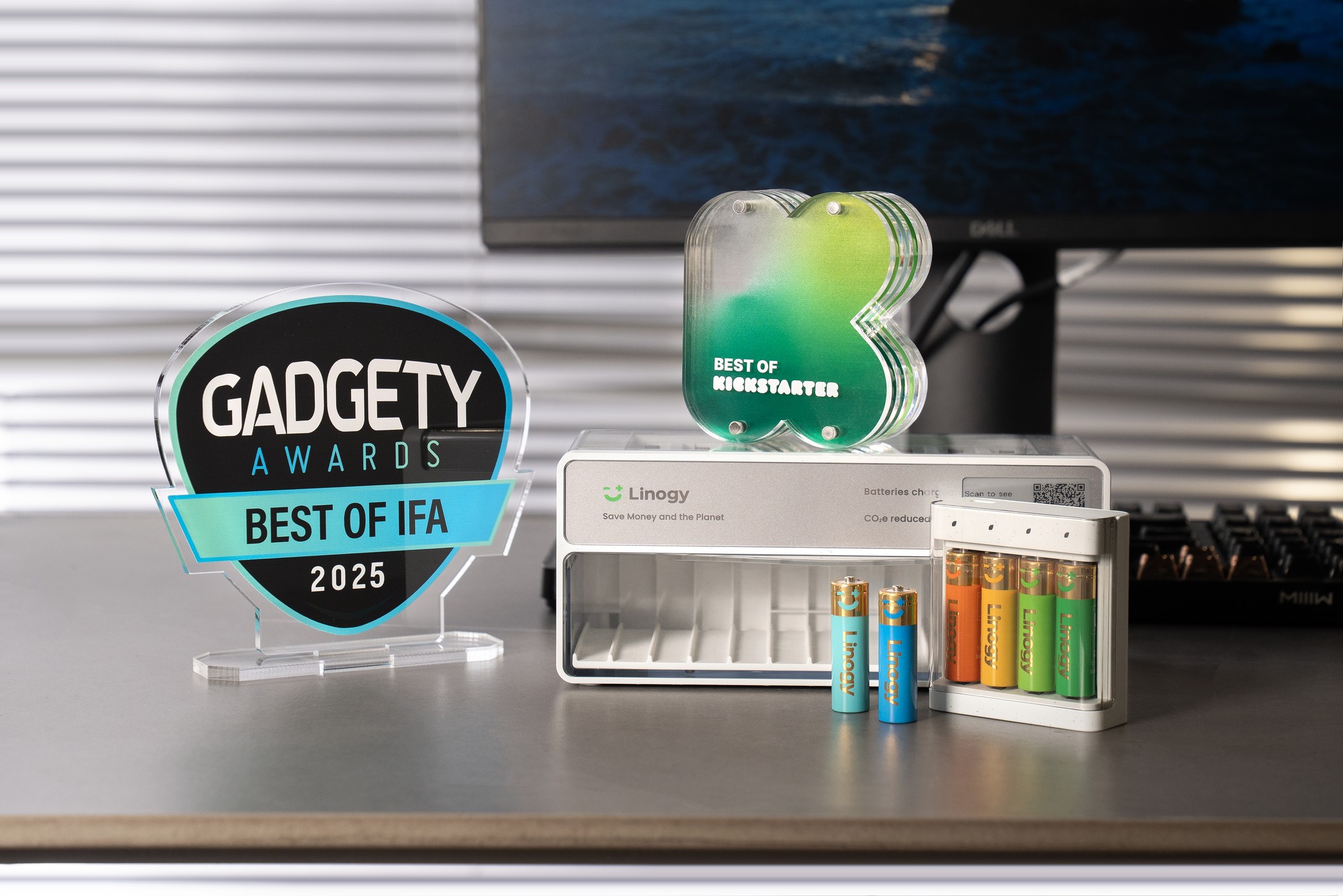
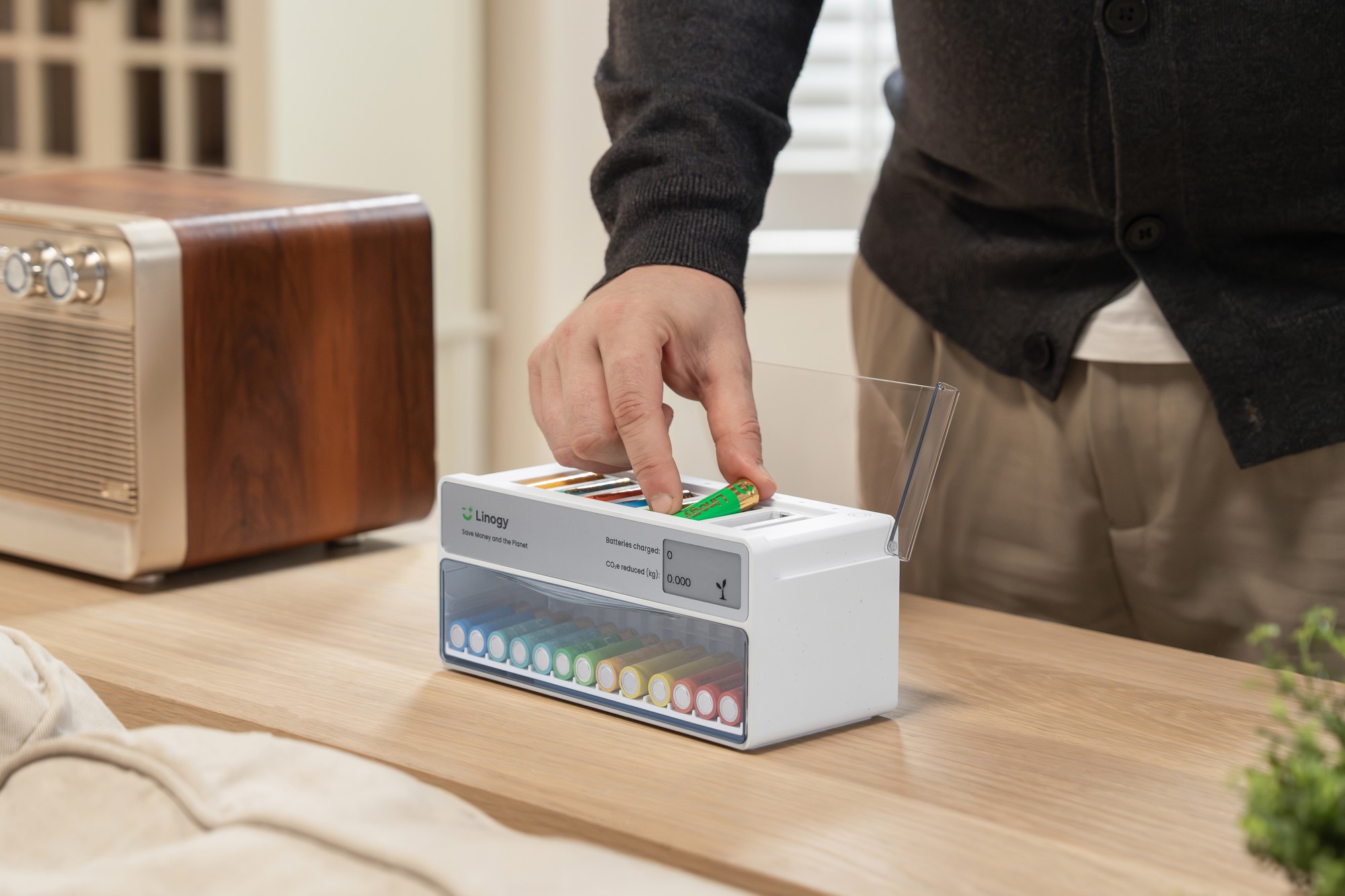
Linogy’s system illustrates how charging, testing, storage, and reuse fit together. Its eight-slot station uses USB-C power and has independently controlled charging slots. Compatible rechargeable AA and AAA cells are supported across lithium-ion, NiMH, and NiCd chemistries.
When charging completes automatically, Auto-Drop releases a fully charged battery into the built-in storage compartment. That compartment holds up to 40 batteries. The mechanism is a workflow feature, not a claim that a cell is ready for every device or that a cumulative counter can tell the user how many cells are currently available.
The E-Ink display shows cumulative batteries charged and an estimated CO2e reduction associated with reuse. Those numbers should be read as activity and modeled environmental indicators, not as a directly measured emissions audit. The system’s battery tester helps assess status and voltage, but it is not a complete diagnosis of internal health or exact remaining life.
Our earlier Linogy AA and AAA rechargeable battery system review focuses on hands-on use, design, and ownership experience. This guide is different: the value of an all-in-one system is best understood by checking the battery specification, charger conditions, and claim qualifications first.
Frequently Asked Questions
Are 1.5V lithium batteries the same as AA?
Not always. AA describes physical size. A 1.5V lithium battery can be a primary cell or a rechargeable regulated cell, and it may be AA or AAA size. Always check size, chemistry, voltage, and charging requirements together.
Are lithium AA batteries better than NiMH?
Not universally. NiMH cells are often simpler, widely supported by dedicated chargers, and may offer strong cycle life at a lower upfront cost. Regulated 1.5V lithium-ion cells are more useful when a device estimates charge from voltage and a 1.2V NiMH cell causes premature warnings. The better choice depends on the device, charger, and required voltage.
Can you use 1.5V lithium batteries instead of NiMH batteries?
Use rechargeable 1.5V lithium batteries in devices designed for standard 1.5V AA or AAA cells, and charge them only with a charger explicitly compatible with the battery chemistry. These are two separate questions. Device-side, a regulated 1.5V lithium cell is built to replace a standard 1.5V cell. Charger-side, the chemistry still has to be supported. Device-specific instructions should always take priority.
What are the downsides of NiMH batteries?
NiMH cells usually operate at 1.2V rather than 1.5V, so some devices may show a low-battery warning early. They also require a NiMH-compatible charger and can lose more charge while sitting in storage than low-self-discharge or regulated lithium alternatives.
Can I use rechargeable and regular batteries together?
It is best not to mix rechargeable and disposable cells in the same battery compartment or device. Their voltage, capacity, and discharge behavior differ, which can cause imbalance, rapid depletion, leakage, or an early low-battery warning. Use the type specified by the device manufacturer.
Can you recharge AAA batteries in an AA charger?
Only if the charger instructions explicitly support AAA cells and provides the correct fit or adapter. A compartment that physically accepts an AA cell may not have the correct terminal spacing or charging profile for an AAA cell. Never force a cell into an incompatible slot.
What are the trade-offs of 1.5V rechargeable lithium AA batteries?
There is no single downside for every application. Important trade-offs include higher upfront cost, the need for a charger that supports the chemistry, sensitivity to physical damage, and the requirement to recycle the cell at end of life. A regulated 1.5V cell also packs a voltage regulator and protection electronics into a small format, so cell and charger quality matter more than with a simple NiMH cell.
Are 1.5V lithium batteries safe?
They must be handled as lithium-ion batteries, not as disposable cells. Use the intended charger, follow the manufacturer’s instructions, and avoid using damaged, swollen, leaking, or abnormal cells. The US Consumer Product Safety Commission says high-energy-density batteries need enhanced safety systems and appropriate care, and recommends testing the cell, battery, charger, and product as a system.
Can I charge any rechargeable AA battery in a multi-chemistry charger?
No. Check the charger’s named chemistries and the battery manufacturer’s instructions. A charger that supports several chemistries is still not a guarantee of universal compatibility. Never use a disposable or unsupported battery as a test.
How many AAA batteries can the Linogy station charge with adapters?
Up to six AAA batteries and two AA batteries can charge simultaneously when up to three station-mounted adapters are used. The adapter configuration should not be presented as supporting eight AAA batteries at once.
Does a battery tester in a rechargeable AA system tell me exactly how much life is left?
No. A built-in tester can provide status or voltage information, but it is not a full health diagnosis or an exact remaining-life prediction for a 1.5V rechargeable lithium cell.
Is one recharge equal to one disposable battery avoided?
Not necessarily. Reuse can replace some disposable purchases over time, but the outcome depends on the battery’s actual use, the number of cycles completed, the original manufacturing impact, and what happens at end of life. A modeled CO2e figure should not be treated as a direct measurement.
Conclusion: Use the Specification, Not the Slogan
Rechargeable AA and AAA batteries are not one uniform category. A 1.5V lithium-ion cell can offer useful regulated voltage, but that feature comes with charging and safety requirements. AA and AAA formats, capacity units, cycle claims, testers, and environmental indicators all need careful interpretation.
Start with the device’s voltage and chemistry requirements, then confirm charger compatibility and the manufacturer’s conditions. If those details line up, a well-managed system can make rechargeable batteries easier to organize and reuse. If they do not, a higher headline capacity or a familiar “1.5V lithium” label is not enough.


