
Not all biodegradable plastic rots. In a 320-day test in oxygen-free landfill liquid, one biodegradable plastic almost vanished in 17 days while another barely changed after nearly a year. The result challenges the idea that the word biodegradable alone tells you what happens after disposal.
A joint team from KAIST and UNIST ran a biodegradable plastic landfill experiment by burying three common biodegradable plastics in landfill leachate at 35 degrees Celsius without oxygen and measured how much plastic carbon microbes turned into gas. Polyhydroxybutyrate, known as PHB, reached 99.9% mineralization in 17 days. Polylactic acid, known as PLA, reached 83.6% after 320 days. Polybutylene adipate terephthalate, known as PBAT, reached only 2.7%, close to ordinary plastic. This article explains what those numbers mean, why landfill differs from composting, and what to buy and how to dispose of it.
What the KAIST and UNIST Teams Actually Tested
On November 10, KAIST announced findings from a team led by Professor Myung Jae-wook of the Department of Civil and Environmental Engineering, working with Professor Lee Chang-soo of UNIST. The paper appeared in the study of anaerobic fates of biodegradable plastics in landfill leachate in Nature Communications on October 20, and the university summarized the work in the KAIST announcement describing divergent outcomes by material.
The setup was designed to mimic the liquid inside a landfill, not a compost bin. The researchers used leachate from a landfill that has operated since 1997. Leachate is the liquid that seeps through buried waste and carries dissolved substances and microbes with it. They placed samples of PHB, PLA and PBAT in that liquid, kept them at 35 degrees Celsius without oxygen, and ran the experiment for up to 320 days. For comparison, they also tested low-density polyethylene, or LDPE, a conventional plastic.
They measured mineralization. That is the share of carbon in the plastic that microbes convert into gases such as methane and carbon dioxide. It is a stricter test than watching plastic crack, fade or fall apart, because fragmentation alone can leave microplastics behind.
The co-first authors were Dr. Choe Shin-hyeong, a KAIST graduate now at the Swiss Federal Institute of Aquatic Science and Technology, and Dr. Choi Hyung-min, a UNIST graduate now at Hokkaido University.
Mineralization vs Disintegration: Why the Number Matters
Shoppers often use three words as if they mean the same thing. They do not, and the difference explains much of the confusion around biodegradable plastic in landfills.
- Disintegration means the item falls into smaller pieces. A bag can disintegrate and still be plastic, only smaller.
- Biodegradation means microbes chemically break polymer chains into simpler substances they can use.
- Mineralization means the carbon completes that journey and leaves as gas, measured here as methane and carbon dioxide, plus microbial biomass. This is what the KAIST and UNIST team quantified.
That distinction is why the headline numbers are powerful. PHB did not merely crumble in 17 days. Microbes converted 99.9% of its carbon into gas. PBAT did not merely stay whole. After 320 days, only 2.7% of its carbon had become gas, which means most of the material persisted in chemical terms. Ordinary LDPE reached 0.4% in the same test, so PBAT was closer to conventional plastic than to PHB under these specific conditions.
This also connects to older warnings about misleading labels. Intelligent Living previously covered biodegradable bags that still held shopping after three years buried, where visible persistence and microplastic formation were the concern. The KAIST and UNIST study adds the missing gas measurement, which separates real microbial conversion from mere crumbling.
Three Plastics, Three Fates After 320 Days
The phrase biodegradable plastic covers materials with very different chemistry. PHB is made by microbes and has chemical bonds many soil and water microbes already know how to attack. PLA is made from plant sugars and is common in cups and food packaging. PBAT is a flexible fossil-based copolyester often used in compostable bags and wraps.
| Plastic | What it is commonly used for | Mineralization in landfill leachate at 35C, no oxygen | What the team observed |
|---|---|---|---|
| PHB | Packaging, agricultural film, specialty molded goods | 99.9% in 17 days | Rapid and near complete conversion to biogas |
| PLA | Cups, lids, food containers, liners | 83.6% after 320 days, after about 20 days with little change | Slow start, then steady breakdown with biofilm on cracks |
| PBAT | Compostable bags, wraps, flexible film | 2.7% after 320 days | Largely persisted under these test conditions |
| LDPE, conventional plastic control | Bags, films, bottles | 0.4% after 320 days | Essentially no meaningful breakdown, as expected |
The PLA result is the surprise. PLA is usually described as a material that needs high heat composting, because its chains break apart slowly below about 58 degrees Celsius. Earlier work found limited breakdown in soil, fresh water and seawater at ordinary temperatures. Yet in warm, oxygen free leachate with landfill microbes, PLA passed 80% mineralization over 320 days after an initial lag of about 20 days. Under the electron microscope, cracked and damaged areas were covered by biofilm.
The PBAT result needs careful wording. A rate of 2.7% after 320 days means very little breakdown happened in this experiment. It does not prove PBAT can never biodegrade anywhere. It means that in this leachate, at this temperature, without oxygen and over this period, PBAT was recalcitrant. Other environments, longer times, different microbes or pretreatment could give a different outcome, but shoppers should not assume a compostable bag will disappear in a landfill.
Why a Landfill Is Nothing Like an Industrial Composter
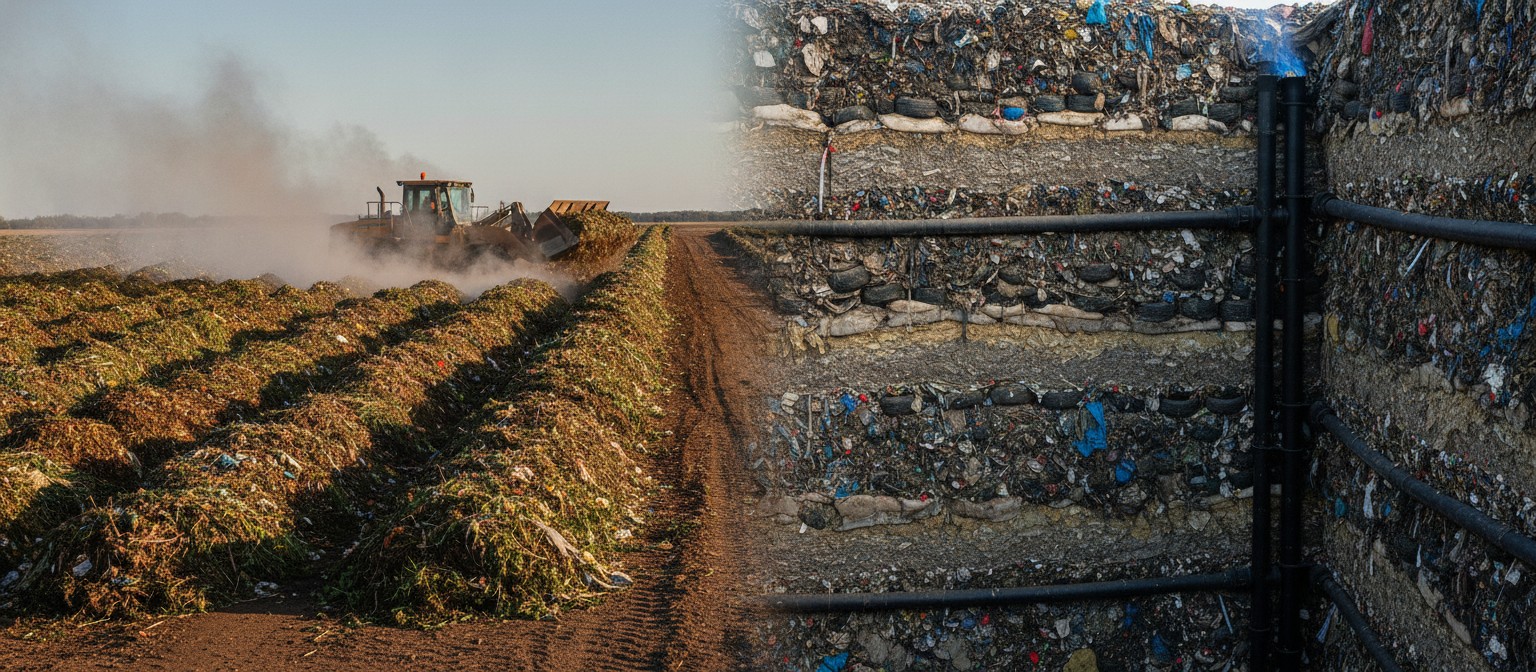
Many biodegradable plastic failures come from imagining the wrong destination. An industrial composter is hot, aerated and managed. A deep landfill zone is cooler, oxygen free and highly variable.
Industrial composting usually runs at 55 to 75 degrees Celsius with moisture, oxygen and dense thermophilic microbes. Certification systems reflect that engineered environment. In the United States, the specification for compostable plastics in the United States explains ASTM D6400 testing, while a review of compostability standards describes the European EN 13432 approach. Broadly, certified industrially compostable plastic must fragment so that most of it passes a 2 mm sieve within about 12 weeks, convert at least 90% of polymer carbon to carbon dioxide within about 180 days under industrial conditions, and leave compost that supports plant growth without toxicity.
PLA shows why temperature matters. Its glass transition sits around 55 to 60 degrees Celsius. Above that range, its chains become mobile, water enters more easily and hydrolysis accelerates. Below that range, the same material can be stubborn. That is why a PLA cup can perform well in a 58 degree industrial test yet persist in cool soil or seawater.
A landfill adds other constraints. Oxygen is scarce, temperatures vary by depth and site, nutrients and moisture are uneven, and waste is compacted. Where separate collection is lacking, compostable packaging often ends up buried with ordinary trash. The KAIST and UNIST experiment does not reproduce every landfill, but it isolates the key landfill like feature that compost labels ignore: warm, oxygen free liquid rich in landfill microbes.
This is also why earlier compost breakthroughs do not automatically solve landfill. Enzyme-embedded films that broke down in home compost with built in enzymes rely on moisture and heat triggering the right chemistry. An additive that claims to make common plastics biodegrade in soil within two years was tested for open air terrestrial conditions, not for deep burial. Disposal environment decides the outcome.
The Biofilm Clue: 238 Genomes Narrowed to 49
The team did more than weigh gas. They asked which microbes might be doing the work, using DNA to see which genes were present and RNA to see which genes were actually switched on.
From the experiment, they reconstructed 238 microbial genomes. Of those, 118 contained candidate genes for enzymes that could attack PHB or PLA. Only 49 showed signs those genes were active. In other words, carrying a possible tool is not the same as using it.
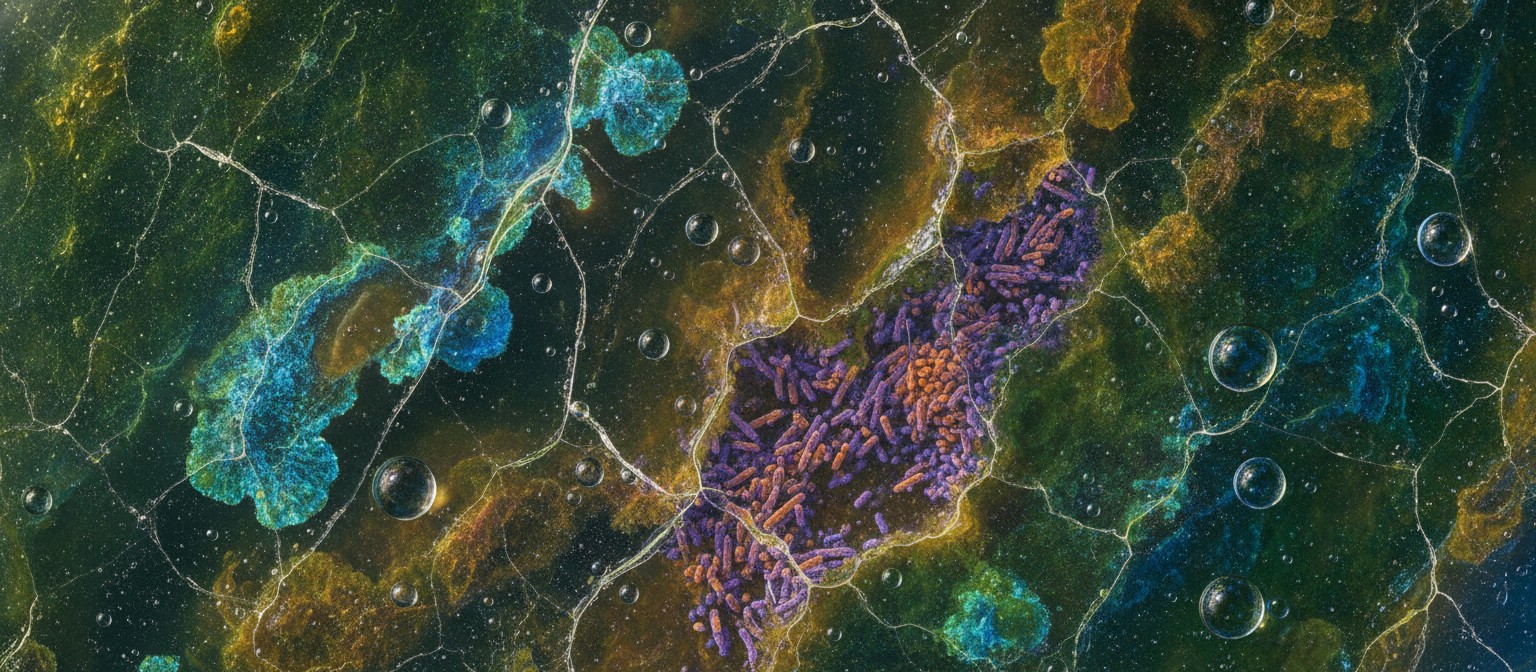
Two patterns stood out. First, activity was higher in biofilm on the plastic surface than in the surrounding leachate. Biofilm is the thin microbial layer that forms when cells attach to a surface. On PLA, it clustered around cracks and damaged spots, suggesting that attachment and local chemistry matter more than which microbes merely float nearby. Second, 37 of the 49 active genomes belonged to poorly studied lineages, pointing to possible new degraders and enzymes.
That finding is preliminary in an important way. Gene activity is a strong clue, not proof that a specific microbe or enzyme breaks a specific plastic. The researchers said follow-up work is needed to confirm function. They also cautioned that the rates came from controlled bottles at 35 degrees Celsius, so real landfills with different temperatures, waste mixes, oxygen levels and nutrients will not give identical speeds or shares.
What to Buy and How to Dispose of It
The practical lesson is to match the material to the disposal route you actually have, not the one printed optimistically on the pack.
- Do not treat biodegradable as litter safe. In landfill like conditions, PBAT barely mineralized over 320 days. Even PLA needed months after a slow start. Nothing in this study supports tossing packaging into nature.
- Save industrially compostable packaging for industrial composting. If your city collects certified compostable packaging and actually composts it, use that route. If you have only trash and recycling bins, a compostable bag or cup is likely to be landfilled.
- Keep compostable plastic out of conventional recycling. It can contaminate plastic recycling streams, and recyclers cannot turn it back into durable plastic in the same way as PET or HDPE.
- Choose PHB where durability allows and disposal is uncertain, but read the whole label. Fast mineralization in this test does not make every PHB product low impact, because sourcing, thickness, additives and local collection still matter.
- Reduce and reuse first. The most reliable way to avoid the landfill question is to avoid single use items, whether fossil plastic, bioplastic or paper.
When you shop, look for the destination, not only the word biodegradable. Useful labels name a standard and a route, such as industrially compostable only where facilities exist, home compostable, or recyclable in a named stream. Vague wording without temperature, time or facility guidance is a warning sign.
Frequently Asked Questions
Does biodegradable plastic break down in landfill?
Sometimes, but not reliably. In this 35 degree oxygen free leachate test, PHB mineralized almost completely in 17 days, PLA reached 83.6% after 320 days, PBAT reached only 2.7%, and ordinary LDPE reached 0.4%. The label alone does not predict the outcome.
How long does biodegradable plastic take to decompose in a landfill?
There is no single answer, because time depends on chemistry, temperature, oxygen, moisture and microbes. This study shows the range can span weeks to longer than a year. PHB needed days, PLA needed months after a lag of about 20 days, and PBAT showed little change after 320 days under these conditions.
Is PLA biodegradable in landfill?
PLA can mineralize far more than older low temperature studies suggested, at least in warm anaerobic leachate. It reached 83.6% after 320 days here, despite its reputation as a high heat composting material. That does not mean every landfill will do the same, and PLA still performs most reliably in industrial composting near 58 degrees Celsius.
Does PBAT biodegrade in landfill?
Very little in this test. PBAT reached 2.7% mineralization after 320 days, near the 0.4% seen for ordinary polyethylene. That is evidence of persistence under the tested conditions, not proof that PBAT never degrades anywhere. Do not assume compostable film will vanish if landfilled.
How should I dispose of biodegradable plastic?
Follow the local route for that exact product. Put certified industrially compostable items in industrial organics collection only if your program accepts them. Put conventional recyclable plastic in recycling. Put anything without a clear local route in trash rather than wish cycling, and avoid buying single use compostable items when you lack compost collection.
Conclusion
The KAIST and UNIST results give shoppers a clearer rule: ask where it breaks down, not only whether it is called biodegradable. Under identical oxygen free landfill liquid conditions, PHB converted almost fully to gas in days, PLA converted substantially over months with help from surface biofilm, and PBAT largely remained. The microbe data adds a promising lead, with 49 active genomes and many poorly studied lineages, but function still needs direct proof and real landfills will differ from laboratory bottles.
For policy and product design, the message from Professor Myung is direct. Materials should be judged and certified for the disposal environment they will actually enter. Until labels and collection catch up, the safest choice is to reduce single use packaging, reuse what you own, and reserve compostable plastics for places with real compost collection.


