
Inside a 5,000-liter steel tank in Vacaville, California, a microbial culture is eating a gas that most industries pay to get rid of. The feed is methane drawn from wastewater treatment plants, landfills, and anaerobic digesters. The bacteria are not burning it. They are storing its carbon as plastic.
The microbes are methanotrophs, a group of bacteria that use methane as their only source of carbon and energy. Under the right conditions, certain strains pack their cells with granules of polyhydroxyalkanoate (PHA), a biodegradable polyester that can be melted and molded into films, fibers, and 3D-printing filament. The company running the tank is Mango Materials, which sells the polymer under the brand name Yopp.
The pitch is unusually tidy. Take a potent greenhouse gas, feed it to organisms that convert it into a material, and end up with packaging that breaks down when it is finished. Methane holds roughly 81 times the warming power of carbon dioxide over a 20-year window, according to the IPCC’s Sixth Assessment Report, and about a fifth of human-caused methane comes from waste. Methane-eating bacteria bioplastics attack both problems in the same reactor.
The biology, it turns out, is the easy part. The cost of getting the plastic back out of the bacteria is not.
How bacteria turn a greenhouse gas into plastic
Every methanotroph begins with the same difficult chemistry. The carbon-hydrogen bond in methane is one of the strongest in organic chemistry, and breaking it requires an enzyme called methane monooxygenase, which inserts a single oxygen atom to produce methanol.
Methanotrophs build two versions of that enzyme. Particulate methane monooxygenase sits in internal membranes and needs copper. Soluble methane monooxygenase works in the cytoplasm and needs iron. Which one a cell makes depends on how much copper it can find, and the bacteria are relentless about finding it: some species secrete a molecule called methanobactin that strips copper out of surrounding minerals.
From methanol, the route runs through formaldehyde and then forks. Type I methanotrophs, mostly gammaproteobacteria, assimilate carbon through the ribulose monophosphate pathway and tend to favor protein. Type II methanotrophs, mostly alphaproteobacteria, use the serine pathway, and they are the ones that store plastic.
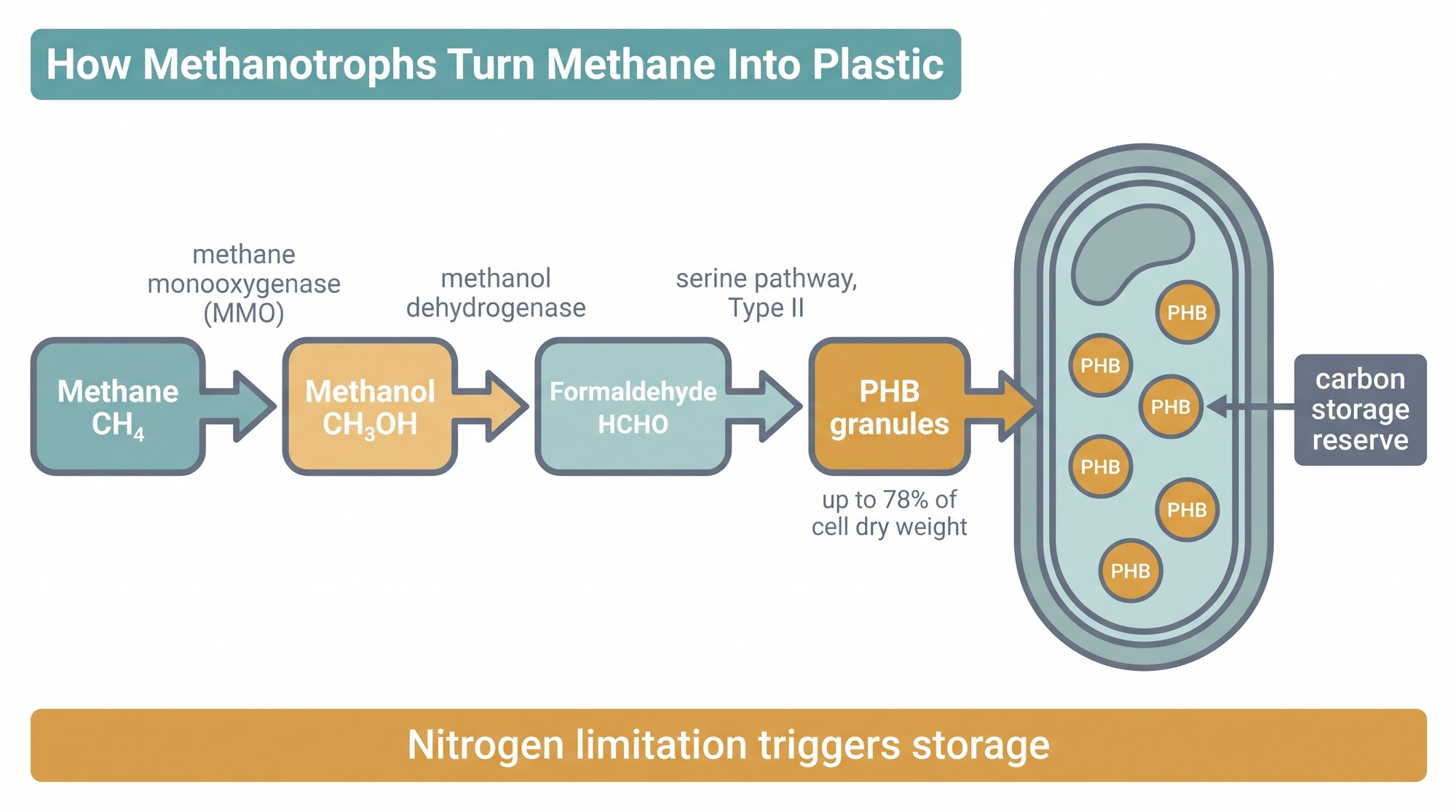
Their trigger is a kind of deliberate malnutrition. When type II methanotrophs have plenty of methane but run short of nitrogen, they stop dividing and start hoarding carbon as poly-3-hydroxybutyrate (PHB) granules inside their cells, a reserve to draw on when conditions improve. A 2020 study isolated two Methylocystis strains that accumulated up to 55.7% PHB by cell dry weight when fed landfill gas and digester gas. The best performer, Methylocystis parvus BRCS2, reached that figure on landfill gas alone without any loss in growth. Other work has reported accumulation as high as 78%.
Percentage of cell weight is only half the equation, because it says nothing about how much methane it took to get there. A culture dominated by Methylocystis consumed 95.8% of the methane fed to it but produced just 0.59 grams of biomass per gram of methane, roughly a third of which was polymer. A single-carbon feedstock means much of the input exits as carbon dioxide and water rather than as plastic, which is why gas-to-polymer conversion efficiency, not cell content, is the number engineers watch.
Methylocystis can hold more than half its own weight as plastic. The trouble is that the rest of that weight is a cell.
The methane nobody is using
Global methane emissions reached roughly 610 million tonnes a year in 2020, according to the Global Methane Budget, with human activity responsible for almost two-thirds of the total. NASA’s monitoring network recorded an atmospheric concentration of 1,935 parts per billion in June 2026, more than double pre-industrial levels.
The sources are broad. Agriculture accounts for around 40% of human-caused emissions, largely from livestock and rice cultivation, a problem that has attracted its own wave of feed additives and breeding strategies. The energy sector contributes roughly 35%, and waste accounts for about 20%, split between landfills and wastewater. Solid waste alone made up an estimated 12% of anthropogenic methane between 1990 and 2024; wastewater added about 6%.

Much of that gas is diffuse and impractical to capture. Landfills and sewage plants are the opposite: concentrated, already piped, and available at a single point. Today the default use is combustion, either flaring it or burning it for heat and power. Both convert methane into carbon dioxide, which is far less potent over any timescale, but both throw the carbon away. Fermentation keeps it solid.
The scale of the opportunity is real but bounded. An October 2026 study from IIASA and UNEP found that fully implementing the methane plans governments have already submitted would cut global emissions by about 11% between 2020 and 2030. A 22% reduction is achievable at relatively low cost, and a 30% cut would nearly exhaust what current technology can deliver. Turning methane into materials sits inside that last, expensive tranche.
The collection plumbing mostly exists already. Anaerobic digestion has spread far enough that household and municipal biodigesters produce a steady methane stream in many cities, each one a pre-fitted gas source rather than a hole in the ground that has to be capped first.
From the bench to a 5,000-liter tank
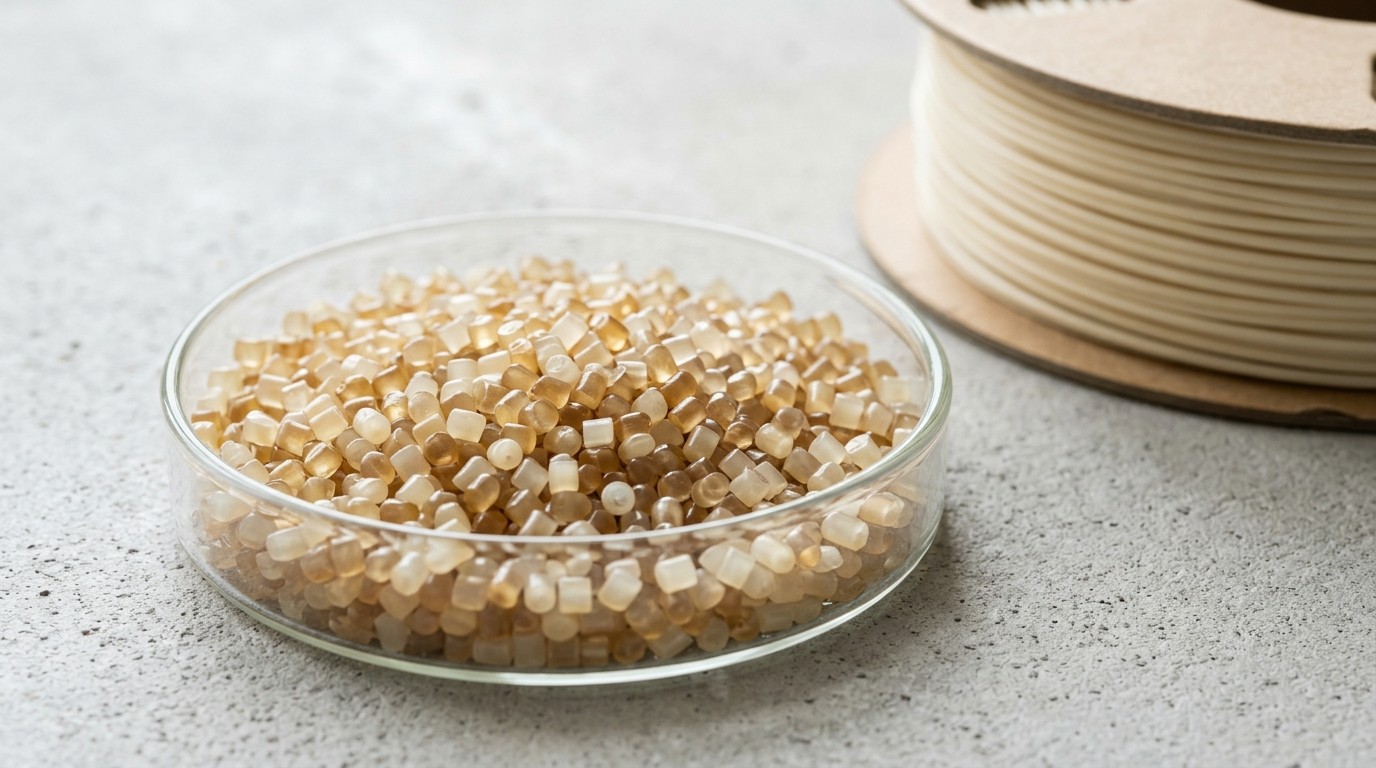
Mango Materials has been developing its process for more than a decade and now operates at a demonstration scale. In September 2026 the company announced a partnership with the University of California, Davis, funded by the National Science Foundation and BioMADE, to attack the step that dominates its costs. Newlight Technologies, another California company, runs a methane-based process; it brands AirCarbon and sells the resulting biopolymer in cutlery, eyewear, and fashion.
The extraction problem
Inside a fermenter, PHA granules sit within cells that are mostly water. Separating the polymer means breaking those cells open, removing proteins and other cellular material, and purifying what remains, a sequence the industry calls downstream processing. Yi Wang, an assistant professor of biological and agricultural engineering at UC Davis, is genetically engineering methanotrophs so their plastic can be released more easily, cutting the time and energy the separation demands.
The numbers explain the urgency. Across the industry, extraction and purification account for 40% to 60% of total PHA production cost and up to half its cumulative energy demand. Commercial PHA sells for roughly $4 to $6 a kilogram against $1 to $2 for the polyolefins it is meant to replace. A techno-economic model of a 100,000-tonne-a-year methane-fed plant put the production cost at $4.10 to $6.80 per kilogram, which is to say, “viable in principle, uncompetitive in practice.”
The partnership also gives academic researchers access to equipment well beyond a university lab, including Mango Materials’ 5,000-litre bioreactor. The company points to alignment with a $117 million Department of Energy investment in domestic bioindustrial manufacturing and was ranked ninth in Biofuels Digest’s 2026 list of the hottest advanced bioeconomy companies. It has begun selling a direct-to-consumer 3D-printing filament, with fiber and film grades in development. In Europe, a publicly funded effort called the Methanotrophy project pursued the same goal from the other direction, testing methanotroph cultures as methane-absorbing biofilters that produce PHB as a by-product.
Where the engineering gets hard
Three constraints compound the separation bill. The first is gas transfer: methane dissolves poorly in water, so a large share of the gas bubbling through a reactor never reaches a cell, and forcing it into solution consumes energy. The second is heat, because methane oxidation is exothermic and large vessels need continuous cooling. The third is dilution, since the polymer leaves the reactor as a few percent of a very watery broth that has to be dewatered and dried before anything can be extracted.
Sterility is the constraint most likely to break. Pure cultures require sterilized equipment and media, and that overhead is a large part of why PHA costs what it does. Continuous fermentation of Halomonas, a salt-tolerant bacterium that thrives in conditions contaminants cannot, has been modelled at around $2 per kilogram, close to half the going rate. Methanotroph equivalents are in view: thermophilic strains operating at 60°C have been assessed at $3.20 to $5.40 per kilogram in place of the $4.10 to $6.80 achieved by mesophilic cultures.
A separate BioMADE project with the engineering firm Black & Veatch, running from 2024 to 2026, tested whether the process could work at small, decentralized sites. The team found that using non-potable water did not affect bioplastic quality, recycled fermentation broth and processing water to raise efficiency, and used techno-economic and life-cycle modelling to identify the most energy-intensive processing steps. Modifying those steps produced validated cost and electricity reductions.
The same bacteria can feed fish
Plastic is the younger of the two products these organisms can make. Single-cell protein came first, and it is far closer to industrial scale.
Protein versus plastic economics
Calysta, a Californian company, grows Methylococcus capsulatus on natural gas to produce FeedKind, a protein meal for aquaculture and livestock, through a joint venture with the animal nutrition firm Adisseo. Denmark’s Unibio runs a similar process for its UniProtein product. Methanotroph biomass can exceed 70% protein by dry weight, and the material is already commercial in pet food, which the industry treats as its entry point into the feed market.
Calysta’s planned facilities are designed to produce more than 30,000 tonnes of protein a year, with the first expected to be operational in 2028. The company’s own framing is striking: half a tonne of product a day is roughly the protein intake of 9,000 people.
Protein carries an economic advantage that has nothing to do with biology. The product leaves the cell as biomass, so it sidesteps the extraction step that makes PHA expensive. The same fermentation platform can therefore make animal feed at a lower cost per tonne, or plastic at a higher value per tonne. Which one a plant chooses is a business decision, and for now protein is winning on volume.
Why methane plastic is not just another bioplastic
Most bioplastics begin on a farm. Polylactic acid, the most common, is fermented from corn or sugarcane starch, which means it competes for land, water, and fertilizer with food production. Roughly 0.7 million hectares of farmland are currently devoted to bioplastic feedstock. Methane-derived PHA starts with a waste stream that would otherwise be flared, and the distinction matters because feedstock is where most waste-derived bioplastic claims either hold up or fall apart.
The material behaves differently too. PHA biodegrades in soil, fresh water, and marine environments, whereas PLA needs the sustained high temperatures of an industrial composting facility to break down at any useful rate. The gap shows up in certification. PHA grades have earned TÜV Austria’s OK compost HOME and MARINE marks, the latter requiring around 90% breakdown within six months at ambient seawater temperatures, and in May 2026 CJ Biomaterials launched an all-PHA coating resin for paper foodservice ware certified to home, industrial, and marine standards at once. PLA fails the home composting test outright because its glass transition sits near 60°C, well above any garden heap.
There is an honest caveat. When PHA biodegrades, its carbon returns to the atmosphere as carbon dioxide. This is not permanent sequestration. The climate case rests on two things: avoiding methane’s short, intense pulse of warming and displacing fossil-derived plastic that would have persisted for centuries. If the methane in question would have been flared anyway, the benefit is smaller than the headline implies.
The comparison with other engineered microbes is instructive. Bacteria built to grow on carbon dioxide need an external energy input to fix their carbon; methanotrophs get both carbon and energy from the same molecule, which is part of why the gas fermentation route is further along.
What has to go right
Three things will determine whether methane-eating bacteria bioplastics move beyond specialty products.
- Cost. PHA from any feedstock still trades at a premium to commodity polyolefins, and downstream processing is the largest single lever. Strain engineering that lets cells release their polymer more readily, or that raises PHB content per cell, is the most direct route to parity. So is capital: a greenfield PHA plant runs $180 million to $220 million per 50,000-tonne line, roughly double a comparable polyethylene unit, which is why capacity has grown slowly even where demand exists.
- Feedstock access. Methane capture at landfills and treatment plants is well established in Europe and North America, but the Global Methane Pledge’s own reporting shows implementation remains uneven. Satellite monitoring is quietly helping: public super-emitter maps now reveal concentrated plumes that were previously invisible, which amounts to a siting dataset for anyone building a biorefinery.
- Scale logic. One large plant dependent on trucked-in gas looks fragile. Small modular reactors at individual wastewater plants, the model BioMADE tested, trade economies of scale for cheaper feedstock and no transport. Which approach wins is still open.
The industry has one loud warning about what happens if none of this lands. Danimer Scientific spent roughly $380 million developing PHA, listed it, and then sold its assets for about $19 million. The chemistry worked. The price did not.
The bacteria, meanwhile, are not the bottleneck. They already perform the chemistry at ambient temperature and pressure, using a gas the rest of the world treats as a nuisance. Whether the plumbing, the economics, and the policy catch up in time is the part that remains unwritten.


