
Moving a climate model or an AI training set between supercomputer centers can take hours. On October 30, 2026, a Japanese research team showed it does not have to. In a demonstration, two working research tools moved data between storage systems at more than 750 gigabits per second (Gbps) over an 800 Gbps link, reaching a peak near 775 Gbps. That is about 97 percent of the link capacity, sustained for several minutes.
This was a demonstration, not a new commercial service. The partners were RIKEN, the National Institute of Informatics (NII), the University of Tokyo, NTT EAST, and NTT WEST. The link ran between the RIKEN Center for Computational Science (R-CCS) in Kobe and the University of Tokyo Kashiwa Campus, using the All Photonics Network (APN), which is the network part of the IOWN next-generation communications infrastructure. IOWN stands for Innovative Optical and Wireless Network, an NTT-led program to replace electrical switching with light-based paths where possible.
What 750 Gbps Means in Plain Terms
Network speeds are easy to quote and hard to picture. Here is one translation. At 750 Gbps, roughly 94 gigabytes move each second. A two-hour ultra-high-definition movie file of about 15 gigabytes would cross in well under one second. At that pace, around six such movies move each second, or more than 300 movies in a minute.
The link carried two kinds of research traffic. One path used the HPCI Shared Storage test environment. HPCI is the High Performance Computing Infrastructure, Japan’s shared supercomputing system. The shared storage layer, built on Gfarm, a network file system, lets distant sites read and write the same files. The other path used MMCFTP, which stands for Massively Multi-Connection File Transfer Protocol. It is a file transfer tool that opens many parallel connections and adjusts their number to hold a steady rate over long distances.
Demonstration at a Glance
- Link: 800 Gbps between RIKEN R-CCS in Kobe and University of Tokyo Kashiwa Campus.
- Peak: near 775 Gbps combined, about 97 percent of link capacity.
- Sustained: above 750 Gbps for several minutes.
- Tools: HPCI Shared Storage test environment plus the MMCFTP parallel transfer tool.
- Next step: planned Japan-to-United States transfer tests over MMCFTP, aimed at SC26, a supercomputing conference in Chicago in November 2026.
Why Light Instead of Electricity Inside the Network
Photonics is technology that uses light, instead of electric current, to carry information. Most current networks still convert light back to electricity at many points so routers can read packet addresses and decide where each packet goes next. Each conversion costs energy and adds delay.
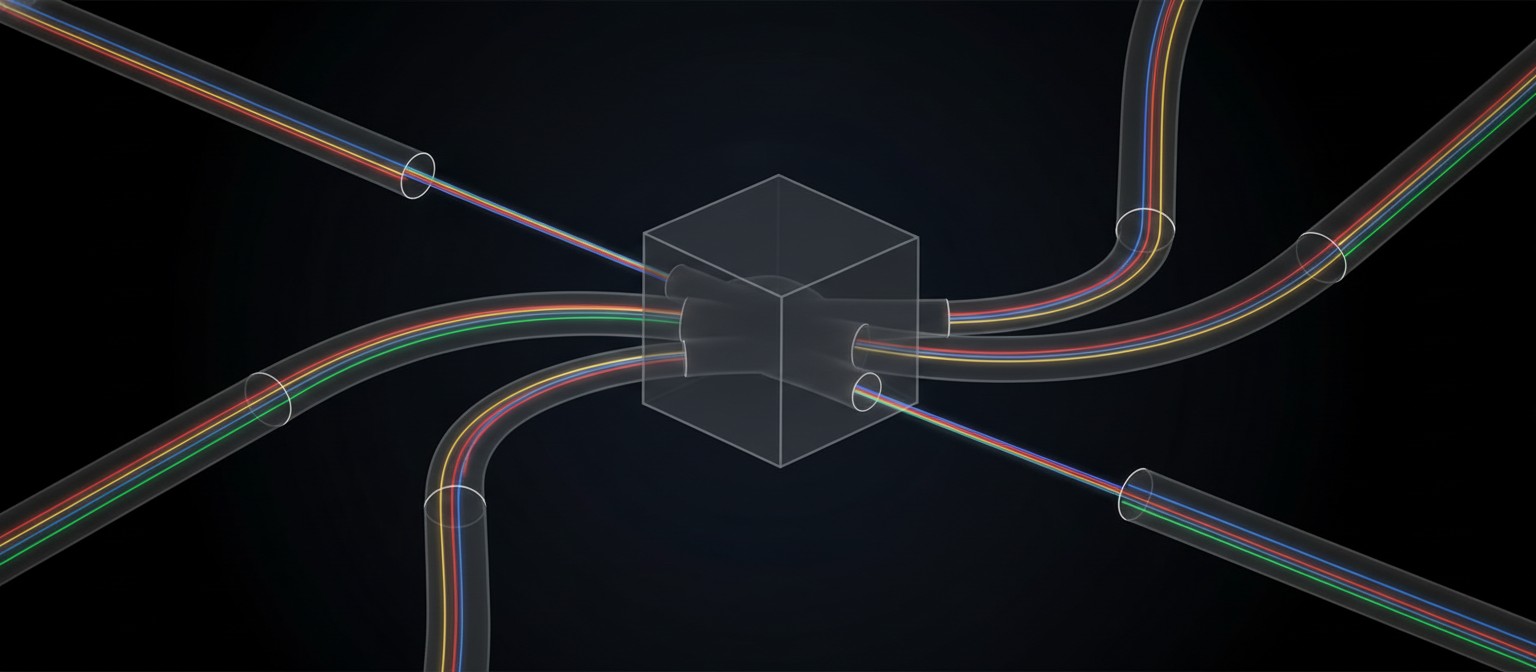
An All Photonics Network reduces those conversions because it keeps signals as light from end to end. Each light path travels on its own wavelength, like a lane of a single color, so data can pass through without repeated electrical processing. NTT describes the long-term IOWN goal as sharply lower power use, much higher capacity, and much lower delay by 2030, with photonics used from devices through the network.
The sustainability angle is direct. As AI and climate modeling send larger datasets between sites, networks burn more power on switching and retransmission. A light-based path that stays efficient as distance and frequency grow could move science data without a matching rise in energy use. The IOWN Global Forum notes that photonics power use stays stable even as transmission distance and frequency increase, unlike electron-based systems.
How the Team Filled the Link
The figures come from the RIKEN R-CCS announcement of October 30, 2026. The team filled the link by running both tools at the same time, so data flowed from two sources at once. The rate then held steady for minutes instead of spiking briefly, which is the hard part at these speeds.
Using existing research software is the quiet achievement here. Neither HPCI Shared Storage nor MMCFTP was rewritten for this test. Current workflows for AI training data, simulation output, and shared archives could therefore scale up when faster light-based links arrive. A smaller test points the same way. In March 2026, GMO Internet connected AI training computers in Fukuoka to storage in Tokyo over an APN line, and AI training jobs ran nearly as fast as when the storage sat in the same room.
What This Is Not, and What Comes Next
This demonstration does not replace the public internet. It ran over one dedicated research link between two sites. Like China’s CENI testbed, which moved 72 terabytes across about 1,000 kilometers in 96 minutes, it belongs to a family of national research networks built to try future internet ideas at scale without disturbing commercial traffic.
The partners say joint work will continue on large data transfer and synchronization between sites. They also plan to extend part of the setup to the SC26 supercomputing conference venue in Chicago in November 2026 for Japan to the United States file transfer tests using MMCFTP. Earlier financial sector tests over APN also explored live workload moves and long distance replication between data centers, which shows the same light-based approach is being tried for different jobs.
For readers who follow photonic chips moving into data center networking, this RIKEN result is the wide-area complement. Chips bring light inside the building. APN brings light across the country. If both mature, moving a model, a simulation, or an archive could feel less like shipping freight and more like opening a local file.


