
Thirty years ago, getting braces meant biting into a tray of pink putty while a stranger told you to hold still. Today your orthodontist can wave a wand over your teeth and skip the goo entirely. That shift is small on the surface and enormous underneath, because the digital scan is only step one. The brackets themselves are now built from that same scan.
I spent a few weeks reading through how these systems actually work, and the honest answer is that the marketing outruns the engineering in places. The engineering is still genuinely interesting. If you are a parent pricing out options for a teenager or an adult who has been putting this off since high school, you deserve a plain explanation of what changed and what did not. There is a guide to clear braces Kelowna teens choose worth reading if you want the patient-facing version from a practice that runs the system. This piece is the wider view.
Here is the short version: the bracket is no longer a generic piece of metal. It is a part designed around one specific tooth in one specific mouth.
Wait, how are brackets actually printed?
Traditional brackets come off an assembly line by the thousand. A technician glues them to your teeth at angles estimated from a mold or a scan, and the wire does the rest. The precision lives in the wire and the clinician’s hands.
A printed bracket flips that. Software plans the final position of every tooth, and then the bracket geometry is generated to match the surface it will sit on. Printing happens in biocompatible resin or a ceramic-filled material, layer by layer, the same way industrial prototypes get built. If you want to understand the underlying manufacturing story, industrial 3D printing has been reshaping low-volume production for years, and Siemens has published widely on how additive processes moved from prototypes to finished parts.
The same shift is underway across medicine, where 3D printing has already moved into surgical planning, implants, and custom-fit devices built around a single patient’s anatomy.
What that means for you in the chair: fewer adjustments where the orthodontist has to reposition a bracket because it landed a millimeter off. The plan already accounted for the millimeter.
What the lab bench says, and what it doesn’t
Printing a part is the easy half. Making a part that survives the year and a half or more that fixed braces typically stay on, through chewing, brushing, and an occasional bite into a bagel, is the hard half. Bond strength, wear resistance, and how the material behaves under repeated load all matter, and those get tested against standards.
The National Institute of Standards and Technology is the body most people have never heard of that quietly underpins a lot of this, setting measurement frameworks that manufacturers use to prove a material behaves the way the spec sheet claims. If a bracket maker tells you their resin holds up, ask what standard the claim rests on. Most patients never do. Most practices never volunteer it either.
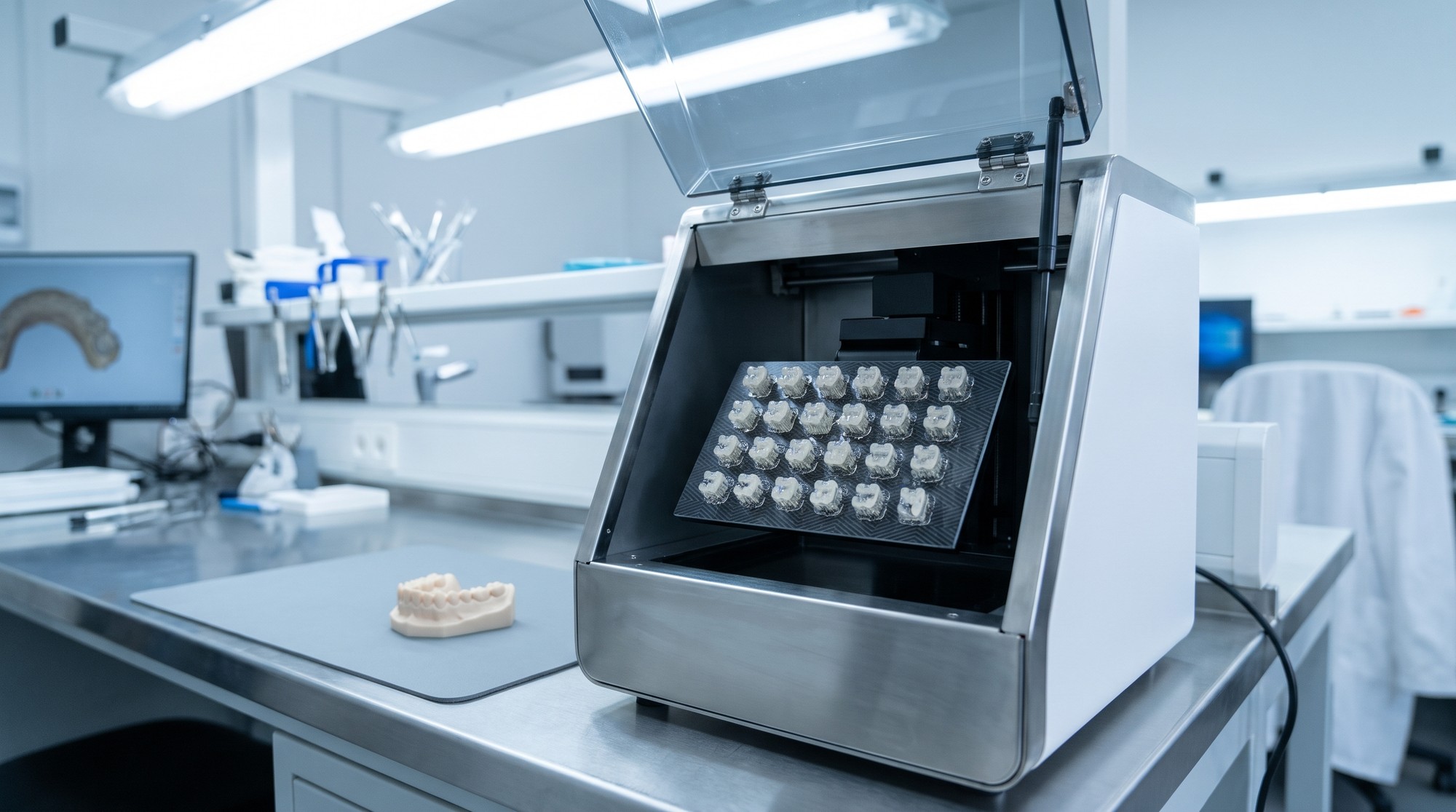
My honest read: printed brackets are not automatically better than metal ones. They are different, with different failure modes. A well-placed metal bracket from an experienced clinician beats a poorly planned printed one every time. The technology amplifies good planning and does not rescue bad planning.
Printed brackets versus clear aligners versus metal
People conflate printed brackets with clear aligners constantly. They are cousins, not twins. Aligners are a series of removable trays. Printed brackets are fixed hardware, just customized hardware.
| Option | Removable | Custom fit | Best for |
|---|---|---|---|
| Metal brackets | No | Rarely | Complex rotations, tight budgets |
| Clear aligners | Yes | Yes, per tray | Milder crowding, disciplined wearers |
| Printed clear brackets | No | Yes, per tooth | Cases that need fixed control with better aesthetics |
If I were choosing for a teenager who plays a sport and forgets things, I would pick the fixed option and stop fighting the discipline problem. Aligners work beautifully for the person who actually wears them twenty to twenty-two hours a day. They fail quietly for the person who does not, and nobody notices until the trays stop tracking.
Three things to ask before you commit
Bring these to your consultation. The answers tell you more than any brochure.
- How many of these have you placed? A practice new to a system is still learning its quirks. Ask directly.
- What happens if a bracket debonds? Printed parts get reprinted or replaced from a digital file. Ask about the turnaround and whether there is a fee.
- Can I see the digital treatment plan? Good practices will walk you through the predicted final position on screen before anything gets bonded.
The third one matters most to me. If a practice cannot or will not show you the plan, that is a signal about how much of the customization is real versus how much is a sales script.
The part that still has nothing to do with software
Nobody prints the outcome. Straighter teeth still depend on a clinician reading a bite, spotting the underlying skeletal issue a scan will not flag, and knowing when to stop moving things. The American Dental Association notes that orthodontic treatment decisions rest on a full clinical evaluation, not on a single imaging tool.
That is the piece people skip when they get excited about the printer. The hardware got smarter. The judgment did not get automated. Ask about the clinician’s case history with the system, not just the name on the box.

What I would actually tell a friend
Printed brackets are a real improvement in comfort and fit, a modest improvement in aesthetics, and a small one in chair time. They are not a shortcut, and they will not make a complicated case simple. If your case is straightforward and you care about how the hardware looks, they are worth asking about. If your case is complicated, ask about them anyway, then listen hard to whether the answer is tailored to your mouth or recited to the room.
The putty tray is gone. That alone is a win. What is your orthodontist doing with the scan that replaced it?


