
Every other appliance in a home has an off state. The refrigerator does not. It runs 24 hours a day for ten to fifteen years, and depending on whose figures you use, it accounts for roughly 5 to 8 percent of a household’s electricity. That makes it an unusual case in the sustainability conversation: small changes in how well it runs are multiplied by every hour of every year, and the decision to repair it or replace it carries both an energy cost and a materials cost that most people never see.
Why a refrigerator’s energy use drifts upward
A refrigerator does not generate cold. It moves heat from the inside of the box to the outside, using a compressor, a refrigerant loop, and two heat exchangers. Anything that makes heat harder to move makes the compressor run longer, and run time is what the meter measures.
Three things do most of the damage. The first is dust on the condenser coils and the warm grille on the back or under the front kick plate. Dust is an insulator; it keeps the heat in the coil instead of letting it leave, so the compressor works harder to reach the same temperature. The U.S. Department of Energy’s Building America program recommends cleaning the coils every six to twelve months, more often with pets. The second is the door gasket. A gasket that has hardened or torn lets warm, humid room air in continuously, which the machine then has to cool and dehumidify. The old test still works: close the door on a sheet of paper, and if it slides out with no resistance, the seal is gone at that point. The third is frost. A refrigerator that is meant to be frost-free runs a small heater on a timer to melt ice off the evaporator; when that defrost system fails, ice builds up, airflow drops, the fresh-food side warms, and the compressor runs almost without pause. The telltale sign is a freezer that is fine while the refrigerator section slowly warms.

The numbers behind “just buy a new one”
A new ENERGY STAR certified refrigerator uses about 9 percent less electricity than a comparable standard model, according to Natural Resources Canada and the U.S. Department of Energy. Against a well-maintained unit that is five or eight years old, the saving is real but modest: tens of dollars a year for a typical household, not hundreds. The large savings quoted in older advice came from replacing 1990s refrigerators, which were far less efficient than anything sold today. If a current refrigerator’s bill has jumped, the cause is almost always one of the three faults above, not the age of the design, and fixing the fault recovers the loss.
Replacement also has a materials side. A refrigerator is 60 to 80 kilograms of steel, copper, aluminum, polyurethane foam, and plastic, plus a refrigerant charge. Modern units use R-600a, isobutane, which has a global warming potential of about 3; older ones used R-134a, with a potential of roughly 1,300 to 1,430 depending on the assessment period. Both must be recovered by a licensed technician at the end of life, and foam blowing agents in older cabinets are their own disposal problem. Manufacturing and shipping a new unit before it has saved a single kilowatt-hour is a cost that never appears on a utility bill.
Repair or replace: a decision rule that holds up
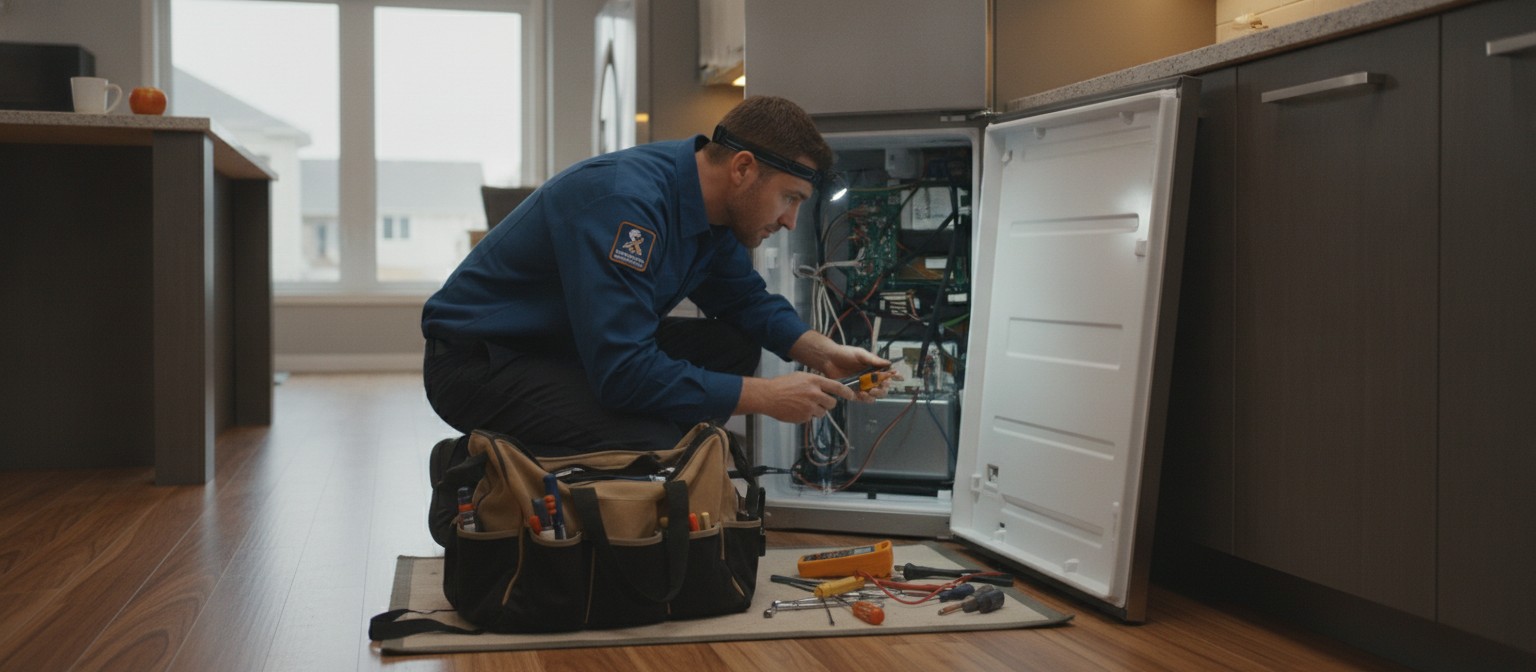
Technicians tend to split refrigerator faults into two groups. Sealed-system faults, meaning the compressor, a refrigerant leak, or a blocked capillary tube, are expensive and on an older unit are often not worth it. Everything else, including defrost heaters and thermostats, evaporator and condenser fans, door gaskets, control boards, and water valves and ice makers, is a part that costs far less than the appliance and restores it to its original efficiency.
A diagnostic visit, with one Denver-area service listing what the common faults look like on its page about refrigerator repair in Denver, typically costs a small fraction of a new unit and is the only way to know which of the two situations you are in. A workable rule: if the unit is under ten years old and the fault is outside the sealed system, repair it; if it is past twelve to fifteen years and the compressor is gone, replace it and recycle it through a program that captures the refrigerant and foam. In between, compare the quote with the price of a new unit and remember that the new one carries its own manufacturing footprint.
Running costs you control without a technician
- Set the fresh-food section to 37–40°F (3–4°C) and the freezer to 0°F (−18°C). Colder than that is wasted energy and does not keep food longer.
- Leave a few centimeters of clearance around the cabinet so the condenser can shed heat, and keep the refrigerator away from the oven and direct sun.
- Vacuum the coils twice a year. It takes ten minutes and is the single highest-return maintenance task on any appliance in the house.
- Let hot food cool before it goes in, cover liquids so the compressor is not dehumidifying the box, and keep the freezer reasonably full; frozen mass holds temperature through door openings.
- Check the gasket once a year and replace it when the paper test fails. It is a clip-in or screw-in part on most models.
The refrigerator is the quiet constant in a home’s energy use. Keeping it running as designed is the cheapest efficiency measure available, and knowing when a repair is the responsible choice rather than a replacement is a decision with a footprint far larger than its price tag suggests.


