
Late in October 2026, Finnish forest products company Stora Enso and Chinese anode manufacturer Shanshan Technology announced a partnership to build a demonstration line in Ningbo, China. The line will produce hard carbon from lignin, the woody binder that pulp mills mostly burn for heat. Its target market is the anode of a sodium-ion battery.
That announcement is easy to skim past. It should not be. Sodium, unlike lithium, is one of the cheapest and most abundant elements on Earth, and sodium-ion cells have already reached commercial grid deployment. What they now need in industrial quantity is the carbon at the other end of the cell: a disordered, pore-riddled material called hard carbon, which turns abundant sodium into a battery you can actually ship.
The piece below is a plain-language guide to what a hard carbon anode is, why graphite cannot be swapped into a sodium cell, which biomass feedstocks are competing to supply it, and what still separates a laboratory result from a billet of factory-grade carbon.
What a Hard Carbon Anode Actually Does
Every rechargeable battery has two electrodes. The cathode releases ions during discharge, and the anode stores them during charge. In a lithium-ion cell, the anode is almost always graphite, a crystalline form of carbon whose flat layers hold lithium ions neatly between them.
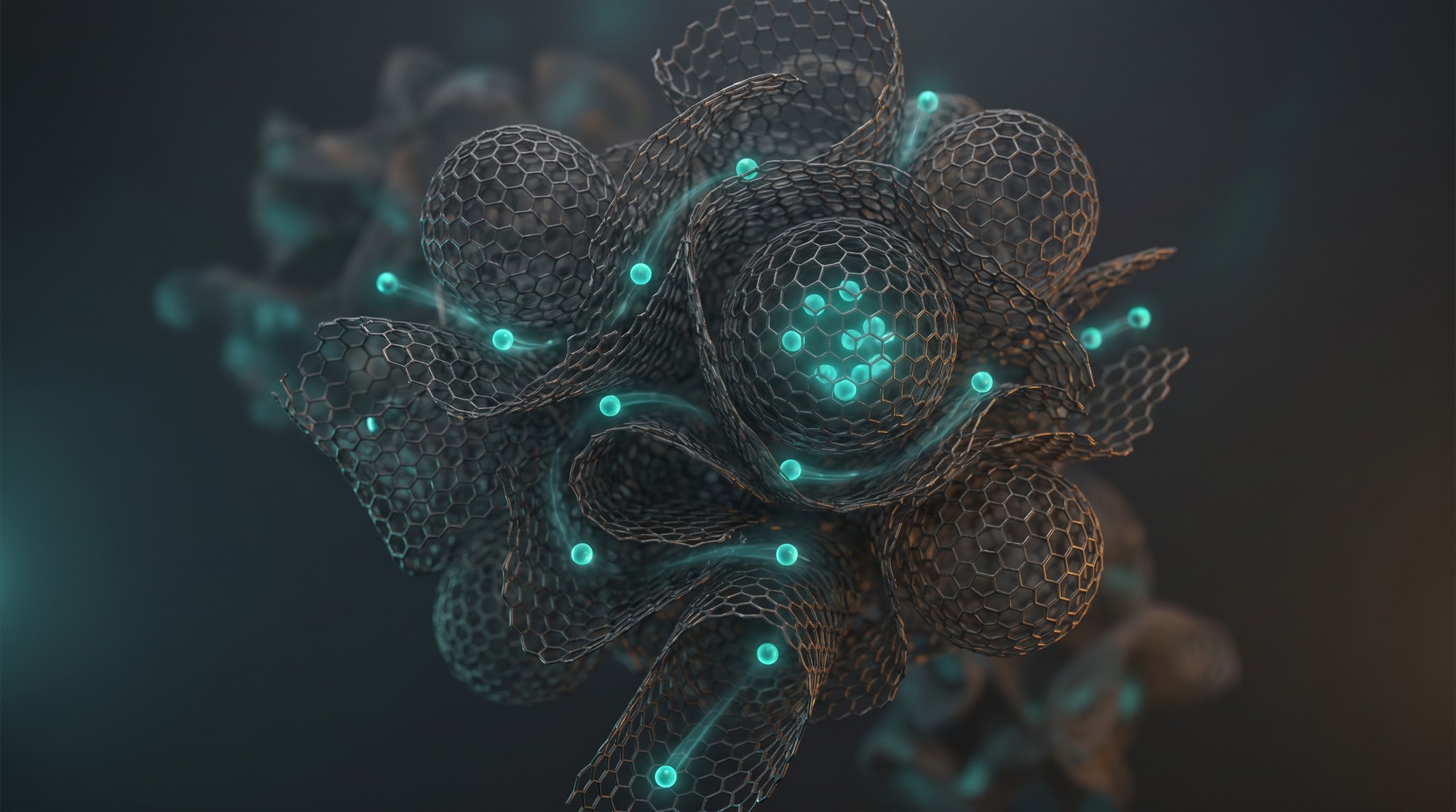
Hard carbon is the same element in a different arrangement. Its structure cannot be coaxed into flat, neat layers along the way, so it instead crumples into curved, irregular parquet that never fully align, with small open channels and windowless sealed pores throughout.
Those gaps decide the chemistry, because sodium ions are the larger working particle, roughly a third wider than lithium ions. Graphite’s tightly stacked layers have too little space for sodium to move in and out reliably, which is why the material that made lithium-ion possible is close to useless in a sodium-ion cell. Hard carbon’s irregular voids and closed pores give sodium somewhere to sit.
| Property | Graphite | Hard carbon |
|---|---|---|
| Structure | Flat, stacked crystalline layers | Curved, tangled fragments with closed pores |
| Behavior when heated | Graphitizes readily | Refuses to turn into ordered graphite |
| Storing sodium | Poor, because the layers leave too little room | Good, because sodium fills pores and gaps between fragments |
| Reversible capacity | About 370 mAh/g with lithium | Roughly 300 to 350 mAh/g with sodium in laboratory cells |
| Main weakness | Unsuitable for sodium, and supply is concentrated | Low first-cycle efficiency, and performance moves with the feedstock |
Hard Carbon vs Graphite: Why Sodium Needs a Different Carbon
The distinction is not cosmetic. Graphite is a mature industry built around a single crystal structure, and the sodium-ion anode is a different material with a different manufacturing chain. Market analysis of the sodium-ion hard carbon market treats hard carbon as the chemistry’s only commercially viable anode, which makes qualifying a carbon supplier a prerequisite for any cell maker entering the field.
There is a strategic angle too. Graphite supply is concentrated among a small number of producers, and synthetic routes are energy intensive. Hard carbon can be made from biomass, from coal-derived precursors or from synthetic resins, which means anode production can be sited near the feedstock rather than near a mine. That is part of why sodium-ion has been framed as a route to domestic battery supply chains, as covered in our report on America’s first grid-scale sodium-ion battery plant.
Hard carbon is not exclusive to sodium, either. Korean materials maker Aekyung Chemical has produced hard carbon for lithium-ion batteries since 2012, and hard carbon anodes are also being pushed for ultra-fast-charging lithium cells, where their open structure helps ions move quickly. The sodium market is the growth story, not the whole market.
Hard Carbon vs Soft Carbon: Why “Hard” Costs More
Carbon precursors fall into two families, and the split was established in the 1950s by Rosalind Franklin, who showed that some organic materials turn into ordered graphite when heated while others refuse. Soft carbons, typically made from pitch or petroleum residues, graphitize easily. Hard carbons, made from biomass or certain polymers, keep their disorder.
That stubbornness is the point. Soft carbon is simpler to process and can be graphitized at lower cost, but its ordered structure stores less sodium. Hard carbon keeps the pores and gaps that sodium needs, at the price of higher processing temperatures, tighter precursor control and a much narrower margin for error in the furnace.
Exactly why some precursors refuse to graphitize has been difficult to observe directly. In October 2026, a team at the University of Oxford led by Professor Volker Deringer published machine-learning-driven atomistic simulations that traced how polyvinylidene chloride, a classic hard carbon precursor, decomposes atom by atom. The work, described in the university’s summary of the study, is an attempt to turn an industrial art into a design rule.
How Biomass Becomes a Hard Carbon Anode
The manufacturing route is conceptually simple and operationally fussy. Biomass goes through four broad stages:
- Collection and drying. Husks, shells, wood chips or lignin are cleaned and dried so the water content is predictable.
- Pretreatment. Acid or alkaline washes strip out minerals and ash, and some processes add chemical agents that shape the carbon that follows.
- Carbonization. The material is heated in an oxygen-free furnace so that everything except carbon is driven off, leaving a disordered carbon skeleton with pores.
- Milling and electrode making. The carbon is ground to a powder with a controlled particle size, then coated onto foil with a binder to become an anode.
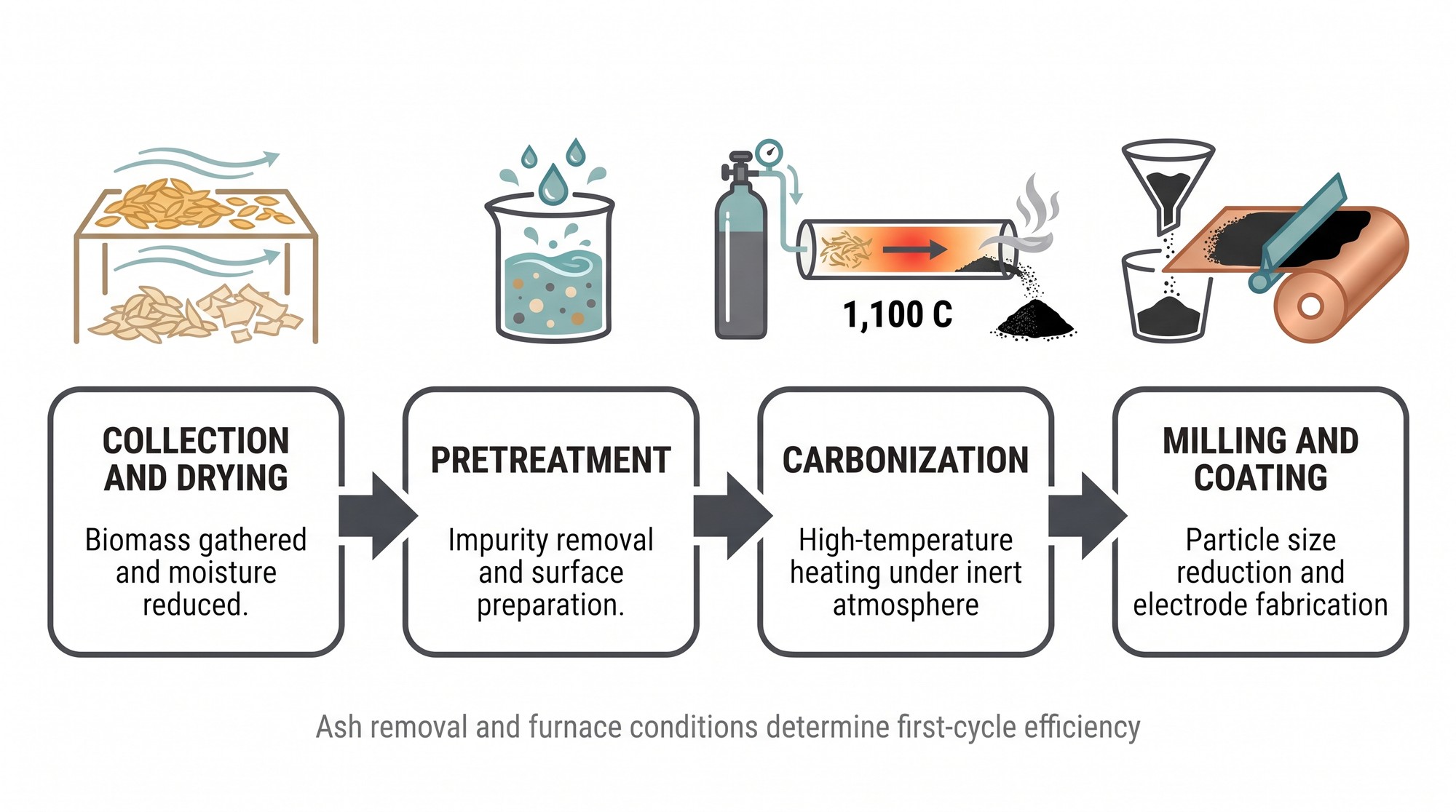
Each stage leaves a fingerprint on performance. Ash is the main contaminant: minerals left in the raw material can consume sodium on the first charge or clog the pores. The fraction of sodium that survives that first cycle is called initial Coulombic efficiency, or ICE, and it is the number the industry watches most closely, because every point lost means sodium to pay for and cathode material oversized to compensate.
Recent laboratory results show how much a good pretreatment is worth. A 2026 study in ACS Applied Materials & Interfaces converted kenaf, a low-cost fiber crop, into hard carbon using acid pretreatment and controlled carbonization, then added a fluorine-doped surface layer. The material reached an initial Coulombic efficiency of 91.2% and kept 87.3% of its capacity over 500 cycles even at 500 ppm of moisture, a notable result because sodium-ion cells are sensitive to water.
The Feedstock Race: Lignin, Rice Husks, Coconut Shells and Crop Waste
Almost any carbon-rich plant material can be pyrolyzed into hard carbon. The contest is not what can be turned into carbon, which is nearly everything; it is what a mill can deliver at consistent quality, in tonnage, at a price a cell maker will accept.
| Feedstock | Where it comes from | Strength | Limitation |
|---|---|---|---|
| Wood lignin | By-product of pulp mills; 20 to 30% of wood | Ready-made industrial volume, already a consistent mill by-product | Needs fractionation and drying before carbonization |
| Coconut shell | Coconut processing in tropical Asia | Dense, well-understood precursor already used for activated carbon | Supply tied to one crop and a few regions |
| Rice husk | Rice milling | Yields carbon plus a silica by-product with its own market | A mineral burden that has to be stripped out or managed |
| Crop residues and bagasse | Sugar, grain and fibre harvests | Cheap, local and abundant | Volatile by nature: ash and moisture swing from season to season |
| Bamboo | Fast-growing plantations | High yield per hectare | Thinner industrial processing infrastructure |
Lignin has the clearest industrial logic. Trees are roughly a fifth to a third lignin, and pulp mills already separate it at scale, which is why Stora Enso describes its Lignode material as coming from a side stream that is mostly burned for energy today. The company’s own third-quarter report confirms the Shanshan demonstration line and frames it as a step toward large-scale European anode production.
Agricultural waste has its own momentum. In India, the government’s Technology Development Board agreed in April 2026 to fund a project with Indigenous Energy Storage Technologies in Roorkee to commercialize hard carbon derived from bio-waste and agricultural residues, aimed at grid storage, inverters, solar street lighting and small electric vehicles such as e-rickshaws.
The same biomass is also wanted by other industries. Pyrolyzed plant matter is a soil amendment, a filtration medium for contaminated water and a route to carbon nanosheets for supercapacitors, as shown by work turning tamarind shells into carbon nanosheets and by biochar used to strip contaminants from wastewater. Battery-grade carbon demands far tighter specifications than any of these uses require, which is the real gate on supply.
Why Sodium Batteries Still Aren’t Everywhere
Three constraints explain the slow rollout:
- Energy density. Sodium-ion cells are heavier and bulkier than lithium-ion cells for the same energy, which rules out most electric cars and all phones.
- Price. Cell costs are still above lithium iron phosphate, with parity projected around 2028, and the advantage depends on lithium staying expensive enough to justify switching. Several ventures have already collapsed on that assumption.
- Qualification. A promising laboratory number is not enough. Cell makers need tonnage with consistent particle size, ash content and first-cycle efficiency.
For now the first serious market is stationary storage, where weight barely matters. The chemistry also keeps improving: cathode and electrolyte work has steadily raised sodium-ion performance, a line of progress we traced from early sodium-ion research that matched commercial lithium-ion capacity to the products now shipping from CATL’s salt-based battery line.
That qualification gap is why several manufacturers are hedging. LG Energy Solution aims to ship samples to storage customers next year using a blend that starts with some graphite and raises the hard carbon share over time, while POSCO Future M plans to finish hard carbon development by the third quarter of 2027 and begin mass production in 2028, according to Korean industry reporting.
What a Hard Carbon Anode Costs, and Who Is Building the Supply
Cell-grade hard carbon is sold under negotiated contracts rather than public price lists. The size of the market still gives a sense of scale. Market research firm Mordor Intelligence puts the sodium-ion battery-grade hard carbon market at about $107.6 million in 2026, rising to $440.5 million by 2031, a compound annual growth rate of roughly 32.6%. Biomass-based hard carbon accounted for 40.56% of that market in 2025 and is forecast to grow fastest.
Next to the wider battery industry, these are pocket-change volumes. That is exactly why capacity announcements now matter more than forecasts. Aekyung Chemical is converting a lithium-ion hard carbon line at its Jeonju plant to sodium-ion grades, lifting capacity from 350 tons a year in 2024 to 1,300 tons, a 3.7-fold increase due to be completed this year. The company has also shifted its feedstock from a polyurethane resin base to biomass since 2024, a change it made to cut costs.
Stora Enso and Shanshan are betting on the same direction from the other end of the chain, pairing a pulp by-product with a major anode manufacturer’s process know-how. The Indian project takes a third route, aiming to turn local agricultural residue into anode carbon for domestic storage manufacturing.
What Researchers Are Still Fixing
Three problems still dominate the literature. The first is first-cycle efficiency: a hard carbon anode that wastes a fifth of the sodium in the cell forces the manufacturer to build in extra cathode capacity, which erodes the cost advantage sodium-ion is supposed to deliver.
The second is storage mechanism. Sodium appears to be held in three ways at once, adsorbed on surfaces, inserted between carbon fragments and trapped in closed pores, and researchers still debate how much each contributes. That uncertainty makes rational design difficult: a precursor that performs well can do so for reasons nobody can fully specify, which is exactly the gap the Oxford simulations are trying to close.
The third is durability in real conditions. Moisture, trace impurities and the growth of a passivating film on the anode all cost capacity over hundreds of cycles, and the surface treatments that fix one problem can worsen another.
And the competition is not only hard carbon. Other battery chemistries have entered the race too. Calcium-ion cells have advanced to the point of 1,000 charge cycles in laboratory testing, and they avoid hard carbon altogether. Sodium’s advantage is that it is further along the manufacturing curve, not that it is the only option.
Frequently Asked Questions
What is a hard carbon anode made of?
Hard carbon is made from any carbon-rich precursor that resists graphitization when heated. Biomass such as lignin, coconut shell, rice husk, bamboo and crop residue is common, alongside synthetic resins and coal-derived materials. The precursor is carbonized in an oxygen-free furnace, milled to a powder and coated onto foil with a binder to form the electrode.
Why can’t graphite be used in sodium-ion batteries?
Sodium ions are larger than lithium ions, and graphite’s tightly stacked layers leave too little room for them to move in and out reliably. Hard carbon’s disordered structure includes larger gaps and closed pores that can accommodate sodium. Graphite remains the standard anode for lithium-ion cells.
How is hard carbon made from biomass?
The biomass is cleaned and dried, often washed with acid or alkali to remove ash, then heated in an oxygen-free furnace so that only carbon remains. The temperature, duration and any chemical pretreatment determine how the carbon orders itself, and therefore how much sodium it can store and how much it loses on the first cycle.
How much does a hard carbon anode cost?
There is no published spot price. Cell-grade hard carbon is sold under long-term contracts that reflect purity, particle size and first-cycle efficiency. The entire sodium-ion battery-grade hard carbon market was worth about $107.6 million in 2026, which is small enough that most producers are building supply ahead of demand.
Do carbon anodes need to be replaced?
Not as a separate service part. The anode is sealed inside the cell, so it degrades with the rest of the battery rather than being swapped out. In sodium-ion cells the main degradation routes are film growth on the carbon surface, pore blockage and moisture-driven side reactions, all of which reduce capacity gradually over hundreds or thousands of cycles.
Is hard carbon only used in sodium-ion batteries?
No. Hard carbon has been used in lithium-ion batteries, where its open structure supports fast charging, and it is being developed for both chemistries at once. Sodium-ion is simply the application where it is indispensable rather than optional.
The Anode Decides
The sodium-ion story has spent a decade being told as a story about sodium: cheaper, more abundant, free of the supply anxieties that come with lithium. The harder and more consequential story is about carbon. Cell makers can source sodium almost anywhere. What they cannot yet do is buy hard carbon at scale, to a consistent specification, from a supplier they trust.
That is why a demonstration line in Ningbo and a converted production hall in Jeonju matter more than another laboratory record. The material has already been proven in cells. What remains is the unglamorous work of proving it in tonnes, and the feedstocks that win that contest will decide how quickly sodium-ion moves from storage projects into everything else.


