
The tropical fruit tamarind may not be commonplace in Europe and North America, but it’s consumed in great quantities in Asia. The bulky shells are discarded during food production and take up a substantial amount of space in landfills.
To tackle the problem of this agricultural waste, a team of international scientists led by Singapore’s Nanyang Technological University (NTU) found a way to use and give value to the shells. The scientists converted the waste material into carbon nanosheets (ultra-thin layers of carbon) by processing the carbon-rich tamarind shells.
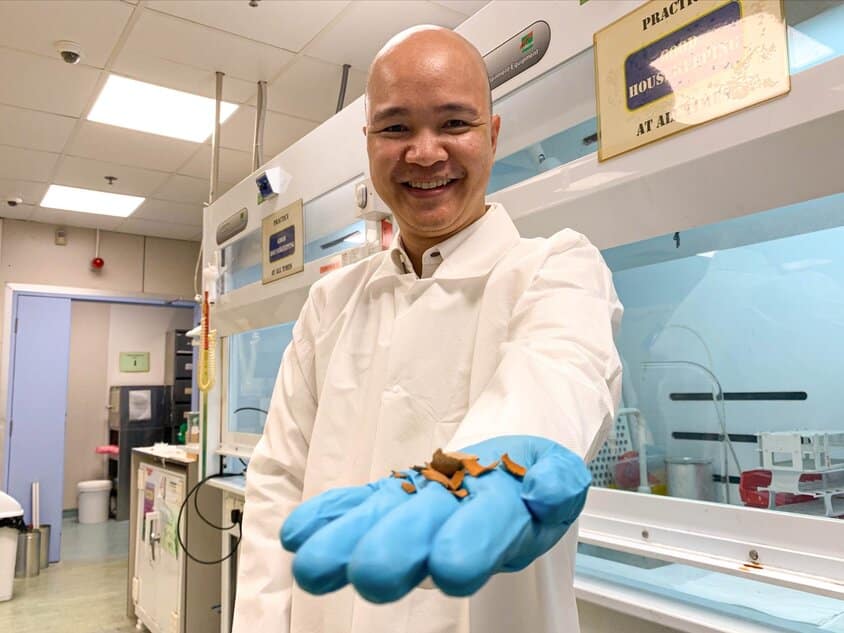
Carbon nanosheets are a core component of supercapacitors, storing the electrical charge within the device. Supercapacitors are energy storage devices used in trains, buses, electric vehicles (EVs), and elevators. Many EVs use them along with their batteries for tasks like quickly delivering power while accelerating.
The Study
- The team collected shells from the food industry and washed them.
- Then, they dried the shells at a temperature of 100°C (212°F) for about six hours.
- Next, they ground the dried shells into a powder and baked the dust in a furnace without oxygen at 700 to 900°C (1,292 to 1,652°F) for 150 minutes.
- The powder turned into carbon nanosheets.
The tamarind shells are porous structures rich in carbon, making them particularly well-suited to the task. Their porosity increases the carbon nanosheet’s surface area, allowing it to store more electricity.
The tamarind shell-derived nanosheets showed good electric conductivity and thermal stability, making them promising options for energy storage. Furthermore, the production process was less energy-intensive than the one commonly used when making nanosheets out of hemp fibers. The hemp fibers have to be heated at over 180 ºC (356 ºF) for 24 hours in that process.
The team envisions the tamarind-derived nanosheets serving as an eco-friendly alternative to their industrially produced counterparts when scaled up while cutting down on waste simultaneously.
The researchers are currently trying to reduce their technique’s energy requirements while investigating how they can make it even more eco-friendly.


