
A field radio is a sealed box holding a battery, a circuit board, and an antenna, and a thick casing protects most of it. The place where a handset, a headset, or a power cable meets that box is a different matter. It has to be opened and closed again and again, often in mud or rain, and each time the seal, the metal contacts, and the locking mechanism are exposed to whatever is around them.
That’s why engineers designing equipment for armed forces treat the connector as a design problem of its own. It meets heat, water, dust, and vibration together, usually while someone is handling it.
What makes a connector “military grade”?
The phrase is used far more loosely in marketing than in engineering. In the United States, two documents usually sit behind it. MIL-DTL-38999 is a detail specification for a family of circular connectors, fixing dimensions, contact arrangements, and performance so that parts from different suppliers fit and behave the same way. MIL-STD-810, a Department of Defense standard, does a different job: it describes environmental test methods, from thermal shock to sand, dust, and salt fog, and asks engineers to select and adjust them according to what a piece of equipment will go through over its working life, which the standard calls the Life Cycle Environmental Profile.
A product isn’t certified to MIL-STD-810 the way a household plug is approved against an electrical safety code. The manufacturer states which methods it ran and at what levels, and the buyer has to judge whether those levels match the vehicle, aircraft, or backpack the equipment will actually live in. That judgement is what separates military connectors built for a named platform from ones that simply carry the phrase.
Heat, cold, vibration, and water at the same time
Laboratory tests usually apply one condition at a time. A connector on the outside of an armored vehicle is shaken by the engine and the road, heated by sun on the hull, cooled by rain or a river crossing, and coated in fine dust, sometimes within a single day. Each of those stresses is manageable on its own. Combined, they produce failures none of them would cause alone: vibration slackens a coupling nut by a fraction of a turn, the small gap lets moisture past the seal, and a drop in temperature condenses that moisture onto the contacts, where corrosion starts.
MIL-STD-810 addresses this with Method 520, a combined environment test that applies temperature, humidity, vibration, and altitude at the same time, and it also takes account of fluctuations in the input electrical power. For a connector designer, what makes an environment harsh is the way its stresses combine, rather than any single extreme. A part that passes every test separately can still fail in service when those conditions arrive together, and the test plan has to be written with that in mind.
Ratchet or push-pull: choosing how a connector locks
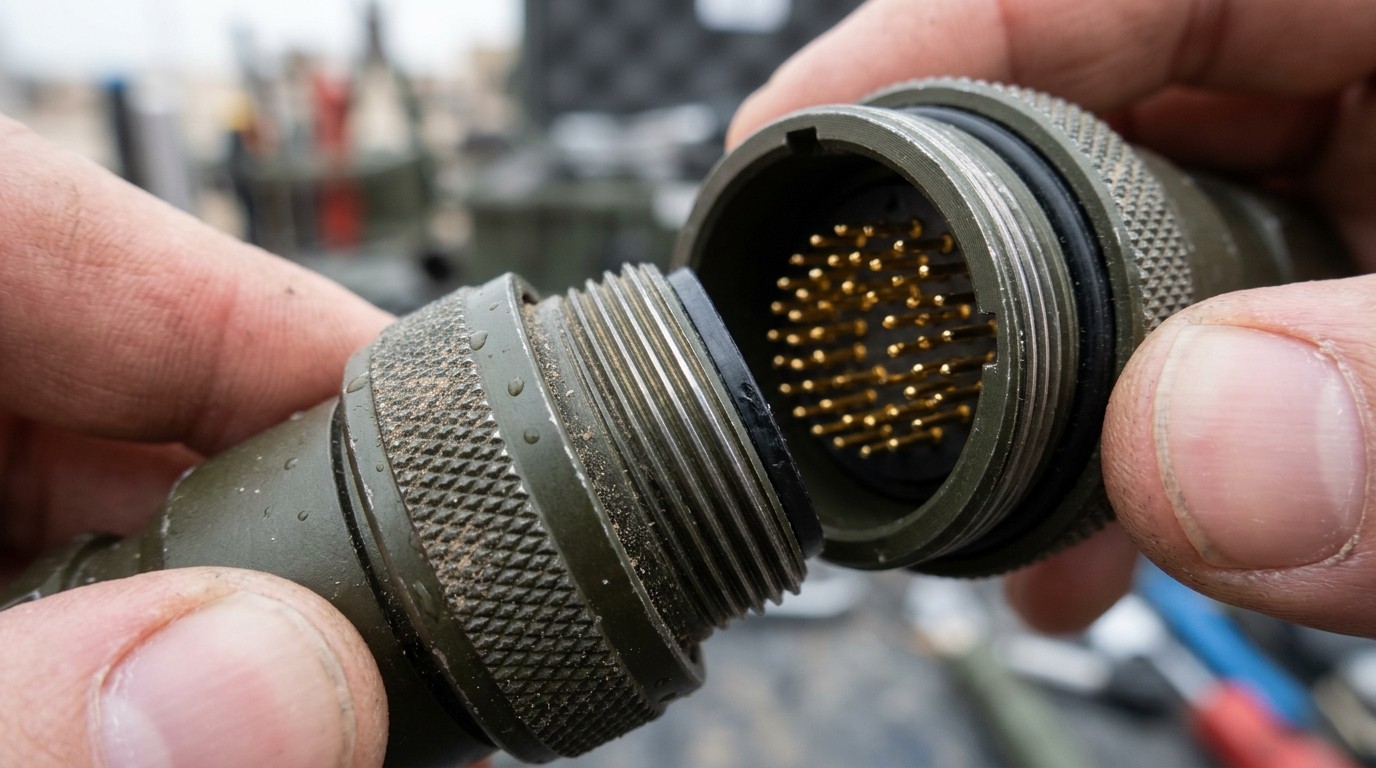
Much of this is settled by the way a plug locks into its socket. Threaded couplings, the traditional choice on military circular connectors, screw a nut onto the receptacle. On a vehicle the risk is that hours of vibration slowly back that nut off. A ratchet mechanism adds teeth that only let the nut turn under deliberate force, so the connection stays tight while the engine runs.
On equipment a person carries, the priorities shift. A radio operator wearing gloves at night has to connect a headset by feel and release it quickly, and every gram added to a vest is felt by the end of a patrol. Push-pull latching answers that need: the plug clicks home when pushed in and releases only when its outer sleeve is drawn back, so a tug on the cable itself won’t separate it.
The military range published by LEMO follows this split, with rugged ratchet-coupling connectors aimed at tactical equipment, unmanned systems, and naval use, and push-pull series intended for soldier-worn communication systems, portable radios, and avionics, where weight and space are the tighter constraints. Compared side by side, the two families show that the way a connector locks is chosen to suit the person or vehicle using the equipment, and neither mechanism is simply better than the other.
Seals, shielding, and the connector left open
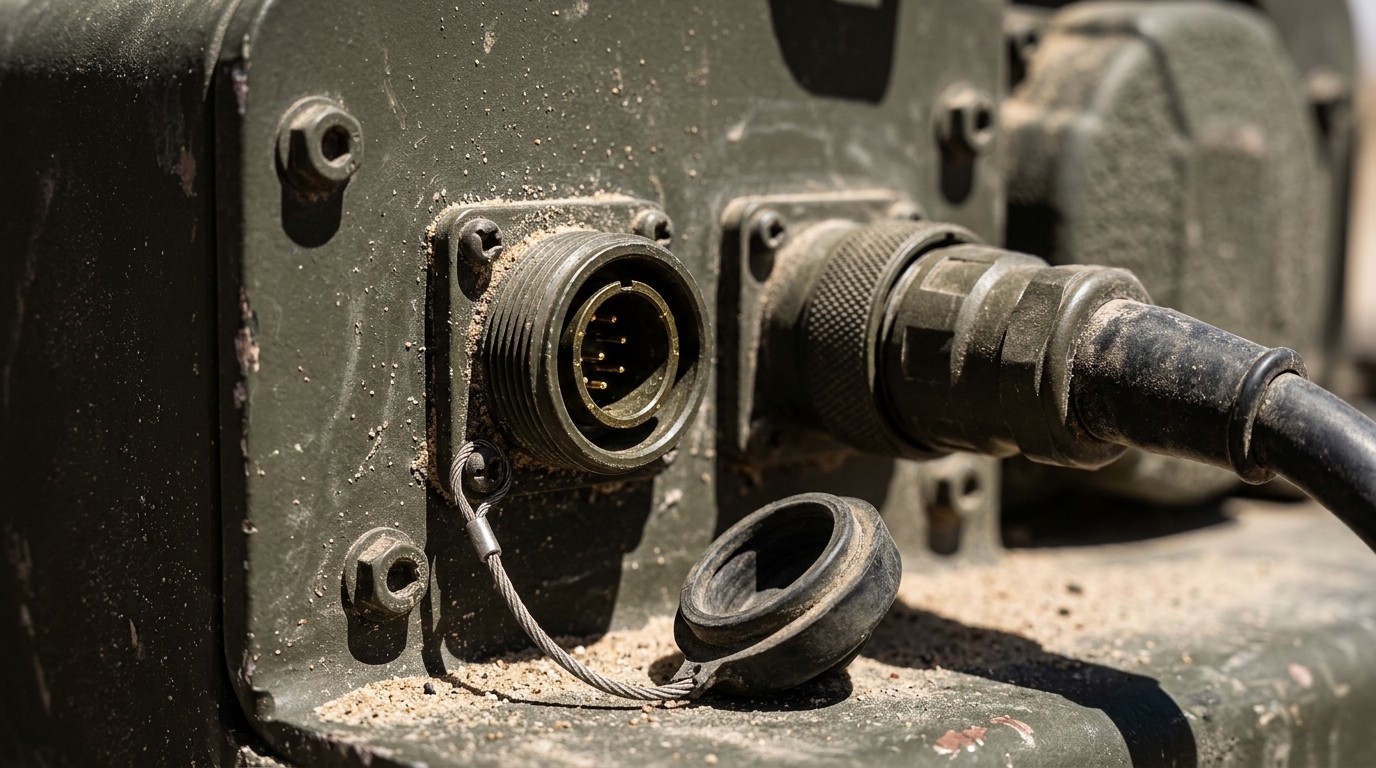
Sealing figures on data sheets need careful reading. An IP68 rating means an enclosure is dust-tight and protected against continuous immersion under conditions the manufacturer specifies, and for a connector it normally describes the mated pair. The vulnerable moment comes when the plug is out: an open socket in sand or spray collects exactly the contamination that causes trouble later, which is why rugged equipment carries tethered dust caps and why some sockets are designed to stay sealed when unmated.
Shielding is the other half. A shell that wraps the contacts in a continuous metal screen, usually called 360-degree shielding, stops interference from nearby radios and vehicle electronics getting in or out at the join.
When a review commissioned by NASA’s Engineering and Safety Center looked at connector problems across the agency’s programs, the recurring issues included bent or recessed pins, contamination, corrosion, worn coupling mechanisms, and torn seals. Its authors concluded that most connector issues were linked to how the parts were applied, and that they could surface at any stage of a system’s life. The review dealt with spacecraft hardware, but a field radio’s connector faces the same hazards, from bent pins to grit in the socket to a torn seal, every time it’s unplugged outdoors.
Where military connector engineering ends up in civilian kits
This engineering is used well beyond the armed forces. Inspection and agricultural drones, broadcast cameras used outdoors, portable medical equipment, and offshore sensors all face the same mix of vibration, moisture, and repeated handling, and they borrow its coupling and sealing designs. A crop-spraying drone, for instance, carries its battery and sensor connectors through dust, spray drift, and rotor vibration on every flight. Connectors rated for hundreds or thousands of mating cycles also make repair practical, because a damaged cable or module can be swapped out while the rest of the device keeps working.


