
Ghostly white coral branches, on the brink of death, have regained their full color in a Stanford laboratory. The rescue required no chemicals and no genetic engineering, only direct contact with a healthy piece of the same coral.
In a study published on October 14, 2026, in Science Advances, researchers describe the fastest documented recovery of bleached coral: a complete return to health in seven weeks. The work offers a new way of thinking about coral bleaching, the stress response that has turned reefs around the world bone white in recent years.
Here is what the team actually found, how the recovery works, and how far the discovery is from saving a reef.
What Coral Bleaching Really Does to a Reef
Corals are animals, and most of the color people associate with them comes from microscopic algae living inside their tissues. These endosymbionts, a family of single-celled dinoflagellates known as Symbiodiniaceae, photosynthesize inside their hosts and hand over much of the energy a coral needs to grow, reproduce, and build a reef. The partnership is so tight that biologists describe the animal and its algae as a single functional unit, or holobiont.
When seawater gets too warm for too long, that partnership breaks down. Corals expel their algae, lose their color, and begin to starve. This is coral bleaching, and it is often lethal because the pale tissue left behind is more vulnerable to disease and to being overgrown by harmful algae.
The main cause is heat, delivered by marine heat waves that climate change is making more frequent and more intense. A bleached coral that survives can take months, and sometimes years, to rebuild its algal population, and the recovery is rarely uniform across a colony.
The pressures that tip a colony past its limit rarely act alone:
- Ocean acidification: it does not bleach a coral directly, but it slows calcification and weakens the reef framework a colony depends on.
- Local pollution and disease: runoff and outbreaks of coral disease lower a colony’s resilience before the next heat wave arrives.
- Cold snaps and heavy rainfall: rarer triggers that can bleach shallow reefs, though they seldom drive events on a global scale.
- Overfishing and coastal development: when grazing fish disappear and shorelines are built over, reefs lose the conditions they need to bounce back.
Reefs are not a niche concern. They shelter roughly one third of all known marine species, buffer coastlines against storms and flooding, and support fisheries and tourism that feed and employ hundreds of millions of people. NOAA’s Coral Reef Watch tracks the heat stress behind bleaching events worldwide.
The Accidental Discovery That Started It All
The finding began with a small mishap. In 2025, Steve Palumbi, the Jane and Marshall Steel, Jr. Professor in Marine Sciences, noticed that two coral fragments in a tank had tipped over and come to rest against each other. One was bleached and pale, the other healthy. Where the two pieces touched, color began creeping back into the bleached fragment.
Around the same time, Danny Collins, an oceans PhD student in the same laboratory at Stanford’s Doerr School of Sustainability, was studying how bacteria travel between corals through physical contact. That work raised an obvious question in reverse.
“Harmful bacteria enter corals through physical contact,” Collins said. “We were curious about what would happen if we used contact to reintroduce something good.”
What makes the trick possible is cloning. Many reef-building corals reproduce by making genetically identical copies of themselves, and identical tissue fuses on contact instead of provoking a rejection response.
The Experiment: Ten Pairs and One Clear Result
Collins turned the accident into a controlled test using Pocillopora damicornis, a common branching coral also known as cauliflower coral. He bleached the fragments by heating a tank to about 34.5°C (94°F) for four hours a day until they lost all color, then cut the branches into pieces roughly half an inch long.
Each bleached fragment was then glued to a ceramic plug beside a healthy fragment taken from the same colony. Five pairs sat close enough for their tissues to touch, while the other five were separated by a few millimeters, near enough for any drifting algae to reach them but too far for the tissue bridges to form, a control that isolated direct contact as the decisive variable.
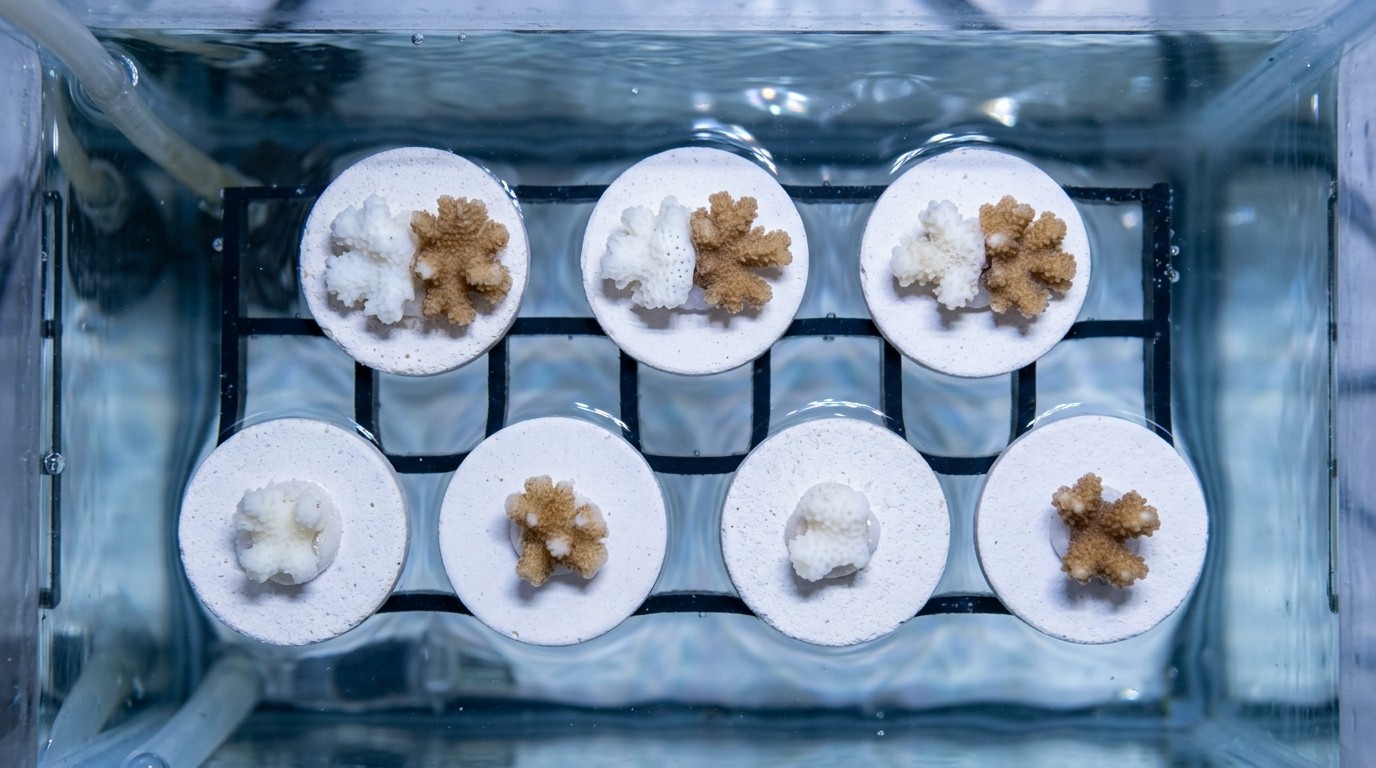
The outcome was stark. Every bleached fragment in the touching pairs recovered fully, and one regained its color in as little as four weeks. None of the separated fragments were recovered, and most were smothered by algae. The team informally calls the technique “helping hands.”
| Setup | Pairs tested | Algae transfer | Outcome |
|---|---|---|---|
| Touching, tissues fuse | 5 | Symbionts detected within 3 days | Full color recovery in 7 weeks, one in 4 weeks |
| Separated by a few millimeters | 5 | None observed | None recovered; most were overgrown by algae |
How the Rescue Works: Fused Tissues and a Flood of Algae
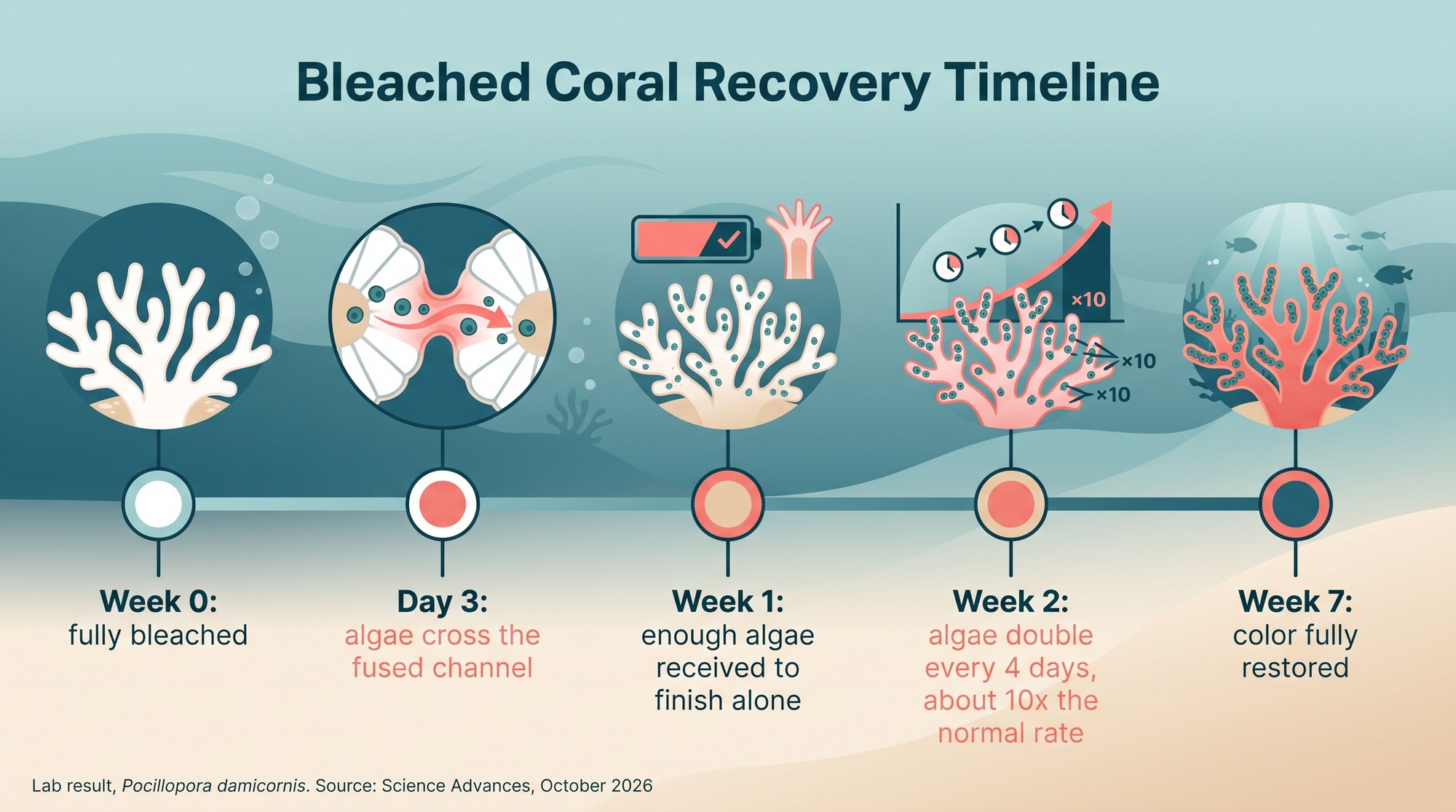
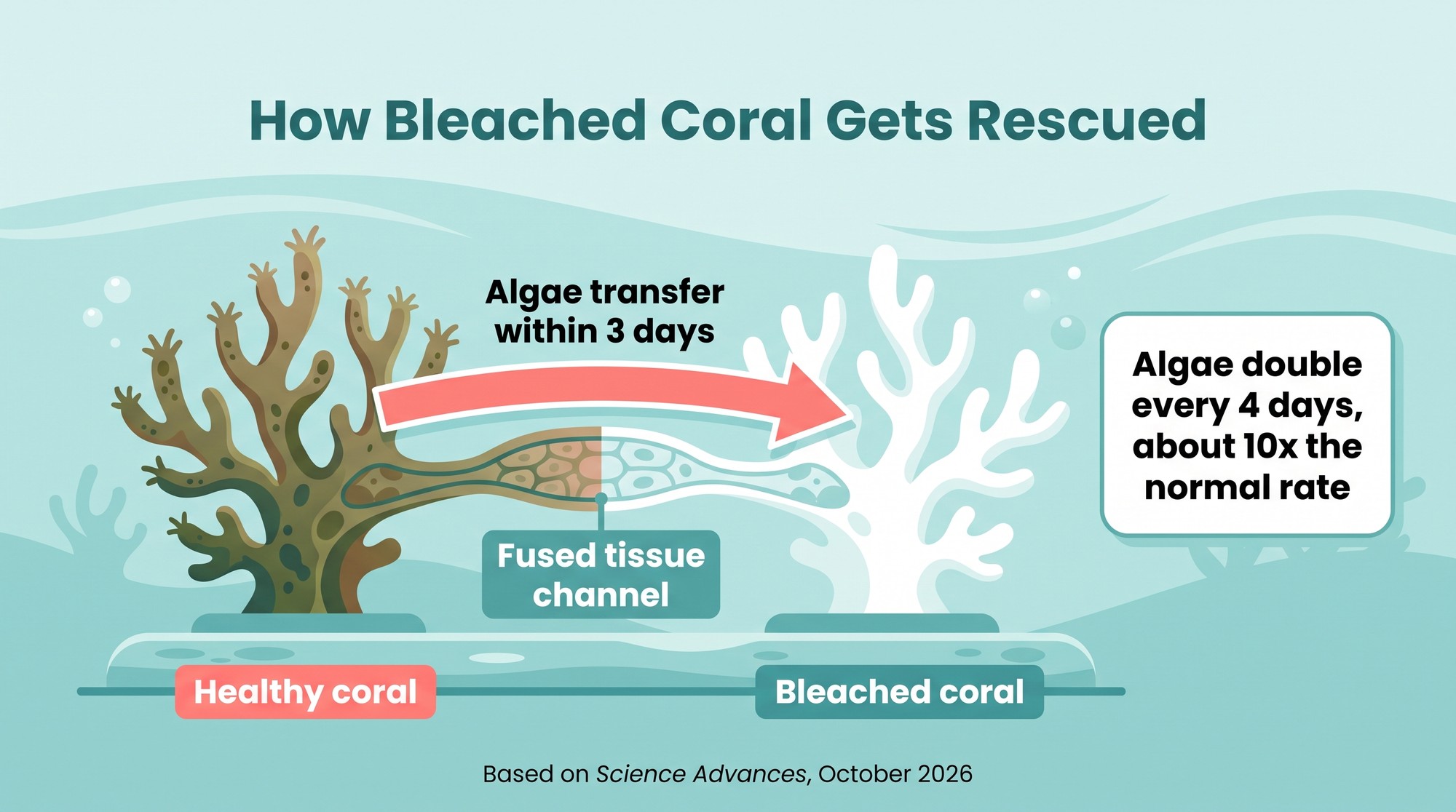
Under the microscope, the mechanism resolved into something closer to a graft than a repair. Within days of contact, microscopic channels in the tissues of the two fragments align, forming a transport pathway between the healthy animal and its bleached neighbor. Algae and the nutrients they carry move across that bridge, and the transfer was detectable within three days.
Once inside, the algae do not simply spread out through the host tissue. They multiply, and quickly: during the second week of contact, the symbiont population inside the bleached fragments doubled every four days, roughly ten times the rate seen in corals recovering on a natural reef. It was that proliferation, rather than a continuing supply from the healthy partner, that drove the rest of the recovery.
“Once beneficial algae enter bleached corals, they don’t just spread out,” Palumbi said. “They flood in and start dividing at the fastest rates seen in corals.”
Contact does not have to be permanent either. Three days of contact was enough to start the transfer, and five days was enough for the bleached fragment to finish the job on its own, although the shortest exposures produced only early signs of recovery that later faded. Pairs separated after a week still reached full recovery in seven weeks, matching the pairs that stayed joined for the whole experiment. By week 20, the rescued fragments had gone back to growing new branches.
Why Genetic Clones Are the Key
The technique only worked between fragments from the same genet, the term for a single genetic individual, which in corals grows into a colony of identical polyps. When the team paired a bleached fragment with a healthy coral from a different colony, the polyps reacted as if facing an intruder, extending tiny stinging filaments and refusing to cooperate, and those bleached corals died.
“Genetically identical corals recognize one another when they come into contact,” Palumbi said. “Their tissues fuse if they are from the same clone.” He compares the process to organ donation, where a transplant is most likely to succeed when the donor is an identical twin.
That requirement is also the technique’s central limitation: restoring a wild reef this way would mean finding a healthy clone for every bleached colony and holding the two in continuous contact, which is nowhere near feasible at the scale reefs need, where a single reef system can hold hundreds of distinct coral genotypes. The team is now exploring a shortcut, harvesting algae from healthy corals long before a heat wave and delivering them in batches to bleached colonies afterwards, though whether symbionts transferred that way take hold as reliably as they do through a fused tissue bridge remains an open question.
What This Could Mean for Coral Reefs
Bleaching has long been treated as a one-way trip. Successive marine heat waves have hit reefs across Florida, the Caribbean and the Pacific, and the Great Barrier Reef has lost more than half of its coral since 1995. A 2025 estimate warns that reefs could be lost within decades if warming continues.
Restoration science has traditionally concentrated on preventing that damage before it happens:
- Selective breeding: cultivating thermally tolerant genotypes of reef-building corals so that heat resistance can be passed to the next generation.
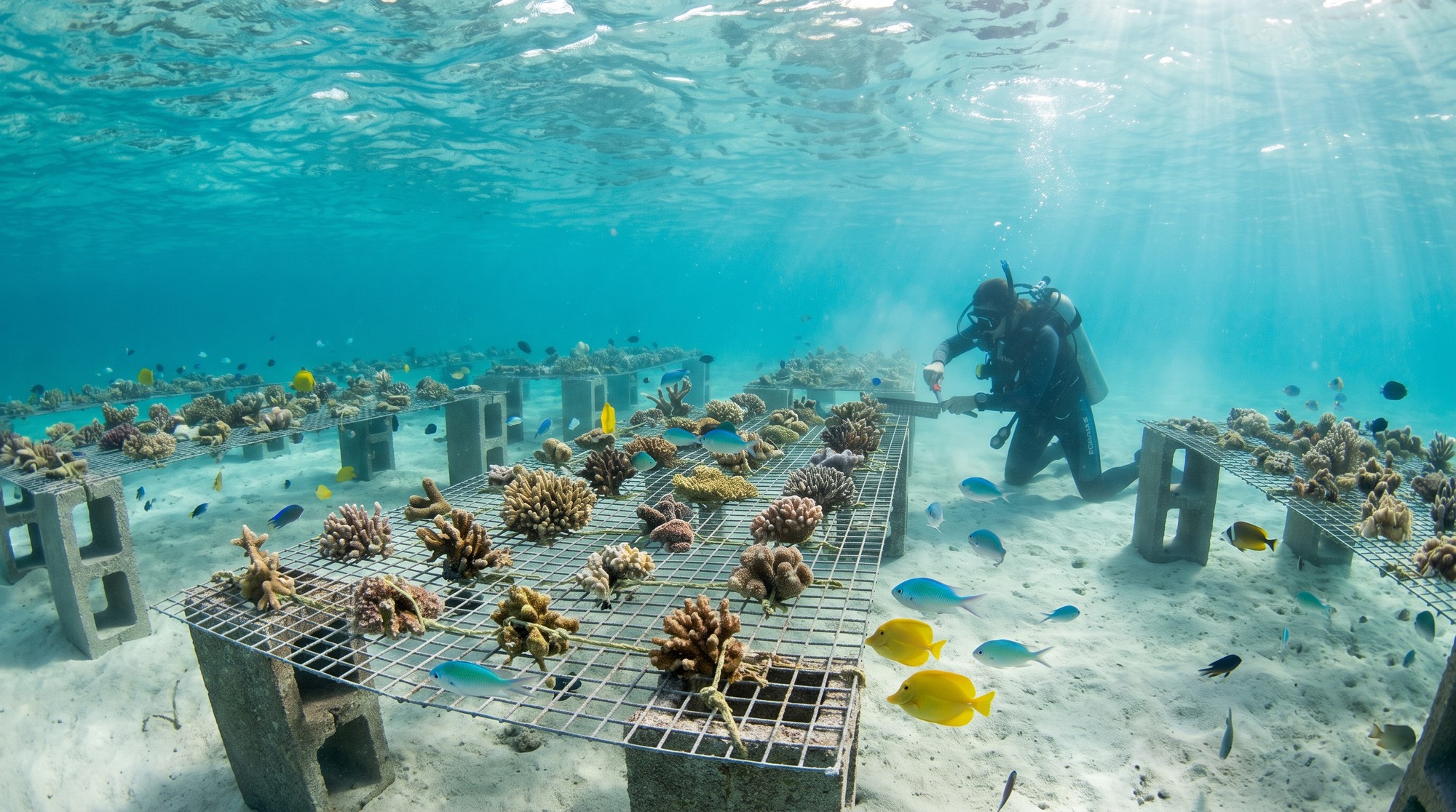
- Coral nurseries: growing fragments under controlled conditions for replanting onto degraded reefs, including transplanting bleaching-resistant corals between reefs.
- Microbiome transplantation: introducing beneficial bacteria to colonies whose microbial partnerships have been disrupted by stress.
- Thermal refugia: identifying reefs that stay naturally cooler and giving them stronger protection, on the logic that they can reseed surrounding areas later.
The new study suggests a different lever, one that is pulled after the heat has passed. “Bleached corals are often considered a lost cause because recovery after a heatwave is very slow, if it happens at all,” said Fiorenza Micheli, a professor of marine science at Stanford and a co-author of the work. She hopes the finding will inspire solutions that keep corals healthy long enough to recover.
It is worth being precise about what this is: a laboratory result in one coral species, on cloned fragments, and not yet tested on a reef. What it changes is the assumption that a bleached coral is beyond help. “While bleached corals may be dying, they are not dead yet,” Collins said. Other teams have found their own shortcuts by accident, including a laboratory mishap that made coral grow 40 times faster.
Frequently Asked Questions
Can coral recover from bleaching?
Yes, and often it does. Bleaching is a stress response rather than an automatic death sentence, so if the heat passes and other conditions allow, a coral can rebuild its symbiont population and regain its color, although the process is usually slow. The Stanford experiment showed that the same outcome can be reached far faster when a bleached coral is fused with a healthy genetic clone.
How long does it take a bleached coral to recover?
On a reef, recovery typically takes months to years, because a colony has to rebuild its algae population slowly. In the Stanford study, bleached fragments in contact with a healthy clone regained their full color within seven weeks, and one recovered in just four.
What is the main cause of coral bleaching?
Heat stress is the leading cause. When seawater stays unusually warm, corals expel the algae living inside their tissues. Warm water is not the only trigger, since pollution, disease, and cold snaps can also bleach shallow reefs, but the mass events that make headlines are driven by marine heat waves.
How does climate change affect coral reefs?
Warmer oceans make bleaching events more frequent, longer, and more severe, leaving reefs less time to recover between them. Climate change also drives ocean acidification, which slows the growth of the calcium carbonate skeletons that hold a reef together.
How does ocean acidification affect coral reefs?
As the ocean absorbs carbon dioxide, its chemistry shifts and carbonate becomes scarcer. Corals use carbonate to build their skeletons, so more acidic water means slower growth and weaker reef structures, especially for colonies already weakened by bleaching.
What can be done to save coral reefs?
Researchers are pursuing several routes at once: breeding heat-tolerant corals, growing corals in nurseries for replanting, rescuing and regrowing bleached coral in aquariums, and studying faster ways to replace the algae that bleached colonies have lost. Cutting greenhouse gas emissions remains the fundamental fix, because it addresses the heat that triggers bleaching in the first place.
The Bottom Line
The Stanford experiment does not mean reefs are saved. It does mean the picture after a heat wave is less hopeless than it looked. Bleached coral is stressed, not always doomed, and the machinery for recovery is already built into coral tissue. If researchers can learn to deliver the right algae without the need for a permanent partner, that could give reefs something they have been running out of: time.

