
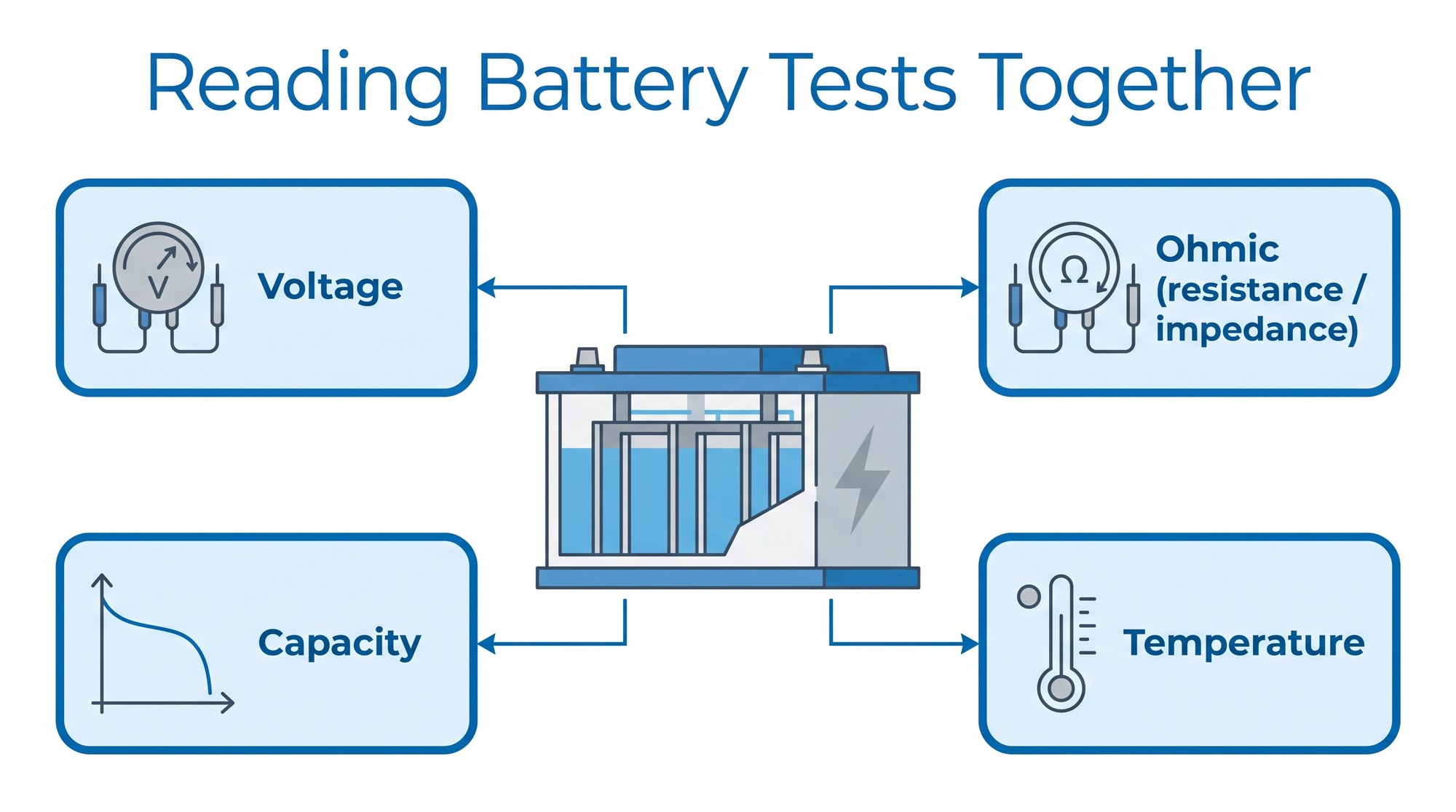
A stationary battery can produce several test results that seem to point in different directions. A cell may show an ordinary float voltage while its ohmic value has moved from its established baseline. Temperature can also change the context in which a reading was taken, while a capacity test answers a different question altogether.
The useful response is not to choose the most alarming number. Each measurement describes a different part of battery behavior, and the comparison becomes more informative when the measurements are taken under known, repeatable conditions. This article explains how to read voltage, internal ohmic values, temperature, and capacity together, then decide what additional evidence is needed when the results still do not agree.
Start With What Each Battery Measurement Actually Tells You
Before comparing results, establish what each measurement can and cannot show. Voltage, ohmic measurements, temperature, and discharge capacity describe different characteristics of a battery, so they work best as complementary evidence.
Voltage Shows Electrical Condition but Does Not Describe Battery Health by Itself
Battery voltage testing tells you the electrical potential at the point of measurement. In a stationary battery system, individual cell or unit voltage can be recorded during float operation and used to identify readings that differ from the expected range.
Voltage is also affected by the operating state. A reading taken while a charger is maintaining float conditions does not answer exactly the same question as an open-circuit measurement after a rest period. Manufacturer procedures can specify when voltage should be measured, so the test condition belongs in the record with the result.
A voltage reading therefore has value as part of a broader condition-monitoring program. By itself, it does not establish available capacity or provide a complete picture of battery health.
Internal Ohmic Measurements Can Reveal Changes That Voltage Alone May Not Show
Battery ohmic measurements assess electrical characteristics inside the battery using a low-level test method. Depending on the instrument and method, the reported value may be resistance, conductance, or impedance. These quantities are related but should not be treated as interchangeable measurements.
A useful application of battery internal resistance or battery impedance testing is trending. An ohmic value that moves away from a battery’s own established baseline or becomes an outlier within a string can identify a unit that deserves further investigation.
The result still needs context. Internal resistance varies among battery types and manufacturers, and manufacturer guidance describes ohmic measurements as a trending tool for identifying potentially weak or troublesome units. A changed value is therefore a diagnostic signal.
Temperature Provides Important Context for Battery Condition and Test Results
Battery temperature monitoring adds a condition that shapes both battery behavior and how test results are read. Its main effects include:
- Available capacity: Tends to fall at lower temperatures, which is why ratings are typically stated at 25 °C (77 °F).
- Charging requirements: Float voltage often needs temperature compensation, as set by the manufacturer.
- Ohmic readings: Internal resistance usually decreases as temperature rises, and conductance increases.
- Service life: Sustained operation above the rated temperature tends to shorten it.
Manufacturer procedures can specify temperature corrections or require measurements at comparable temperatures, so readings from different seasons can be compared on a consistent basis.
Discharge Testing Provides Direct Evidence of Available Capacity Under the Test Conditions
Battery capacity testing answers a different question: how long the battery can support the specified discharge conditions before reaching the defined end point. During battery discharge testing, the load, discharge rate, timing, voltage, and end-of-discharge criteria are established for the application and battery.
This makes discharge testing particularly useful when the question is actual available capacity. Manufacturer procedures calculate capacity from test discharge time relative to rated discharge time under specified conditions.
Because a capacity test places the battery under load, it should be planned around the manufacturer’s procedure and the applicable maintenance or testing practice. IEEE 450 and IEEE 1188 address maintenance and testing programs for stationary lead-acid batteries, while IEEE 2962 covers stationary lithium-ion batteries.
Understand Why Battery Test Results Can Appear to Disagree
Different measurements can disagree without any of them being inherently wrong. The apparent conflict often disappears once the question answered by each test is separated from the others.
A Normal Voltage Reading Can Exist Alongside a Changing Ohmic Value
Voltage and ohmic measurements respond to different electrical characteristics. A battery can remain within an expected voltage range while an ohmic measurement moves relative to its historical value.
This is one reason stationary battery testing commonly combines voltage, resistance or impedance, temperature, and trend records. Battery management systems can likewise monitor several parameters at the battery-block level.
The practical interpretation is to treat the changed ohmic value as a reason to investigate the affected unit, rather than as proof that its capacity has already fallen by a particular amount.
Battery Temperature and Operating Conditions Can Change How Results Should Be Interpreted
Two measurements taken at different temperatures, charge states, or operating conditions may not provide a clean trend. Temperature affects battery performance, while charging and discharging conditions affect what the instrument is measuring.
The same issue applies to the test procedure itself. A float voltage, a resting voltage, and a voltage recorded during discharge are different observations. The measurement record should therefore include the conditions needed to understand what the number represents.
Reduced Available Capacity May Not Be Obvious From a Resting or Float Voltage Reading
A battery can show a plausible voltage while still requiring further evaluation for available capacity. Voltage and internal impedance measurements cannot by themselves provide completely reliable conclusions about the capacity of the overall installation, which is why controlled discharge testing has a separate role.
That distinction matters in battery condition monitoring. Voltage can help identify charging or cell-level abnormalities, while capacity testing evaluates performance under the specified load. The two results answer related but different questions.
Make Sure the Measurements Are Comparable Before Diagnosing a Change
Before interpreting a difference as deterioration, confirm that the comparison itself is valid. A trend becomes useful when the measurement method and the relevant operating conditions are controlled closely enough to make changes meaningful.
Compare Results Taken Under Similar Charge, Load, and Operating Conditions
A measurement can be compared fairly with earlier ones when the battery was in the same state each time. Record the following with every reading:
- Operating state: Float, charging, resting, or under load.
- Time since the last discharge or recharge: Readings shift for a while after either event.
- Cell or ambient temperature: Needed to correct results or compare them.
- Capacity-test parameters: Discharge rate, load, starting condition, and end-point voltage set by the procedure.
With these details on file, a change in operating state is less likely to be mistaken for a change in battery condition.
Use the Same Test Method and Consistent Measurement Points When Trending Results
Battery performance trending depends on comparable measurements. Use the same measurement points and a consistent test method where the maintenance procedure calls for trending.
For ohmic measurements, establish a reference value when the battery is new or otherwise in a known condition, then compare later readings with that baseline. Record the individual battery or cell identity so a change can be associated with the same physical unit over time.
Check Connections, Test Setup, and Measurement Repeatability Before Treating an Outlier as Battery Deterioration
An unexpected value deserves a setup check before it becomes a diagnosis. Inspect connections and confirm that the instrument is being used according to its instructions. Manufacturer capacity-test procedures specifically call for clean, tight battery connections before testing.
If one result is substantially different from the surrounding trend, repeat the measurement under the same conditions where the procedure permits it. A repeatable deviation carries more diagnostic weight than an isolated value whose test conditions are uncertain.
Use Baselines and String-Level Context Instead of Isolated Numbers
A stationary battery string provides useful comparison points because individual cells or blocks operate as part of the same installation. Historical data and within-string differences can make a developing deviation easier to recognize.
Compare Each Cell or Battery With Its Own Historical Baseline Where Available
A baseline captures what a particular battery looked like under a known set of conditions. This is more informative than applying a generic resistance or conductance number across different battery models.
The baseline should include enough context to make later readings meaningful: battery identity, measurement method, temperature, operating state, and the relevant voltage or ohmic value. Trend records then show whether the same unit is changing over time.
Compare Similar Cells or Batteries Within the Same String to Identify Meaningful Outliers
Within-string comparison provides another reference. A unit that differs noticeably from neighboring units of the same type and operating condition can warrant closer inspection.
This does not make the lowest or highest reading an automatic failure criterion. The comparison is a way to identify where additional evidence may be useful.
Look for Patterns Across Voltage, Ohmic Values, Temperature, and Other Relevant Measurements
A changed parameter is easier to interpret when it is viewed alongside the others. Common combinations and what they may suggest:
- Rising ohmic value, normal voltage and temperature: Gradual aging that calls for closer trending.
- Rising ohmic value with elevated cell temperature: Possible thermal stress or dry-out in VRLA cells.
- Low float voltage with a stable ohmic value: A possible internal short or charge imbalance.
- High intercell connection resistance: A loose or corroded connection that may cause local heating.
- A shift across the whole string: A likely link to ambient temperature or charger settings rather than a single cell.
Modern monitoring systems collect several of these parameters together, which makes such patterns easier to trend over time.
Decide What Additional Evidence Is Needed When the Results Still Conflict
When the available measurements do not provide a consistent explanation, the next test should answer the unresolved question. That keeps additional testing purposeful instead of turning the maintenance process into a collection of unrelated readings.
Do Not Treat a Resistance or Impedance Change as Proof of Lost Capacity
A rising resistance or impedance value can indicate a battery that deserves investigation, particularly when the change is significant relative to its baseline. It does not, by itself, establish a precise remaining-capacity value.
Manufacturer guidance describes ohmic readings as a trending tool for identifying potentially weak or troublesome units. The appropriate conclusion is therefore that an abnormal trend calls for further evaluation.
Use a Controlled Discharge Test When Available Capacity Needs to Be Confirmed
When the unresolved question is whether the battery can deliver the required capacity, a controlled discharge test provides the relevant evidence. The test should use the discharge conditions, end voltage, and other parameters specified for the battery and application.
The result can then be compared with the rated or required performance under those same conditions. After testing, the battery should be returned to the required charging state according to the applicable procedure.
Evaluate Results Against Battery Manufacturer Guidance, Applicable Procedures, and System Requirements
There is no single interpretation that fits every stationary battery. Battery chemistry, model, installation, operating regime, and application all affect the appropriate maintenance and testing approach, whether the installation uses a familiar lead-acid string or a different technology such as a vanadium redox flow battery.
Use the manufacturer’s documentation together with the applicable standard or site procedure. IEEE 450-2020 addresses vented lead-acid stationary batteries, IEEE 1188-2025 addresses VRLA batteries, and IEEE 2962-2025 addresses stationary lithium-ion batteries. These documents provide frameworks for maintenance, testing, analysis, and replacement decisions within their respective scopes.
Match Safety Controls to the Battery System and Test Method
The final interpretation is useful when the measurement process itself is safe. The controls needed depend on the battery chemistry, voltage, energy level, the installation, and the type of test.
Before testing, confirm the manufacturer instructions, site procedures, isolation requirements, protective equipment, and ventilation provisions. Also confirm that the battery testing equipment is set up correctly for the planned discharge. For a capacity test, plan for the heat the load bank gives off and for recharging the battery to its required operating state afterward.
A practical review can be reduced to five questions:
- What does each measurement actually measure?
- Were the compared results obtained under sufficiently similar conditions?
- Does the current result differ from the battery’s own baseline or from comparable units?
- Does the available evidence indicate a need for further testing?
- Which manufacturer or applicable procedure defines the next diagnostic step?

Build the Diagnosis From the Whole Test Record
Conflicting stationary battery results are easier to interpret when each measurement plays the role it can support. Voltage reflects one operating point, ohmic readings show trends, temperature adds context, and capacity testing confirms performance under defined discharge conditions.
Effective battery condition monitoring connects these measurements instead of expecting one number to answer each question. Consistent methods, documented conditions, and historical baselines make unusual results easier to investigate. They also reduce the risk of mistaking normal variation for a loss of capability.


