
For four decades, the Arctic’s melt season kept getting longer. Spring melt arrived earlier, autumn freeze-up came later, and by the 2000s the season was expanding faster than at any other point in the satellite record.
Then it stopped.
A NASA-led study published in Communications Earth & Environment found that the Arctic melt season is now roughly 40 days longer than it was in 1979, but that almost all of that increase happened before 2010. Since then the average length of the season has stayed surprisingly flat, even as individual years swing from one extreme to another.
Read quickly; that sounds like relief. It is not a recovery. The plateau is what happens when a thinner, younger ice pack becomes more sensitive to the weather passing over it and when clouds begin shading an ocean that had been soaking up extra heat. Here is what actually changed, why the 2000s were so different, and what the pause does and does not mean.
What an Arctic melt season actually is
An Arctic melt season is not a single event. It has a beginning and an end, and both are detected from space.
Researchers use passive microwave sensors to pinpoint the moment the ice surface starts to melt in spring and the moment it starts to freeze again in autumn. Melt onset is not a wall of water sweeping across the Arctic; it is a signal that appears region by region as the sun climbs, and freeze-up arrives in the same patchwork way months later. The instruments have changed over the decades, from the SMMR sensor on NASA’s Nimbus 7 satellite to the SSM/I and SSMIS sensors on the DMSP series, but the principle has stayed the same: melting ice radiates differently from frozen ice, and satellites can measure the difference.
The team behind the new study analyzed those observations across 1979 to 2023, one of the longest continuous climate records in existence.
One result stands out. The lengthening was driven mainly by later autumn freeze-up rather than by spring melt arriving much earlier. Spring did shift earlier, but it accounted for a smaller share of the total change.
Forty extra days, and the decade that added most of them
The headline number is about 40 days, which is how much longer the melt season now runs compared with 1979. Almost all of that gain was banked before 2010.
A season that long is not simply a longer summer. Every extra week of open water is another week in which the dark ocean can absorb solar energy instead of reflecting it and another week in which the ice that eventually forms starts out thinner than it otherwise would have.
The pattern looks like this:
| Period | Change in melt season length | Dominant driver |
|---|---|---|
| 1979 to 1999 | Gradual lengthening from the 1979 baseline | A mix of earlier spring melt and later autumn freeze-up |
| 2000 to 2009 | Fastest lengthening in the record, up to five extra days per year in the most affected regions | Retreating ice exposed dark ocean water, which absorbed more sunlight and delayed the freeze |
| 2010 to 2023 | Average length roughly stable, with large year-to-year swings | Thinner, younger ice, plus changing cloud cover and weather patterns |
The long-term trend and the recent behavior are two different stories. The first describes a season that expanded dramatically for three decades. The second describes a season that has, on average, stopped expanding while becoming far more erratic from one year to the next.
Why the 2000s were so extreme
During the 2000s the ice pack lost much of its reflectivity. Bright white ice bounces incoming sunlight back to space. Dark open water absorbs it. As ice retreated, more ocean was exposed, and the extra absorbed energy had to go somewhere. One consequence was a later start to the annual freeze.
Maps built from the study’s satellite data show the result clearly. In the 2000 to 2009 period, the melt season lengthened by up to five additional days per year in the worst-affected parts of the Arctic, the fastest rate anywhere in the record.
This loop, where melting ice exposes darker water that in turn absorbs more heat and drives further melting, is one of the better understood examples of Arctic amplification. It is a large part of why the region has been warming so much faster than the rest of the planet.

What changed after 2010
After 2010, that feedback lost some of its force.
Changing cloud patterns have reduced the amount of sunlight reaching parts of the Arctic Ocean, which limited the surplus heat that had been pushing the freeze-up later into the year. The result is a season that still jumps around from one year to the next but no longer trends steadily upward.
The ice itself had changed too. Much of the Arctic pack is now younger and thinner than the multiyear ice that once survived several summers in a row, and thin ice is far easier for storms, winds, and cloud cover to push around.
“Previously, there was more of this multiyear ice that didn’t melt away each summer. Now that the ice is thinner and there’s less of it, there’s a lot more variability.”
That is Linette Boisvert, a co-author on the study and an ice scientist at NASA’s Goddard Space Flight Center.

Why a plateau is not a recovery
If the trend line has flattened, the obvious question is whether the Arctic has turned a corner. The study’s authors are explicit that it has not.
Three things remain true. The melt season is still around 40 days longer than in 1979. The remaining ice is substantially thinner than it was a few decades ago. And the region is still warming nearly four times faster than the global average.
When the 2026 minimum was announced, Walt Meier, a senior research scientist at the National Snow and Ice Data Center, described the situation in a single line: “We’ve plateaued, but we’re still low relative to the earlier part of the record.”
That warming has not gone quiet. Record-smashing polar heatwaves that would once have been called implausible have become part of the pattern rather than a freak outlier.
What the study describes is a change in what now drives the melt season, not a change in direction. When the pack was thick and extensive, the length of the season was governed largely by how much ice there was. Now it is governed far more by atmospheric conditions such as cloud cover, storms, and wind.
It is worth being precise about what a plateau does and does not mean:
- It does not mean the Arctic has stopped warming, which is still proceeding at nearly four times the global rate.
- It does not mean sea ice has recovered. The pack is thinner and younger than the ice of the 1980s.
- It does not mean the melt season has shrunk back toward its 1979 length. It is still about 40 days longer.
- It does not mean ice-free summers are off the table.
- It does not mean the long-term trend has reversed. Weather is holding the trend roughly in place, not undoing it.
- It does not mean the next decade will look like the last one.
“Melt season length is much more dependent on atmospheric effects. They seem to be playing a bigger role because the ice is generally thinner and more vulnerable to begin with.”
On average, the decline in ice thickness and extent that marked the 2000s appears to have paused for the time being. A pause, though, is not the same thing as a return. It means the trend is temporarily held in place by weather rather than reversed by the ice recovering.
Where the next rapid change could come from
Thick, old ice still survives year-round north of Greenland and across the Canadian Arctic Archipelago. It is the Arctic’s remaining stronghold of the kind of ice that used to be common across the ocean.

The study points out that continued thinning in those regions could trigger another period of rapid loss, with the potential to lengthen the melt season again. Whether the recent plateau is a lasting shift or a pause before the next acceleration is not a question the current record can settle.
One limit shapes how much weight the finding can carry: the satellite record analyzed here ends in 2023, so it does not include the 2024, 2025, or 2026 melt seasons. Whether the plateau has held through those years is a question the next few years of data will settle.
A separate 2026 review of five decades of sea ice change, published in Nature Reviews Earth and Environment, reaches a compatible conclusion about the dominant role of later autumn freeze-up, which suggests the mechanism is not an artifact of a single dataset or a single analysis method.
What a more variable melt season means in practice
The phrase in the study’s own title is “a highly variable regime”, and that phrase matters more than the flat average. A melt season that swings widely from year to year is harder to plan around than one that changes at a steady rate, even when the long-run numbers look similar.
In Alaska, the timing of the autumn freeze-up determines when sea ice along the Chukchi and Beaufort coasts becomes solid enough for travel and for subsistence hunting. Sea ice also shapes shipping routes, fisheries, and the marine mammals, including walruses and polar bears, that depend on it for resting and hunting. When freeze-up arrives weeks late one year and closer to normal the next, planning around it becomes a gamble rather than a schedule.
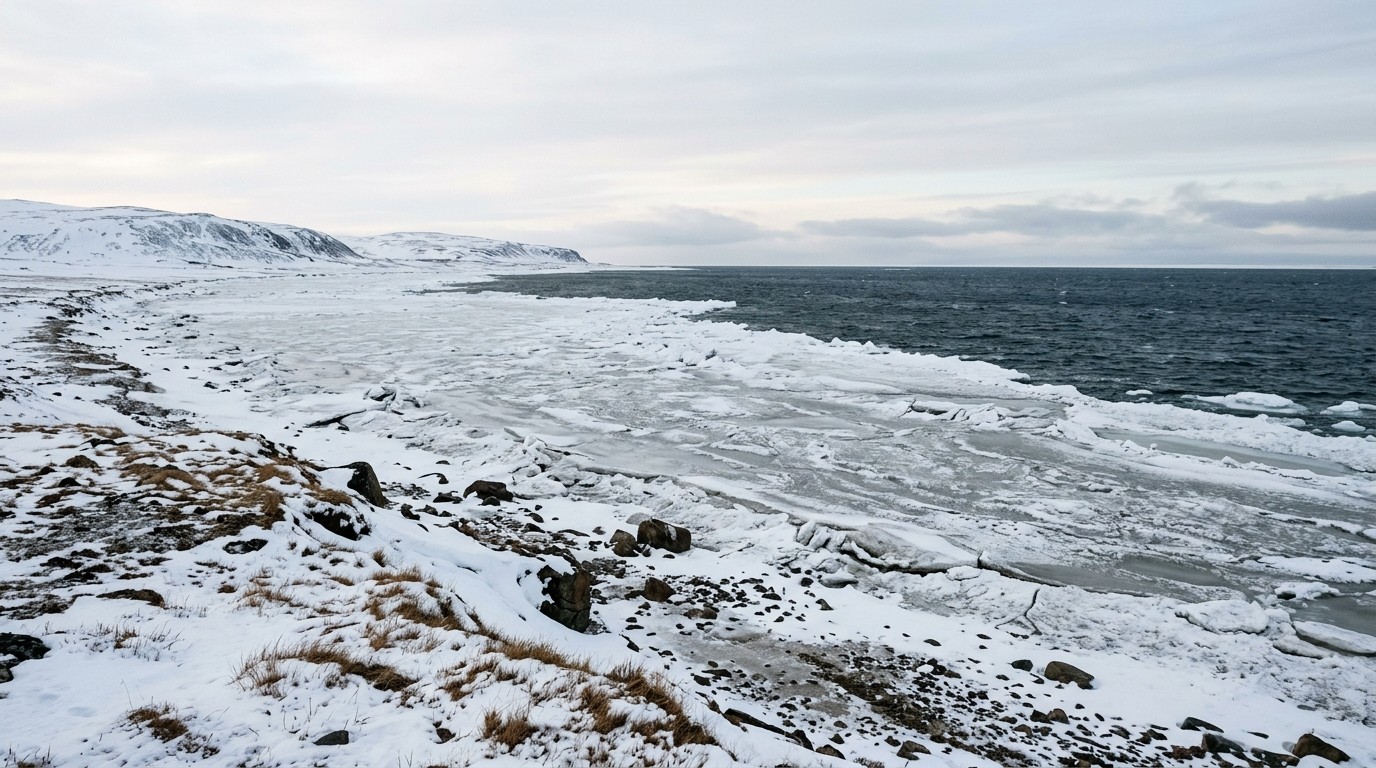
The same logic applies offshore: erratic ice is a different operational problem from ice that is merely thinner.
Frequently Asked Questions
Is the Arctic really melting?
Yes. The melt season is about 40 days longer than in 1979, and the ice that remains is thinner and younger than the pack that existed a few decades ago. The long-term decline in extent is also unambiguous. The National Snow and Ice Data Center reported that the 2026 Arctic minimum, reached on 12 September, was 4.60 million square kilometers (1.78 million square miles), tying for the tenth lowest in the near-50-year satellite record. The twenty lowest annual minimum extents in that record have all occurred since 2007.
Why did the Arctic melt season stop getting longer?
Two things changed at once. The ice pack became thinner and more mobile, so it now responds more strongly to year-to-year weather. And changing cloud patterns since around 2010 have reduced how much sunlight reaches parts of the Arctic Ocean, removing some of the extra heat that had been delaying the autumn freeze. The outcome is more variability and less of a steady trend, not a cooling Arctic.
Does the Arctic melt every summer?
Yes, though a melt season is more specific than a summer. Arctic sea ice retreats during the warmer months and refreezes every winter. What researchers measure is the interval between the first surface melt in spring and the start of the autumn freeze-up. That interval is currently about 40 days longer than it was in 1979, even though its average length has stopped growing since 2010.
What year will the Arctic be ice-free?
This study does not put a date on it, and the plateau should not be read as evidence that ice-free summers are off the table. An ice-free September depends on future emissions and on how quickly the thickest remaining ice thins, which is a question for projections rather than for the satellite record. What the data do show is that the conditions for another period of rapid loss still exist north of Greenland and the Canadian Arctic Archipelago.
Does this apply to Antarctica and the Greenland ice sheet too?
No, and the distinction is worth keeping straight. This study concerns Arctic sea ice, which is frozen seawater floating on the ocean. The Greenland ice sheet and the Antarctic ice sheet are land-based ice. Melting land ice raises global sea level, while melting floating sea ice does not, because that ice already displaces the water it sits in. Sea ice shapes the climate mainly by reflecting sunlight and by insulating the ocean beneath it.
The bottom line
The story of the Arctic melt season is no longer a simple upward line. It is a longer season than the satellite era has ever recorded, running on thinner ice, with its behaviour now dictated as much by clouds and storms as by the ice itself.
A flat trend line invites relief. The evidence does not support it. What has changed is the mechanism, not the underlying direction, and the thickest ice left in the Arctic sits precisely where the next abrupt shift is most likely to begin.

