
Industrial hemp leaves behind a bulky waste problem. Only the outer bark becomes fiber for products like traditional hemp textiles, while the woody inner core, called hemp hurd, makes up roughly 70% of the stalk by weight and is mostly discarded. A team led by Dr. Hoyong Kim at the Korea Research Institute of Chemical Technology (KRICT) has turned that leftover hurd into a reinforcing filler for hemp biodegradable plastic films, raising tensile strength by 26.2% using ordinary oven drying instead of costly freeze-drying.
Here is the precise finding, because the headline number needs its context. The researchers added the treated hemp cellulose at 10% by weight into a thermoplastic starch and poly(butylene adipate-co-terephthalate), or TPS/PBAT, film. Compared with the same unreinforced TPS/PBAT control film, tensile strength rose 26.2%. The same film reinforced with conventionally dried hemp cellulose improved by only 1.5%. So the breakthrough is the drying method that preserves the microfibrils, not simply the presence of hemp. The material remains about 90% TPS/PBAT blend, so this is a reinforced biodegradable film rather than a plastic made mostly from hemp.
Why TPS and PBAT films need reinforcement
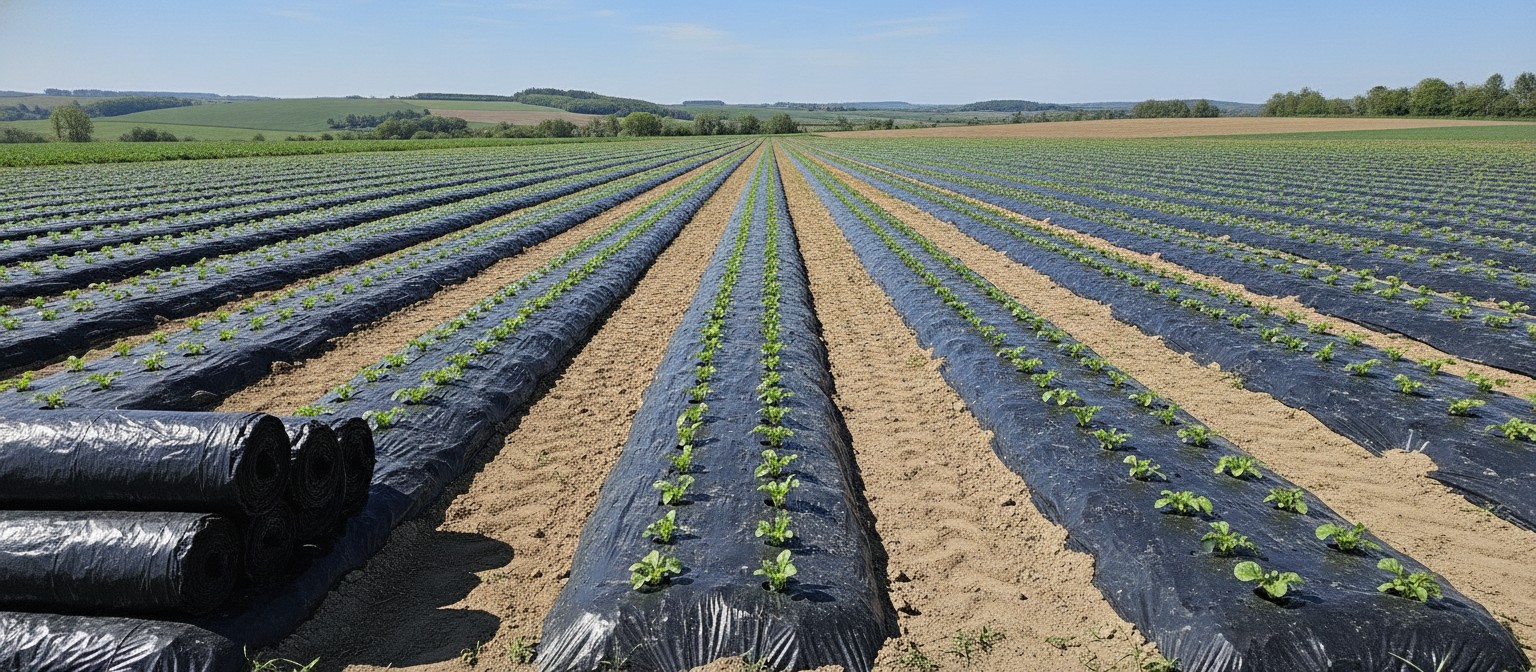
Biodegradable films made from thermoplastic starch (TPS) and PBAT attract interest for eco-friendly packaging and agricultural mulch films because they can biodegrade in soil. The drawback is mechanical: they tear easily and resist moisture poorly. Cellulose microfibrils from cotton or wood pulp can reinforce them, but added microfibrillation and processing steps raise costs. Hemp hurd offers a cheaper feedstock because it is already a waste stream. Industrial hemp for this work comes from designated Regulation-Free Special Zones, including Andong, Gyeongsangbuk-do, and using its discarded hurd could cut both agricultural waste and raw material costs.
The real obstacle: hornification during drying
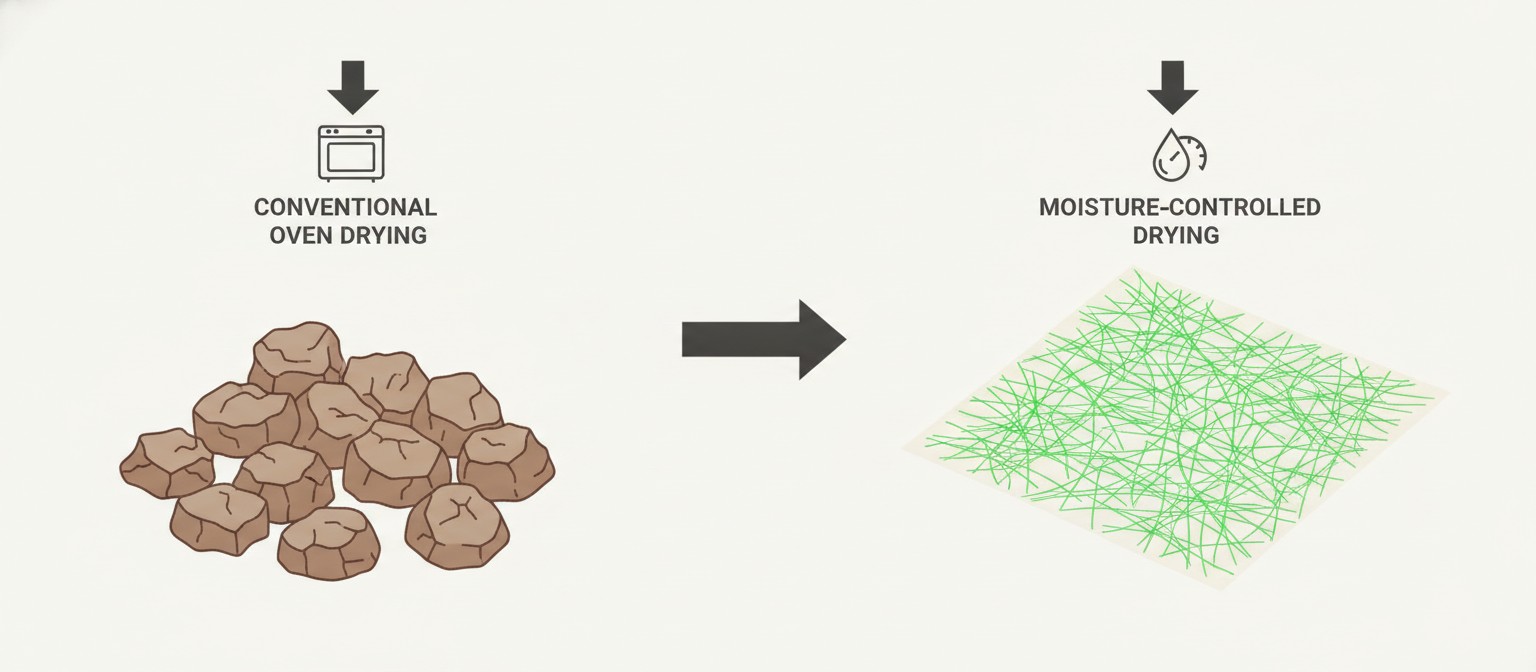
The challenge is a phenomenon called hornification. When cellulose microfibrils dry by conventional methods, water removal pulls neighboring fibrils together, and strong hydrogen bonds collapse the fine, porous fibrillar network into dense clumps. Clumped fibers cannot disperse evenly through the polymer matrix, so instead of distributing stress, they act as weak points where the film tears. Freeze-drying and spray-drying can suppress this clumping, but their energy use and equipment costs make large-scale production difficult.
Fiber saturation point guidance plus AKD treatment
The KRICT team solved this with a two-step physicochemical strategy built around conventional oven drying. Plant fibers have a critical moisture threshold called the fiber saturation point, or FSP, near 30% moisture content. Above it, free water sits in the fiber pores; below it, bound water inside the cell walls begins to leave and irreversible hydrogen bonding sets in. Using differential scanning calorimetry, the team identified the FSP of hemp hurd fiber at approximately 30% and found that milling at about 37% moisture, just above that threshold, balanced brittleness against residual water retention.
The second step was surface treatment with alkyl ketene dimer (AKD), a low-cost agent whose hydrophobic alkyl chains create steric hindrance between neighboring microfibrils. That further suppresses hydrogen bonding during drying. Together, moisture control and AKD treatment preserved the fine fibrillar structure with standard oven drying alone. The resulting filler showed smaller particle size, larger specific surface area, and a better preserved porous structure than conventionally dried material.
What the 26.2% result actually measured
To be explicit about the comparison, because this is where coverage of this story can go wrong:
- Test film: TPS/PBAT film containing 10 wt% of the new FSP-guided, AKD-treated hemp hurd cellulose.
- Control film: the same TPS/PBAT film with no hemp cellulose filler.
- Result: tensile strength 26.2% higher than the control.
- Contrast: TPS/PBAT film with 10 wt% conventionally dried hemp cellulose gained only 1.5% over the control.
Barrier performance improved as well. Water vapor transmission fell by about 17% and oxygen transmission by about 9% relative to the control film. Again, these are lab film measurements against the unreinforced TPS/PBAT baseline, and they describe this specific 10% loading formulation.
Can hemp be made into plastic?
Yes, in the sense tested here: hemp-derived cellulose can reinforce a biodegradable plastic matrix rather than replacing the polymer itself. At 10% loading, the film is still overwhelmingly a starch and PBAT blend, with hemp microfibers acting as internal reinforcement the way rebar strengthens concrete. Related work on hemp plastic packaging has explored other blends and products, as covered in Intelligent Living’s earlier look at hemp plastic alternatives for packaging. This KRICT study does not claim a fully hemp-based plastic, and it should not be read that way.
What about compostability and scale?
Two cautions matter. First, the sources I could read, including the NST release and Korean coverage, report tensile and barrier results but no new compostability or soil-biodegradation test data for the reinforced film and no compost certification. TPS and PBAT are known as soil-biodegradable blend components, but that is a property of the matrix, not a demonstrated result for this exact reinforced formulation, so I am not claiming it here. Second, this is laboratory film work with no commercial production demonstrated. The team plans further studies and suggests the approach could extend to soybean stalks and rice straw, but packaging shelves are not yet in view.
The research was published online on July 15, 2026 in the Chemical Engineering Journal and was supported by KRICT’s institutional research program and Korea’s Rural Development Administration cooperative program (RS-2025-02263976). For readers tracking the broader problems with bioplastics, from end-of-life confusion to weak mechanical performance, this study addresses one specific failure mode: how to dry plant microfibers cheaply without destroying the structure that makes them useful. That is a genuine step, even though the packaging problem as a whole is not solved. The detailed release is available from EurekAlert’s coverage of the KRICT announcement.
Can this hemp biodegradable plastic replace conventional packaging now?
No. It is a lab-scale film formulation at 10 wt% loading with no demonstrated commercial production and no reported compost certification in the sources available. Treat it as a promising reinforcement method, not a finished product. The team suggests the same approach could extend to soybean stalks and rice straw, which would widen the feedstock pool well beyond hemp.
What material in this study is actually biodegradable?
The TPS/PBAT polymer matrix is the soil-biodegradable component. The hemp cellulose filler is plant-derived. But the study as reported does not present new biodegradation test data for the combined film, so its end-of-life behavior should not be overstated.


