
Around one in six adults lives with some form of dental anxiety, and a national Canadian survey found that almost half of those with high dental fear had at some point avoided an appointment because of it. Very few of them are frightened of fluoride. A beige waiting room, a fluorescent light buzzing at a pitch nobody can ignore, and forty minutes of delay can convince almost anyone that doing a root canal at home would be preferable. Then an infection forces the issue, and the same patient ends up in a clinic where someone offers a warm blanket. Same appointment. Completely different person in the chair.
The difference isn’t bravery. It’s the room. Your nervous system reads a space long before your rational brain catches up, and dental offices have spent decades sending exactly the wrong signals. If you’ve been putting off a visit and can’t explain why, the answer is probably architecture, not courage. Finding a dentist edmonton at Meadowleaf Dental that treats the space as part of the treatment is a real advantage, because a calm room does measurable work before anyone touches your teeth.
Here’s what’s actually happening, and how to spot a practice that understands it before you ever sit down.
What Your Body Registers Before You Check In
Dental fear is usually a memory problem wearing a disguise. Most people who dread the chair had one bad experience, often in childhood, and their brain filed the sound of the drill alongside the smell of gloves. Show up to a room that smells and sounds identical and the file reopens whether you want it to or not.
That’s why surface-level reassurance fails. A receptionist saying “don’t worry” doesn’t overwrite a fifteen-year-old memory. What overwrites it is sensory evidence that this time is different: daylight instead of buzzing fluorescents, a door you can see from the chair, a person who tells you what the next ten minutes will look like before it starts. According to the National Institute of Mental Health, anxiety responses are learned and can be unlearned through repeated exposure to safer versions of the same trigger. That’s the whole mechanism. You’re not being calmed down. You’re being retrained.
Which means a practice that rushes patients through the door, straight into a room, and into a chair is actively making the next visit harder. A clinic that lets someone sit in the waiting area for eight minutes with a magazine is a better bet than one that prides itself on being fast, every single time.
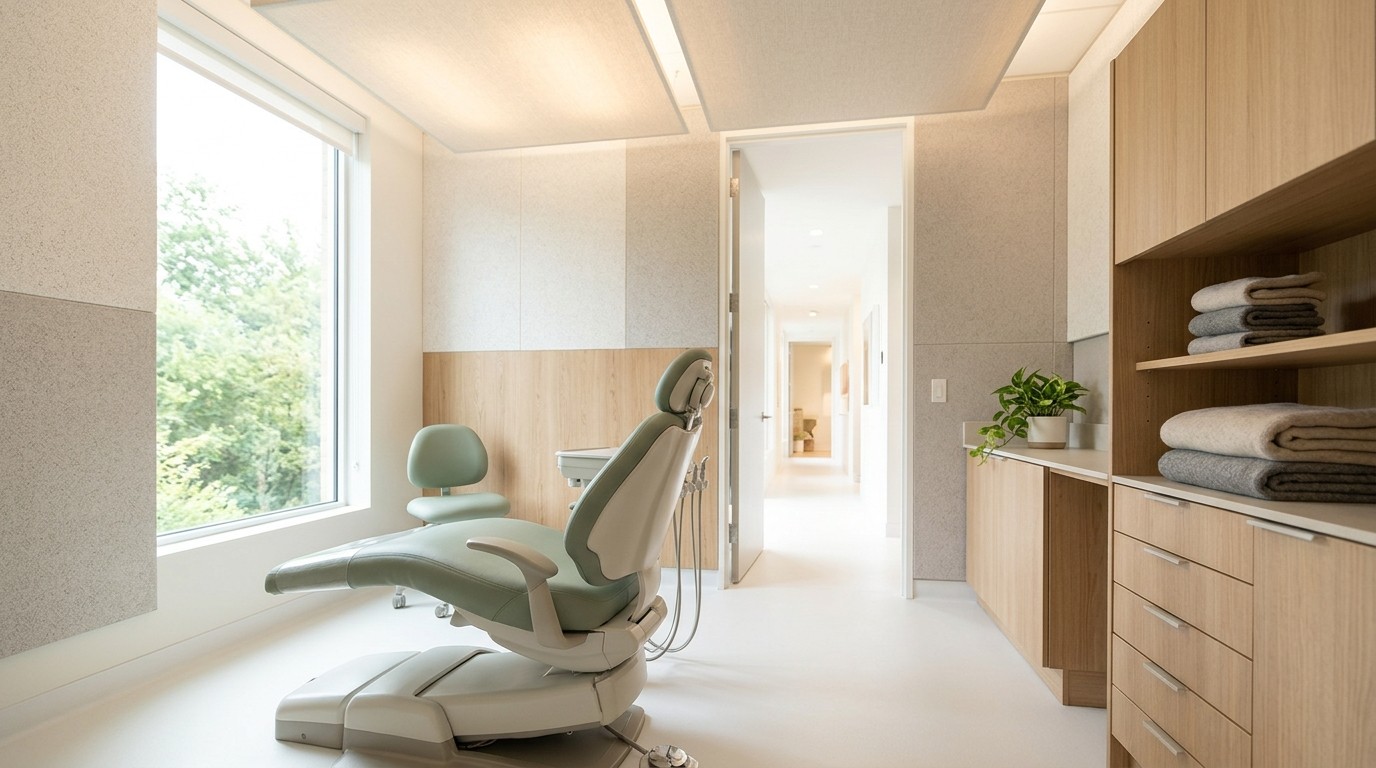
The Three Signals That Actually Matter
Forget the aquarium and the coffee bar. Those are nice, and they are not doing the work. What genuinely shifts a nervous patient’s baseline comes down to three features, grouped here as the Signal Triad: control, sound, and pace. They are the same principles that sit behind good interior design for medical clinics.
Control is the big one. Can you see the door? Does anyone ask before putting a bib on you? Is there a stop signal you’ve been told about out loud? A patient who can end a procedure with a raised hand is a patient whose nervous system stays out of fight-or-flight, because it knows an exit exists. This costs a clinic almost nothing and changes everything.
Sound is the most underrated. Dental drills are a specific frequency and there’s no way around that, but ceiling tiles, hard floors, and open hallways amplify it into the waiting room. A practice with soft surfaces and closed treatment rooms gives your ears a break before your brain starts writing stories about what it’s hearing. Noise-cancelling headphones help, but they’re a patch on a design flaw.
Pace is where the good clinics separate from the average ones. An unhurried appointment is not a slower appointment. It’s one where nobody narrates your chart to a hygienist over your head, and where the dentist sits down instead of hovering. Hovering is a dominance cue, whether anyone intends it that way or not.

A Test You Can Run in Five Minutes
You don’t need to be a patient to evaluate a practice. Walk in, or call, and run this checklist:
- Ask how they handle a first visit for someone who’s nervous. Vague answers are an answer.
- Ask whether you can see the treatment room before booking. Refusal is a red flag.
- Listen to the waiting room. Can you hear the drills from the front desk?
- Notice whether anyone greets you within the first thirty seconds. It sounds small. It sets the tone for the whole visit.
If a clinic fails two or three of those, keep looking. There are plenty of practices in any city and the one you pick should be boring in the best possible way.
Sedation Isn’t the Only Off-Ramp
Plenty of anxious patients ask for sedation dentistry as a first move, and sometimes that’s exactly right. But it’s worth knowing you have cheaper, gentler options before you go straight to the pharmaceutical route. Nitrous oxide wears off within minutes. A good topical anaesthetic means the needle is a rumour rather than an event. And simplest of all, a dentist who talks through each step in plain language removes most of the fear of the unknown before it ever forms.
The Centers for Disease Control and Prevention notes that regular preventive dental visits are tied to better long-term oral health outcomes, which is the practical case for pushing through the dread. The anxious-patient case is simpler: going once every six months in a calm room is far easier than going once every four years in a crisis.
The First Appointment Worth Booking
If the chair has been avoided for years and a visit is finally on the table, don’t start with a full cleaning and X-rays on day one. Book a consultation. Ask to see the room. Say, in plain words, that you’re nervous and that you need things to move slowly. A good practice will not flinch. A great one will thank you for telling them.
The first appointment is really a rehearsal. You’re not there to fix everything, you’re there to prove to your own nervous system that this room is different from the one in your memory. Get through that, and the second visit is genuinely easier. Get through the second and you’ve broken the loop.
So here’s the question worth sitting with: when you picture your next dental appointment, are you picturing the procedure, or are you picturing that buzzing light in the waiting room? If it’s the light, you don’t have a dental problem. You have a room problem, and that one’s fixable. Book a visit somewhere that treats the space like it matters, and see how differently the chair feels when the rest of the building is on your side.


