
QuantumScape Osprey, unveiled on Nov. 11, is an all-solid-state battery platform that pairs a ceramic separator and anode-free lithium-metal design with a solid sulfide cathode. The headline result is striking: 1,000 full cycles to about 80% capacity at just one atmosphere of pressure, plus 10% to 80% charging in five minutes and operation below minus 20 degrees Celsius. The catch lies in the scale and test conditions: the headline cycle life comes from a 0.3 to 0.4 Ah two-layer lab cell rather than an automotive pack, and some of the most quoted figures were measured under very specific temperatures or pressures.
What Osprey Actually Is
Osprey is not a shipping car battery. It is a development platform that builds on QuantumScape’s QSE system, according to the company announcement of the Osprey open platform.
Here is the architecture change in plain terms. The current QSE platform, including the QSE-5 cell sampled from the Eagle Line pilot in San Jose, uses a ceramic separator with a high-nickel NMC cathode and a liquid catholyte. Only the separator is solid. Osprey keeps that proprietary ceramic separator and anode-free construction, where lithium plates against the separator on first charge, but swaps the liquid in the cathode for a solid sulfide electrolyte. That makes the whole cell solid.
The distinction matters because QuantumScape spent years arguing that sulfide electrolytes cannot work as separators. In its new materials, the company says that view has not changed. Sulfides conduct lithium ions well inside a cathode, but they react with lithium metal, require heavy clamping, struggle in the cold, and invite dendrites during fast charging. Osprey therefore uses sulfide only in the cathode, where it moves ions, and lets the ceramic separator face the lithium metal. More background appears in QuantumScape’s technical overview of the Osprey platform.
QuantumScape describes Osprey as open because automakers can either use its sulfide cathode made with a proprietary dry process, or bring their own. The company says it has already tested Osprey with solid cathodes developed by automotive customers, which points toward licensing and co-development rather than selling a single fixed cell.
Why 1 Atmosphere Changes the Math for Cars
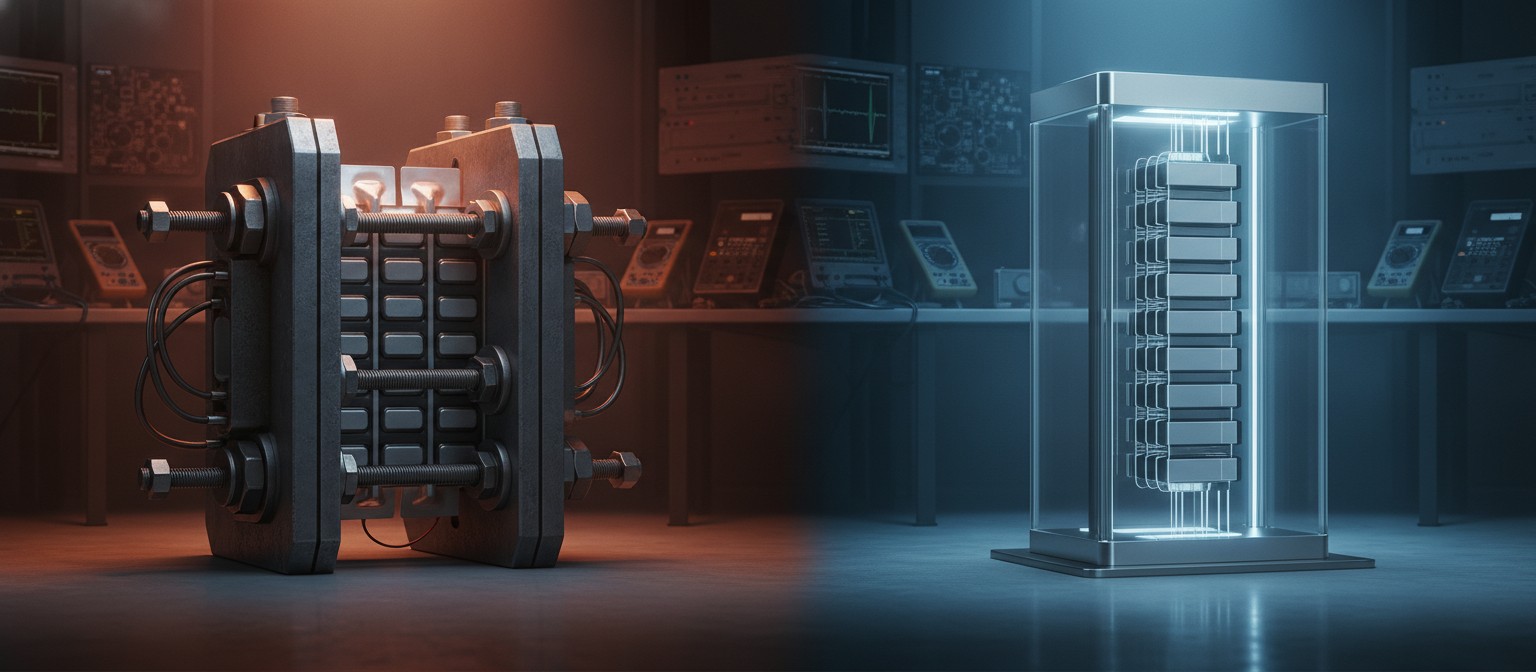
Solid-state batteries often only work when squeezed hard. Many sulfide lab cells run at 30 to 100 atmospheres of stack pressure, or 3 to 12 MPa, and higher. That pressure keeps two solids in contact, but it forces pack designers to add thick end plates, tie rods, and stiff module structures.
QuantumScape illustrates the penalty this way: 20 atmospheres on a single 10 by 24.2 cm cell equals roughly 5,000 kilograms of force, about the weight of three mid-size cars. Hold that across a full pack and you add weight, volume, and cost that erase much of the density advantage solid-state chemistry promised.
A cell that cycles at about 1 atmosphere, roughly the air pressure around you, avoids most of that hardware. That is why the 1,000-cycle result drew attention across the solid-state battery versus lithium-ion comparison: low pressure is a packaging win, not just a lab curiosity. If it holds at production size, it simplifies thermal management, module design, and vehicle integration.
What the Tests Show So Far
QuantumScape published four data sets with test conditions. Placed side by side, the results look strong on endurance and narrow on everything else.
| Claim | Test cell | Conditions reported | What it proves |
|---|---|---|---|
| 1,000 cycles to about 80% retention | 2-layer pouch, 50 x 65 mm cathode, about 0.3 to 0.4 Ah | 1C charge and 1C discharge, 0 to 100% depth, 30 degrees C, 1 atm, 5.5 mAh per sq cm loading | First public sulfide-cathode result at this duration and low pressure with a lithium-metal anode |
| 10% to 80% in 5 minutes | 2-layer cell, 10C rate | 80 degrees C, labeled “high temperature enables fast charge” | Speed is real, but only at heat well above normal EV preconditioning |
| Operation below minus 20 degrees C | Single-layer cell, 21 x 21 mm cathode | Slow C/3 discharge, 68% capacity and about 52% energy vs room temperature | Sulfide operation in the cold, but in a postage-stamp cell at a gentle rate |
| Up to about 1,100 Wh per L | 11 mm coin-size cell | 10 mAh per sq cm loading, 3 atm, 100 cycles | Projection, not a demonstrated automotive cell at 1 atm |
For reference, QSE-5 is rated at 844 Wh per L and 301 Wh per kg. The 1,100 Wh per L figure therefore implies a jump from higher cathode loading, roughly double today’s EV loadings, rather than a cell you can order now.
The pattern is familiar from other solid-state programs. A flexible electrolyte developed at Rice University showed how hard it is to keep two solids in contact without pressure, even when conductivity looks good. Osprey attacks the same contact problem from the opposite side: keep the pressure low and let material choice do the work.
What the Headlines Leave Out
The cycle-life result is the most solid piece. A two-layer cell with commercial-area electrodes and realistic 5.5 mAh per sq cm loading ran 1,000 full 1C cycles at 30 degrees C and 1 atm. QuantumScape says no other sulfide-based cell has shown this, and no published data set found so far contradicts that.
But the same white paper narrows the other headlines:
- Size: Two layers at that footprint work out to roughly 0.3 to 0.4 Ah, compared with about 5 Ah for a QSE-5. Scaling to multi-layer automotive cells with larger area remains unproven.
- Fast charging: The five-minute 10% to 80% run happened at 80 degrees C, or 176 degrees F. EVs do precondition packs before fast charging, but 80 degrees C is well above typical preconditioning. No room-temperature fast-charge curve was published.
- Cold weather: The minus 20 degrees C data came from a single-layer 21 by 21 mm cell discharged slowly at C/3. It kept 68% of room-temperature capacity and about 52% of energy, and 85% capacity at 0 degrees C. That is progress for sulfides, which historically needed heat, but not a winter pack test.
- Energy density: The 1,100 Wh per L figure is projected from high-loading cathodes. The supporting test used an 11 mm coin cell at 3 atm for 100 cycles, not 1 atm.
- Retention baseline: Retaining about 80% capacity after 1,000 cycles is a strong baseline, though it sits below the 95% retention after 1,000 cycles that Volkswagen’s PowerCo confirmed in earlier QSE cells in 2024. It is a different chemistry at an earlier stage, but worth keeping in context.
None of those caveats erase the low-pressure endurance result. They define what kind of result it is: a lab-scale materials and architecture proof, not production readiness.
An Open Platform, Not Just a Cell
The business move may matter more than any single chart. After years as the sulfide skeptic, QuantumScape now wants to sell the one part sulfide developers struggle with: a separator and anode-free design that survives contact with lithium metal at low pressure.
That fits the licensing model already used with Volkswagen’s PowerCo and Honda. “Osprey is the result of years of frontier R&D efforts,” said CEO Siva Sivaram in the announcement. QuantumScape reported $9.8 million in customer billings in Q3 and announced a 100 MWh line targeting the start of production in 2028 for QSE-5.
There is no timeline for Osprey. The white paper says the process has been demonstrated at laboratory scale, higher-throughput processes are still in development, and significant work remains in process engineering. Automakers also want larger prismatic formats than QSE-5, which means more layers and more area per layer.
Where Osprey Fits in the 2027 Solid-State Race
Every major solid-state program has converged on 2027 to 2030, but with different chemistries and readiness levels:
- Samsung SDI: Targeting mass production of sulfide all-solid-state cells in Ulsan in the second half of 2027.
- BYD: Planning small-batch sulfide production in 2027, with mass production toward the end of the decade. Our breakdown of BYD’s solid-state roadmap details its 400 Wh per kg target and dual-electrolyte patent push.
- Toyota: Aiming for 2027 to 2028 after earlier targets slipped from 2020, 2023, and 2026.
- Factorial: Developing its sulfide Solstice platform targeting up to 450 Wh per kg, with a Mercedes demonstration run exceeding 1,200 km.
- CATL: Warning in June that true mass-market solid-state production from the world’s largest battery maker remains years away, around 2030.
None of those companies has published 1,000-cycle data at 1 atm with a sulfide cathode and lithium-metal anode. That is QuantumScape’s opening. The question is timing. Osprey remains a lab process that rivals would need to license before their own 2027 to 2030 plans lock in, and QuantumScape notes that replication at commercial scale, pack safety certification, and cost remain unproven. The company also reports an enhanced safety profile versus conventional lithium-ion, but full pack-level safety validation is still ahead. For context on how the United States is trying to scale pilot output, see Greater Bay’s A-sample manufacturing milestone.
Frequently Asked Questions
Is QuantumScape battery technology real?
Yes, in the sense that QuantumScape publishes testable cells and conditions. QSE-5 samples are shipping from a pilot line, and Osprey cycle data includes rate, temperature, loading, and pressure. The limits are scale and independence: Osprey results come from company testing on small lab cells, not third-party pack validation or mass production.
What makes Osprey different from QuantumScape’s current battery?
QSE uses a ceramic separator with a liquid catholyte in the cathode. Osprey replaces that liquid with a solid sulfide electrolyte, making the whole cell solid while keeping the same separator and anode-free lithium-metal approach.
Can Osprey really charge in five minutes?
Under the reported conditions, yes, but those conditions were 10C at 80 degrees C in a two-layer cell. That is much hotter than a typical EV fast-charge precondition. QuantumScape has not published a room-temperature five-minute result, so do not treat the headline as an everyday charging time.
When could Osprey appear in an EV?
There is no date. QuantumScape calls out QSE-5 scale-up to a 100 MWh line in 2028, while Osprey is described as laboratory scale with process engineering still to do. Any automotive use would require larger multi-layer cells, pack validation, and a licensing or co-development deal first.
The Bottom Line for Drivers and the Grid
Osprey is the most compelling development QuantumScape has published in recent years because it reframes the engineering problem. Instead of fighting the industry’s sulfide investment, it offers a separator that could make sulfide cathodes viable at car-friendly pressure.
The 1,000-cycle result at 1 atm is legitimately new for a sulfide cathode with a lithium-metal anode, and QuantumScape deserves credit for publishing full test conditions where many rivals do not. The rest is still lab scale: a 0.3 to 0.4 Ah demonstrator, a hot fast-charge, a tiny cold cell, and a projected density figure.
If the low-pressure endurance survives scale-up, pack designers save weight, volume, and cost that sulfide stacks would otherwise waste on clamping hardware. Until then, the honest description is a promising open platform with one standout endurance result, not a five-minute production battery.

