
The solid-state battery race just got a major new contender. In early August 2026, BYD published six new patents detailing a dual-electrolyte cathode architecture for all-solid-state batteries, reinforcing the company’s timeline to begin small-scale production in 2027. With an energy density target of 400 Wh/kg, a 1,200-kilometer range, and an ambitious goal of reaching cost parity with liquid lithium-ion cells at $70 per kWh, BYD’s solid-state program represents one of the most detailed and aggressive roadmaps in the electric vehicle industry.
BYD’s Solid-State Battery Timeline: From Lab to Road
BYD’s solid-state battery program did not appear overnight. The company has been working through a structured, multi-year roadmap that predates most of its competitors’ public commitments. In 2024, BYD completed pilot production of a 60 amp-hour all-solid-state cell, achieving 400 Wh/kg energy density and over 800 Wh/L volumetric density, according to the company’s published timeline, as documented by the IEA’s special report on batteries and secure energy transitions, solving the critical solid-solid interface impedance challenge in the process.
The years 2025 and 2026 have been dedicated to vehicle installation and extreme-condition testing. BYD has been validating reliability at temperatures ranging from minus 40 degrees Celsius to 120 degrees Celsius, while simultaneously optimizing fast-charging performance. The cells now support 5C ultra-fast charging, capable of replenishing 80 percent of capacity in just 10 minutes. Even at minus 30 degrees Celsius, discharge efficiency holds at 85 percent.
In 2027, the program shifts from testing to demonstration. BYD plans to produce approximately 1,000 vehicles equipped with all-solid-state battery packs, targeting high-end electric coupes with a driving range exceeding 1,200 kilometers. These will not be mass-market models: the first recipients are expected to be premium offerings under the Yangwang and Denza sub-brands, where the higher production cost can be absorbed by segment pricing. The Shenzhen pilot production line, with an annual capacity of roughly 200 MWh, will supply enough cells for 2,500 to 3,000 vehicles in the first commercial year.
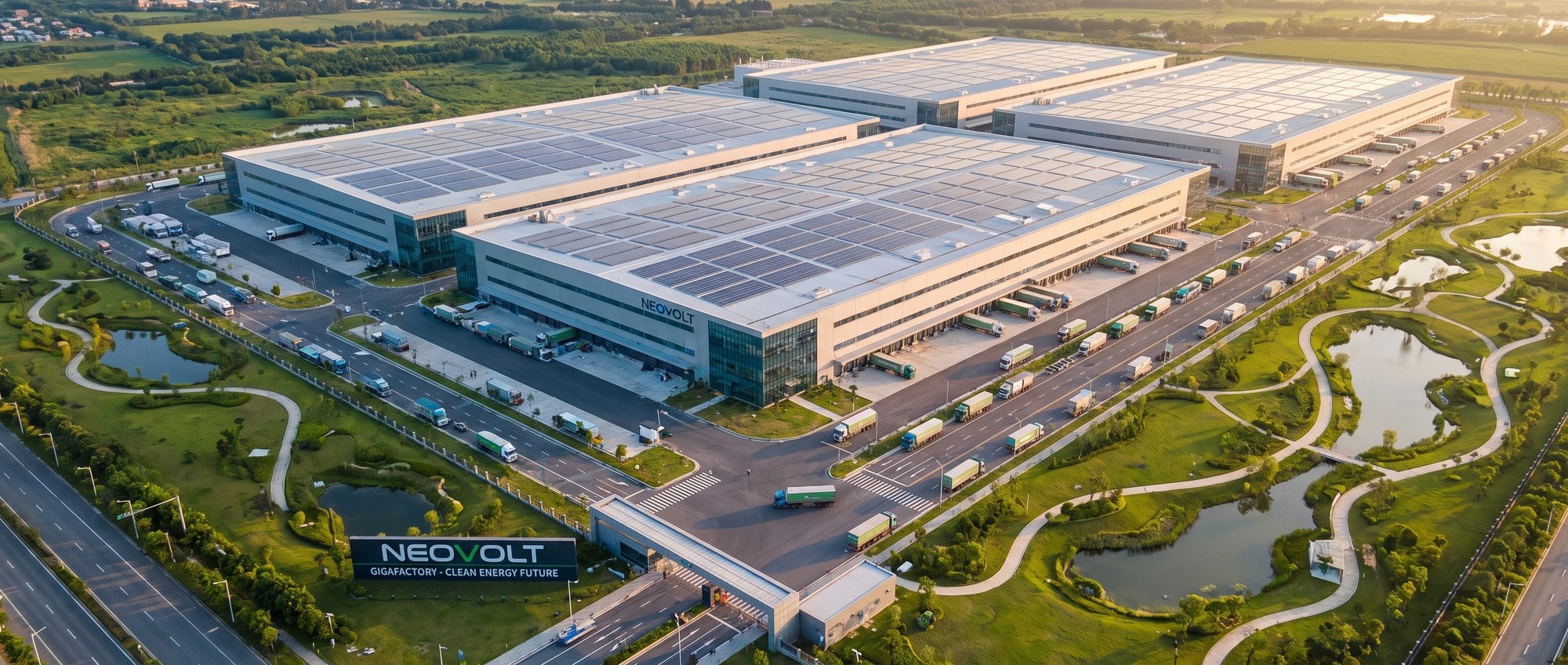
Scaling accelerates from there. The Chongqing Bishan base, a planned 100 GWh facility, will see its first 20 GWh phase come online as production ramps. BYD targets 40,000 solid-state-equipped vehicles by 2030, with full replacement of liquid batteries in its lineup sometime after 2030. At that point, the company envisions a global shipment volume of 556 GWh, supported by additional factories in Bengbu and Xi’an scheduled to expand between 2027 and 2028.
BYD Confirms First Solid-State Battery EV for 2027
On September 13, 2026, BYD Executive Vice President Stella Li confirmed the company’s most senior public commitment yet to a near-term solid-state deployment, telling reporters in a Carwow.es interview conducted in Valencia that BYD will field one model equipped with the technology next year.
“Any battery technology, I guarantee you will find in one corner of BYD R&D; we are studying that,” Li said. “So, talking about solid-state battery, we’re in the leading position; we’re in the leading position for the commercial line, and for the technology. So to prove that, even next year we will have one model that will be the first model with this technology there.”
The confirmation aligns exactly with the roadmap BYD’s battery arm, FinDreams Battery, has described since 2025. FinDreams Chief Technology Officer Sun Huajun has said the company will build roughly 1,000 vehicles fitted with sulfide-based all-solid-state cells in 2027, delivering them to selected customers rather than to the open market. Those vehicles are expected to sit on BYD’s premium Yangwang and Denza platforms, where higher pricing can absorb early-stage cell costs that remain several times those of conventional liquid-electrolyte batteries. Denza is already pushing long-range LFP in the near term with the Denza N8, now on pre-order with a claimed 1,003 km of CLTC range.
Li did not name the vehicle, publish battery specifications, or give a retail launch date, which is consistent with how the company has framed the milestone. The 2027 vehicle is a demonstration deployment intended to collect real-world performance data, not a consumer product. Mass production at commercial scale remains targeted for approximately 2030, with mainstream models across BYD’s wider lineup following between 2030 and 2032.
BYD Chief Scientist Lian Yubo has separately indicated that solid-state and conventional lithium-ion batteries are likely to coexist for another 15 to 20 years, suggesting the 2027 vehicle marks the beginning of a long transition rather than a sudden replacement of current battery chemistry.
Inside the Dual-Electrolyte Cathode: How BYD Solved the Interface Problem
The central technical challenge in solid-state batteries is deceptively simple: solid materials do not maintain reliable contact the way liquids do. In a conventional lithium-ion cell, the liquid electrolyte naturally flows into every gap between electrode particles, ensuring consistent ion transport. When both the electrolyte and electrodes are solid, repeated charging and discharging causes expansion and contraction that can crack or separate the interface, degrading performance over time.
That contact problem is an active research front in its own right. A Rice University team recently reported a softer metal-organic framework designed to deform with the electrode rather than crack away from it, although its conductivity is well below the sulfide chemistry BYD is using.
BYD’s solution, revealed across a suite of seven patents filed with the China National Intellectual Property Administration (CNIPA), takes a fundamentally different approach from most competitors.

Rather than searching for a single perfect solid electrolyte, BYD combines two: a halide electrolyte with small particles and a sulfide electrolyte with larger particles, mixed together with the active cathode material to form a composite electrode. The small halide particles fill the gaps between the larger sulfide particles and the cathode material, dramatically increasing the total contact surface area.
The six new patents, published in early August 2026, layer additional innovations on top of this dual-electrolyte foundation:
Patent CN122494747A adds an ion-conducting, electrochemically stable interlayer between the halide and sulfide materials. This prevents direct contact that could trigger unwanted chemical reactions, extending cycle life. Patent CN122494554A introduces a buffer layer and sets a hard thermal safety threshold: the active cathode material must not release more than 117 joules of energy per gram, reducing the risk of thermal runaway.
Patent CN122494567A tackles the cathode structure itself with a dual-layer design. The inner layer uses mono-crystal cathode material, which resists fracturing during charge-discharge cycling. The outer layer employs poly-crystal material, which offers superior rate performance due to its larger surface area but is more prone to grain-boundary cracking. Combining both layers aims to capture the benefits of each while mitigating their respective weaknesses.
Patent CN122494558A describes a tri-material cathode mix: metal oxides and metal sulfides treated with lithium, then combined with a solid electrolyte. The patent claims this reduces electrical resistance at the solid-solid interface while improving rate performance, specific capacity, and cycle life simultaneously.
The final two patents move from chemistry toward manufacturing readiness. CN122494552A applies ionic liquid wetting agents with a gradient distribution, concentrating more agent at the outer edges of the electrode than the center, to improve ion transport throughout the cell. And CN122494553A introduces a quality-control metric called “Re”: a minimum of 60 percent of each cathode particle’s perimeter must be in direct contact with electrolyte particles before the cell passes inspection.
This 60-percent-contact metric aligns with independent research from the Chinese Academy of Sciences (CAS) Institute of Physics, where Professor Wu Fan’s team found that using smaller sulfide electrolyte particles improved capacity retention by nearly 18 percentage points. Smaller particles mean more particles can adhere to a single cathode particle, directly raising the Re contact ratio that BYD now uses as a manufacturing benchmark.
400 Wh/kg, 5C charging, and 1,200 km Range: BYD’s Performance Targets
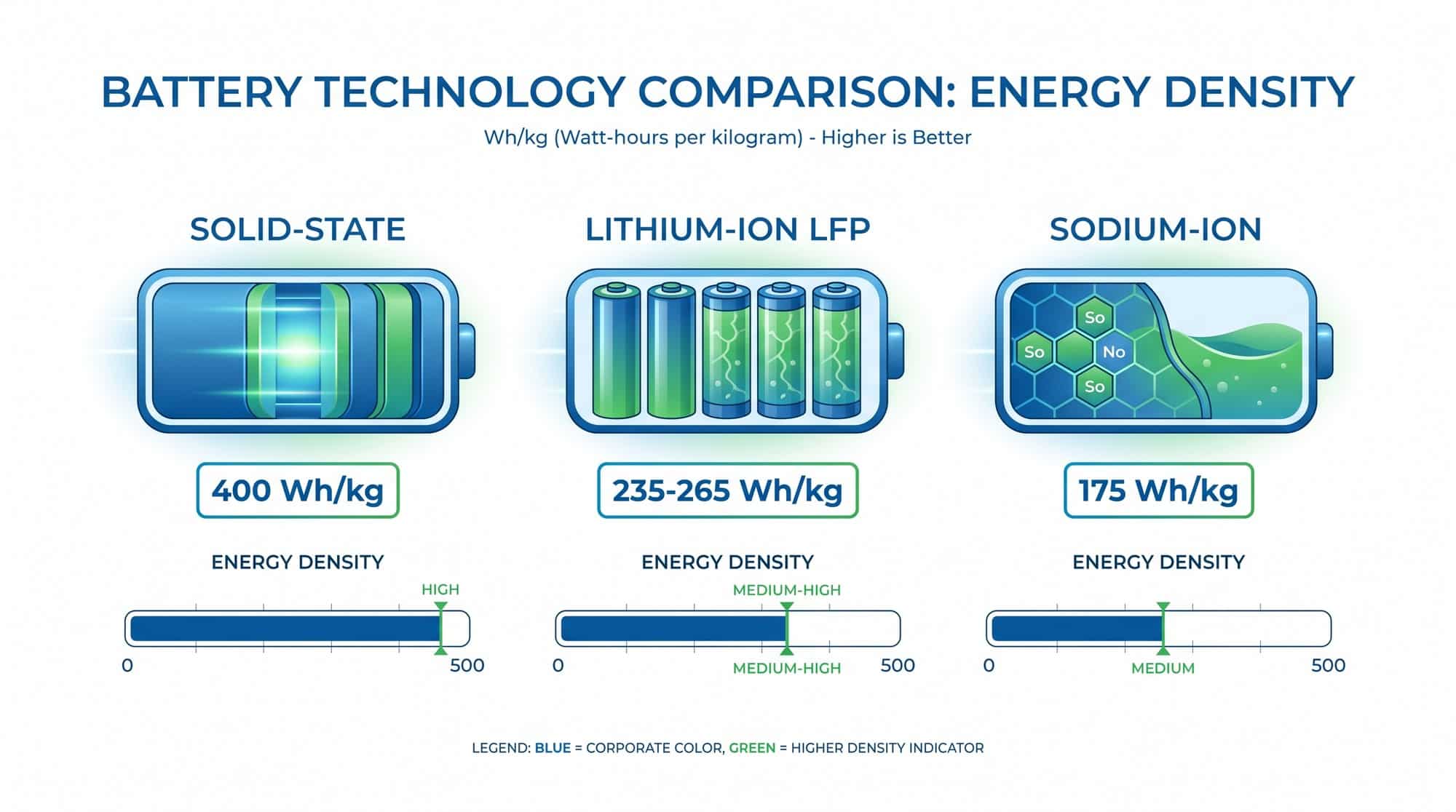
The numbers attached to BYD’s solid-state program represent a substantial leap over current lithium-ion technology. At the cell level, BYD’s solid-state design achieves 400 Wh/kg, compared to the 235 to 265 Wh/kg range of the company’s current Blade lithium iron phosphate (LFP) batteries. At the pack level, energy density exceeds 280 Wh/kg. Volumetric density reaches beyond 800 Wh/L.
These figures translate directly into driver experience. BYD is targeting a range above 1,200 kilometers for the first solid-state-equipped vehicles, which would effectively eliminate range anxiety for all but the most extreme use cases. The 5C fast-charging capability delivers 80 percent charge in approximately 10 minutes, approaching refueling times for gasoline vehicles. Even in cold climates, the cells maintain 85 percent of their discharge capacity at minus 30 degrees Celsius, addressing one of the most persistent criticisms of current EV batteries.
Cycle life is projected at 10,000 cycles, far exceeding the 2,000 to 3,000 cycles typical of LFP cells used in electric vehicles. A battery that lasts 10,000 full charge-discharge cycles could theoretically serve for several decades in a passenger vehicle or be redeployed for second-life energy storage applications after its automotive service ends.
| Specification | BYD Solid-State | BYD Blade 2.0 (LFP) | Industry LFP Average |
|---|---|---|---|
| Cell Energy Density | 400 Wh/kg | 235-265 Wh/kg | ~205 Wh/kg |
| Pack Energy Density | >280 Wh/kg | ~180 Wh/kg | ~150 Wh/kg |
| Driving Range | >1,200 km | >1,000 km (CLTC) | 400-600 km |
| Fast Charging | 5C (80% in 10 min) | ~3C | ~2C |
| Cycle Life | 10,000 cycles | ~3,000 cycles | 2,000-3,000 cycles |
| Cost Target | $70/kWh (at scale) | ~55-65/kWh | $81/kWh (pack, BNEF 2025) |
For a deeper technical comparison between solid-state and conventional lithium-ion cells, see our complete solid-state versus lithium-ion battery comparison.
The $70/kWh Target: Can Solid-State Match Liquid Battery Prices?
Perhaps the most audacious number in BYD’s roadmap is the cost target: $70 per kWh at a 20 GWh production scale, claiming parity with current liquid batteries. Today, solid-state cells cost an estimated $400 to $500 per kWh, roughly four to five times the price of conventional lithium-ion cells, according to Mordor Intelligence. BloombergNEF’s 2025 survey pegged the average LFP pack price at $81 per kWh, with cells alone at $79 per kWh.
Reaching $70 per kWh would therefore require a cost reduction of roughly 85 percent from current solid-state pricing, compressed into just a few years. BYD’s internal cost data suggests the company has already made significant progress. In 2023, BYD’s solid-state cell samples cost approximately 1,800 yuan per kWh. By mid-2025, through sulfide electrolyte process optimization and adaptation of silicon-based anodes for mass production, that figure dropped 33 percent to about 1,200 yuan per kWh. With the Shenzhen 20 GWh pilot line now operational, BYD expects costs to fall further to roughly 500 yuan (about $70) per kWh during the 2027 demonstration phase.
Industry analysts are cautious. The consensus view places true cost parity between solid-state and liquid batteries closer to 2030 or 2032, not 2027. CATL has notably declined to publish any cost target for its own solid-state program, which the company rates at Level 4 on a 1-to-9 technology readiness scale. CATL’s chairman stated in June 2026 that mass-market solid-state adoption remains “years away” due to engineering and manufacturing constraints.
BYD’s cost levers include sulfide electrolyte process improvements, the switch to silicon-based anodes which reduce material costs, and automation investments across 2026 and 2027. The company has also secured supply agreements with two domestic chemical producers, Yunnan Lithium Industries and Anhui Solid State Materials, for the high-purity sulfide precursors required. Domestic supply chain capacity, rather than technology, has been cited as the principal near-term constraint on scaling up.
Not Just Solid-State: BYD’s Parallel Sodium-Ion Breakthrough
While the solid-state timeline grabs headlines, BYD has been quietly advancing another battery chemistry that may prove equally transformative. The company’s third-generation sodium-ion platform now targets 10,000 charge cycles, double the cycle life of current LFP cells, using poly-anion materials that solve the sodium precipitation and heat-generation issues that plagued earlier sodium-ion designs.
Sodium-ion batteries offer several strategic advantages over lithium-based chemistries. Sodium is abundant and cheap, with no reliance on lithium, cobalt, or nickel supply chains. Cold-weather performance is exceptional: sodium-ion cells retain roughly 90 percent of their nominal capacity at minus 40 degrees Celsius, far outperforming lithium-ion in extreme climates, according to the IEA. Current sodium-ion cells reach up to 175 Wh/kg energy density, lower than the latest LFP cells at 205 Wh/kg but sufficient for urban vehicles and stationary energy storage.

BYD’s approach treats these chemistries as complementary rather than competitive. Solid-state targets the premium segment, where higher cost can be justified by class-leading range and charging speed. Sodium-ion serves the mass market and energy storage sectors, where cost and durability matter more than outright energy density. Lithium iron phosphate, which BYD continues to advance with its Blade 2.0 platform offering over 1,000 km of CLTC range, bridges the two. This three-chemistry strategy means BYD is not betting its future on any single technology, a diversification that its competitors have been slower to adopt. For a complete overview of how sodium-ion technology works and where it stands in 2026, see our sodium-ion battery technology guide.
The Global Solid-State Race: BYD vs. Toyota, CATL, and the Rest
BYD does not have the 2027 solid-state milestone to itself. Across China, Japan, South Korea, and Europe, automakers and battery manufacturers have converged on a remarkably similar timeline.
Toyota, long considered the frontrunner in solid-state development, plans to integrate solid-state batteries into a hybrid vehicle by 2027 or 2028, with its first fully solid-state Lexus flagship to follow. Toyota’s joint venture with Idemitsu on sulfide electrolyte production is building a pilot plant expected to complete in 2027. Unlike BYD, Toyota has published no cost target, and its initial volumes are expected to be small, measured in thousands of units rather than tens of thousands.
CATL, BYD’s primary Chinese battery rival, has taken a more conservative position. The company rates its solid-state technology at Level 4 out of 9 on its internal readiness scale and targets Level 7 to 8 by 2027, with commercialization not expected before 2030. That strategy centers on CATL’s sulfide solid-state battery with a 500 Wh/kg patent and 2027 pilot. CATL’s chairman publicly poured cold water on rapid deployment timelines in June 2026, emphasizing that engineering and manufacturing constraints remain the dominant bottlenecks. The company has not disclosed a cost roadmap.
Several other Chinese manufacturers are charging ahead, building on China’s broader national solid-state battery initiative. SAIC Motor, in partnership with Qingtao Energy, has already produced a prototype with its “Guangqi” all-solid-state battery and aims for mass production in 2027, following the launch of the world’s first mass-produced semi-solid-state vehicle, the MG4, in late 2025. Changan Automobile’s “Golden Bell” solid-state battery claims 400 Wh/kg and over 1,500 km of CLTC range, with prototype deployment scheduled for late 2026. Chery has unveiled cells with similar specifications. Dongfeng Motors is testing prototypes at 350 Wh/kg, targeting 1,000 km of range. All have pointed to 2027 as their commercial launch window.
South Korean manufacturers Samsung SDI and LG Energy Solution have indicated 2028 as their solid-state commercialization target, though neither has confirmed pilot production. In the United States, QuantumScape and Factorial Energy continue development, with Mercedes having demonstrated a modified EQS sedan achieving over 1,200 km on Factorial cells. However, no US-based manufacturer has confirmed a production timeline as specific as BYD’s. For a wider view of which manufacturers are shipping, testing, and scaling solid-state batteries this year, see our Solid-State Battery Scoreboard 2025-2026.
Elon Musk has expressed skepticism about solid-state batteries for years, maintaining that Tesla’s focus on improving conventional lithium-ion cells and manufacturing processes yields better results. Tesla has not announced a solid-state program of its own.
What This Means for EV Buyers and the Industry
For consumers, the practical implications of BYD’s solid-state timeline are both exciting and measured. The first solid-state vehicles, arriving in 2027, will be low-volume premium models priced well above mass-market EVs. Buyers of Yangwang and Denza vehicles will be the first to experience 1,200 km ranges and 10-minute fast charging, but broader availability is not expected until after 2030.
The question of whether BYD batteries are better than Tesla’s is complex. On specifications alone, BYD’s solid-state cells outperform any current Tesla battery in energy density, charging speed, and projected cycle life. However, Tesla’s advantage lies in manufacturing scale, vertical integration, and real-world reliability data accumulated across millions of vehicles. Comparing a 2027 pilot product to a mature, mass-produced system involves different yardsticks. BYD appears to be winning the technology roadmap race, but Tesla’s installed base and manufacturing efficiency remain formidable.
For buyers in the United States, the situation is more complicated. BYD currently does not sell passenger vehicles in the US market, which is protected by a 100 percent tariff on Chinese-made EVs. While BYD is expanding aggressively in Europe, Southeast Asia, and Latin America, American consumers are unlikely to have access to BYD solid-state vehicles in the near term. That may change if BYD establishes manufacturing facilities outside China, but no such plans have been confirmed for the US specifically.
For the broader automotive industry, 2027 is shaping up to be an inflection point. Multiple manufacturers, each with independently developed solid-state chemistries and production roadmaps, have converged on the same target year. China has also begun formalising the terminology these roadmaps depend on: our report on its new national solid-state battery standard explains the 0.5 percent rule that now decides which products may legally be called solid-state. If even half of these programs deliver on their promises, the second half of this decade will see the first genuine alternative to liquid lithium-ion batteries reach the market at scale. Navigating market entry in Europe will also demand meeting digital traceability mandates under the EU battery passport starting in 2027. The implications for battery supply chains, vehicle design, charging infrastructure, and energy storage markets are profound and will unfold over the coming years.
Frequently Asked Questions
What does Elon Musk say about solid-state batteries?
Elon Musk has consistently expressed skepticism about solid-state battery technology. He has argued that Tesla’s approach of incrementally improving conventional lithium-ion cells through manufacturing innovation and electrode chemistry optimization delivers better cost-to-performance ratios than pursuing solid-state designs. Tesla has not announced any solid-state battery program of its own, and Musk has suggested the technology is overhyped relative to its near-term commercial viability. However, with multiple manufacturers, including BYD, Toyota, and CATL, now targeting 2027 for production, the competitive pressure on Tesla to respond may increase.
Are BYD batteries better than Tesla?
On paper, BYD’s upcoming solid-state batteries surpass Tesla’s current lithium-ion cells in several key metrics: energy density (400 Wh/kg versus approximately 265-300 Wh/kg for Tesla’s best cells), charging speed (5C versus approximately 3-4C), and projected cycle life (10,000 versus approximately 1,500-3,000 cycles). However, Tesla’s batteries have the advantage of being proven at a massive scale, with billions of miles of real-world reliability data. BYD’s solid-state cells are still in the pilot and demonstration phase, and their long-term durability in consumer vehicles remains unverified. The two companies are pursuing different strategies: BYD is betting on a next-generation chemistry leap, while Tesla focuses on continuous improvement of proven technology.
Can I buy a BYD in the USA?
No, BYD passenger vehicles are not currently sold in the United States. The US market imposes a 100 percent tariff on Chinese-made electric vehicles, effectively blocking BYD’s entry. BYD does sell electric buses and commercial vehicles in the US and operates a manufacturing facility in Lancaster, California, for those products, but consumer cars are not part of its current American strategy. BYD is actively expanding in Europe, Australia, Southeast Asia, and Latin America, where its vehicles are increasingly competitive on both price and specifications. US consumers interested in solid-state EV technology will likely need to wait for domestic or allied-nation manufacturers to bring similar products to market.
How soon will solid-state batteries be available?
The first solid-state batteries in production vehicles are expected in 2027, but availability will be extremely limited. BYD plans to produce roughly 1,000 solid-state-equipped vehicles in 2027, while Toyota expects a few thousand units for its Lexus brand. SAIC, Changan, and Chery have all indicated 2027 commercial launches, though volumes are likely to be similarly constrained. Most manufacturers, including BYD and CATL, do not expect true mass-market adoption of solid-state batteries until after 2030. The technology will appear first in premium vehicles, where the higher cost can be justified, with gradually expanding availability as manufacturing scales up and costs decline through the late 2020s and early 2030s.
Conclusion
BYD’s solid-state battery program represents one of the most detailed and ambitious technology roadmaps in the electric vehicle industry. The dual-electrolyte cathode design, supported by seven patents and backed by a structured manufacturing timeline spanning from pilot production through to gigafactory-scale output, signals that the company is treating solid-state not as a distant research project but as an imminent commercial reality.
The broader strategic picture is equally important. BYD is not placing a single bet. It is advancing solid-state for premium vehicles, sodium-ion for mass-market durability and energy storage, and LFP for everything in between, creating a diversified battery portfolio that insulates the company from the risk of any single technology failing to deliver on its promises. As 2027 approaches, the question is no longer whether solid-state batteries will reach the market, but which manufacturer will deliver them at scale first and at what price.


