
The AI boom is queuing behind a steel almost nobody has heard of. Data-center projects that need power this year are being told their transformers will arrive in two to four years. The reason sits one step earlier in the supply chain, at the mills that roll the magnetic core inside every large transformer.
That core uses grain-oriented electrical steel. Grain-oriented steel means a specialty steel rolled and heat treated so its magnetic crystals line up in one direction. A transformer core means the stacked steel heart where voltage is stepped up or down. Lead time means the wait from order to delivery. Right now, that wait translates into years of delay for grid projects, power plants, and server campuses alike.
What This Obscure Steel Does Inside Every Transformer
Every transformer moves power by moving magnetism. Alternating current in copper windings creates a magnetic field. That field must pass through iron with as little waste heat as possible. Grain-oriented steel does this job better than ordinary steel because its crystals point the same way the field wants to go.
The process is exact. Mills control chemistry, rolling temperature, thickness reduction, and high temperature annealing. The result is thin sheets, each coated to insulate it from its neighbor, then stacked into a core. Windings of copper or aluminum wrap around that core. The assembly is dried under vacuum, placed in a tank, filled with insulating oil, and tested for weeks.

Around 95% of transformer cores in the United States use this steel, according to a Congressional Research Service analysis of distribution transformer supply. It is also the core material for large power transformers, the 100 megavolt ampere and larger units that step voltage between transmission lines. There is no drop in substitute that matches its loss performance at full load. Amorphous steel, the main alternative, works well at low loads but is larger, heavier, and less suited to dense urban substations.
This is why steel metallurgy now sets server schedules. Without qualified core steel, a transformer factory has a full order book and nothing to build. That dynamic echoes other single ingredient chokepoints, where a tiny specialty material can throttle jets, chips, and defense systems even when bulk raw materials are available.
How Many Years the Wait Has Become
The numbers are stark. A large transformer that took less than a year before the pandemic now takes two to four years. A distribution unit that took months took up to two years at the 2024 peak.
The table below keeps each figure with its publisher and date. Weeks convert at 52 weeks per year so rows share one unit. Compare averages to averages and estimates to estimates, not across different measures.
| Class | Publisher and date | Wait as published | Years of waiting |
|---|---|---|---|
| Distribution | DOE Office of Electricity webinar, 5 Mar 2026 | 3 to 6 months in 2019, then 1 to 2 years or longer in 2024 | 0.3 to 0.5 years, then 1 to 2-plus years |
| Distribution | National Laboratory of the Rockies, Feb 2024 | Up to 2 years, a fourfold rise from before 2022 | Up to 2 years |
| Distribution | Wood Mackenzie Jul 2025 estimate reported by CRS, Apr 2026 | 30 weeks | About 0.6 years |
| Power transformers | POWER 2 Jan 2026 reporting Wood Mackenzie Q2 2025 survey | 128 weeks average, a confirmed survey result | About 2.5 years |
| Generator step-up | POWER 2 Jan 2026 reporting Wood Mackenzie Q2 2025 survey | 144 weeks average, a confirmed survey result | About 2.8 years |
| Large power, 100 MVA and larger | DOE report to Congress, Jul 2024 | 36 months commonly quoted, up to 60 months maximum | 3 years typical, up to 5 years |
| Large substation and generator units | Wood Mackenzie, 2 Apr 2024 | 80 to 210 weeks range, a confirmed survey range | 1.5 to 4.0 years |
Some of these numbers are measured and some are projections, so it matters who published them. The 128 week and 144 week figures are confirmed survey averages from Wood Mackenzie’s Q2 2025 work, while the 30 percent power transformer supply deficit and 10 percent distribution deficit for 2025 are analyst estimates from Wood Mackenzie’s August 2025 outlook, not counted deliveries. Prices show the same split: the Bureau of Labor Statistics producer price index rose roughly 40 percent from 2020 to 2024 after inflation adjustment, a confirmed federal series, while the 77 percent rise for power transformers since 2019 is an industry survey estimate reported in trade coverage.
Before the pandemic, a large unit could be ordered with less than a year of lead time, according to DOE’s July 2024 resilience report. By 2024, DOE’s electricity chief was describing large units as growing from three to as much as four years. That shift turns the transformer from a late procurement detail into the first reservation on a project timeline.
One US Mill Gates Every Domestic Core
Only one mill in the United States makes grain-oriented electrical steel at scale. That mill is Cleveland-Cliffs Butler Works in Butler Township, Pennsylvania. DOE said in a 2024 notice that distribution transformer manufacturing uses either imported steel or steel from the sole domestic producer.
The dependence runs deep. Between half and three quarters of finished cores used in assembled domestic distribution transformers are imported, CRS found. Cores made domestically get 95 percent of their steel from that one supplier, CRS found in the same report. As of 2020, about 85 percent of imported grain-oriented steel came from South Korea, before tariff rules changed.

World supply is narrow. Qualified producers include Nippon Steel and JFE in Japan, POSCO in South Korea, ThyssenKrupp in Germany, Baosteel in China, Stalprodukt in Poland, NLMK in Russia, and Cleveland-Cliffs in the United States. Each line needs precise annealing and then an 18 month qualification with transformer makers before utilities will accept the steel. A new line is a multiyear capital project, not a shed with a rolling mill.
Butler is now expanding. Cleveland-Cliffs greenlit a 195 million dollar hot mill expansion that began production earlier this year and is expected to complete by 2028, a 25 percent capacity addition, with 75 million dollars from a DOE grant that survived the change from the Biden to the Trump administration, according to local reporting on the company’s August 2026 briefing. The company argues that stable demand for grain-oriented cores is needed to justify that investment.
Trade policy tightened around the same steel. Section 232 tariffs on steel reached 50 percent, with derivative products including cores and laminations added effective 15 August 2025. A separate 50 percent tariff on certain copper products took effect 1 August 2025. Copper matters because it forms the windings wrapped around the steel core. Tariffs do not create steel, but they change the math for domestic expansion.
Why Data-Center Growth Feels It First
Data centers do not wait like other loads. A campus needs a substation, one or more large transformers, and upstream reinforcement before servers can run. When those units quote at 128 to 144 weeks, the energization date moves by years, not months.
Demand hit at the same time from every direction. Wood Mackenzie’s August 2025 estimate put US power transformer demand up 116 percent since 2019, against 41 percent for distribution units. Generator step-up demand, the units that connect power plants to the grid, grew 274 percent in one industry tally. That surge is why federal efforts to count data-center power use site by site matter for planning, because averages hide local peaks that force transformer swaps.
Money alone cannot print a delivery slot. Framework agreements now reserve factory capacity years ahead, which favors large buyers who can promise volume. A municipal utility or a single campus pays more, waits for a cancellation, or buys through an intermediary. That structure explains why tech firms pledged to pay for new power supply and grid upgrades tied to their loads, yet still face physical queues for substations and transformers.
Two facts explain why servers wait on steel:
- Each campus needs large units. Substation and step-up transformers are custom built for site voltage, impedance, and fault levels.
- Each slot is shared. Wind, solar, replacement, and data-center orders all draw from the same test bays and annealing lines.
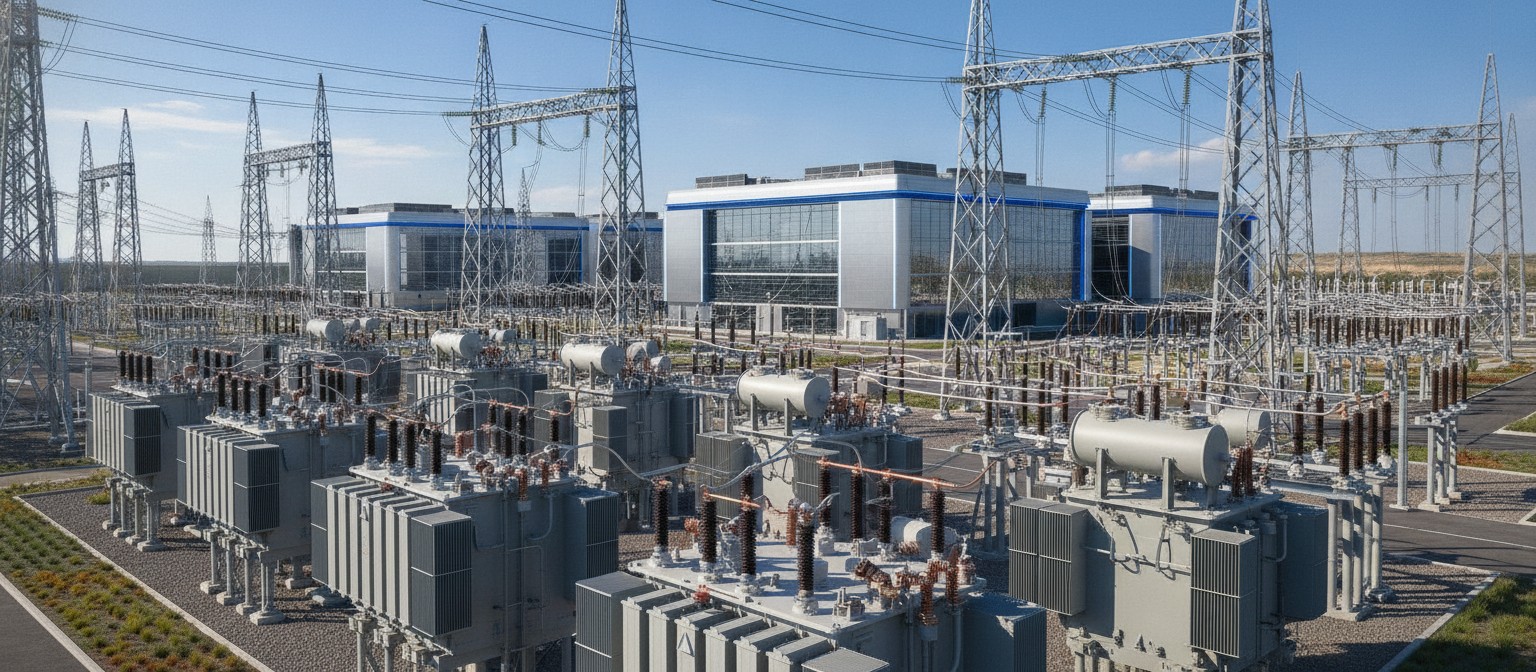
There is also a direct competition for slots and for steel. When offshore wind projects were canceled or delayed in 2023 and 2024, their transformer slots were reallocated. Data centers took some of them. That reallocation is useful, but it shows the queue is shared. One project’s exit becomes another project’s entry. Grain-oriented steel is also used in electric motors and EV chargers, so transformer makers compete with motor makers for the same mills.
Some data-center operators try to bypass the queue with on-site generation. That workaround has its own bottleneck, because gas turbines recently quoted at three to seven years with prices in 2027 expected near triple 2019 levels. The steel queue is not avoided. It is traded for a turbine queue.
Old Transformers Compete With New Data Centers
The grid must replace as well as expand. Between 60 million and 80 million distribution transformers serve the United States. Roughly half are over 33 years old and near end of life. Utilities add or replace 1.4 million to 2.4 million units per year. Large power units last 30 to 40 years, and many now in service were installed between the late 1950s and late 1970s.
A replacement order uses the same factory slot as a new data-center substation. A city substation with a failing 1968 unit cannot defer forever, because a summer peak with no spare is a blackout risk. Yet a replacement adds no new capacity, so it never shows up as progress toward connection targets. Utilities are therefore choosing between keeping old units alive and serving new load.
Condition monitoring buys time but not renewal. Dissolved gas analysis, thermal imaging, and partial discharge testing can extend safe life by years. They cannot restore aged cellulose insulation to new condition. The difference between replacing at year 35 and year 45 is a decade of avoided demand on a constrained supply chain. That decade is valuable when new capacity takes three to five years to arrive.
What Could Shorten the Queue
New plants are coming, on dated schedules. Siemens Energy announced its first US transformer plant in Charlotte, North Carolina in February 2024, first with early 2026 timing and later with production expected in early 2027. Prolec GE added a medium power line in Goldsboro, North Carolina in May 2025 with plans to double capacity by 2030. Hitachi Energy announced a large power facility in South Boston, Virginia in September 2025. Virginia Transformer is expanding in Rincon, Georgia with construction expected from January 2026. Each date is a company statement, while delivery dates still come only from a supplier quote.
- Standardize designs. Ten design attributes can yield about 80,000 distribution configurations, an Oak Ridge National Laboratory speaker told a March 2026 DOE workshop. Fewer variants mean fewer changeovers. National Grid cut about 32 percent of its roughly 700 stock keeping units by March 2026.
- Approve alternates early. Special arresters, breakers, fuses, and dual voltage switches still lagged in March 2026. Prolec GE estimates simpler connections and single voltage designs can cut cycle time 5 to 8 percent.
- Settle the efficiency rule. The final efficiency standards published in April 2024 require compliance for units made on or after 23 April 2029. DOE says the final levels need far less amorphous steel than proposed and let about 75 percent of units stay on grain-oriented cores. A June 2026 request for information on grid security and material supply gathers data only. The 2029 date stands.
- Pool spares and refurbish. Utilities are holding more spares and refurbishing units they once would have replaced. Spare large units need the same maintenance as working units, so storage records and oil history decide whether a bridge unit is safe.
None of these adds a transformer this quarter. New winding lines take one to two years to obtain. New plants take one to three years to build. Qualification adds months more. The realistic outlook is late decade relief for large units, with distribution improving first.
Frequently Asked Questions
What is grain-oriented electrical steel?
It is a specialty steel rolled and annealed so magnetic crystals align with the rolling direction. That alignment lets magnetic fields pass with low energy loss. It forms the laminated core inside most transformers.
What is a transformer core?
It is the stacked steel heart of a transformer. Thin insulated sheets are stacked into a shape that keeps magnetic flux inside the iron. Copper windings wrap around it to change voltage from high to low or low to high.
What is lead time in this context?
It is the wait from order or drawing approval to delivery. Published figures often leave the start point open. Always ask a supplier whether the date runs from order or from approved drawings, and when the factory test slot is booked.
Why does the electrical steel transformer shortage delay AI data centers?
Each campus needs substation and step-up transformers to connect. Those large units now average 128 to 144 weeks in confirmed 2025 survey results, or about 2.5 to 2.8 years. Without the transformer, the line and the servers wait.
How long do transformers take right now?
Distribution units eased to an estimated 30 weeks by Q2 2025 after a two year peak in 2024. Large power units still take years. DOE cites 36 months commonly and up to 60 months maximum. Wood Mackenzie’s 2024 range was 80 to 210 weeks, or 1.5 to 4.0 years.
Who makes this steel?
A handful of mills worldwide, including producers in Japan, South Korea, Germany, China, Poland, and Russia. In the United States, Cleveland-Cliffs Butler Works is the sole domestic source. Most US transformer steel beyond that mill is imported.
Will new factories fix it?
They help after 2027, not this year. Announced US plants add slots at the margin and must still qualify steel, hire welders and winders, and book test bays. Distribution should ease first. Very high voltage units ease last.
What Happens Next
The binding constraint is physical, not procedural. Queue reforms can shorten paperwork. They cannot add a transformer. The grid discovered all at once that it needs several hundred large units per year, plus millions of smaller ones, from a steel supply rolled in a handful of mills.
The constructive path is unglamorous. Order early. Standardize where protection settings allow. Qualify alternates. Track oil history on spares. Give mills like Butler a clear demand signal so annealing lines are worth building. The AI era will still arrive. It will arrive on the schedule of its steel.


