
CATL, the world’s largest EV battery maker, has confirmed it will start small-scale trial production of a sulfide-based solid-state battery in 2027, with lab cells already hitting 500 Wh/kg. The announcement lands alongside a newly published WIPO patent that reveals how CATL plans to stabilize sulfide electrolytes, a long-standing barrier to commercialization. Chairman Robin Zeng’s warning that the technology is still at “Level 4 of 9” reminds us this is a pilot, not a mass-market product. This explainer unpacks the patent chemistry, the readiness scale, and what 500 Wh/kg really means for electric vehicles.
What CATL Actually Announced: 500 Wh/kg and a 2027 Pilot Line
On August 10, 2026, CATL confirmed plans to move its all-solid-state battery, domestically branded Ningde Shidai All-Solid-State, into small-scale trial production in 2027. The company reported that early sulfide-based cells have already achieved 500 Wh/kg at the cell level in lab testing, roughly double the energy density of today’s best mass-produced lithium-ion packs.
Three details define the announcement:
- 500 Wh/kg cell energy density: Cited by CarNewsChina and widely reported across Chinese media, this figure refers to prototype pouch cells, not pack-level density. Pack-level density is typically 25-35% lower once housing, cooling, and battery management systems are added.
- Pilot, not mass production: CATL is targeting a small batch of automotive-grade samples in 2027, with capacity reported around 5 GWh for initial validation. Mass commercialization is not expected until around 2030, a point Chairman Robin Zeng reinforced in June 2026.
- 20 Ah to 60 Ah progression: Development is moving from 20 Ah laboratory samples toward 60 Ah automotive-grade prototypes, the format needed for real vehicle integration and testing.
This timeline has been consistent for years. CATL has worked on solid-state batteries for more than a decade and joined China’s All-Solid-State Battery Collaborative Innovation Platform (CASIP) in early 2024, a government-coordinated consortium that aims to build a domestic solid-state supply chain by 2030.
Inside the Patent: How a Fluorine Salt Creates a LiF Shield for Sulfide Electrolytes
The technical heart of CATL’s approach was disclosed on March 5, 2026, when the World Intellectual Property Organization (WIPO) published international patent PCT/CN2025/086345, titled “Positive Electrode Sheet, Solid-State Battery Cell, Battery Device, Electric Device, Positive Electrode Active Material and Preparation Method Therefor.”
Most coverage stopped at the headline. The chemistry inside explains why this patent matters.
The sulfide problem
Sulfide solid electrolytes offer the highest ionic conductivity among solid electrolytes, which enables fast charging, but they are chemically unstable at the interface with electrodes. They tend to decompose when in contact with lithium metal or high-nickel cathodes, forming resistive interphases that raise impedance and degrade cycle life. Interface contact failure is the dominant failure mode for sulfide cells.
CATL’s fluorine-containing solution
According to the patent summary described by electrive and Electronic Design, CATL’s positive electrode plate uses a specific three-layer anode active material: a substrate material, a cobalt-rich material, and a coating. The first two layers contain a transition metal oxide, while the outer coating contains a fluorine-containing lithium salt combined with sulfide solid electrolyte material.
The mechanism works in two steps:
- High thermal stability: The fluorine-containing lithium salt itself offers excellent stability, particularly at high temperatures, reducing unwanted side reactions during operation.
- In-situ LiF formation: The sulfide electrolyte material can decompose in a controlled way to generate lithium fluoride (LiF). The LiF forms a dense, protective layer on the anode surface, acting as a passivation film that mitigates further decomposition of the sulfide electrolyte and suppresses dendrite growth.
In effect, CATL is using a sacrificial, controlled decomposition to build its own protective shield. LiF is a well-known solid electrolyte interphase (SEI) component in conventional liquid cells for its mechanical strength and electrochemical stability, and the same properties are being engineered here for a solid-state environment.
This differs from approaches that add external coatings or interlayers after cell assembly. By embedding the fluorine salt directly in the electrode preparation, the protective layer forms in situ during initial cycling, improving interface contact without adding extra manufacturing steps.

Why Sulfide Is the Hardest Path and Why CATL Chose It Anyway
Solid-state batteries come in three broad electrolyte families: polymer, oxide, and sulfide. Each trades conductivity, stability, and manufacturability differently.
- Polymer electrolytes are flexible and easier to process but have low ionic conductivity at room temperature and limited voltage stability, which caps energy density.
- Oxide electrolytes are chemically stable and safer but are brittle, making it difficult to maintain intimate contact with electrodes over thousands of cycles. They also require high-temperature sintering that complicates manufacturing.
- Sulfide electrolytes deliver liquid-like conductivity, enabling high power and fast charging, but they are moisture-sensitive, produce toxic hydrogen sulfide if exposed to air, and decompose at electrode interfaces, exactly the problem CATL’s patent targets.
CATL’s choice of sulfide reflects a bet on performance. The company has publicly chased both semi-solid (hybrid solid-liquid) and all-solid routes in parallel. For true solid-state performance, sulfide currently offers the only realistic path to 500 Wh/kg with acceptable charging rates. The trade-off is a far more demanding manufacturing environment, requiring dry rooms with dew points below -50°C and precise control of interface chemistry, which is one reason costs remain 3 to 5 times higher than conventional lithium-ion today.
A recent supply-chain signal reinforces the bet: in November 2025, CATL signed a framework agreement with Guangdong Jiayuan Technology to reserve 626,000 tons of copper foil capacity for 2026 to 2028, valued at about 66 billion yuan (roughly 8.4 billion euros). The copper foil serves as an anode current collector for both semi-solid and all-solid-state routes, indicating CATL is securing materials well before pilot output.
TRL 4 to 7-8: Decoding CATL’s Readiness Scale and Zeng’s Level 4 Warning
The most important context for CATL’s 500 Wh/kg claim is where the technology sits on the readiness scale.
CATL uses a 9-level Technology Readiness Level (TRL) system adapted from NASA and aerospace. In June 2026, Chairman Robin Zeng said at the World Economic Forum’s Annual Meeting of the New Champions in Dalian that CATL’s all-solid-state technology is at Level 4, clarifying in a June 25 follow-up that mass commercialization before 2030 is unlikely.
Here is what the levels mean in battery development terms:
- TRL 1-3: Basic research. Principles observed, concepts formulated, proof of concept in lab.
- TRL 4: Lab validation. Cell chemistry validated in laboratory conditions. CATL’s current 20 Ah samples sit here.
- TRL 5-6: Prototype demonstration. 60 Ah automotive-grade cells tested in relevant environments, including thermal, vibration, and safety tests like nail penetration and 150°C hot-box tests.
- TRL 7: System prototype demonstration in operational environment. Cells integrated into battery packs and tested in vehicles.
- TRL 8: System completion and qualification. Pilot-scale vehicle integration, qualified for small-batch production.
- TRL 9: Full mass production. Qualified supply chain, qualified manufacturing, millions of vehicles.
CATL’s chief scientist Wu Kai has said the target is to reach Level 7 to 8 by 2027, which aligns with the small-scale trial production window. That still leaves a gap to Level 9. Zeng noted that three paths must clear simultaneously before mass adoption: the technology must work, the product must be manufacturable at quality, and the commercial case must make sense for automakers and buyers. He added that initial applications will likely appear only on premium platforms priced above 250,000 yuan (about 32,000 euros), a pattern also noted in early solid-state metal battery efforts, before costs fall.
In short, 500 Wh/kg at TRL 4 is a lab achievement. TRL 7-8 in 2027 would mean prototype cars can drive with these cells. Millions of cars at a competitive cost remains a 2030 horizon.

CATL vs Toyota vs Samsung vs BYD: Four Different Roads to Solid State
Every major battery maker is pursuing solid-state, but with different chemistries and timelines. Understanding the divergence explains why direct comparisons are often misleading.
| Maker | Electrolyte Approach | Energy Density Claimed | Pilot Timeline | Mass Production View |
|---|---|---|---|---|
| CATL | Sulfide + fluorine LiF shield (patent PCT/CN2025/086345) | 500 Wh/kg (cell, lab) | Small-scale trial 2027, 5 GWh line | Around 2030, premium vehicles first |
| BYD (FinDreams) | Dual-electrolyte (oxide + sulfide hybrid) | 400 Wh/kg | Vehicle integration 2027 | Large-scale 2030, targeting $70/kWh |
| Toyota | Sulfide (with Idemitsu partnership) | ~500 Wh/kg class, targeting 1,200 km range | 2027-2028, limited flagship models | Measured in hundreds of tons initially (tens of thousands of vehicles) |
| Samsung SDI | Oxide / sulfide all-solid-state | 500 Wh/kg class, 600-mile range claim | Pilot line operational, automotive samples to OEMs | Late 2020s, performance-first premium EVs |
For a deeper look at how solid-state compares to today’s lithium-ion on safety, cycle life, and cost, see our explainer on Solid-State Battery vs. Lithium-Ion: The Complete Comparison. Our coverage of BYD’s 2027 solid-state production plan details the dual-electrolyte design and cost trajectory that contrasts with CATL’s sulfide approach.
The key distinction for CATL is the patent-led interface solution. BYD hedges with two electrolytes, Toyota bets on long-term sulfide scale with petrochemical support, and Samsung SDI leans on oxide stability. CATL’s in-situ LiF layer is the most chemically explicit attempt to solve sulfide instability published to date.
What 500 Wh/kg Really Means for EVs: Range, Weight, Cost, and Charging
Energy density dominates headlines, but pack-level reality determines what drivers experience. Here is how to translate CATL’s 500 Wh/kg cell claim:
Range
At the cell level, 500 Wh/kg could theoretically enable 1,000 km or more on a single charge if a 100 kWh pack could be built at that density. At the pack level, density falls to roughly 320 to 380 Wh/kg after adding housing and thermal management, suggesting a realistic 800 to 1,000 km range for a sedan with a 100 kWh pack, depending on aerodynamics and efficiency. CATL has denied rumors of a 2,000 km solid-state EV by 2027, a useful reality check on viral claims.
Weight
For a fixed 75 kWh usable capacity, a 500 Wh/kg cell pack could be about 30% lighter than today’s best nickel manganese cobalt (NMC) packs at around 250 to 280 Wh/kg cell level. That translates to roughly 80 to 100 kg saved, improving handling and efficiency, but the saving shrinks once structural integration is accounted for.

Cost
Solid-state remains 3 to 5 times more expensive than liquid lithium-ion today, according to estimates cited by Chinese media. The July 21, 2026, supplier conference disclosed that CATL’s third-generation condensed solid-state battery (high-nickel NCM cathode + silicon-carbon anode) achieved 420 Wh/kg and more than 1,500 cycles while passing nail penetration and hot-box tests, but that 420 Wh/kg figure already reflects trade-offs for manufacturability and cycle life versus the 500 Wh/kg lab peak.
Charging
Sulfide’s high conductivity promises faster charging than oxide, but solid-state does not automatically mean faster. Charging speed depends on interface resistance, lithium metal anode stability, and thermal management. Semi-solid packs are already shipping in China (Nio’s 150 kWh WeLion pack since April 2024, SAIC MG4’s mass-produced semi-solid units) charge at rates comparable to advanced liquid cells. True solid-state fast charging at scale is still unproven outside the lab.
China’s July 2026 National Standard and the Road to 2030 Mass Production
China plans to release its first national standard for automotive solid-state batteries, GB/T 43568-2026 “Solid-State Batteries for Electric Vehicles Part 1: Terminologies and Classification,” in July 2026. A draft for public consultation was completed in December 2025
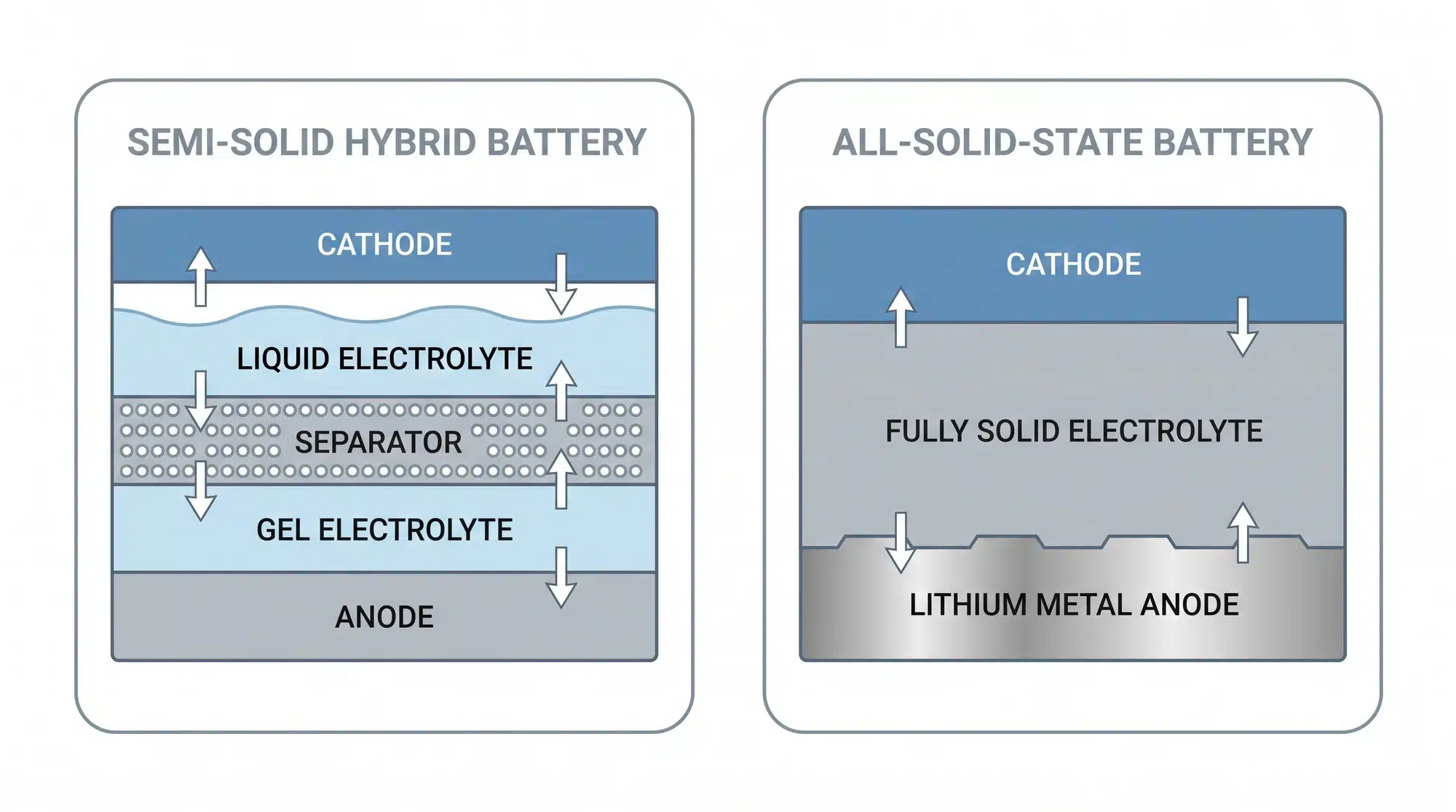
The standard matters because it formally defines three categories: liquid batteries, hybrid solid-liquid (semi-solid-state) batteries, and all-solid-state batteries. Under this taxonomy, the semi-solid packs already on sale in China (marketed as “solid-state” by automakers) are classified as mixed liquid-solid batteries, not true solid-state. That reclassification will make it harder to market semi-solid products as solid-state breakthroughs.
Beyond terminology, July 2026 is expected to mark three inflection points noted by SMM and Metal News: policy standardization plus consumption tax exemptions, commissioning of multiple hundred-ton-level sulfide electrolyte production lines, and solid-state-adjacent products (such as SVOLT’s hybrid solid-liquid batteries) entering volume production. All-solid-state itself remains in validation, but the supply chain is being built now for ton-level electrolyte transactions, with tender prices already falling below 2 million yuan per ton.

For mass production, the consensus among CATL, BYD, and Toyota points to 2030 as the real inflection, with 2027 representing prototype vehicles and customer validation. Zeng’s caution is strategic as well: as the holder of roughly 40% global EV battery market share, a dominance explored in our coverage of China’s solid-state battery initiative, CATL has the most to lose if solid-state arrives too early and undermines its shipping LFP and sodium-ion roadmaps. Yet the 2027 pilot keeps CATL in the race without overpromising.
Frequently Asked Questions
Who is leading in solid-state battery technology?
No single leader controls the field. CATL leads in scale and sulfide R&D with 311 international patent filings in 2025 (37% growth year-on-year) and a 500 Wh/kg lab result. Toyota leads in sulfide patent depth and is the longest-running program with over 1,300 solid-state patents, targeting 2027 to 2028 for limited production. Samsung SDI leads on oxide-based prototypes shipped to automakers for testing, and BYD leads on cost-down strategy with its dual-electrolyte approach. The current reality is measured in lab cells and pilot lines, not shipping products.
Is Tesla using a CATL battery?
Tesla uses CATL cells in some models, particularly LFP packs for Standard Range variants produced in China and exported globally, and CATL supplies LFP to multiple automakers, including Tesla, BMW, and others. There is no confirmed Tesla model using a CATL all-solid-state battery. Current Tesla packs are liquid electrolyte. Any future solid-state supply would be a new agreement.
Can I buy a CATL solid-state EV in 2027?
No. The 2027 target is small-scale trial production of automotive-grade cells for prototype vehicles and validation testing, not dealer inventory. Even if prototypes drive in 2027, consumer availability at volume and competitive cost is projected for around 2030, starting with premium models.
What is the difference between semi-solid and all-solid-state batteries?
Semi-solid (hybrid solid-liquid) batteries replace part of the liquid electrolyte with a gel or quasi-solid electrolyte, improving safety and energy density marginally while remaining manufacturable on existing lines. All-solid-state batteries replace all liquid with a solid electrolyte, enabling lithium metal anodes and the highest energy density but requiring entirely new manufacturing. Under China’s forthcoming GB/T 43568-2026, only the latter is classified as true solid-state.
Does 500 Wh/kg mean a 2,000 km range?
No. CATL explicitly denied rumors of a 2,000 km solid-state EV by 2027. Range depends on pack-level density (lower than cell level), vehicle efficiency, weight, and aerodynamics. A 500 Wh/kg cell translates to roughly 320 to 380 Wh/kg at pack level, suggesting 800 to 1,000 km for an efficient sedan with a large pack, not double that.
What does Elon Musk say about solid-state batteries?
Elon Musk has repeatedly expressed skepticism about near-term solid-state for mass-market EVs, arguing that incremental improvements to liquid lithium-ion (particularly cost, manufacturing scale, and fast charging) deliver better value than waiting for solid-state to mature. His position aligns with CATL’s Zeng on timeline caution, though Musk has acknowledged solid-state potential over a longer horizon.
Conclusion: A Patent, a Pilot, and a Decade-Long Climb
CATL’s move from 500 Wh/kg lab cells to a 2027 pilot line, supported by a concrete patent that tackles sulfide instability with an in-situ LiF shield, is the clearest signal yet that sulfide solid-state batteries are leaving pure research. But the readiness scale tells the honest story. Level 4 means the chemistry works in the lab. Levels 7 and 8 in 2027 would mean prototype cars work on the road. Level 9 around 2030 means you can buy one at a competitive price.
The next milestones to watch are not energy density headlines but integration results: 60 Ah prototype qualification, cycle life beyond 1,000 cycles, safety certification under China’s new national standard, and whether pilot costs can fall from today’s 3 to 5 times premium. CATL has shown the chemistry path. The manufacturing and commercial paths still have to clear.


