
Global carbon budgets may be missing a rainy detail. A new analysis in Nature Geoscience finds that rain increases ocean carbon uptake by 13.6% compared with calculations based on wind-driven exchange alone, largely because freshwater dilutes the salty surface and shifts seawater chemistry toward absorbing more carbon dioxide.
The extra uptake does not mean the climate is safer. More carbon entering the sea means more acidification, and the same study warns that current budgets could underestimate the ocean sink by roughly 5% to 15% because rain effects are only partly observed. Here is how the effect works, why measurements missed it, and what it changes.
How the Ocean Controls CO2, and Where Rain Fits In
The ocean controls atmospheric CO2 through constant exchange across a microscopically thin surface skin. Wind has long been the main dial in models of that exchange, with stronger winds generally driving faster gas transfer between air and water.
Before industry reshaped the atmosphere, the ocean released and absorbed roughly equal amounts of CO2. Today it is a net sink, absorbing around 29% of human CO2 emissions over the past decade, according to the Global Carbon Budget 2025 update. Together, land and ocean sinks took up about half of human emissions, yet both sinks are under growing climate stress.
The new study adds rain as a second dial that models have underplayed. Led by Carson Witte and Christopher Zappa of Columbia University Lamont-Doherty Earth Observatory with Wade McGillis of the University of Notre Dame, the team combined high-resolution satellite rainfall data with global maps of salinity, temperature, wind, and carbon chemistry for the reference year 2000, covering oceans between 60 degrees south and 60 degrees north.
Dilution Does Most of the Extra Work
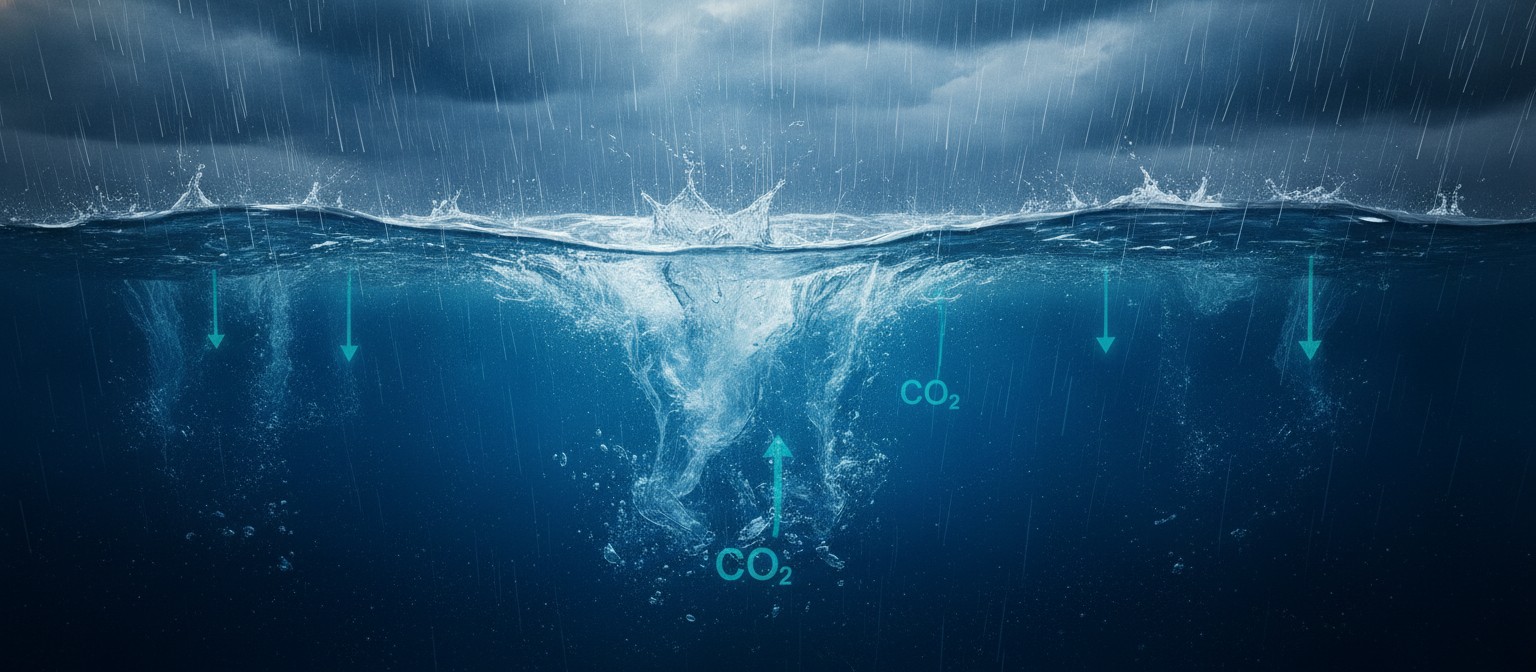
The largest effect is dilution. Fresh rainwater lowers salinity in the top meters of the ocean. Less salty water repartitions the carbonate system in a way that favors greater uptake of atmospheric CO2.
In the new calculation, dilution accounts for about 8 percentage points of the 13.6% rain-driven increase, or roughly two thirds of the total. That finding doubles the previously reported upper bound for rain enhanced ocean carbon uptake, which came from a 2024 study that put the effect near 7.7%.
Why the jump? The team used a model called RIM-3 that tracks how rainfall freshens surface salinity over time, accounting for recent rain and how the freshened layer evolves before winds mix it downward. The model was checked against satellite salinity observations. When the same rainfall and wind data were run through a simpler approach, the estimate fell to 8.4%, close to the older 7.7% value. The authors conclude simpler methods miss much of the dilution effect.
For context, the 2024 predecessor study covering 2008 to 2018 found a smaller 5 to 7% lift, equal to 140 to 190 million tonnes of carbon per year, with wet deposition being the largest term. The new analysis reverses that ranking and puts dilution first.
| Rain mechanism | Added uptake vs wind only | What it means |
|---|---|---|
| Surface dilution | About 8% | Freshwater lowers salinity and shifts chemistry toward absorption |
| Wet deposition | 3.8% | Raindrops carry dissolved CO2 from air into sea |
| Turbulence plus interaction | Remainder to 13.6% | Drop impacts stir surface and amplify dilution |
| Cooling, not in main total | Up to about 2 extra points | Cooler water holds more gas, treated as upper bound |
Rain Also Delivers CO2 and Stirs the Surface
Rain helps ocean carbon absorption in two other ways. As researcher Wade McGillis put it:
“When rain falls through the atmosphere, it scoops up atmospheric carbon dioxide that it then injects into the ocean.”
That direct delivery, known as wet deposition, adds 3.8% to uptake in the study. Each drop absorbs CO2 on the way down and injects it on impact.
Drop impacts roughen the surface and amplify dilution when the two happen together, though turbulence adds little alone.
Rain cooling is excluded from the headline total and could add up to about 2 percentage points as a likely upper bound.
Why Ships and Floats Missed the Effect
If rain matters this much, why did ocean carbon records miss it? The answer is depth.
Rain effects concentrate in a shallow, fresher layer only 1 to 3 meters deep. That layer can persist for hours after rain and, in some cases, days, unless wind mixes it downward. Yet nearly 95% of measurements in SOCAT, the leading surface ocean CO2 database, are taken at 5 meters, below the main zone of rain influence.
The team estimates current ocean carbon observations capture only about 30% of the combined rain influence on surface exchange. Research vessels, floats, and moorings that sample at 5 meters or deeper simply sample beneath the freshened skin where chemistry has shifted.

This is not the first time a shallow or shifting boundary changed the sink math. A Woods Hole reanalysis found the oceans may absorb twice as much carbon through the biological pump once the sunlit euphotic zone was mapped with chlorophyll sensors rather than fixed depths. In both cases, the measurement depth shaped the answer.
Where Rain Matters Most
Rain shifts CO2 exchange toward greater ocean uptake across nearly the entire globe, either raising absorption or reducing release, except in a small part of the eastern tropical Pacific.
The relative effect is largest in the tropical Indian Ocean, where wind-driven uptake is comparatively small, so rain looms larger. Across the tropics, rain offsets some of the CO2 the ocean would otherwise release. Only a small part of the eastern tropical Pacific breaks the pattern.
This geography matters for future budgets. The authors note that future changes in rainfall, wind, ocean CO2 levels, temperature, and salinity could raise or lower total rainfall contribution depending on how those shifts overlap. But one piece is directional; as Zappa said, the dilution due to rain itself will always work to increase uptake by the ocean.
What This Means for Global Carbon Budgets
It helps to keep two numbers separate. The 13.6% figure compares the new rain-inclusive model with wind-only exchange. The 5% to 15% range is the authors’ guide to how much current budgets may underestimate the real ocean sink after accounting for rain effects already captured in observations.
Taken together with other work, the team suggests current models may underestimate the ocean carbon sink by about 10%. The Global Carbon Budget 2026 briefing still shows how tight the math has become, with less than four years of emissions left in the 1.5 degree budget at 2026 rates, or about 150 billion tonnes of CO2. Even a 10% shift in the ocean sink matters for tracking where emissions go, but it does not create new room to emit.
- 13.6% is the modeled rain lift versus wind-only exchange.
- 5% to 15% is the guide to how much budgets may undercount the real sink.
- About 30% of rain influence is captured by current 5-meter sampling.
- About 10% is the rough central hint for the missing sink, pending direct proof.
The history also cautions against treating this as settled. Zappa and McGillis began testing rain gas exchange in Biosphere 2 experiments in Arizona in 2003 and 2004, followed by work in the western equatorial Pacific. As McGillis noted:
“We need to better understand what controls rain dilution at the ocean surface, how much carbon dioxide rain falling from the atmosphere carries, and how mixing and turbulence at the surface change before, during and after rainfall.”
In other words, the direction is clearer than the exact size. The authors describe the 5% to 15% range as a general guide, not a precise correction, because dilution uncertainty remains hard to quantify with statistical confidence.
Why Stronger Uptake Is Not a Climate Rescue
More ocean carbon uptake sounds helpful, but seawater keeps the receipt. Dissolved CO2 forms carbonic acid, lowering pH and reducing carbonate ions that corals, shellfish, and many plankton need to build shells and skeletons.
That is why biologists track both the physical pump and the living pump. Microscopic phytoplankton already drive a biological carbon pump powered by ocean bacteria and nitrogen fixers that moves carbon from surface waters to the deep sea. Added CO2 from rain enters that same system, where it can stress calcifiers, shift food webs, and in high CO2 waters, even favor toxic algae growth observed around the Canary Islands.

- More uptake means faster acidification in surface waters, not less warming on its own.
- Carbon budgets track where emissions go, they do not erase the need to cut emissions.
- Changing rainfall patterns could alter where and when this extra sink appears.
As Witte put it:
“When we do global carbon accounting, we need to account for rain. It is a big enough effect that getting it wrong biases our ocean carbon budgeting.”
Conclusion
Rain does more than roughen the sea. By freshening the top meters, delivering dissolved gas, and stirring the surface, it lifts ocean carbon uptake well above wind-only estimates. The 13.6% finding sharpens the picture of how the ocean controls CO2, and the measurement blind spot between 1 meter and 5 meters explains why budgets missed part of it.
The next step is direct proof in the rain itself: more near-surface salinity data, more rainfall data in equatorial oceans, and direct air-sea CO2 flux measurements during and after storms. Until then, treat this as a sharper map of the sink we already have, not a new excuse to fill the sky.

