
It’s no new news that rising levels of CO2 in the oceans are a hazard to marine life and human health. Previous research shows that it could spark blooms of toxic algae—an occurrence that will only intensify as CO2 levels rise. Higher carbon concentrations in the atmosphere mean the oceans absorb more, and that will stimulate harmful algal blooms across the globe.
Prof. Jef Huisman of the University of Amsterdam, a scientist who was involved in a separate study a few years ago, said, “In essence, the rise in atmospheric CO2 concentrations is one big fertilization experiment at an unprecedentedly large scale. An enhanced CO2 influx into aquatic ecosystems is not just a problem for a few local lakes, it will intensify algal blooms in nutrient-rich waters across the globe. Water managers and policymakers will have to prepare for a deterioration of the water quality due to climate change.”
Aquatic plants become completely smothered by the dense blooms; without oxygen escaping from plants, fish die from hypoxia. Some of the algal species even produce dangerous toxins that cause potentially fatal digestive, liver, and neurological diseases in birds and mammals, including humans. Harmful algal blooms are of great concern in water quality management.

Now, a new study by researchers in the Canary Islands collected experimental evidence showing that one particular species of toxic algae, called Vicicitus globosus, is supercharged by high amounts of ocean acidification—something that happens due to seawater absorbing CO2 from the atmosphere. The research has been published in Nature Climate Change.
Vicicitus globosus is a type of toxic algae found off the coasts of Europe, the Americas, and Southeast Asia. When the waters are acidic, this species of algae can become dominant in the marine ecosystem. Climate change could provide the perfect environment for the algae to flourish and pose a threat to aquaculture, coastal communities, and fisheries.

Around the world, the impacts of toxic algae are already being felt. Marine algae can cause harm at scale in other ways too: record sargassum blooms smothered Mexico’s Caribbean beaches in 2026. For example, Australia has suffered from toxic blue-green algae blighting up to 1,700km of the Murray River for several years in a row. It has restricted the amount of safe water available to already drought-stricken farmers. Meanwhile, in the US, there have been at least 510 cases of toxic blue-green algae reported since 2010. Nearly half (239) of them occurred in the last year alone, according to the NGO Environmental Working Group.
Initially, it was thought that the cause of toxic algal blooms was poor water management and fertilizer run-off because they lead to excess nutrients being released into the ocean. And while that is the case, this new research shows that warming sea temperatures caused by climate change is also a culprit, as is ocean acidification caused by increasing greenhouse gases.
Prof. Ulf Riebesell, lead author of the study and a biological oceanographer from GEOMAR Helmholtz Centre for Ocean Research, told Carbon Brief, “This study shows for the first time how rising CO2 levels in the ocean could also aid the spread of one species of toxic algae. V. globosus is a widespread alga that can release harmful chemicals known as ‘cytotoxins.’ Blooming of this species has been associated with fish mortality in coastal waters and aquacultures in various locations. Direct effects on dolphins and turtles have not been reported, but can also not be excluded. Humans should not go swimming in waters where V. globosus is blooming because the toxins may irritate eyes and the respiratory system.”
The oceans have already absorbed about 30% of the CO2 released by human activity since the industrial revolution, and that number is only going to increase if humans don’t change their ways. As the oceans become less alkaline over time due to ocean acidification induced by carbon emissions, toxic algae like V. globosus could thrive.
The Experiment
- The test site was off the coast of Gran Canaria.
- The experiment was designed to gain an understanding of how ocean acidification could impact V. globosus and other marine microorganisms, primarily plankton.
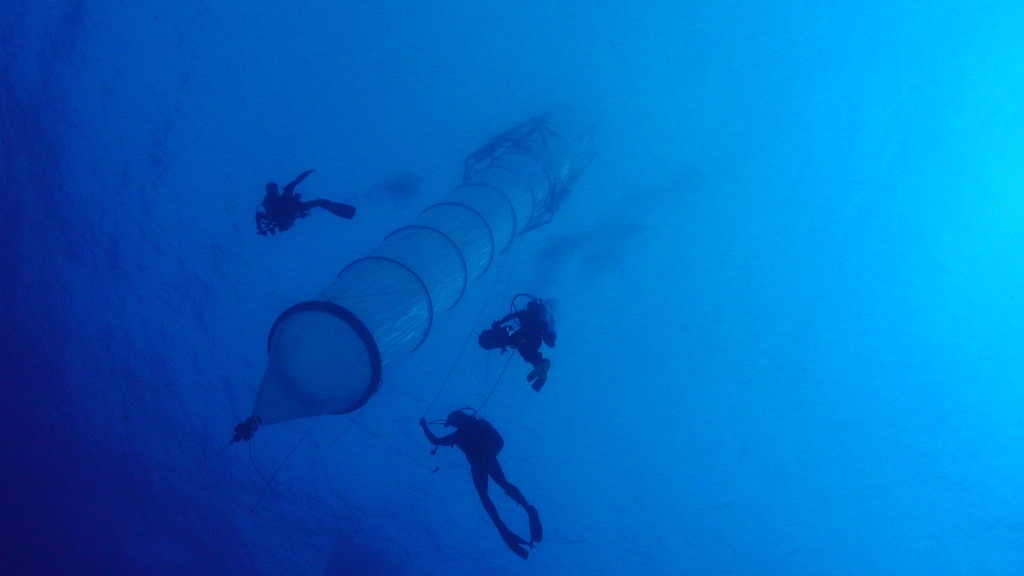
Riebesell explains, “We deployed nine sea-going “mesocosms” – kind of like giant test tubes [pictured below]. Each mesocosm consists of a flotation frame at the sea surface, which holds a 15-meter-long plastic tube vertically in the water. The tubes contain 35 cubic meters of seawater and enclose a natural plankton community. The enclosed water column was enriched in CO2 to levels expected for different CO2 emission scenarios. We then closely monitored the development of the plankton community over 57 days.”
The Results
- If the CO2 levels were close to today’s levels within the mesocosm (or experimental ecosystem), then the presence of V. globosus remained relatively low.
- If the CO2 levels rose above 600μatm (micro atmospheres) – currently, they are around 400μatm – then the numbers of V. globosus began to increase rapidly.
Riebesell explains, “If CO2 emissions continue at current rates [as in the high-emissions scenario “RCP8.5″ scenario], this level will be reached within the next three to four decades. If CO2 emissions are reduced rapidly and drastically to the extent that the Paris Agreement and we stay below 2C of warming, we may actually stay below 600µatm CO2.”
- In the mesocosms that exhibited the highest levels of CO2, the amount of V. globosus increased exponentially, forming harmful blooms. The faster the growth, the more harmful the impact on the other species in the plankton community.
Riebesell says, “Our study also shows that the blooming of V. globosus in our mesocosms disrupted the pelagic [open sea] food web by suppressing the growth of micro- and mesozooplankton [animal microorganisms]. This is important because zooplankton are food for higher trophic levels, including fish and baleen whales.”
Conclusion
The researchers still don’t know why the V. globosus disproportionately benefit from rising CO2 levels in seawater.
Riebesell says, “Either the algae benefit disproportionately compared to other competing species in terms of its growth rate, for example through increased photosynthesis under elevated CO2. Or, its toxicity increases with rising CO2 – so that it is eaten less.”

This study is but another piece of evidence to add to the mounting pile of scientifically backed warnings about the climate crisis. The findings reinforce the necessity to take stricter actions to limit global warming.
Riebesell says, “First and foremost, these results emphasize the need for a strong and rapid reduction of CO2 emissions. The results of this study should be regarded as a warning call. An emerging threat for human society lies in being unprepared for range expansions of toxic microalgae in currently poorly monitored areas.”
Taking action NOW will help reduce the anticipated threat that climate change will have on wildlife and humans.


