
The industrial revolution has had another negative impact on the planet, one that was previously overlooked. Earth’s oceans are now around 25% more acidic than pre-industrial revolution. This presents a real danger to marine life and the entire marine food chain including the humans that choose to eat seafood.

Scientists that were researching the characteristics of human blood, at the Ben-Gurion University of the Negev in Israel, made the discovery. Professor Ehud Pines, from the Department of Chemistry, told Haaretz, “We just didn’t realize exactly how important carbonic acid is in regulating the acidity of our blood — and the oceans.”
The current pH of the ocean is being measured at 8.1 and the pH of blood in the human body is 7.4.
What Pines and his team have demonstrated is ocean acidification studies and projections have failed to factor in a key element that can speed up the process much faster than anticipated. The large amounts of carbon dioxide dissolved in the oceans causes a huge increase in oceanic carbonic acid.
Pines goes on to explain that the problem is when carbon dioxide (CO2) molecules in the sea react with water molecules (H2O), they form carbonic acid (H2CO3).
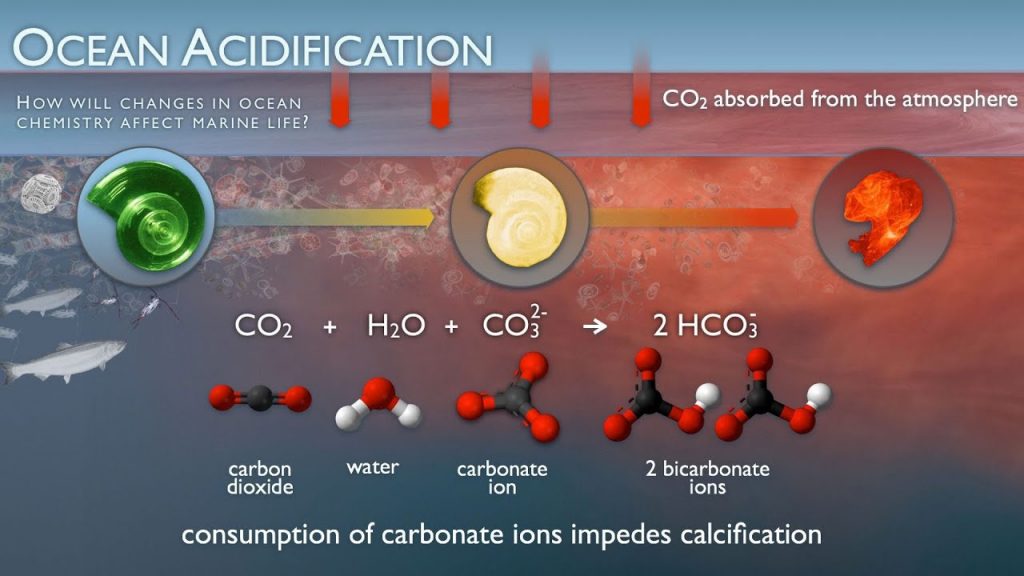
It turns out this fact has been largely ignored up until this point because carbonic acid is here one minute and gone the next. So, no one ever thought it was that harmful.
Pines told Haaretz:
The only thing everybody talking about climate change can’t argue about is the concentration of carbon dioxide in the air, and they can’t argue that when it enters the water, it creates more carbonic acid in the water.
The scientists use the phrase “blinks out” when referring to carbonic acid, which is a euphemism for “breaks down into carbon dioxide and water again.” However, before it “blinks out” it is still in the form of acid and as they point out, the number of carbonic acid molecules is growing by the day. The more times they are multiplied, the greater the negative impact they will have.
In our seas, when CO2 and water mix, carbonic acid is created. In the body when bicarbonate in our blood mixes with any acid, it creates carbonic acid. Bicarbonates are present to help us regulate our CO2 output and blood acidity.
Pines explains:
I look at systems from above — grosso modo [more or less]. It was clear to me that [blood and the oceans are] the same system and they have the same carbonic acid in water. Carbonic acid is the universal acidity regulator. What could be more universal than having the same regulation system in our blood and in the oceans… and no wonder it maintains fixed acidity in about the same place in the sea and blood. The acid’s instability doesn’t affect its activity as an acid. Biological systems don’t care about the individual identity of one molecule. It isn’t that each molecule has a name and number.
The higher the concentration the more it throws off the equilibrium.
Professor Maoz Fine studies coral reefs’ response to environmental changes. He has a study published in Nature Communications about ocean acidification and the effect it has on coral skeletons. In the study, he points out that coral cannot live in acidic conditions and that all sea life is sensitive to these conditions. The higher the pH levels, the more damaging the effect to the exoskeleton of the coral.
One thing is certain, our CO2 emission levels are still rising and so are the carbonic acid levels in the oceans. It makes sense to look at the sea and think of it like blood. Without blood, humans could not live and without water, there could be no life here on Earth. Humans have poisoned the bloodlines of the planet, now with the help of these scientists we need to figure out how to fix it.


